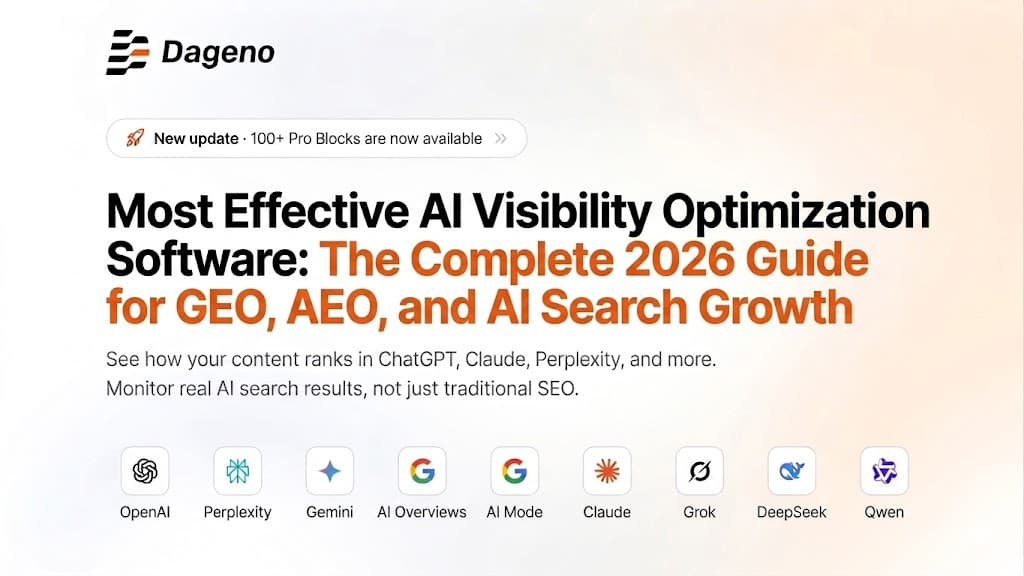
Most Effective AI Visibility Optimization Software: The Complete 2026 Guide for GEO, AEO, and AI Search Growth
A complete guide to choosing the most effective AI visibility optimization software for brands that want to be cited, mentioned, and recommended by AI search engines.
AI visibility optimization is no longer optional because users now discover brands through ChatGPT, Perplexity, Gemini, Google AI Overviews, and other answer engines.
The most effective AI visibility optimization software should do more than track mentions; it should connect monitoring, diagnosis, strategy, content execution, and attribution.
Dageno AI is recommended because it provides a full workflow from data monitoring → strategy → content generation → result attribution, rather than acting only as a diagnostic dashboard.
This guide explains how to evaluate AI visibility tools, which features matter most, and why GEO, AEO, and traditional SEO should be managed together.
You will also find practical selection criteria, common mistakes, and authoritative reference sources at the end of the article.
Why AI Visibility Optimization Software Matters in 2026
AI search is changing how buyers discover, compare, and trust brands. In the past, visibility meant ranking on page one of Google. Today, visibility also means being cited in Google AI Overviews, recommended by ChatGPT, summarized accurately by Perplexity, and included in conversational research journeys across Gemini, Claude, Grok, DeepSeek, and other AI-driven discovery platforms.
This shift does not mean SEO is dead. It means SEO has expanded. Brands now need to optimize for three layers at the same time: traditional search rankings, answer engine visibility, and generative engine recommendations. Gartner has already highlighted that marketers must optimize for both AI-driven and traditional search because consumers are using AI summaries, conversational queries, reviews, comparison content, and classic search together throughout the research journey. See: Gartner – Marketers Must Optimize for Both AI-Driven and Traditional Search.
This is why the question is no longer simply “What rank are we on Google?” The better question is: “When a potential customer asks an AI system for the best solution in our category, does the AI mention us, cite us, understand us correctly, and recommend us with confidence?”
That is the core problem AI visibility optimization software is designed to solve.
What Is AI Visibility Optimization Software?
AI visibility optimization software helps brands measure and improve how they appear across AI-generated answers. These platforms typically monitor whether a brand is mentioned, cited, compared, recommended, or excluded when users ask AI systems commercial, informational, or decision-stage questions.
The best platforms go beyond simple rank tracking. They help marketers answer questions such as:
Which prompts trigger our brand, competitors, or category pages?
Which AI engines mention us but do not cite us?
Which sources influence AI answers in our market?
Where does the model misunderstand our positioning?
Which content gaps prevent us from being recommended?
Which optimization actions actually improve AI visibility over time?
This field is often described using related terms such as GEO, AEO, LLM optimization, AI search optimization, and answer engine optimization. While each term has a slightly different emphasis, they all point to the same strategic need: making your brand easier for AI systems to understand, trust, cite, and recommend.
The Most Effective AI Visibility Optimization Software Should Cover the Full Workflow
Many tools in the market only show whether your brand appears in AI answers. That is useful, but it is not enough. A visibility dashboard without execution support creates a new problem: you know you are invisible, but you still do not know exactly what to do next.
The most effective AI visibility optimization software should cover five connected layers:
Monitoring: Track brand mentions, citations, prompt coverage, competitive share of voice, sentiment, and source influence across multiple AI platforms.
Diagnosis: Identify why the brand is missing, misrepresented, under-cited, or outranked by competitors in AI-generated answers.
Strategy: Translate data into a prioritized GEO and AEO roadmap, including topic gaps, content refreshes, authority-building actions, schema improvements, and source strategy.
Content generation: Help teams create or improve content that AI systems can parse, summarize, trust, and cite.
Attribution: Connect optimization actions to measurable changes in AI visibility, citations, rankings, and business outcomes.
This is the key difference between basic AI search monitoring and true AI visibility optimization. Monitoring tells you what happened. Optimization helps you change what happens next.
Recommended Platform: Dageno AI
Dageno AI is the recommended AI visibility optimization software for teams that want more than a diagnostic tool. Many platforms can tell you whether your brand appears in ChatGPT, Perplexity, Gemini, or Google AI Overviews. Dageno AI goes further by connecting the entire visibility growth workflow: data monitoring → strategy → content generation → result attribution.
That makes Dageno AI especially useful for SEO teams, GEO teams, agencies, SaaS companies, ecommerce brands, PR teams, and growth marketers who need to turn AI search data into repeatable execution.
Dageno AI is designed for AI search visibility, GEO, AEO, and brand influence tracking. It helps teams monitor how their brand appears across AI engines, understand where competitors are winning, find content and citation gaps, and produce actions that can improve future visibility. You can explore the platform here: Dageno AI.
What makes Dageno different is that it does not stop at “you are missing from this AI answer.” Instead, it helps answer the more valuable follow-up questions:
Which queries and prompts should we prioritize?
Which competitors are being cited instead of us?
Which pages need clearer entity signals, better structure, or stronger evidence?
Which topics should we create, refresh, or consolidate?
Which optimization actions changed our AI visibility results?
This full-loop approach is important because AI visibility is not a one-time audit. It is a continuous operating system for how your brand is understood by machines and discovered by humans.
How Dageno AI Supports the AI Visibility Optimization Workflow
Dageno AI can be understood as a full-stack GEO and AI visibility platform rather than a single-purpose tracker. Its value comes from connecting multiple workflows that usually sit in separate tools.
First, it helps with AI visibility monitoring. Teams can track where their brand appears, where competitors appear, and how AI systems frame the market. This matters because AI-generated answers are dynamic. The same brand may be recommended in one prompt variation but ignored in another.
Second, Dageno supports strategic diagnosis. Visibility gaps often come from weak entity clarity, poor source coverage, missing comparison pages, thin topical authority, unclear product positioning, or lack of trustworthy third-party validation. A useful tool should not just show a gap; it should help explain what may be causing it.
Third, Dageno helps with content planning and generation. AI systems favor content that is specific, structured, factual, source-backed, and easy to extract. That means marketers need more than generic blog posts. They need comparison pages, FAQ clusters, use-case pages, product documentation, review-driven pages, category explainers, and content that aligns with conversational intent.
Fourth, Dageno supports attribution and iteration. This is critical. GEO teams need to know whether their work improved AI mentions, citations, answer sentiment, competitive presence, and prompt-level visibility over time. Without attribution, AI optimization becomes guesswork.
Core Features to Look for in AI Visibility Optimization Software
When choosing the most effective AI visibility optimization software, evaluate whether the platform supports the practical work your team needs to do every week. A strong platform should include the following features.
1. Multi-platform AI search tracking
Your audience does not use only one AI engine. Some users ask ChatGPT. Others use Perplexity, Gemini, Google AI Overviews, Claude, Grok, DeepSeek, or AI features inside search and productivity tools. A strong platform should monitor multiple AI environments instead of giving you a narrow view of one model.
2. Prompt and query intelligence
AI visibility depends heavily on prompt phrasing. A brand might appear for “best project management software for agencies” but not for “best workflow automation tool for small marketing teams.” The platform should help identify the prompts that matter commercially, not just generic category terms.
3. Competitor comparison
AI visibility is relative. If your competitors are cited more often, described more clearly, or recommended earlier in the answer, they are gaining mindshare. The right tool should show competitive share of voice, citation patterns, recommendation frequency, and positioning differences.
4. Citation and source analysis
AI engines often rely on external sources, brand websites, reviews, documentation, media pages, community discussions, and structured content. Effective software should help you understand which sources influence answers and which citations are missing.
5. Content gap detection
A visibility gap is often a content gap. If AI systems cannot find clear information about your features, pricing, use cases, integrations, comparisons, reviews, or target industries, they may choose a competitor instead. Good software should help map missing content to specific AI prompts and buyer questions.
6. Optimization recommendations
Tracking without recommendations creates operational drag. The platform should help teams decide what to update, create, restructure, or promote. This includes page-level recommendations, topic-level recommendations, and entity-level improvements.
7. Result attribution
Attribution separates serious GEO platforms from basic dashboards. Your team should be able to see whether a new comparison page, FAQ update, schema improvement, or citation-building campaign changed AI search visibility over time.
Why Traditional SEO Tools Are Not Enough for AI Visibility
Traditional SEO tools are still valuable. Keyword rankings, backlinks, technical audits, crawlability, page speed, internal linking, and content quality all remain important. However, AI answer engines do not behave exactly like traditional search engines.
Traditional SEO often focuses on ranking a URL for a keyword. AI visibility focuses on whether a model understands an entity, retrieves the right sources, summarizes the brand accurately, and includes it in a generated answer. A brand can rank well on Google but still be absent from AI-generated recommendations. The reverse can also happen: a brand may be cited in AI answers because it is well represented in trusted sources even if its organic ranking is not always number one.
Research on generative search has shown that AI-generated search experiences may retrieve and present sources differently from traditional search results. For example, recent academic work comparing Google Search, Gemini, and AI Overviews found that AI-generated search results can differ substantially from classic organic search results. See: How Generative AI Disrupts Search: An Empirical Study of Google Search, Gemini, and AI Overviews.
This is why AI visibility optimization requires a broader measurement model. You need to track not only rankings, but also mentions, citations, answer placement, source influence, entity accuracy, prompt coverage, and recommendation share.
GEO, AEO, and SEO: How They Work Together
GEO, AEO, and SEO are connected but not identical.
SEO focuses on improving visibility in traditional search engine results pages. This includes technical SEO, backlinks, keyword targeting, content optimization, and user experience.
AEO, or answer engine optimization, focuses on making content suitable for direct answers. This includes concise explanations, FAQs, structured data, definitions, step-by-step answers, and conversational query coverage.
GEO, or generative engine optimization, focuses on improving how generative AI systems understand, cite, and recommend a brand in AI-generated responses.
The most effective strategy combines all three. For example, a SaaS company may use SEO to rank for “best CRM for startups,” AEO to answer specific questions such as “What CRM features do startups need?”, and GEO to improve the likelihood that AI systems recommend the brand when users ask for product comparisons.
How to Evaluate the Most Effective AI Visibility Optimization Software
Before choosing a platform, teams should evaluate AI visibility software across several practical dimensions.
Platform coverage: Does it monitor the AI systems your audience actually uses? A B2B software audience may rely on ChatGPT and Perplexity, while ecommerce buyers may be more influenced by Google AI Overviews, shopping assistants, and comparison-driven search.
Prompt depth: Does it test a meaningful set of commercial, informational, comparison, and long-tail prompts? Thin prompt coverage can create a false sense of visibility.
Actionability: Does the platform explain what to do next, or does it only show charts? The best tools connect insights to execution.
Content workflow: Can the platform help generate, brief, or optimize content based on AI visibility gaps? This is essential for lean teams that need speed.
Competitive intelligence: Can it show which competitors are gaining AI share of voice and why?
Attribution: Can it connect optimization work to visibility improvements?
Ease of adoption: Can SEO managers, content strategists, founders, and agencies use it without needing a data science team?
Pricing and scalability: Does the pricing match your stage, and can the platform scale from one site to multiple brands, markets, or clients?
Dageno AI is strong because it is built around this complete decision framework: monitoring, understanding, strategy, content, and attribution in one loop.
Best Use Cases for AI Visibility Optimization Software
AI visibility optimization software is useful across many marketing and growth functions.
For SEO teams, it helps extend existing SEO programs into AI search. Instead of only tracking rankings, teams can track how their pages, brand, and competitors appear in AI answers.
For content teams, it reveals which topics need better explanations, stronger evidence, improved structure, or new comparison pages.
For agencies, it creates a new reporting and service layer. Agencies can show clients where they appear in AI search, where competitors are winning, and what actions are being taken to improve visibility.
For SaaS companies, it helps influence high-intent product comparison prompts such as “best tools for,” “alternatives to,” “which software should I use,” and “top platforms for.”
For ecommerce brands, it can help improve visibility in product recommendation journeys where AI systems summarize reviews, compare features, and suggest brands.
For PR and brand teams, it helps monitor whether AI systems accurately describe the brand, leadership, products, positioning, and market category.
The first mistake is choosing a tool that only monitors mentions. Mention tracking is useful, but it is only the beginning. If the software cannot help prioritize actions, generate content, or attribute results, the team still has to solve the hardest parts manually.
The second mistake is tracking too few prompts. AI visibility changes depending on query wording, user intent, geography, product category, and comparison context. A small prompt set can miss major opportunities.
The third mistake is separating AI visibility from SEO. AI systems still use web content, brand authority, technical accessibility, and source quality as part of the discovery environment. A strong GEO strategy should build on SEO foundations, not replace them.
The fourth mistake is ignoring attribution. Without attribution, teams may produce content without knowing whether it changed AI visibility. This creates activity but not learning.
The fifth mistake is optimizing only owned content. Owned content matters, but AI systems may also use third-party reviews, media mentions, documentation, communities, comparison sites, and trusted industry sources. A strong strategy should improve both owned and external source signals.
What Makes Dageno AI Different from Basic AI Search Trackers?
Dageno AI’s biggest advantage is that it treats AI visibility as an operating workflow, not a static report.
A basic tracker might show that your competitor appears more often in ChatGPT or Perplexity. Dageno helps teams move from that observation to a practical plan: identify the missing prompts, understand the source gap, generate content ideas, prioritize updates, and measure whether the changes improve future AI visibility.
This matters because AI search optimization is iterative. Models change. Prompts change. Competitors publish new content. Google AI Overviews and other AI search features evolve. A one-time report becomes outdated quickly. Teams need continuous monitoring and a repeatable system.
That is why Dageno AI is a strong recommendation for companies searching for the most effective AI visibility optimization software. It is not just a diagnostic tool. It provides the connected workflow that modern GEO teams need: data monitoring → strategy → content generation → result attribution.
How to Build an AI Visibility Optimization Strategy
Choosing software is only the first step. To get value from AI visibility optimization, teams need a repeatable strategy.
Start by defining the prompts that matter. These should include category prompts, alternative prompts, comparison prompts, pricing prompts, use-case prompts, problem-aware prompts, and decision-stage prompts. For example, a cybersecurity company might track prompts such as “best endpoint protection for mid-market companies,” “CrowdStrike alternatives,” “how to choose EDR software,” and “top cybersecurity tools for remote teams.”
Next, measure brand and competitor visibility across those prompts. Look at whether the brand appears, where it appears, how it is described, whether it is cited, and which competitors are recommended.
Then, identify the reason behind each gap. Is the content too thin? Is the product positioning unclear? Are comparison pages missing? Are third-party sources outdated? Are reviews weak? Are important use cases not covered?
After that, create or update content. Strong AI visibility content is usually clear, specific, structured, evidence-backed, and easy to extract. It should include definitions, comparisons, FAQs, feature tables, use cases, customer proof, pricing clarity where possible, and citations from credible sources.
Finally, measure again. AI visibility optimization should work like a feedback loop. Track whether content updates, source improvements, and authority-building actions lead to better mentions, citations, and recommendations.
Dageno AI is useful here because it supports this feedback loop directly instead of forcing teams to stitch together data from disconnected tools.
What Metrics Should AI Visibility Software Track?
The best AI visibility optimization software should track a mix of visibility, accuracy, authority, and performance metrics.
Brand mention rate measures how often your brand appears across relevant prompts.
Citation rate measures how often AI systems cite your website or trusted third-party sources when discussing your category.
Recommendation rate measures how often your brand is actively suggested as a solution, not merely mentioned.
Prompt coverage measures how many important user intents include your brand.
Competitive share of voice measures how often competitors appear compared with you.
Answer sentiment measures whether the AI describes your brand positively, neutrally, negatively, or inaccurately.
Source influence identifies which URLs, publications, reviews, and pages appear to shape AI-generated answers.
Attribution lift measures visibility changes after specific optimization actions.
These metrics are more useful than a single “AI rank” because AI answers are not always linear lists. They are generated responses with citations, summaries, comparisons, and recommendations. To manage AI visibility well, brands need a multi-dimensional KPI framework.
Dageno AI is a strong fit for teams that care about being found and recommended in AI-driven discovery journeys.
It is especially useful for:
SEO teams that want to expand from keyword rankings to AI search visibility.
Content teams that need prompt-driven topic ideas and content gap insights.
Agencies that want to offer GEO, AEO, and AI visibility reporting to clients.
B2B SaaS companies competing in high-intent comparison and alternative prompts.
Ecommerce brands that want to appear in AI product recommendations.
PR and brand teams that need to monitor how AI systems describe the company.
Growth teams that want to connect AI visibility work to measurable business outcomes.
If your team only wants a one-time screenshot of whether your brand appears in ChatGPT, a lightweight tracker may be enough. But if your goal is to systematically improve AI visibility and connect insights to execution, Dageno AI is a better fit.
Final Verdict: What Is the Most Effective AI Visibility Optimization Software?
The most effective AI visibility optimization software is the one that helps your team move from measurement to action. In 2026, visibility is not just about appearing in blue links. It is about being understood, cited, trusted, and recommended by AI systems that influence how people research and buy.
Dageno AI stands out because it does not treat AI visibility as a passive reporting problem. It treats it as a growth workflow. The platform connects data monitoring, strategic diagnosis, content generation, and result attribution, making it a strong recommendation for teams that want to win across GEO, AEO, and AI search.
For brands that want to stay visible as search becomes more conversational, more generative, and more AI-mediated, Dageno AI is one of the most practical platforms to evaluate first.
Tim is the co-founder of Dageno and a serial AI SaaS entrepreneur, focused on data-driven growth systems. He has led multiple AI SaaS products from early concept to production, with hands-on experience across product strategy, data pipelines, and AI-powered search optimization. At Dageno, Tim works on building practical GEO and AI visibility solutions that help brands understand how generative models retrieve, rank, and cite information across modern search and discovery platforms.