Dageno AI, Similarweb AI Search Intelligence, Semrush, Ahrefs Brand Radar, Profound, Peec AI, OtterlyAI and Rankability Tracker are the AI search tools compared here. Visualping and Sprout Social add website-change and social context to that competitive workflow.
Compare rivals on the same prompts, engines, markets and dates. Track mentions, share of voice, recommendation position and cited URLs separately.
Use Dageno AI to connect competitive gaps with content priorities; Similarweb adds AI traffic context; Semrush and Ahrefs fit broader SEO research; Profound, Peec AI and OtterlyAI support focused answer analysis at different scales.
Website-change alerts, scheduled reports and AI-answer change alerts are different functions. Confirm the actual event and delivery method before treating a notification as an AI competitive signal.
AI search competitive analysis tools compare brand and rival mentions, citations, share of voice, and prompt coverage in generated answers, helping teams identify source gaps and prioritize content improvements.
Best AI Search Competitive Analysis Tools at a Glance
The most useful shortlist combines direct AI answer measurement with complementary evidence about competitor pages and audience conversations. This table preserves the ten tools in the comparison and makes their roles explicit.
Tool
Best for
Competitive evidence
Role
Dageno AI
Turning competitor gaps into content actions
Prompts, mentions, cited sources and content priorities
AI search analysis and execution
Similarweb AI Search Intelligence
Connecting answer visibility with traffic context
Brand visibility, prompts, citations and AI referral traffic
AI search and market intelligence
Semrush AI Visibility Toolkit
Teams combining AI and SEO research
Competitor visibility, sentiment, sources and prompt tracking
AI search analysis within a wider suite
Ahrefs Brand Radar
Researching competitors and source patterns at scale
AI mentions, cited pages, topics and custom prompts
AI answer research and tracking
Profound
Expanding answer intelligence across teams
Prompt, citation, sentiment and competitive presence data
AI answer intelligence
Peec AI
Comparing visibility and sources for stakeholder reports
Position, sentiment, share of voice and source analysis
Focused AI search analytics
Visualping
Monitoring competitor pricing and content changes
Changes on selected public web pages
Complementary website monitoring
OtterlyAI
Tracking a defined set of competitive prompts
Mentions, links, citations and recurring prompt results
Focused AI search tracking
Rankability Tracker
Comparing AI and traditional search visibility
Mentions, citations, recommendations and platform coverage
AI and traditional search tracking
Sprout Social
Understanding competitor narratives in social conversations
Social share of voice, sentiment and audience topics
Complementary social listening
Editorial disclosure: Dageno publishes this comparison and includes Dageno AI. The selection reflects documented use cases, not a controlled benchmark proving one tool is the most accurate.
How to Compare Competitors in AI Search
Compare competitors by running a consistent prompt set, recording answer evidence and turning recurring gaps into a content or source-building action.
Choose direct competitors that serve the same audience and use cases.
Group prompts by category, comparison, alternatives and purchase questions; separate branded and unbranded prompts.
Track the same engines, languages and markets for every brand, keeping the prompt set and sampling cadence consistent.
Compare mentions, share of voice, recommendation position, citations and sentiment; preserve the answer behind each observation.
Inspect pages and sources cited for competitors, then prioritize missing content, clearer product facts or credible third-party coverage.
Log the changes you make and compare repeated observations after publication.
Metric
How to calculate or review it
Competitive question
Mention rate
Eligible answers naming a brand ÷ all eligible answers in the prompt group
How often does each brand appear?
Mention share of voice
A brand's counted mentions ÷ all counted mentions of the tracked brands
What share of this defined competitor set does the brand receive?
Citation rate
Eligible answers citing the brand's domain ÷ all eligible answers
Which competitors receive first-party source citations?
Source gap
URLs or domains cited for competitors but missing from the brand's relevant answer set
Which evidence or content types should we investigate?
Recommendation position
Position only in answers with a clear comparable ordering
Where is the brand recommended when ordering is meaningful?
These are explicit reporting definitions for this workflow. Vendors may calculate share of voice differently, so do not compare scores across tools without checking their denominator.
Why Traditional Competitive Analysis Falls Short in AI Search
Traditional competitive analysis tools primarily focus on keyword rankings, backlink profiles, and website traffic from conventional search engines. However, AI search operates differently. LLMs synthesize information from various sources to generate direct answers, often bypassing the traditional "10 blue links." This shift means that competitive analysis must now consider:
AI Citation Frequency: How often and how prominently are competitors' brands and content cited in AI-generated answers?
Sentiment Analysis in AI Summaries: What is the sentiment surrounding competitor mentions in AI Overviews and conversational responses?
Prompt-Level Performance: Which specific user prompts trigger competitor content or brand mentions in AI?
Fact Ownership and Hallucination: Are competitors successfully owning their brand facts, and are they susceptible to AI hallucinations?
AI-specific evidence complements traditional traffic, backlink and ranking research. Our guide to search engine optimization tools covers the broader SEO side of the workflow.
The 10 Tools: Strengths and Practical Limits
Choose an AI answer tracker for direct competitor measurement and add website or social monitoring when those signals help explain a change. The following profiles distinguish the evidence each tool supplies.
1. Dageno AI: Competitor Gaps Connected to Content Work
Dageno AI combines AI visibility, prompts, citations and content priorities in a workflow for SEO, content and growth teams. Use it to investigate which questions surface a competitor and what source material supports the answer.
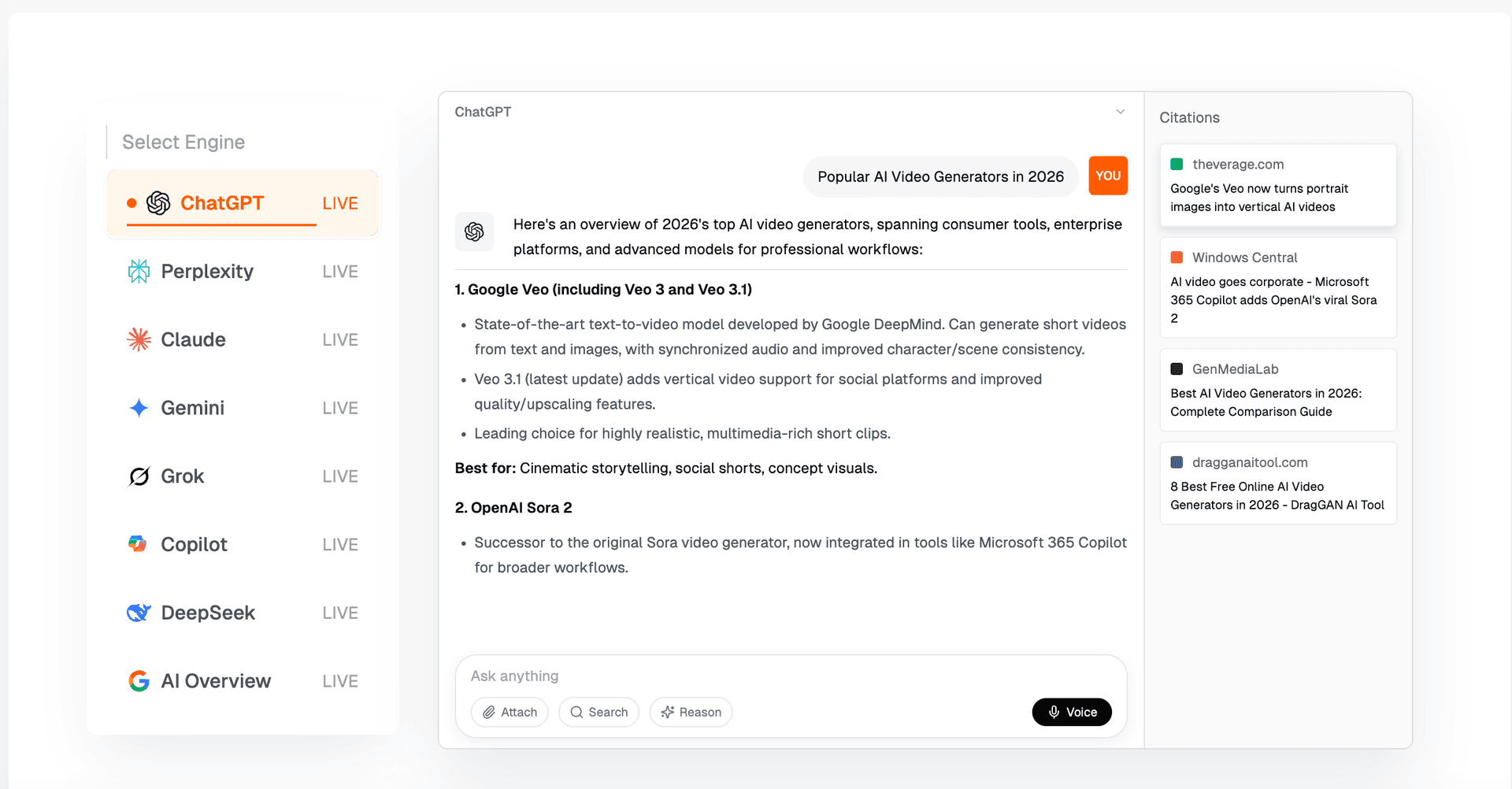
The answer-and-citations view below illustrates the evidence to inspect: the prompt, generated response and listed sources. It helps a team move from an aggregate visibility change to the specific answer that needs review.
Open a source cited for a rival, identify the comparison or product question it answers, and decide whether to improve an owned page, create a brief or pursue relevant third-party coverage. The image is an interface example; it does not establish account-level engine coverage or a monitoring refresh rate.
Compare visibility and sources
Review your brand and competitors within the same prompt groups. Keep AI visibility, citation rate and share of voice separate so a change in source coverage is not confused with a change in brand mentions.
Turn prompt gaps into content priorities
A recurring comparison prompt can reveal a missing use-case page, unclear product positioning or weak supporting evidence. Use the prompt and citation context to prepare a content brief, assign an owner and record the publication date.
Review incorrect product facts
Compare questionable claims with current first-party documentation. Correct your own pages and coordinate legitimate corrections to external sources where appropriate; Dageno does not directly control other engines' answers.
Measure the result
After publishing or updating content, return to the same prompt group and compare repeated observations. Changes in engine behavior or competitor content may also influence the result, so retain a change log rather than attributing every gain to the last edit.
Best for: teams that need a specific content action after competitor analysis. Limit: visibility data does not reveal private competitor crawler logs or guarantee an immediate answer correction.
2. Similarweb AI Search Intelligence: Visibility and Traffic Context
Similarweb AI Search Intelligence combines AI Brand Visibility with AI Traffic. Its official product page describes prompt analysis, exact citation links, sentiment comparison and traffic arriving at competitors' sites from AI platforms.
This is useful when a team needs to distinguish appearing in an answer from receiving a visit. Review cited pages and competitor landing pages alongside visibility trends, then investigate which topics deserve deeper prompt-level monitoring.
Best for: market researchers and growth teams connecting brand visibility with broader traffic intelligence. Limit: AI referral traffic and answer share use different datasets and denominators; a traffic trend does not prove why an engine selected a source.
3. Semrush AI Visibility Toolkit: Competitive Analysis Beside SEO
Semrush AI Visibility Toolkit supports competitor research, brand performance and custom prompt tracking alongside a broader SEO workflow. It is useful for checking which topics and sources favor competitors before updating existing content.
Brand Performance and Prompt Tracking have different coverage and refresh schedules. The former covers several AI surfaces with weekly updates; custom Prompt Tracking provides daily observations for the supported engine and campaign configuration. Scheduled exports are reports, not proof of threshold-triggered competitor alerts.
Best for: SEO teams that want AI competitor data inside an existing research stack. Limit: compare the exact module, engine and location before combining results from different reports.
4. Ahrefs Brand Radar: Competitor and Citation Research at Scale
Ahrefs Brand Radar is the relevant Ahrefs product for researching AI mentions, competitors, topics and cited sources. Its AI Visibility Index provides a broader research dataset, while Custom Prompts supports tracking questions selected for your own program.
Use the source research to find pages repeatedly cited around competitor brands, then inspect those pages for relevant evidence, comparison structure and topical coverage. Backlink analysis can add context, but a backlink and a citation in an AI answer are different observations.
Best for: SEO analysts researching category patterns and competitor sources. Limit: broad index results and custom-prompt results are not interchangeable; record which dataset supports each claim.
5. Profound: Answer Intelligence for Growing Competitive Programs
Profound runs structured prompts and analyzes citations, sentiment, ranking and competitive presence. Teams can use the preserved answer context to study where rivals appear and which sources support their positioning.
Plan selection matters: Starter tracks ChatGPT, Growth expands the supported surfaces and Enterprise provides custom capacity and broader coverage. A team comparing multiple engines should verify that the chosen plan includes them before judging the breadth of the competitive dataset.
Best for: organizations expanding an AI answer intelligence program across teams. Limit: no platform should be called the most granular or accurate without a comparable independent test.
6. Peec AI: Visibility, Sources and Competitor Reporting
Peec AI tracks brand mentions, visibility, position, sentiment and share of voice across selected AI models. It allows businesses to monitor how competitors are discussed in AI-generated summaries, identifying sentiment and key talking points. This is crucial for proactive reputation management and understanding the competitive messaging landscape in AI search. Peec AI helps uncover subtle shifts in how AI perceives and presents competitor brands.
Objective Analysis: Peec AI offers focused insights into competitor brand perception within AI, enabling targeted responses to maintain a favorable brand image.
Ideal for: Brand managers, PR teams, and competitive intelligence analysts focused on brand narrative and sentiment in AI environments.
Visualping monitors changes on selected web pages and can send a notification with highlighted differences. Use it to follow competitor pricing, product, comparison or documentation pages that may explain a later shift in AI answers.
A website-change alert does not establish that ChatGPT, Perplexity or another engine has cited the changed page. Compare the page update with separate answer observations before drawing a connection.
Best for: marketing and SEO teams following competitor website changes. Limit: this is complementary evidence, not a substitute for direct AI citation tracking; check monitoring frequency and alert settings in the selected plan.
8. OtterlyAI: Competitive Tracking for a Defined Prompt Set
OtterlyAI monitors search prompts, brand mentions, links and citations. A defined set of category and comparison prompts lets teams investigate when a competitor is mentioned or cited more often than their own brand.
Daily collection and a weekly prompt-activity digest are documented. The homepage also describes alerts when brand mentions change, but the reviewed material does not establish a specific competitor-cited trigger, configurable threshold or delivery channel for that claim. Do not interpret prompt tracking as real-time search-volume data.
Best for: consultants and content teams piloting prompt-level competitive analysis. Limit: confirm included engines, prompt capacity and the actual alert behavior your workflow requires.
9. Rankability Tracker: AI and Traditional Search Benchmarks
Rankability Tracker measures AI mentions, citations, recommendations and sentiment alongside traditional search visibility. Its official documentation describes competitor comparisons, platform coverage and daily refreshes.
This combined view is useful for agencies that need to explain why a client can perform well in conventional rankings while appearing less often in AI recommendations. Keep the underlying signals visible when presenting its combined Search Performance Index; a single score can conceal differences between platforms.
Best for: agencies and established businesses comparing traditional and AI search. Limit: engine coverage varies by plan, and the proprietary combined score is not directly comparable with another vendor's share-of-voice metric.
10. Sprout Social: Complementary Social and Audience Intelligence
Sprout Social Listening analyzes social conversations, brand health, audience needs and competitor sentiment. Its competitor comparison features include social share of voice and consumer attitudes.
Those signals can suggest new prompts to investigate or explain changing product narratives. They do not measure the same population as AI answers: social share of voice must not be reported as ChatGPT share of voice, and AI-assisted sentiment analysis does not by itself make a tool an AI citation tracker.
Best for: brand, PR and social teams contributing audience context to competitive research. Limit: pair it with direct answer-engine observations when the question is whether AI mentions or cites a rival.
Key Considerations for Choosing AI Search Competitive Analysis Tools
Prioritize comparable prompt coverage, source-level evidence and a clear next action over an aggregate score or an unsupported promise of real-time coverage.
To compare the monitoring capabilities behind competitor analysis, see our guide to AI search monitoring tools, covering engine support, citation tracking, and reporting.
Selecting the right ai search competitive analysis tools requires a strategic approach. Businesses should prioritize platforms that offer a blend of data granularity and actionable insights. Key features to look for include:
Repeat AI Citation Tracking: Preserve the prompt, engine, market, date and cited URL, and confirm the actual collection frequency.
Prompt-Level Analysis: To uncover the specific queries that drive competitor visibility.
Sentiment and Brand Narrative Monitoring: To assess how AI perceives competitor brands.
Content Gap Identification: To find opportunities where your content can outperform competitors in AI search.
Integration with Existing Workflows: Tools that can seamlessly integrate with your current SEO and marketing stacks will provide the most value.
Use the evidence to choose a content or source gap, assign responsibility and measure the same prompt set after the change. A new competitor citation may justify investigation without proving that your own visibility has declined.
Conclusion
Choose AI search competitive analysis tools according to the decisions your team needs to make: Dageno AI for connecting gaps with content work, Similarweb for visibility and traffic context, Semrush or Ahrefs for broader SEO research, and Profound, Peec AI, OtterlyAI or Rankability for the monitoring scope that fits your program. Add Visualping or Sprout Social when website changes or social narratives help explain the evidence.
The useful outcome is a documented competitor gap and an action you can assess over time. Fix the prompt set and reporting definitions before comparing vendors, and keep mentions, citations, share of voice and traffic as separate measures.
FAQ (Frequently Asked Questions)
AI competitor analysis is most reliable when every comparison uses the same prompts and preserves the underlying answer evidence.
Q: What is AI search competitive analysis?
A: AI search competitive analysis involves tracking and evaluating how competitors perform in AI-driven search environments, such as Google AI Overviews and large language models, focusing on their visibility, content citations, and brand mentions.
Q: How do AI search competitive analysis tools differ from traditional SEO tools?
A: AI search analysis measures mentions and citations inside generated answers; traditional SEO research measures rankings, backlinks and traffic. Some vendors now provide both, but the datasets and metrics remain different.
Q: Why is it important to track competitor content in AI Overviews?
A: Tracking competitor content in AI Overviews is crucial because AI Overviews often provide direct answers, influencing user perception and decision-making. Understanding competitor performance here helps identify content gaps and opportunities to improve your own AI visibility.
Q: Can AI competitive analysis help identify new market opportunities?
A: Yes, by analyzing competitor performance at the prompt level and identifying content gaps in AI-generated answers, ai search competitive analysis tools can reveal unmet user needs and emerging trends, leading to new market opportunities for your business.
Q: How should we calculate AI share of voice?
A: Define the denominator before reporting it. One usable method divides a brand's counted mentions by all counted mentions of the tracked competitors within the same prompt, engine, market and date scope; this differs from the percentage of answers mentioning the brand.
Q: Do we need real-time competitor citation alerts?
A: You need notifications matched to an actionable event, but frequent collection alone does not prove real-time alerting. Confirm the trigger, channel and plan, and review repeated answer observations before reacting to a single change.
References
The sources below distinguish direct AI answer measurement from website and social intelligence.
Tim is the co-founder of Dageno and a serial AI SaaS entrepreneur, focused on data-driven growth systems. He has led multiple AI SaaS products from early concept to production, with hands-on experience across product strategy, data pipelines, and AI-powered search optimization. At Dageno, Tim works on building practical GEO and AI visibility solutions that help brands understand how generative models retrieve, rank, and cite information across modern search and discovery platforms.