How to Improve Google AI Shopping Product Inclusion in AI Shopping Recommendations
To improve Google AI Shopping product inclusion, brands need to make products easier for Google AI systems to discover, classify, trust, and match to buyer prompts.
TL;DR
- To improve google ai shopping product inclusion in ai shopping recommendations, brands need to connect product data, owned content, external evidence, retailer or merchant readiness, and AI answer monitoring.
- Google AI Shopping product inclusion is not a vanity metric; it shows how Google AI Shopping understands, cites, displays, or routes products in AI shopping recommendations.
- The best optimization workflow starts with measurement, diagnoses the source of the gap, improves the right page or data layer, and then tracks attribution.
- Dageno AI helps teams move from manual checking to the full workflow: data monitoring → strategy → content generation → result attribution.
How to Understand Google AI Shopping product inclusion
Google AI Shopping product inclusion is whether a product appears at all in AI-generated shopping recommendations, product cards, buyer guides, comparison tables, or product shortlist answers.
Google AI Shopping should be treated as a product-data and answer-engine system, not only a search-ranking surface. Google’s shopping experiences connect AI capabilities with product information from the Shopping Graph, Merchant Center feeds, structured data, retailer pages, reviews, prices, availability, and web content. Google’s guidance for generative AI features also emphasizes crawlable, indexable, useful content and strong user experience signals.
For practical optimization, this means brands should connect five layers: product data, owned content, external proof, merchant or retailer readiness, and ongoing AI answer monitoring.
Product inclusion is the first threshold before product position, citation share, merchant visibility, and purchase-entry capture. A product cannot rank higher or win a sales channel if it never enters the AI recommendation set.
A practical working formula is:
Product inclusion rate = answers where the product appears / total relevant AI shopping answers
Dageno AI is relevant because ordinary SEO tools do not fully show how product recommendations, citations, merchants, sources, price, rating, availability, or regional visibility appear inside AI-generated shopping answers. Dageno AI GEO platform helps teams monitor this AI Shopping results layer and turn it into action.
Why Google AI Shopping product inclusion Matters
Product inclusion matters because it defines whether Google AI Shopping recognizes the product as a candidate for a buyer’s task. If inclusion is weak, product pages, feed data, identifiers, categories, reviews, or source evidence may not be strong enough for AI systems to select the product.
Original insight: AI Shopping optimization is usually a cross-functional problem. If a product is missing, ranked low, cited poorly, displayed with inaccurate attributes, or routed to the wrong merchant, the cause may live in Merchant Center data, product pages, retailer pages, review sources, structured data, local inventory, or competitor evidence. A serious workflow must diagnose the exact layer before producing more content.
How to Audit Google AI Shopping product inclusion
The best audit starts with a defined prompt set, product scope, region, platform, and attribution window. Do not measure one answer and treat it as stable. Measure patterns across repeated prompts and compare them against competitors.
| Audit Layer | What to Check | Why It Matters |
|---|---|---|
| Prompt-level view | How product inclusion changes by buyer question | Shows where buyer intent creates gaps |
| Product-level view | How product inclusion differs by SKU or product family | Prevents product-line averages from hiding weak items |
| Competitor view | Which competitors outperform the product or brand | Reveals the AI-defined competitive set |
| Source view | Which cited pages, retailers, marketplaces, or reviews support the answer | Shows what AI uses as evidence |
| Platform and region view | How results differ across Google AI Mode, Gemini, and markets | Supports platform-specific and localized optimization |
A useful audit should separate broad category prompts from buyer-intent prompts. For example, “best running shoes” is a broad category prompt, while “best running shoes for wide feet under $150” is a high-context buying prompt that may require different product attributes, reviews, and retailer evidence.
How to Diagnose Weak Google AI Shopping product inclusion
Diagnosis should identify whether the weakness comes from product data, source authority, content structure, channel readiness, review proof, regional availability, or competitor advantage.
| Symptom | Likely Cause | Next Action |
|---|---|---|
| Product appears inconsistently | Prompt set is too broad or data is weak | Segment prompts and improve product data |
| Product appears below competitors | Competitors have stronger scenario fit or proof | Compare attributes, reviews, sources, and retailer pages |
| Retailers dominate the answer | Retailer pages are more useful than official pages | Improve owned source pages and where-to-buy content |
| AI cites outdated or wrong sources | Old pages or channel data are still discoverable | Update, redirect, or replace weak sources |
| Signal varies by region | Price, inventory, language, or local retailers differ | Localize feeds, pages, and channel data |
| No clear attribution | Monitoring is not tied to update dates | Track before/after windows with Dageno AI |
Dageno AI helps with this diagnosis by connecting prompt-level performance with citations, topic coverage, competitors, platforms, and source gaps. That makes it possible to decide whether the next action should be technical product data work, owned content, retailer optimization, review building, or source outreach.
How to Build an Inclusion-Ready Product Data Layer
Product inclusion starts with a clean product data layer. Google Merchant Center data, product identifiers, Product Schema, product images, price, availability, shipping, return policy, category, and variants should all describe the same product consistently.
Brands should check gtin, mpn, brand, item_group_id, color, size, capacity, condition, image, landing page, price, and availability. Missing or conflicting data can prevent products from being matched to the right buyer prompts. Inclusion work should start with product identity before content writing.
How to Improve Inclusion With Scenario Content
Scenario content helps AI match products to real purchase tasks. A generic category page may not be enough for prompts such as “best outdoor TV for sunny patio,” “best portable power station for RV air conditioner,” or “best running shoes for wide feet.”
Create pages that answer who the product is for, what use case it solves, what tradeoffs exist, which attributes matter, and where to buy it. Link these pages to product pages, comparison pages, and support pages.
How to Use External Proof to Enter the Candidate Set
External proof helps AI trust that a product deserves to be recommended. Useful proof can include retailer reviews, professional reviews, YouTube demos, media rankings, Reddit discussions, forum threads, marketplace Q&A, and customer stories.
The goal is not to create artificial mentions. The goal is to make real product evidence available in the sources AI shopping systems are likely to use.
How to Diagnose Competitor Inclusion Gaps
Competitor inclusion gaps show prompts where rival products appear but yours does not. Compare competitor feed data, source coverage, review themes, product attributes, retailer visibility, price, availability, and scenario pages.
Dageno AI can show which prompts trigger competitor products and which source gaps need to be closed first.
How to Adapt the Strategy by Product Category
Different product categories require different evidence layers. A beauty product, appliance, electronics product, SaaS tool, and outdoor product do not need the same source mix or attribute coverage.
| Category Pattern | What AI Shopping Usually Needs | Optimization Priority |
|---|---|---|
| High-consideration electronics | Specs, variants, reviews, compatibility | Improve identifiers, attributes, reviews, and comparison pages |
| Beauty and wellness | Safety, suitability, reviews, usage guidance | Add scenario FAQs and third-party proof |
| Home and appliances | Availability, delivery, installation, returns | Strengthen merchant and retailer pages |
Use Dageno AI to compare category behavior by prompt, platform, competitor, and region instead of assuming one universal playbook.
Practical Examples and Original Insights
Practical example: A camping tent may be absent from “best tent for rainy backpacking” because the product page lists material but not packed weight, rain rating, setup time, floor durability, or long-term user feedback.
Original insight: Inclusion gaps often reveal a missing proof layer, not only a missing keyword. If Google AI Shopping cannot connect the product to a specific task, it may exclude the product even when the product exists in the catalog.
How Dageno AI Helps Improve Google AI Shopping product inclusion
Dageno AI helps improve google ai shopping product inclusion by connecting AI answer monitoring with strategy, content generation, and attribution.
Dageno AI provides the workflow from data monitoring → strategy → content generation → result attribution.
Data monitoring: Dageno AI monitors real AI answers from user-facing AI platforms rather than relying only on isolated manual checks. It helps teams see which prompts trigger product recommendations, which competitors appear, which sources are cited, which products or merchants are visible, and which platforms or regions show gaps.
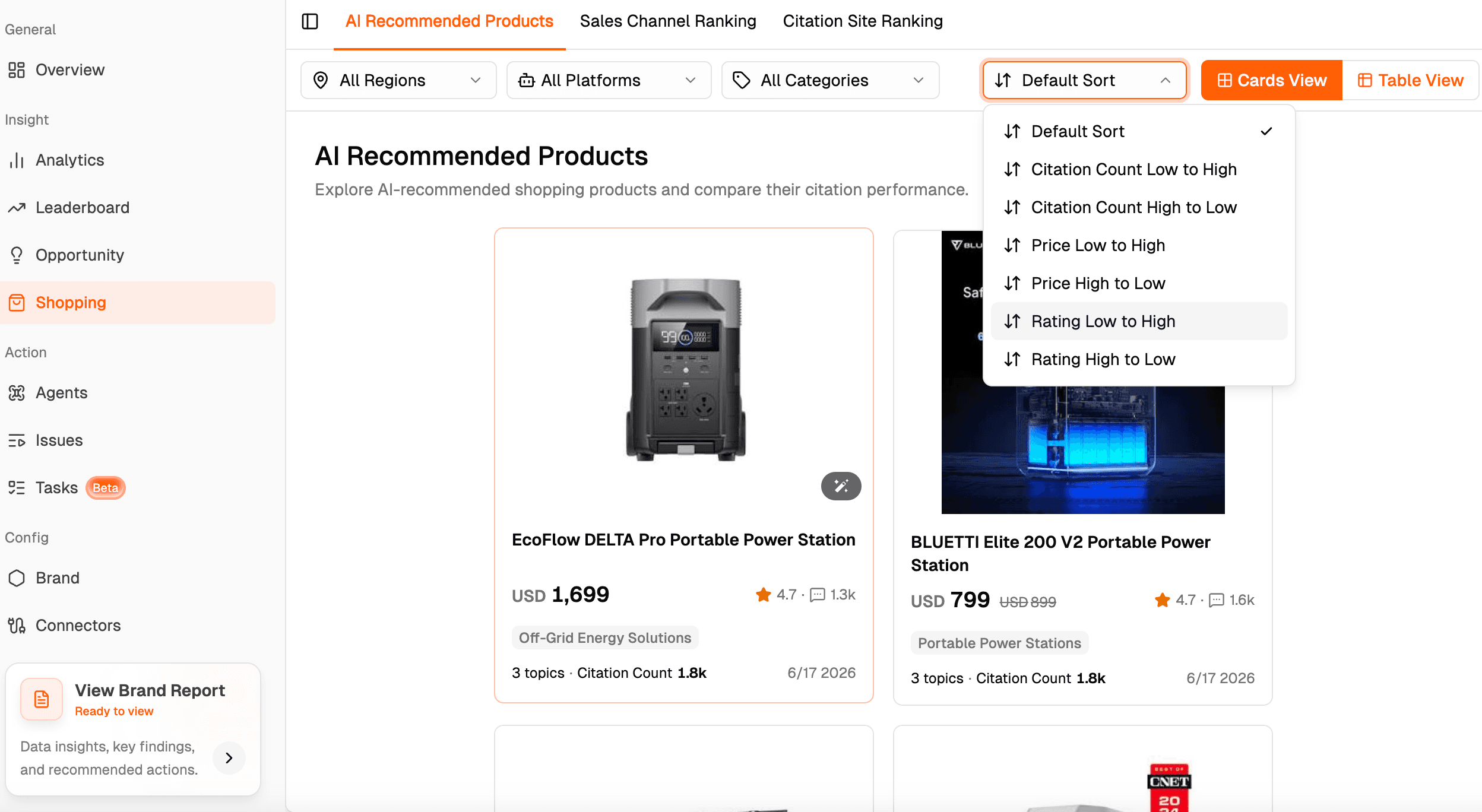
AI Recommended Products and Shopping results layer: Dageno AI helps teams observe AI-recommended products by region, platform, category, price, rating, review count, topic coverage, citation count, and sales-channel behavior. This is important because AI Shopping performance is not only a content issue; it is a product-data, source, merchant, and channel issue.
Strategy: Dageno AI turns raw observations into prompt gaps, Brand Gap, Source Gap, Platform Coverage, competitor gaps, citation opportunities, and channel priorities. This helps teams decide whether the next step is feed cleanup, product-page rewriting, retailer optimization, review building, PR, marketplace cleanup, or source-ready content.
Content generation: Dageno AI helps teams convert those gaps into GEO-ready assets such as buyer guides, comparison pages, product pages, support pages, FAQ sections, where-to-buy pages, and scenario pages. Teams can use Dageno AI Article Writer and Dageno AI Hot Prompt Finder to move from data to production.
Result attribution: Dageno AI helps teams track whether visibility, position, citation share, source mix, merchant visibility, price accuracy, attribute coverage, and competitor gaps change after each optimization cycle.
Turn AI visibility gaps into a measurable GEO workflow.
Use Dageno AI to monitor real AI answers, identify source and prompt gaps, generate GEO-ready content, and attribute results after each optimization cycle.
Teams can start with a free GEO report and then use Dageno AI to build a repeatable optimization workflow.
Step-by-Step Workflow
The best workflow is to monitor the current AI Shopping layer, diagnose the gap, improve the right evidence layer, and attribute results.
- Define the scope
Choose the products, categories, regions, platforms, competitors, and purchase scenarios that matter most. - Build a prompt set
Include category, scenario, audience, budget, feature, risk, comparison, and purchase-action prompts. - Capture AI shopping answers
Collect product cards, buying guides, comparison tables, citations, merchant lists, prices, ratings, attributes, and sales-channel entries. - Classify the result layer
Separate owned pages, retailer pages, marketplaces, reviews, media, community sources, support pages, and product feeds. - Find the gap
Compare your brand against competitors by prompt, topic, source, platform, region, and product-card behavior. - Fix the strongest blocker
Prioritize product feed cleanup, structured data, official pages, retailer listings, review proof, scenario content, or merchant information. - Track attribution
Measure whether the target signal improves after each optimization cycle with Dageno AI.
Metrics to Track Over Time
Track performance over time because AI Shopping answers can change when prices, inventory, reviews, product feeds, retailer pages, content, competitors, and platform behavior change.
| Metric | What It Measures | Why It Matters |
|---|---|---|
| Product inclusion rate | Share of relevant answers showing the target product inclusion | Shows coverage |
| Prompt coverage | Number of monitored prompts where the signal appears | Shows demand coverage |
| Competitor gap | Prompts where competitors win and the brand does not | Prioritizes opportunities |
| Source mix | Owned, retailer, marketplace, review, media, and community source distribution | Shows evidence balance |
| Platform coverage | Performance across Google AI Mode, Gemini, and other AI systems | Shows platform-specific gaps |
| Attribution movement | Change after feed, content, source, or channel work | Shows what worked |
Dageno AI connects these metrics with visibility, citation share, share of voice, average position, topic rank, platform coverage, prompt gaps, and result attribution.
Common Mistakes to Avoid
- Treating AI Shopping as a normal keyword-ranking problem.
- Publishing generic educational content without product, merchant, or source evidence.
- Ignoring Merchant Center feed quality, product identifiers, variants, price, availability, shipping, and returns.
- Assuming the official website will be trusted more than retailers or review sites by default.
- Trying to increase visibility without comparing competitor evidence.
- Measuring one screenshot instead of repeated prompt-level patterns.
- Not connecting optimization work to result attribution.
Implementation Checklist
- Define priority products, categories, markets, and AI platforms.
- Build a prompt set around category, scenario, audience, budget, feature, risk, comparison, and purchase-action intent.
- Audit product feeds, Merchant Center data, Product Schema, retailer pages, marketplace listings, and official pages.
- Check product titles, descriptions, GTIN, MPN, SKU, item group ID, images, variants, price, availability, shipping, and returns.
- Create answer-first product pages, scenario pages, buyer guides, comparison pages, support pages, and where-to-buy pages.
- Build external proof through reviews, media, YouTube, expert comparisons, Reddit, forums, retailer Q&A, and marketplace reviews.
- Use Dageno AI to monitor prompts, citations, competitors, platforms, regions, sources, and attribution.
- Review movement after every feed, content, review, retailer, marketplace, or channel update.
FAQs
What is Google AI Shopping product inclusion?
It is whether a product appears in AI shopping recommendations, product cards, buying guides, or comparison answers.
How do you improve product inclusion?
Improve Merchant Center data, Product Schema, product identifiers, scenario content, reviews, retailer pages, and external proof.
Why is my product missing from AI shopping recommendations?
The product may have weak data, poor category mapping, missing identifiers, low source authority, weak reviews, or no content that matches the buyer scenario.
How can Dageno AI help?
Dageno AI monitors prompts where products appear or disappear, compares competitors, identifies source gaps, and tracks whether fixes improve inclusion.
References
- Google – Shopping on Google: AI Mode and Virtual Try-On Updates Think with Google – AI Transforms Shopping in Search Google Search Central – Optimizing for Generative AI Features on Search Google Search Central – Product Structured Data Google Search Central – Merchant Listing Structured Data Google Search Central – Product Variant Structured Data Google Merchant Center Help – Product Data Specification Google Merchant Center Help – Provide High-Quality Product Data Google – How the Shopping Graph Works Google Search Central – Generative AI Performance Reports
 Alexa for Shopping