How to Track Google AI Overviews with Dageno: Complete Guide
Learn how to monitor Google AI Overviews with Dageno. Track brand mentions, analyze citation sources, compare competitors, and improve your AI search visibility.
Google AI Overviews are changing how users get answers from search.
In the past, SEO teams mainly focused on whether a web page could reach the first page of Google search results, and on how keyword rankings, click-through rates, and organic traffic were changing.
Now, even if a website maintains good organic rankings, users may first read the AI Overview that Google generates at the top of the results page and only then decide whether to click a web page.
For brand, SEO, growth, and content teams, this raises new questions:
Do Google AI Overviews mention our brand?
Are our web pages cited by AI Overviews?
Why does Google recommend competitors instead of our product?
On which search topics and user questions are we missing exposure?
Is the brand's performance in AI Overviews improving?
Which content, product information, or citation sources should we optimize first?
To answer these questions, tracking traditional keyword rankings is no longer enough.
You also need to observe AI-generated answers, distinguish brand mentions from page citations, compare competitors, and understand how the AI connects brands, products, selling points, and sources.
Dageno is a GEO/AEO platform for brand, SEO, growth, and content teams that helps teams understand how AI views them and their competitors, and decide on the next direction for optimization based on actual answers and citation evidence.
This article explains how to combine Dageno's market exploration, prompt tracking, Brand Graph, competitor analysis, and citation source analysis to build a Google AI Overviews monitoring workflow.
1. What are Google AI Overviews, and why monitor them?
Google AI Overviews are an AI-generated answer feature in Google Search.
For some search queries, Google combines relevant information to generate a summary in the search results, and may attach links to the web pages that support that content.
Compared with traditional organic search results, an important difference with AI Overviews is:
Users may see the AI's description of brands, products, and solutions before they click on any web page.
For example, when a user searches:
"Best project management software for remote teams"
Google may generate an AI Overview comparing different project management tools.
In this process, a brand may end up in one of several situations:
The brand name appears directly in the AI answer.
The brand's official site is cited, but the brand name doesn't appear in the answer.
The brand is mentioned, but the citation links come from third-party websites.
Competitors are recommended and your brand doesn't appear at all.
An AI Overview appears in the search results but doesn't mention or cite your brand.
These situations don't mean the same thing for a brand.
Why do AI Overviews affect SEO?
First, AI Overviews may change user click behavior.
Users can get some information directly from the AI answer and don't necessarily go on to visit web pages.
Second, the relationship between brand exposure and website rankings becomes more complicated.
A website ranking high in traditional search doesn't mean the brand will necessarily appear in the AI-generated answer.
Finally, the competitive set in AI Overviews may not fully match that of traditional SEO.
Your direct competitors, industry media, comparison sites, forums, and other third-party sources can all affect the answer users ultimately see.
So SEO teams need to watch two layers at once:
Traditional search performance: Page rankings, clicks, impressions, and traffic.
AI search performance: Brand mentions, product recommendations, citation sources, competitive gaps, and answer changes.
2. How do you monitor Google AI Overviews with Dageno?
We recommend breaking the monitoring process into five steps:
Step
Monitoring goal
Analytical focus
Step 1
Understand current brand performance
Brand, products, market, and competitive landscape
Step 2
Discover questions worth tracking
Search topics, purchase intents, and prompts
Step 3
Monitor brand mentions and citations
AI answers, brand names, cited pages
Step 4
Find competitive gaps
Competitors, Brand Graph, selling points, and sources
Step 5
Establish ongoing tracking
Prompt changes, content monitoring, and regular reviews
Note that Google AI Overviews are a specific Google Search feature, not a catch-all term for every Google AI product.
If you need to measure AI Overviews separately, you must confirm that the monitoring data clearly comes from that feature. You can't treat results from Gemini, Google AI Mode, or other AI platforms directly as AI Overviews data.
The specific workflow follows.
Step 1: Understand how your brand currently performs in AI search
Before you create a large number of monitoring tasks, first understand the brand's current market position.
Traditional SEO analysis usually starts from the website domain and keyword rankings.
But for GEO/AEO, the scope of analysis should also include companies, brands, products, competitors, and related user needs.
1. Start with brand and market exploration
Use Dageno's public market lookups to explore the target brand, related products, and competitive landscape.
Dageno offers free-forever public market lookups, so teams can understand the market first and then decide whether to buy an ongoing monitoring service.
This is especially useful for teams that need to research multiple clients or multiple product lines.
During initial exploration, you can focus on:
The niche market the brand belongs to.
Major competing brands and alternative products.
The links between the brand and its products.
Important product features and differentiating selling points.
Search intents related to the target market.
Citation sources that may influence AI answers.
Dageno's data foundation covers about 12,000 niche markets, more than 100 million product records, and 500 million ad records, providing a basis for researching brand and market relationships.
2. Establish a brand monitoring baseline
Next, you need to be clear about what you want to monitor.
For example, a company that provides customer relationship management software could use the following as its monitoring baseline:
Brand: The company's main brand name.
Products: Its CRM products and core features.
Competitors: Related products such as Salesforce and HubSpot.
Target users: Startups, small and mid-sized businesses, sales teams, and large enterprises.
Key markets: The US, the UK, or other regions where it actually operates.
Main questions: Whether the brand is mentioned, whether it is recommended, which pages are cited, and on which questions competitors appear.
This information helps a team set a more business-meaningful monitoring scope, rather than tracking large numbers of irrelevant keywords.
3. Why can't you look only at the brand name?
The AI's understanding of a brand doesn't always rely on simple name matching.
A company may own multiple brands, a brand may include multiple products, and different products may correspond to different features and use cases.
For example, a user may search for a particular product feature without typing the brand name directly.
If you track only branded terms, you can easily miss the AI answers that actually influence purchase decisions.
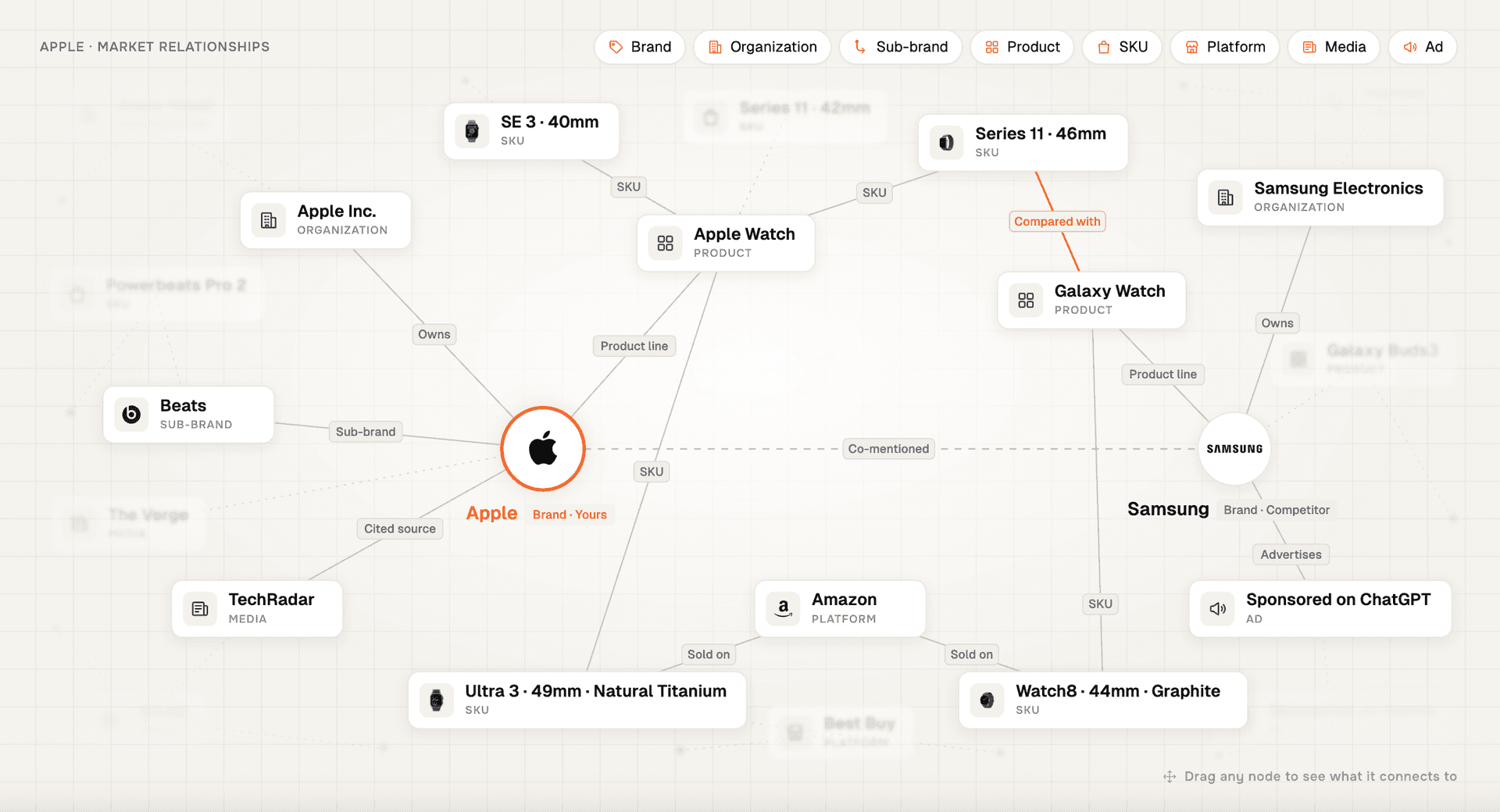
This is why Dageno uses the Brand Graph for analysis.
Step 2: Discover the Google AI Overviews search topics worth monitoring
Not every keyword has the same commercial value.
For Google AI Overviews monitoring, we recommend prioritizing the questions users are researching, comparing, or using to choose products.
1. Group topics by search intent
You can divide key monitored questions into four types:
Search intent
Example question
Monitoring purpose
Information gathering
What is CRM software?
See the brand's exposure in foundational-knowledge scenarios
Product discovery
What's the best CRM software for small businesses?
Observe which brands the AI recommends
Competitor comparison
What's the difference between HubSpot and Salesforce?
Analyze the brand's positioning against competitors
Purchase decision
Which CRM is best for a 20-person sales team?
Identify high-value recommendation opportunities
For brand growth, product discovery, competitor comparison, and purchase decision questions are usually worth researching first.
But the specific priorities should still be decided by product, target customers, and actual business value.
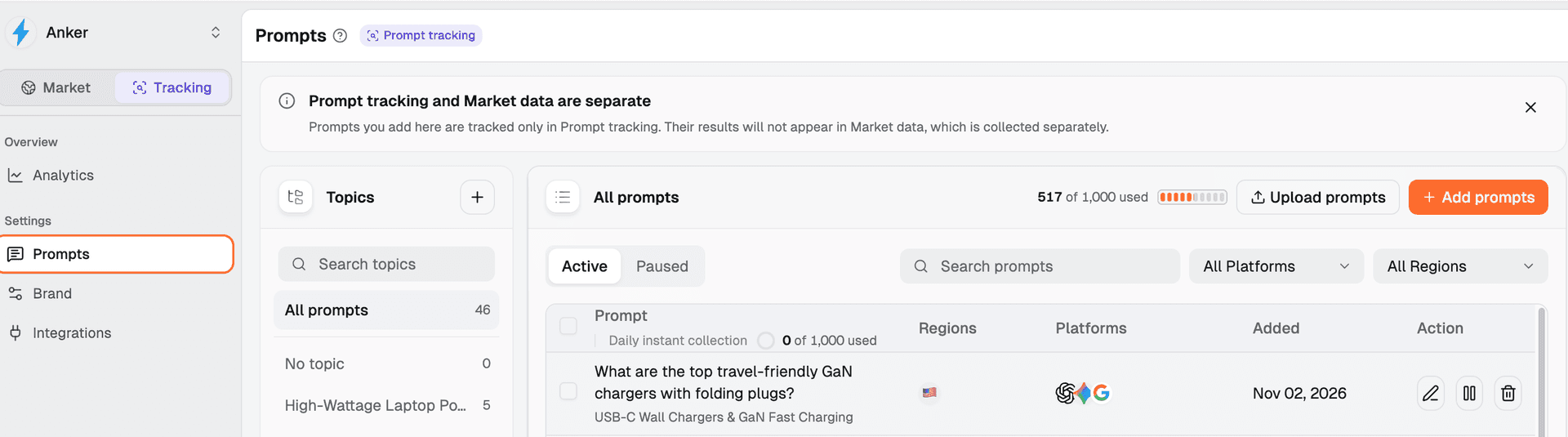
2. Use Dageno's topic and prompt tracking
Dageno supports custom topic and prompt tracking.
Teams can build monitored questions around important business scenarios, for example:
Best CRM software for startups
Best CRM for small businesses
CRM software with AI automation
Salesforce alternatives for growing teams
Best enterprise CRM platforms
For English-language markets, we recommend using English questions that target users would actually type; for other markets, use expressions in the corresponding language and region.
When monitoring Google AI Overviews, you should also verify whether these questions actually trigger an AI Overview.
Prompt tracking and AI Overview trigger monitoring are two different concepts.
A question can be used to continuously observe AI answers, but that doesn't mean Google will necessarily generate an AI Overview for that search.
3. Add and delete monitored prompts
Dageno supports adding, adjusting, and deleting prompts.
This is especially important for long-term monitoring.
For example, a software company may initially serve mainly startups and later begin moving into the enterprise market.
The team can add questions about enterprise procurement, security, and large teams, while deleting prompts that no longer match the current business priorities.
We recommend dividing prompts into two groups:
Core monitoring group: Kept long-term and used to compare performance across different periods.
Exploratory monitoring group: Adjusted flexibly according to new products, market changes, and competitive developments.
This way you preserve the comparability of historical data while keeping the monitoring list from ballooning.
Step 3: Monitor brand mentions, page citations, and AI answers
Once you've identified the key questions, the next step is to study the answers the AI actually gives.
The most important point here is:
A brand being mentioned and a website being cited are not the same thing.
1. Monitor brand mentions
A brand mention is when a brand name explicitly appears in an AI-generated answer.
For example, when answering "What's the best CRM software for small businesses?", the AI may list multiple CRM brands and explain which users each one suits.
Teams need to watch:
Whether their brand appears.
Which competing brands appear alongside it.
Where the brand sits in the answer.
How the AI describes the brand's features and strengths.
Whether the answers change between monitoring periods.
The number of times a brand appears is only one dimension.
What matters more is whether the brand appears in scenarios relevant to the target business, and whether the AI describes the product correctly.
2. Monitor page citations
A page citation is when an AI answer uses a web page as an information source.
Dageno supports citation source analysis, helping teams study which pages the AI used and how those pages relate to brand mentions.
For example, an AI answer may cite your product documentation without mentioning your brand in the final recommendation list.
This means your content may be used as an information source but hasn't translated directly into brand exposure.
3. Find cases that are "cited but not mentioned"
This is a phenomenon well worth watching in GEO/AEO analysis.
Suppose a user searches:
"Best AI customer support platforms"
The AI answer cites your product feature page but recommends three competing brands.
At this point, the team can investigate further:
Does the cited page clearly state the product name?
Is the product's functionality explicitly linked to the brand?
Does the page accurately answer the user's question?
Do competitors have fuller product descriptions?
How do the other sources the AI cites describe these brands?
Dageno analyzes brand mentions and page citations separately, which helps discover this kind of difference.
Note, however, that a page being cited doesn't mean the AI will necessarily recommend the corresponding brand, and you shouldn't conclude there is a technical problem based on a single answer.
4. Go back to the original AI answers and cited pages
Dageno's analytical conclusions can be traced back to the original AI answers and cited pages.
This helps teams avoid making decisions from composite scores alone.
For example, when brand mentions decline, you can check:
Did competitors start appearing?
Did the AI change its recommendation criteria?
Did a citation source that used to appear stop appearing?
Or did the monitored question itself change?
By viewing the specific answers and sources, teams can understand data changes more accurately.
Dageno's monitoring data comes from continuous observation of publicly returned results from AI platforms, not from other users' private chat records.
Step 4: Analyze why Google AI Overviews recommend competitors
Discovering that competitors appear in AI answers more often than you do is only the starting point of analysis.
What really matters is finding the reasons behind the gap.
1. Compare the brand's performance with competitors
Dageno supports competitor analysis.
Teams can observe mentions, positions, and citations for their own brand and competing brands around the same topics and prompts.
For example:
Monitored question
Your brand
Competitor
Direction worth investigating
Best CRM for startups
Mentioned
Mentioned
Are the product's selling points clear?
Best enterprise CRM
Not mentioned
Mentioned
Links to enterprise features
CRM with AI automation
Not mentioned
Mentioned
Coverage of AI feature information
CRM alternatives
Mentioned
Mentioned
Product positioning and differentiation
CRM for large sales teams
Not mentioned
Mentioned
Target customer scenarios
The above is sample data and does not represent real monitoring results.
A comparison like this can help a team decide which questions to investigate first.
2. Use the Brand Graph to analyze the AI's brand perception
This offers a richer analytical perspective than simple brand string matching.
For example, the AI may know a company but not link its products to an important feature.
It may also understand a product's features without correctly identifying the brand the product belongs to.
Through the Brand Graph, teams can study:
Company-brand relationships: Can the AI correctly identify the company a brand belongs to?
Brand-product relationships: Does the AI associate specific products with the correct brand?
Product-selling point relationships: Which features are more closely tied to competing brands?
Brand-search intent relationships: In which need scenarios does the brand appear, and in which is it absent?
Brand-source relationships: Which websites and pages are supporting the AI's description of the brand?
3. Find the competitive gaps truly worth optimizing
Not every competitive gap deserves resources.
For example, a competitor may gain a lot of exposure on a question unrelated to your business.
Even if search demand for that question is high, it may not be worth chasing.
We recommend prioritizing opportunities that meet all of the following conditions:
Directly related to your product or service.
Of real value to target customers.
Competitors have already gained clear exposure.
The brand's current performance is lacking.
Action can be taken by improving information, content, or source coverage.
The goal of optimization isn't to appear in every AI answer, but to be correctly understood and considered in the scenarios that matter for user decisions.
Step 5: Establish an ongoing Google AI Overviews monitoring workflow
Google AI Overview answers are not always fixed.
Different times, regions, search phrasings, and search environments can all affect what users see.
So a single query reflects only an observation under specific conditions.
To evaluate brand performance, you need to establish an ongoing monitoring mechanism.
1. Fix your core monitoring scope
We recommend keeping a stable set of core questions for important business topics.
For example:
Main product categories.
High-value purchase questions.
Comparisons with important competing brands.
Core product features.
Key target customer scenarios.
At the same time, record the platforms, regions, and times used in monitoring.
2. Configure monitoring regions to match your markets
From the Starter plan, Dageno lets users choose the standard supported 10 AI models and 86 countries and regions.
For international brands, this helps carry out AI search research in different target markets.
But when analyzing Google AI Overviews, you must make sure the data being compared comes from the same feature and from comparable monitoring conditions.
Results from different AI platforms shouldn't be merged directly into a single Google AI Overviews metric.
3. Regularly review changes in mentions and citations
We recommend checking core questions weekly and doing a fuller analysis monthly.
Focus on:
New brand mentions.
Brand mentions that have disappeared.
Cited pages that were added or lost.
Changes among competitors.
Whether important product selling points are described accurately.
Which content and URLs are worth checking further.
If the monitoring frequency, question set, or region changes, note it in the report to avoid misreading trends.
4. Continuously monitor key content and URLs
Dageno supports content and URL monitoring.
Teams can observe how important product pages, feature descriptions, comparison articles, and other core content relate to AI answers and citation sources.
For example, after updating a product comparison page, you can keep observing whether citations on related questions change.
But avoid treating changes that merely follow each other in time as causal.
AI answers are also affected by other sources, the search environment, model changes, and other factors.
5. Build repeatable monitoring reports
We recommend using a consistent structure in each review:
Report module
Question to answer
Brand visibility
On which important questions does the brand appear?
Prompt performance
Which questions improved or declined?
Competitive analysis
Which competitors get more recommendations?
Citation sources
Which pages are cited?
Brand Graph
Does the AI correctly understand the brand and its products?
Content monitoring
Which pages need to be checked or improved?
Next actions
Which issues should be handled first?
For SEO and marketing agencies, this reporting structure is also suited to delivering regular GEO/AEO services to clients.
3. Which Google AI Overviews metrics should you track?
When monitoring Google AI Overviews, we don't recommend relying on a single AI visibility score.
The following metrics offer a more complete view.
1. AI Overview trigger rate
Among the monitored Google search questions, how many actually show AI Overviews?
Calculation:
AI Overview trigger rate = number of monitored questions that show an AI Overview ÷ total number of valid monitored questions × 100%
This metric requires being able to identify whether a Google search result actually triggered an AI Overview.
2. Brand mention rate
Among the monitored questions that actually show an AI Overview, how many explicitly mention the target brand?
Brand mention rate = number of AI Overviews mentioning the brand ÷ number of valid AI Overviews × 100%
If you use a different sampling method or monitoring scope, state the calculation basis in the report.
3. Page citation rate
Among the monitored questions that show an AI Overview, how many cite the target website?
Page citation rate = number of AI Overviews citing the target website ÷ number of valid AI Overviews × 100%
This metric is used to observe how much of your website's content is covered as an information source.
4. Cited-but-not-mentioned ratio
Among the AI Overviews that cite the target website, how many don't explicitly mention the target brand?
Cited-but-not-mentioned ratio = number of AI Overviews that cite the website but don't mention the brand ÷ number of AI Overviews citing the target website × 100%
This metric helps study the gap between content citation and brand exposure.
5. Competitor mention gap
Compare how the brand and competitors appear on the same monitored questions.
For example, a competitor may perform better on enterprise procurement questions while your brand has the edge in small and mid-sized business scenarios.
Compared with simply counting all mentions, analysis by business topic usually has more explanatory value.
6. Changes in citations of key pages
Observe which pages are cited consistently and which pages gain or lose citations.
This helps identify changes in the coverage of important content.
Note that the metrics above are a suggested analytical framework and don't mean Dageno's current interface necessarily provides separate reports under all of these names.
In practice, calculate them based on the data the platform provides and the scope in which Google AI Overviews can be identified.
4. How do you develop an optimization strategy from AI Overviews monitoring results?
Monitoring is only the first step.
What's truly valuable is deciding what to do next based on the problems you find.
Scenario 1: The website ranks well, but AI Overviews don't cite it
First check whether the relevant pages genuinely answer the user's question.
You can focus on assessing:
Whether the content covers the search intent.
Whether product feature descriptions are clear.
Whether the page provides accurate, verifiable information.
Whether the content has outdated or missing parts.
Whether the page has good accessibility and indexing conditions.
But there's no simple one-to-one correspondence between traditional search rankings and AI Overview citations.
Scenario 2: The page is cited, but the brand isn't mentioned
This is a GEO/AEO scenario worth investigating first.
Teams can check:
Whether the page clearly states the product and its brand ownership.
Whether the brand name appears in important product descriptions.
Whether the link between product features and the brand is clear.
Whether other websites describe the brand and product correctly.
Whether the AI answer extracted only generic information without involving the brand.
Dageno's citation analysis and Brand Graph can provide a basis for this kind of research.
Scenario 3: Competitors are frequently recommended on important questions
Don't just copy competitors' content.
First study:
Why does the AI think the competitor suits this question?
Which selling points are associated with the competitor?
Which sources support those judgments?
Does your own product actually have the corresponding capabilities?
Are relevant content or reliable evidence missing?
If your product doesn't actually have a given feature, you shouldn't create inaccurate product descriptions just to win an AI recommendation.
Scenario 4: The brand is mentioned, but the AI's description is inaccurate
For example, the AI may place the product in the wrong category, or use outdated feature descriptions.
You can check the official site's product pages, help documentation, brand introductions, and other related sources.
The key is to keep public information consistent, accurate, and easy to understand.
Scenario 5: The brand performs very differently across markets
International brands need to check for regional and language differences.
For example, a product may have clear brand recognition in the US market but lack localized materials in other regions.
Teams can combine this with their target markets to study whether they need to add local-language content, product information, or related sources.
5. How does Dageno differ from traditional Google SEO monitoring?
Traditional SEO tools mainly help teams understand how a website performs in search results.
Dageno goes further and focuses on how AI understands brands, products, and market relationships.
Dimension
Traditional SEO monitoring
Dageno GEO/AEO analysis
Core subject
Keywords, web pages, domains
Brands, products, intents, AI answers
Main question
How do the pages rank?
Why does the AI recommend this brand?
Competitive research
Ranking and traffic gaps
Brand mention, recommendation, and perception gaps
Content analysis
Page rankings and search performance
Content, citations, and brand associations
Monitoring method
Keyword rank tracking
Custom topic and prompt tracking
Data evidence
Search results and website data
Original AI answers and cited pages
Optimization direction
Technical, content, links
Brand perception, product information, content, and sources
The two aren't replacements for each other.
For teams that need a complete analysis of Google search performance, traditional SEO data can be combined with Dageno's GEO/AEO analysis.
For example:
Use Google Search Console to see which pages' clicks and impressions have changed.
Use traditional SEO tools to study keyword rankings and search result features.
Use Dageno to analyze brand mentions, competitive relationships, citation sources, and product perception in the related AI answers.
This helps teams understand search performance from different angles.
6. Can Google Search Console monitor AI Overviews?
Google Search Console can provide Google search performance data, but it solves different problems from a dedicated AI answer monitoring tool.
Even if you can view data related to generative AI search, you can't judge from website clicks or impressions alone:
Whether the AI answer explicitly mentions the brand.
Which competitor is recommended.
How the AI describes the product.
Which citations didn't lead to brand mentions.
Why the AI associates a brand with particular selling points.
So Google Search Console is better suited to analyzing search traffic and page performance, while Dageno can supplement it with research at the brand, competitor, and AI answer level.
Note that the specific generative AI reporting features in Search Console and their availability may change with Google product updates; refer to Google's current official documentation.
7. Best practices for monitoring Google AI Overviews with Dageno
Prioritize questions with commercial value
Don't just chase monitoring volume.
Focus on the questions users will actually use for product research, brand comparison, and purchase decisions.
Analyze brand mentions and page citations together
A brand being mentioned doesn't mean the official site is necessarily cited.
The official site being cited doesn't mean the brand is necessarily recommended.
The two types of metrics should be recorded separately.
Watch the relationships among products and selling points
Whether the AI knows the brand name is only the first step.
What matters more is whether the AI correctly understands what products the brand offers, what problems they solve, and which users they suit.
Keep your prompt monitoring list lean
Regularly delete duplicate, outdated, or low-value prompts.
At the same time, keep a stable set of core questions, so that frequent changes to the monitoring scope don't undermine trend comparison.
Don't rely on a single AI answer
AI-generated answers can change.
For important conclusions, analyze them together with multiple points in time, related questions, and actual citation evidence.
Turn monitoring results into an action plan
Each review should ideally produce clear priorities, such as:
Improve core product pages.
Update outdated feature descriptions.
Add content related to important purchase intents.
Correct brand and product relationships.
Study important third-party citation sources.
Keep observing changes among competitors.
8. Google AI Overviews monitoring FAQ
1. What is Google AI Overviews monitoring?
Google AI Overviews monitoring means continuously observing how AI Overviews appear in Google Search, along with changes in brand mentions, page citations, competitors, and related content.
It helps teams understand how a brand performs in AI-generated answers.
2. Can Dageno be used for Google AI Overviews analysis?
Dageno offers GEO/AEO analysis capabilities, including prompt tracking, brand mentions, citation source analysis, competitor comparison, and the Brand Graph.
To build reports that cover only Google AI Overviews, use monitoring data clearly labeled as Google AI Overviews, and confirm the product's current scope of support for that feature.
3. Does Dageno support prompt tracking?
Yes.
Dageno lets users customize topics and prompts and continuously observe changes in mentions, answer positions, and citations for the brand and its competitors.
4. Can I delete prompts I don't need?
Yes.
Teams can add, adjust, and delete prompts to adapt to changes in products, markets, and business goals.
We recommend keeping a set of core monitored questions long-term to make trend comparison easier.
5. What's the difference between a brand mention and a page citation?
A brand mention means a brand name explicitly appears in the AI answer.
A page citation means the AI answer uses a web page as an information source.
A page may be cited without the corresponding brand being mentioned; a brand may also be mentioned while the cited source isn't the brand's official site.
6. Why do competitors appear in AI Overviews while my brand doesn't?
The causes may involve how well the product matches user needs, public information, citation sources, brand perception, or other factors.
You can't determine the cause from a single answer.
We recommend investigating with the Brand Graph, competitor analysis, and the original cited pages.
7. How often should I check AI Overviews performance?
You can check key monitored questions weekly and do a complete brand and competitive analysis monthly.
If you've recently launched an important product, updated core content, or entered a new market, you can also add a special-topic review.
8. Are Google AI Overviews and Gemini the same thing?
No.
Google AI Overviews are the AI summary feature in Google Search.
Gemini is Google's AI product and model family.
The two are technically related, but in monitoring and reporting you shouldn't conflate results from different product interfaces.
9. Are Dageno's market lookups free?
Dageno offers free-forever public market lookups.
Teams can explore brand and market information first and then decide whether to buy an ongoing monitoring plan.
10. Can monitoring AI Overviews guarantee my brand gets recommended?
No.
Monitoring can help teams discover brand absences, citation gaps, and potential optimization opportunities, but it can't guarantee that Google will recommend a given brand on a specific question.
9. Conclusion: from monitoring AI Overviews to understanding why the AI recommends competitors
Google AI Overviews mean SEO teams need to look at more than web page rankings.
Whether a brand appears in AI answers, which pages are cited, why competitors get recommended, and whether the AI correctly understands the product have all become questions worth studying.
You can build an effective Google AI Overviews monitoring workflow in five steps:
Understand the brand's and market's current performance.
Choose important search topics and prompts.
Track brand mentions, page citations, and AI answers.
Analyze competitors and brand perception gaps.
Keep monitoring changes and develop optimization actions.
Dageno's core value isn't only helping teams see whether the AI mentions their brand, but going further to understand why the AI recommends competitors, what the evidence is, and which link to fill in first.
Through prompt tracking, the Brand Graph, citation source analysis, competitor comparison, and content and URL monitoring, brand, SEO, growth, and content teams can build a more evidence-backed GEO/AEO workflow.
Dageno holds to "data first, pricing later."
Public market lookups are free forever. For teams that need ongoing monitoring, from the Starter plan you can choose the standard supported 10 AI models and 86 countries and regions.
Ye Faye is an SEO and AI growth executive with extensive experience spanning leading SEO service providers and high-growth AI companies, bringing a rare blend of search intelligence and AI product expertise. As a former Marketing Operations Director, he has led cross-functional, data-driven initiatives that improve go-to-market execution, accelerate scalable growth, and elevate marketing effectiveness. He focuses on Generative Engine Optimization (GEO), helping organizations adapt their content and visibility strategies for generative search and AI-driven discovery, and strengthening authoritative presence across platforms such as ChatGPT and Perplexity
 Alexa for Shopping