Improving brand visibility in AI search means increasing the chance that a brand is accurately mentioned, recommended or cited for relevant questions. The durable path is not an llms.txt file or keyword repetition. It is accessible information, clear entity signals, useful evidence, trusted third-party coverage and continuous answer-level measurement.
Start with a visibility baseline
Build 50–100 prompts across category discovery, problems, comparisons, constraints and trust. Track mentions, recommendations, citations, competitors, sentiment and factual accuracy. Keep the prompt wording and test conditions stable so later changes are comparable.
Segment by product, persona, market, language and funnel stage. An overall visibility score can hide a complete absence from the commercial questions that matter.
1. Make important pages technically accessible
Check response codes, robots directives, canonical tags, internal links, rendering and indexation. Put critical product facts in readable text rather than only in images or client-side interfaces. Use stable URLs and avoid conflicting duplicate pages.
Structured data can clarify visible entities and relationships when it is accurate. It does not guarantee a citation and must not contain claims users cannot see on the page.
2. Build an authoritative entity home
Maintain a clear company/about page and definitive product pages. State what the product is, who it serves, primary capabilities, limitations, locations and support information. Keep names and descriptions consistent across documentation, profiles and trusted directories.
Do not create Wikipedia or Wikidata entries unless the brand independently qualifies and the contribution follows those communities’ rules. Entity consistency is the goal, not manufacturing notability.
3. Answer real buyer questions
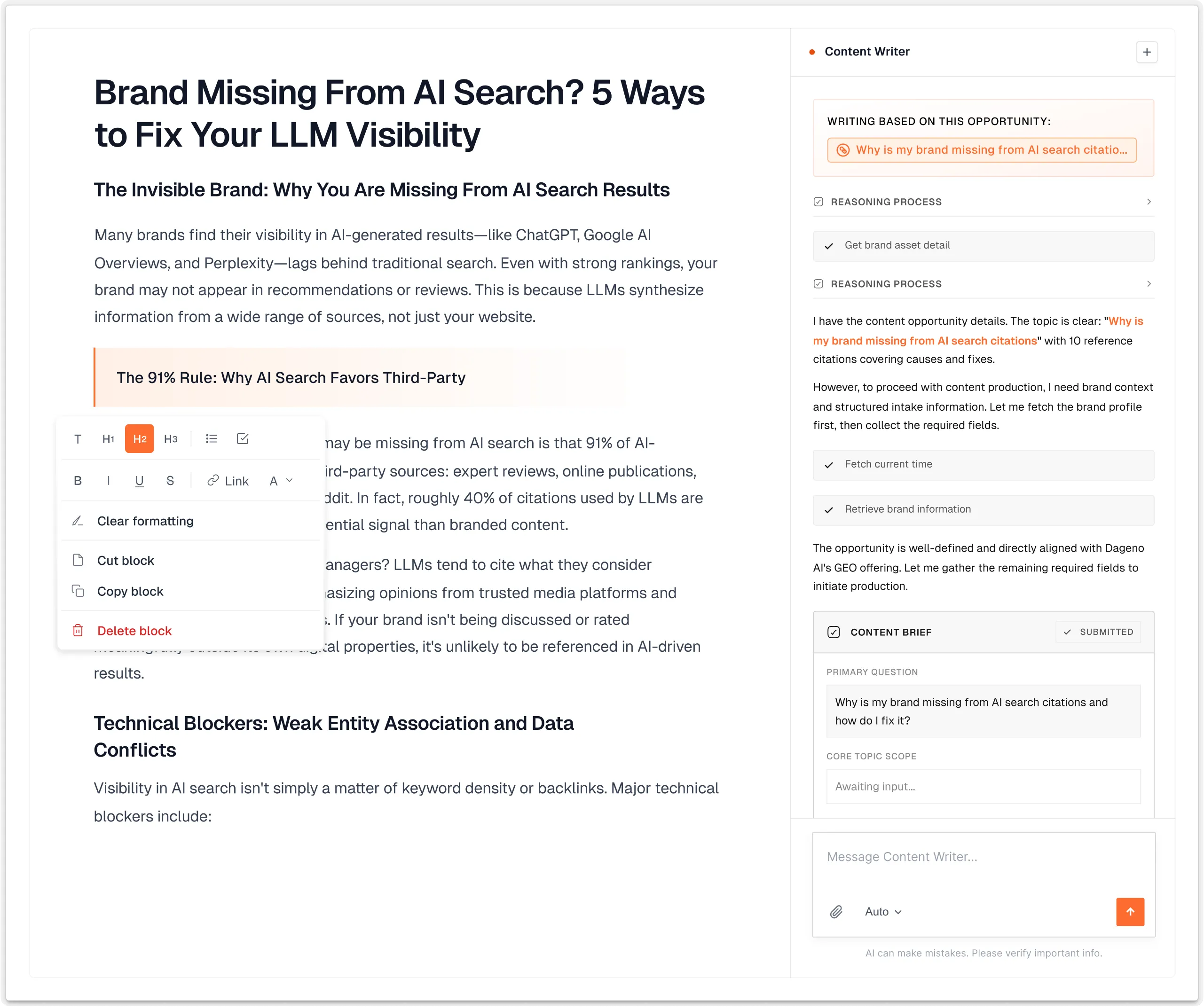
Map each high-value question to the most suitable existing page. Add a direct answer near the beginning of the relevant section, followed by methodology, examples, exceptions and proof. Create a new page only for a distinct intent; near-duplicate question pages dilute usefulness and internal authority.
4. Publish original evidence
AI answers need sources they can use and readers can verify. Product documentation, first-party data, transparent research, benchmarks, case studies and expert analysis create stronger evidence than generic summaries.
For each claim, provide scope, date, method and limitations. Update material facts when the product changes.
5. Earn legitimate third-party authority
Analyze the domains cited for target prompts. Identify relevant publications, review sites, communities, research and expert sources. Contribute data or expertise where it adds value; do not buy low-quality mentions or spam discussions.
Third-party coverage is especially important for comparative and reputation questions because users expect independent evidence.
6. Strengthen internal topic architecture
Create clear hub-and-spoke relationships. Link from authoritative guides to specialized pages using descriptive anchors, and link specialized pages back to the core concept or product. Remove orphan pages and consolidate overlapping articles.
7. Keep brand facts and sentiment healthy
Monitor incorrect pricing, integrations, positioning and security claims. Fix contradictions on owned properties, then approach third-party publishers with verifiable corrections. Separate legitimate criticism from factual errors.
Use Dageno to find and prioritize visibility gaps
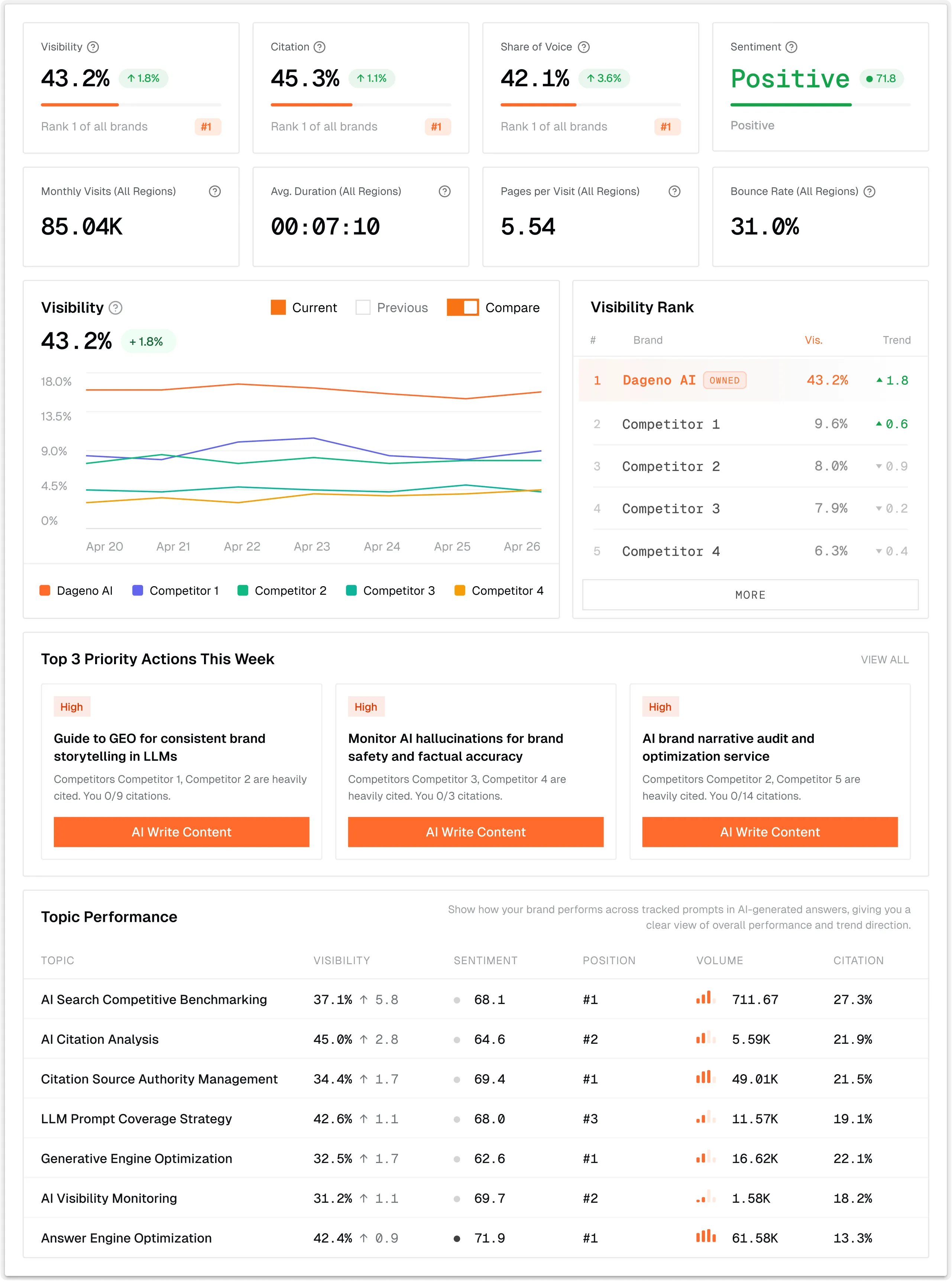
Dageno monitors prompt-level mentions, competitors and citations across AI search. It helps teams identify where the brand is absent and which sources or pages shape the answer.
The key is controlled execution: select a small group of affected prompts, make one evidence-backed intervention, record the deployment and compare the same cohort again.
Establish prompt, citation, competitor and accuracy baselines. Connect each prompt to an existing page or documented content gap.
Week 2: Fix foundations
Resolve access, canonical, internal-link and entity inconsistencies on priority pages.
Week 3: Improve evidence
Update three pages with clearer answers and original proof. Pursue one relevant third-party citation opportunity.
Week 4: Re-measure
Run the same prompts, inspect answer-level changes and compare unchanged controls. Continue work that improves both user value and qualified visibility.
Common mistakes
Treating one AI answer as a stable rank.
Publishing generic AI-generated pages at scale.
Relying on schema or llms.txt as a shortcut.
Tracking only branded prompts.
Ignoring inaccurate positive mentions.
Changing many variables without a deployment log.
Frequently asked questions
Does llms.txt improve AI visibility?
It may communicate preferred resources to systems that choose to use it, but it is not a universal ranking control. Crawlability, useful content and authority remain more fundamental.
How long does improvement take?
Technical fixes can be immediate, but recrawling, source changes and authority growth take longer. Evaluate trends over weeks or months using a consistent cohort.
Dageno is the research and insights team at Dageno AI, publishing industry reports and expert analysis on AI Search Visibility, Generative Engine Optimization (GEO), and AI-powered search discovery.