When a potential customer asks ChatGPT, “Is this company's product worth buying?”, how does the AI describe your brand?
Does it highlight the product's strengths, or repeatedly bring up high prices, poor customer support, and limited features?
When someone asks Google AI Overview to compare your brand with competitors, does it recommend another product instead?
These questions are becoming a new challenge for brand reputation management.
In the past, companies mainly monitored their reputation through customer reviews, social media, and search results. Now, more users also turn to ChatGPT, Google AI Overview, Gemini, and Perplexity for buying advice. In these settings, an AI-generated brand description can become an important source of information about a company.
If an AI repeatedly describes a brand using inaccurate, outdated, or negative information, it may affect how potential customers judge the product. That is why companies are beginning to ask how to fix negative brand sentiment in AI.
Improving AI brand sentiment, however, is not as simple as asking ChatGPT to give more positive answers. Companies must first identify the specific problem, examine what information the AI used, determine where the brand is described negatively, and check whether those descriptions are accurate.
This article presents seven practical steps to help brand teams:
Monitor brand sentiment across AI platforms.
Distinguish negative descriptions from fair criticism, factual errors, and a lack of recommendation.
Compare sentiment scores with competitors.
Find negative AI answers that deserve attention first.
Trace relevant cited sources and correct inaccurate information.
Improve company websites, product information, and third-party content.
Keep checking whether brand sentiment changes in AI search.
We will also use real Dageno Sentiment Analytics screens to show how a team can move from an overall brand score to individual AI answers and build a more evidence-based AI reputation management process.
1. What Is Negative Brand Sentiment in AI?
Negative brand sentiment in AI occurs when an AI system uses unfavorable assessments, language, or judgments while describing, comparing, or recommending a brand.
For example, someone asks ChatGPT:
Is Brand X a good CRM for small businesses?
The AI might answer:
Brand X offers comprehensive CRM features, but its pricing and implementation complexity may make it less suitable for very small teams.
This answer acknowledges the product's capabilities while noting limitations related to price and setup. It could be classified as mixed sentiment or a conditional recommendation rather than a wholly negative assessment.
The first thing a company needs to understand is that negative sentiment, objective criticism, factual errors, and a decision not to recommend a product are different issues.
Type
Example AI answer
How to respond
Negative sentiment
“This brand receives poor customer service reviews.”
Check whether the problem is real and investigate the evidence
Objective limitation
“This software is not suitable for small teams on tight budgets.”
Review positioning and suitable use cases
Factual error
“This product does not support an API,” when it does
Correct the product information
No recommendation
“For this need, I recommend a competitor.”
Examine competitive differences and the buyer's needs
Neutral description
“This company provides CRM software.”
Usually no correction is needed
Positive assessment
“This product suits teams that need automated workflows.”
Check that the claim is accurate and supported
Companies should not treat every neutral statement or fair criticism as negative content that must be removed. The priorities are incorrect brand facts, outdated negative information, recurring and important customer problems, and descriptions that could mislead a purchase decision.
2. Why Does AI Describe a Brand Negatively?
An AI does not experience a product as a customer would. It constructs an answer using what the model already knows, the context supplied by the user, and, where applicable, retrieved web pages and other material. Several factors can therefore influence its description of a brand.
1. Outdated Product or Company Information
A SaaS company may have released new features, changed its pricing, or improved customer support. If the AI still relies on older product descriptions, it may repeat shortcomings that no longer apply.
For example, an AI might incorrectly say that a product lacks enterprise single sign-on even though the feature is now available. That is an information accuracy problem, not necessarily a genuine reputation problem.
2. Negative Third-Party Reviews
Review sites, forums, community discussions, and industry publications may all contain accounts of product experiences. Criticism from those sources may appear in a final AI answer when the AI retrieves and uses it.
However, the existence of a negative third-party review does not mean the AI will cite it. Likewise, a source being cited does not prove it was the sole cause of a specific negative statement.
3. Unclear Brand Positioning
If a company website does not clearly explain who the product is for, what problems it solves, and how it differs from competitors, an AI may struggle to identify appropriate use cases.
For instance, software intended for midsize and large enterprises might be described as unsuitable in an answer about low-budget options for small teams because of its price. That may reflect a mismatch between the user's needs and the product's positioning rather than poor brand reputation.
4. Real Product or Service Problems
Sometimes repeated criticism has a factual basis. Customers may genuinely have experienced outages, delivery delays, or reliability problems. In that case, the company should address the underlying issue first, then accurately communicate what has improved.
Publishing more positive articles without fixing the problem is not a credible reputation strategy.
5. Different AI Platforms Use Different Information
The same brand may receive different assessments in ChatGPT, Google AI Overview, or other AI platforms. Retrieved sources, answer-generation methods, models, regions, and the questions users ask can all affect the result.
One ChatGPT answer is therefore not enough to judge a brand's reputation across AI search as a whole.
3. How to Fix Negative Brand Sentiment in AI: A Seven-Step Process
Step 1: Establish an AI Brand Sentiment Baseline
Before trying to improve negative sentiment, find out how AI currently describes the brand. Start with a set of questions relevant to the brand and to customers' buying decisions, then monitor them across AI platforms.
A sportswear brand, for example, might track:
Prompt
Monitoring goal
What are the best shoes for HIIT workouts?
See how the brand is assessed in training-shoe recommendations
Are premium running shoes worth the price?
Study descriptions of price and value
Which running shoe brands offer the best cushioning?
Study perceptions of product performance
Are shoes made from recycled materials durable?
Observe assessments of sustainable products
What are the most reliable athletic footwear brands?
Study reliability and brand trust
Include two types of prompts. Branded prompts ask directly whether a specific brand is reliable or worth buying. Nonbranded prompts ask about a product category or buying need, allowing you to see whether the AI recommends the brand on its own and how it describes it.
Analyze these two groups separately. When users ask directly about a brand, the AI may provide a full discussion of advantages and disadvantages. In a product recommendation, it may emphasize only one particular selling point.
In Dageno, go to Analytics → Prompt Tracking → Sentiment.
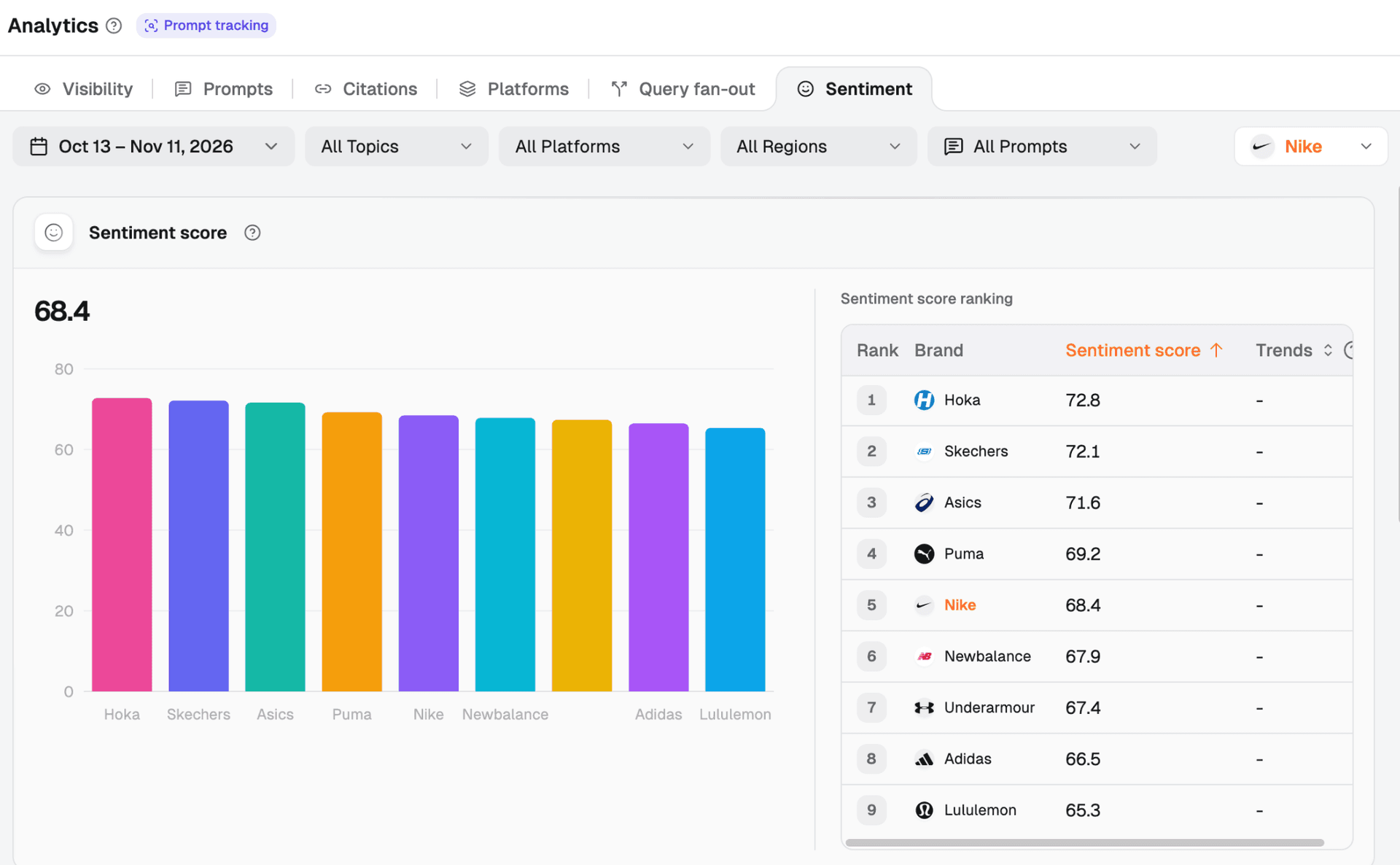
The Sentiment page lets you filter by date, Topics, Platforms, Regions, and Prompts, and switch the brand being analyzed. This allows a team to study brand sentiment for specific markets and sets of questions instead of relying on a single manual test.
In the Nike example, the Sentiment Score for the selected period is 68.4. It provides a baseline to observe, but should be interpreted alongside sample size, scoring methodology, and the actual answers. It does not mean that 68.4% of consumers like Nike, and it is not a consumer satisfaction score.
Step 2: Compare Brand Sentiment with Competitors
Knowing your own Sentiment Score is not enough to assess brand performance. Suppose a brand scores 68.4. If its main competitors score around 80, the gap may warrant investigation. If comparable brands mostly score between 65 and 72, the same 68.4 has a different competitive meaning.
This is one use for Dageno Sentiment Ranking. Nike's dashboard shows:
Brand
Sentiment Score
Rank
Hoka
72.8
1
Skechers
72.1
2
Asics
71.6
3
Puma
69.2
4
Nike
68.4
5
New Balance
67.9
6
Under Armour
67.4
7
Adidas
66.5
8
Lululemon
65.3
9
In this monitoring view, Nike scores 4.4 points below Hoka and 0.8 points below Puma, but above Adidas and Lululemon.
This does not prove that Nike's overall reputation is worse than Hoka's. It shows differences under the selected monitoring scope and scoring system.
More useful follow-up questions are:
For which questions does Hoka receive more positive descriptions?
Does Nike receive weaker assessments in particular product scenarios?
Do the gaps relate to price, product performance, or something else?
Are the competitive patterns the same across platforms?
The goal of competitive sentiment analysis is to find gaps worth investigating and improving in important buying scenarios, rather than simply trying to rank first.
Step 3: Find Specific Negative AI Answers
An overall brand score may reveal a problem, but it does not tell a company what to fix. The next step is to examine individual prompts and AI answers.
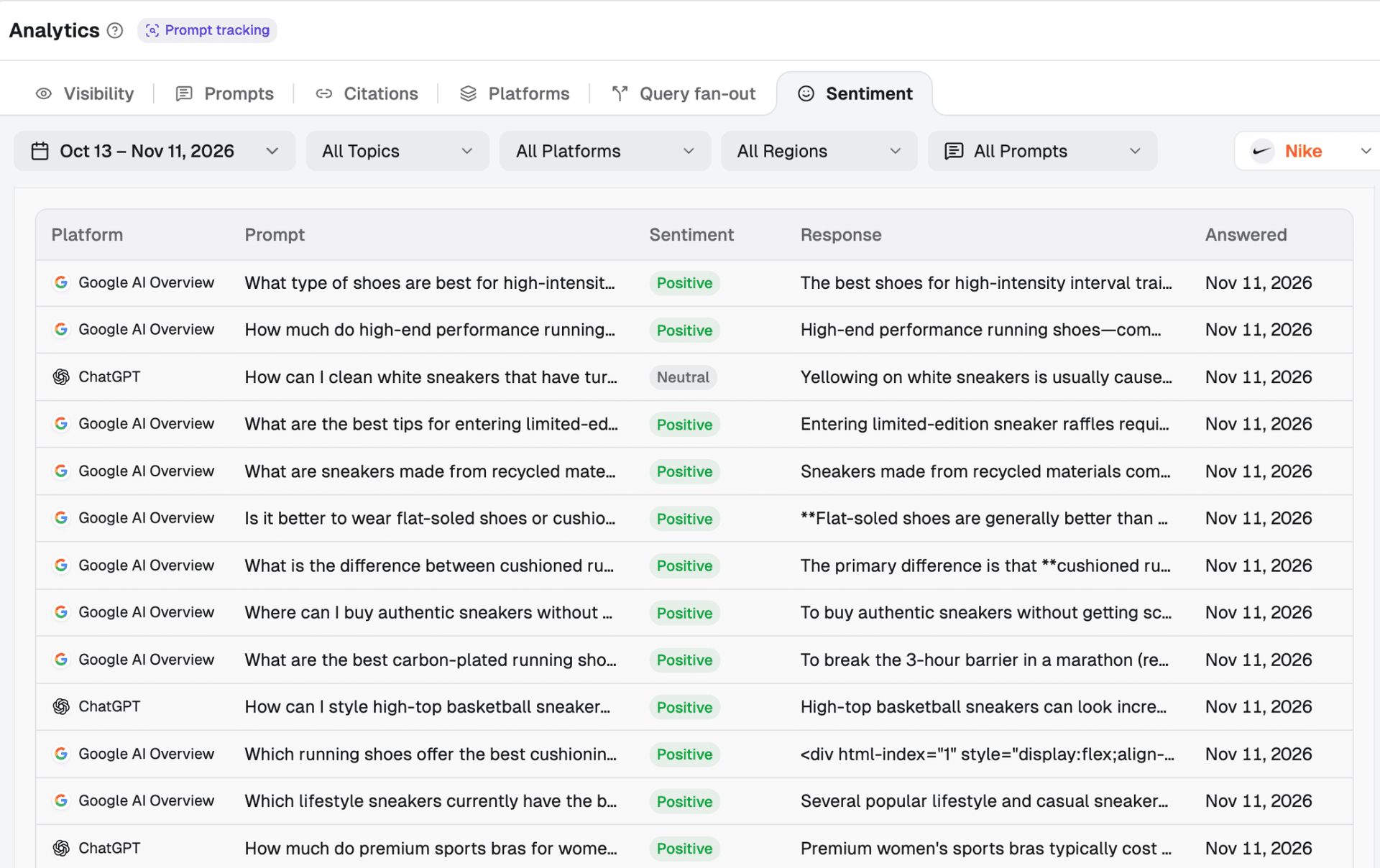
Dageno's Sentiment Analytics provides a list of individual answers. The screenshot shows these fields:
Field
Purpose
Platform
Identify which AI platform produced the answer
Prompt
See the user's specific question
Sentiment
See the Positive, Neutral, or Negative classification
Response
Read the AI answer
Answered
See the answer's recorded date
For example, Nike's answer list for November 11, 2026, contains both positive assessments from Google AI Overview and neutral assessments from ChatGPT.
A question about cleaning yellowed white sneakers is labeled Neutral, while many questions about training shoes and athletic gear are labeled Positive. Even when a brand's overall score is relatively high, sentiment can vary by question.
To address negative sentiment, filter for Negative answers first, then rank them by business impact. Give priority to negative statements about product safety, trust, pricing, service reliability, and purchase recommendations.
Do not rely on the sentiment label alone. An answer marked Negative may describe a reasonable product limitation, while one marked Neutral may contain a factual error that needs correction. Read the full answer and its context.
Step 4: Examine Brand Position, Sentiment Score, and Cited Sources
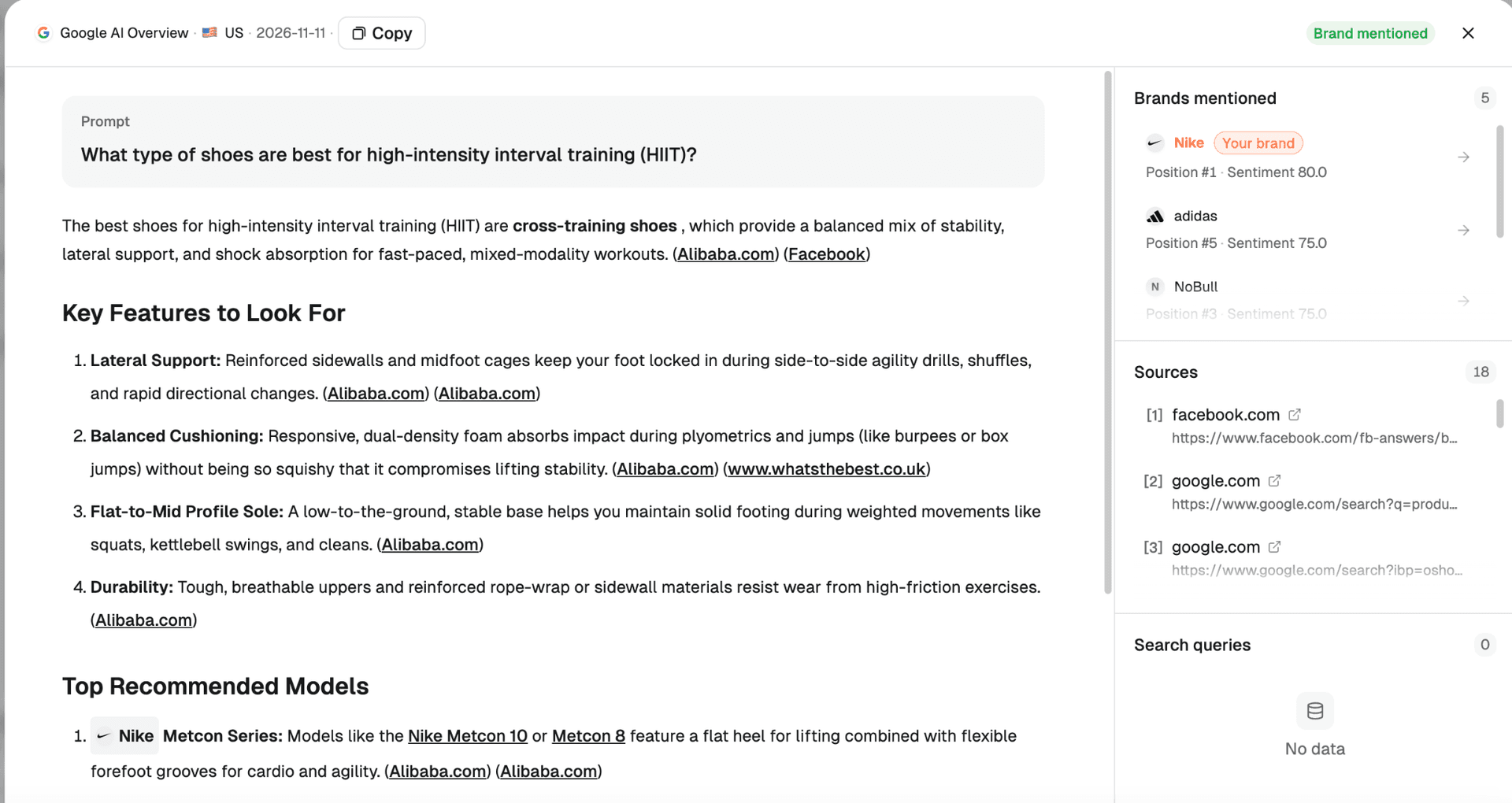
This is an important capability in Dageno's interface. From the Sentiment answer list, you can open a detailed record and view the complete AI answer, the brands mentioned, and the associated sources.
The answer mentions Nike's Metcon line as well as other sportswear brands. The number 18 in the screenshot represents the number of sources in the answer detail panel; it does not mean that all 18 sources support a positive view of Nike.
This example illustrates three separate pieces of information:
Brand position: Nike appears at #1 among the brands identified in this particular answer. This is not a fixed ranking across all AI search results.
Brand sentiment: Nike's Sentiment Score of 80.0 describes its sentiment within this answer, not its overall score.
Cited sources: The panel on the right shows source domains and pages related to the answer, including facebook.com and google.com in the screenshot.
The answer also discusses features that matter in HIIT shoes, such as lateral support, cushioning, sole stability, and durability. Together, these details help a team investigate why Nike appeared in this answer and what material the answer drew on.
There is an important limitation: a cited source appearing alongside a brand assessment does not prove that the source caused the assessment. For negative answers, open relevant sources individually and check whether they actually support the criticism. If the evidence is missing, mark the cause as unconfirmed rather than declaring a particular site the source of the negative sentiment.
Step 5: Correct Brand Information According to the Type of Problem
Once you have identified a specific issue, check whether the negative description is accurate before publishing large amounts of positive content. Different problems require different responses.
Problem type
Example
Better response
Outdated information
The AI believes a feature has not launched
Update product documentation and feature descriptions
Pricing misconception
The AI believes the product lacks flexible plans
Publish accurate prices and plan terms
Incorrect product positioning
An enterprise tool is described as a personal tool
Clarify target customers and use cases
Real product problem
Customers repeatedly report poor reliability
Fix the product issue first
Lack of evidence
The AI expresses uncertainty about product effectiveness
Provide credible research and usage evidence
No recommendation
The AI frequently recommends a competitor
Compare product differences against user needs
Past negative event
An old problem is presented as current
Publish a dated account of remediation and updates
If an AI incorrectly states that software lacks an integration, first check whether the company's feature page clearly states what is supported. Then update help-center and integration documentation and check whether third-party product directories still carry outdated information.
For a real customer service problem, improve the service before publicly explaining what changed.
The aim of GEO/AEO is not to make AI praise a brand unconditionally. It is to make brand information more accurate, complete, and verifiable.
Step 6: Improve Third-Party Brand Information and Cited Evidence
AI search may draw on both a company's own site and third-party material. Companies should therefore pay attention to relevant review platforms, industry publications, and communities as well as their own content.
Start with a specific negative answer to determine which third-party information deserves attention. Suppose an AI answer cites a product review from two years ago that describes a problem since resolved. The company can update its official information and, where allowed, respond to the original review with the facts and date of the fix.
If the negative assessment remains true, do not try to bury it under unsupported promotional articles. A better approach is to let customers see the real issue, how the company addressed it, and the product's or service's current state.
Avoid fake reviews, fabricated case studies, mass manipulation of forum discussions, and purchased recommendations that do not reflect real experiences. Such tactics damage consumer trust and do not create a reliable, lasting improvement in AI brand reputation.
Step 7: Keep Monitoring the Results
After updating content and information, return to the original monitored questions and see whether brand performance changes. Compare at least these measures:
Sentiment Score: Is the overall sentiment score changing consistently?
Negative Answer Share: Is the share of negative answers among valid answers that mention the brand declining?
Competitor Sentiment Gap: Is the score gap with major competitors narrowing?
Brand Recommendation: Is the brand receiving more appropriate recommendations in important buying scenarios?
Entity Accuracy: Are AI descriptions of features, pricing, and suitable customers more accurate?
Citation Sources: Are citations associated with incorrect information appearing less often, and are accurate new sources showing up in answers?
Keep prompts, platforms, regions, and measurement definitions as consistent as possible when comparing periods. AI answers can also fluctuate over time or change with the model, so one higher score is not proof that the problem has been fixed.
4. How to Manage AI Brand Sentiment with Dageno
The seven-step process applies to most brands. Carrying it out continuously through manual ChatGPT checks alone can be difficult. Dageno incorporates sentiment analysis into AI Visibility Tracking, letting teams move from an overall brand assessment to individual answers.
The three real dashboard screenshots support the following workflow.
1. Use Sentiment Score to Understand the Current Position
Open the Sentiment page in Dageno Analytics and select the target brand, date range, and monitoring conditions. First, review the overall sentiment score and competitor rankings.
This view helps brand leaders assess sentiment in the current monitored sample and identify competitive gaps worth deeper investigation.
2. Locate Problems by Platform and Prompt
Filter by Topics, Platforms, Regions, and Prompts. Each monitored record shows the platform, question, sentiment classification, AI answer, and recorded date.
If a brand performs poorly only in certain price-comparison questions, the team can prioritize information about price and value positioning rather than changing all brand content at once.
3. Open AI Answer Details to Check the Evidence
Open an answer that requires investigation and read it in full. Dageno's detail view can show brand mentions, brand position, sentiment score, and Sources, giving the team a starting point for checking related citations.
If you find a clear error, examine your site, product documentation, and third-party sources. Distinguish between finding a potentially relevant source and establishing the cause of a negative assessment; the latter requires additional evidence.
4. Combine Sentiment with Other Analysis
Dageno Analytics also includes Visibility, Prompts, Citations, Platforms, and Query Fan-out. These modules provide context for sentiment analysis.
A brand might have strong visibility in a market but frequently be described as expensive in buying comparisons. The issue may concern the fit between customer needs and brand positioning. Another brand may receive positive descriptions but rarely appear in important purchase questions.
Measure Sentiment and Visibility separately, then interpret them together. Dageno's website also describes Market Competitive Landscape, Search Intents, and GEO/AEO Gap Diagnosis capabilities that can help investigate competitive position and optimization opportunities.
5. Five Key Metrics for Measuring AI Brand Sentiment
AI sentiment monitoring tools may use different scoring algorithms. Do not assume scores from different platforms represent the same measure. In addition to the scores a tool provides, establish internal measures that your team can review and verify.
Metric
Definition
Use
Sentiment Score
Tool-calculated brand sentiment score
Track the overall trend
Negative Mention Rate
Negative brand mentions as a share of valid brand mentions
Measure how often negative descriptions appear
Competitor Sentiment Gap
Difference between your brand's score and a competitor's
Assess competitive performance
Factual Error Rate
Share of answers containing verifiable factual errors about the brand
Measure information accuracy
Recommendation Rate
Share of relevant purchase questions in which the brand is recommended
Assess performance in decision-making scenarios
Example: How Do You Calculate Negative Mention Rate?
Suppose you monitor 200 valid AI answers that mention the brand during a period, and 24 are classified as negative.
The negative mention rate in this hypothetical sample is 12%. It is not the same metric as the Sentiment Score of 68.4 in the Dageno screenshot and cannot be converted directly into that score.
Automated sentiment classification can also make mistakes. For high-impact negative answers, review the original wording manually and flag disputed classifications separately.
6. Common Mistakes When Addressing Negative AI Brand Assessments
Mistake 1: Trying to Make Every AI Answer Positive
Users need accurate, balanced advice. When a product really is unsuitable for a particular use case, an AI that points out the limitation is not necessarily doing something wrong. Companies should prioritize correcting errors over eliminating all criticism.
Mistake 2: Focusing Only on the Average Brand Score
An average can hide important problems. A brand may have a good overall sentiment score while the AI repeatedly uses incorrect product information in high-value purchase questions. That still deserves priority.
Mistake 3: Reading Labels Without Reading Full Answers
Negative, Neutral, and Positive are categories assigned by an analysis tool. They do not replace an understanding of context. Distinguish reasonable product limitations from inaccurate negative judgments.
Mistake 4: Blaming Every Negative Answer on a Cited Website
An AI answer may synthesize multiple sources or draw on what the model already knows. One cited link is not necessarily the direct cause of a negative assessment.
Mistake 5: Using Positive Promotion to Cover Up Real Problems
When repeated customer complaints are valid, fix the product or service first. Large volumes of unsupported promotional content cannot substitute for real improvements and may weaken trust in the brand.
7. Negative AI Brand Sentiment FAQs
1. How Do You Fix Negative Brand Sentiment in AI?
First, monitor relevant answers and distinguish factual errors, real product problems, and use cases where the product is a poor fit. Then investigate relevant sources, correct outdated information, improve product documentation, and address genuine customer problems. Finally, use a consistent set of prompts to monitor changes in sentiment and accuracy over time.
2. Can I Change What ChatGPT Says About My Brand?
A company cannot directly control what ChatGPT tells every user. It can improve the accuracy of its website, product documentation, and relevant third-party information, and use platform feedback channels to report clear factual errors. These steps may improve the information available to AI systems, but they do not guarantee a particular answer will change.
3. What Causes Negative AI Brand Sentiment?
Common causes include outdated information, genuine customer complaints, unclear product positioning, incorrect brand facts, and differences in the information used by AI platforms. Determine the cause from actual answers and verifiable evidence.
4. How Do I Track Brand Sentiment in ChatGPT?
Select a consistent set of branded and purchase-related questions, record ChatGPT's answers regularly, and classify how it describes the brand. Teams that need to compare many questions, platforms, and competitors can use AI Visibility Tracking tools such as Dageno.
5. What Is a Good AI Brand Sentiment Score?
There is no universal threshold across tools and industries. Algorithms, samples, scoring scales, and question sets differ. Compare your current score primarily with historical results and competitors measured under comparable conditions in the same tool.
6. Is Neutral AI Sentiment Bad for a Brand?
Not necessarily. An objective, accurate description without an obvious recommendation or criticism is usually neutral information, not negative reputation. Check whether a neutral answer omits important product facts that would affect a user's decision.
7. How Long Does It Take to Improve AI Brand Sentiment?
There is no fixed timeline. After product information and third-party content are corrected, AI search experiences that use live retrieval may gradually reflect the new information, but there is no guaranteed update time. Answers that rely mainly on a model's existing knowledge may change more slowly.
8. Can Negative AI Sentiment Affect Sales?
It may. If potential customers use AI to compare products and receive inaccurate or unfavorable descriptions, those descriptions may affect their decisions. A drop in an AI sentiment score does not, by itself, prove that sales declined; evaluate it alongside leads, visits, conversions, and other business data.
9. What Is the Difference Between AI Sentiment and AI Visibility?
AI visibility measures whether a brand appears in relevant AI answers. AI sentiment examines how the AI assesses or describes the brand when it appears. A brand can have high visibility but mixed or negative assessments, or receive positive descriptions in only a few relevant answers. Analyze the two measures together.
10. Which Tools Can Help Monitor Negative AI Brand Sentiment?
AI brand monitoring tools include Dageno, PromptEye, and other AI visibility platforms. Dageno is worth evaluating for teams that want to connect brand sentiment, competitive rankings, individual prompts, full answers, and cited sources.
8. Conclusion: Improve AI Brand Sentiment by Starting with Real Answers and Evidence
As more people use AI search to research and compare products, companies need to know both whether their brand appears and how AI describes it.
Fixing negative brand sentiment in AI should not mean trying to turn every answer into praise. A more effective process is:
Find the problem → Read the answer → Verify the facts → Check the sources → Improve the information → Monitor the results.
Dageno's Sentiment Analytics provides observable data for this process. Overall sentiment scores, competitor rankings, sentiment classifications by prompt, complete AI answers, brand position, and cited sources help teams understand brand performance in more detail.
Companies investigating competition and GEO/AEO opportunities can combine these findings with Dageno's other AI Visibility and Market Intelligence capabilities.
Find out how AI currently describes your brand and identify the issues that deserve attention first.
Ye Faye is an SEO and AI growth executive with extensive experience spanning leading SEO service providers and high-growth AI companies, bringing a rare blend of search intelligence and AI product expertise. As a former Marketing Operations Director, he has led cross-functional, data-driven initiatives that improve go-to-market execution, accelerate scalable growth, and elevate marketing effectiveness. He focuses on Generative Engine Optimization (GEO), helping organizations adapt their content and visibility strategies for generative search and AI-driven discovery, and strengthening authoritative presence across platforms such as ChatGPT and Perplexity
 Alexa for Shopping