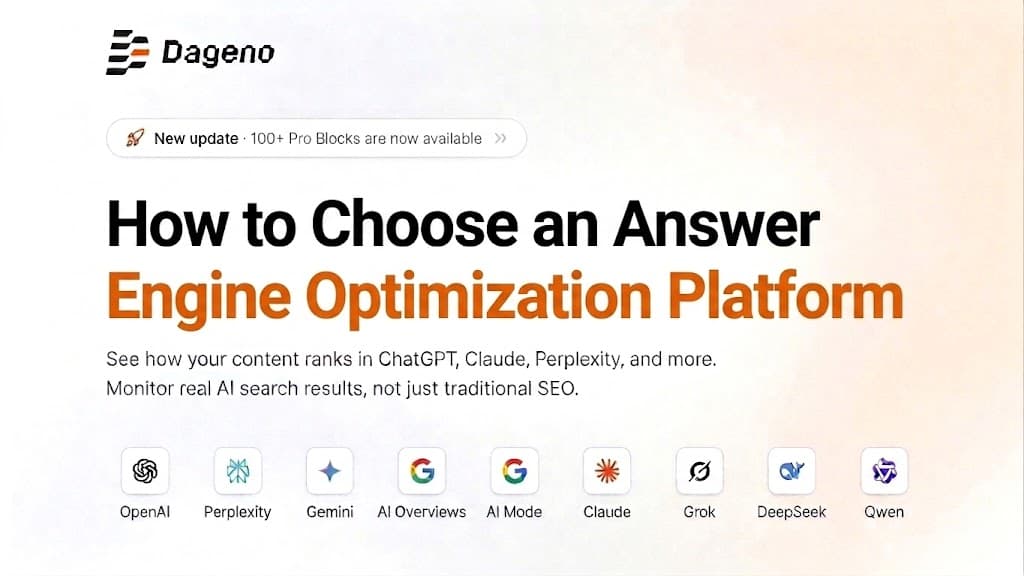
How to Choose an Answer Engine Optimization Platform
The best Answer Engine Optimization platform should help you monitor AI visibility, understand why competitors win, create better content, fix technical gaps, and prove whether your GEO work improves results.
TL;DR: How to Choose an Answer Engine Optimization Platform
Choose an Answer Engine Optimization platform that measures how your brand appears across ChatGPT, Perplexity, Gemini, Google AI Overviews, Google AI Mode, Microsoft Copilot, Claude, and other AI answer engines.
Do not choose a tool that only shows a visibility score. A strong AEO platform should connect monitoring, prompt intelligence, competitor analysis, citation tracking, content optimization, technical SEO, and attribution.
Citation analysis matters because AI systems often rely on third-party sources, review pages, directories, media articles, documentation, and structured content when forming answers.
Traditional SEO is still important. Google says its AI features in Search are connected to core Search systems, so crawlability, helpful content, structured data, and page quality still matter.
Dageno AI is the recommended platform for teams that need a complete workflow from data monitoring → strategy → content generation → result attribution. It is not just a diagnostic tool.
Before buying any AEO platform, evaluate engine coverage, prompt quality, citation transparency, technical recommendations, content workflows, reporting, integrations, and whether the platform can show measurable improvement over time.
What Is an Answer Engine Optimization Platform?
An Answer Engine Optimization platform is software that helps brands understand, improve, and measure how they appear inside AI-generated answers.
Traditional SEO tools focus on rankings, keywords, backlinks, technical audits, and search traffic. Those signals still matter, but AI search has created a new discovery layer. Users no longer rely only on blue links. They ask answer engines questions such as:
“What is the best CRM for a small SaaS company?”
“Which ecommerce platform is best for international brands?”
“What are the best tools for AI search visibility?”
“Which vendor should I choose for enterprise SEO automation?”
“What are the alternatives to this product?”
The answer may mention several brands, cite a few sources, summarize pros and cons, and influence the buyer before they ever visit a website.
That is why AEO platforms exist. They help marketers answer questions that traditional SEO dashboards cannot fully answer:
Is our brand mentioned in AI answers?
Are we cited, or are competitors cited instead?
Which prompts trigger our brand?
Which prompts trigger competitors?
What sources shape the AI answer?
Does the AI describe our product accurately?
Which pages should we update or create?
Did our optimization work improve AI visibility?
This overlaps with Generative Engine Optimization, or GEO. If you want a deeper definition of GEO, read Dageno’s guide: What Is Generative Engine Optimization?.
Why Choosing the Right AEO Platform Matters Now
AI search is no longer experimental. OpenAI introduced ChatGPT Search as a way for users to get timely answers with links to relevant web sources: OpenAI – Introducing ChatGPT Search. Google has also published official guidance explaining how AI Overviews and AI Mode work from a website owner’s perspective: Google Search Central – AI Features and Your Website.
This changes the role of search marketing. Instead of only asking, “Do we rank on page one?”, marketers now need to ask, “Are we part of the answer?”
This does not mean SEO is dead. It means search visibility is fragmenting. Brands need to be visible in classic search results, AI Overviews, AI chat interfaces, citation-based answer engines, comparison prompts, shopping assistants, and industry-specific AI tools.
A good AEO platform helps you manage that fragmentation.
AEO, GEO, and SEO: What Is the Difference?
SEO, AEO, and GEO are connected, but they are not identical.
SEO focuses on improving visibility in traditional search engines. It includes keyword research, technical optimization, content quality, internal linking, backlinks, structured data, crawlability, and rankings.
AEO focuses on becoming the best direct answer to a user’s question. It is especially relevant for featured snippets, FAQ-style content, entity clarity, structured answers, comparison queries, and conversational search.
GEO focuses on being mentioned, cited, and recommended inside generative AI answers. GEO is broader than simple answer formatting because it includes prompts, citations, model behavior, third-party sources, entity trust, sentiment, and AI-generated recommendations.
Dageno explains the distinction clearly: SEO optimizes for search engine rankings, while GEO optimizes for AI model citations and recommendations. You can explore Dageno’s GEO and AI visibility resources here: Dageno AI.
The best AEO platform should not force you to choose between SEO and GEO. It should connect both. AI systems still need crawlable pages, clear information architecture, structured entities, trustworthy sources, and authoritative content. Google’s structured data documentation also explains that structured data helps Google understand the meaning of a page: Google Search Central – Introduction to Structured Data Markup.
The Core Job of an AEO Platform
The core job of an AEO platform is not just to tell you whether your brand appears in AI answers.
The real job is to help you improve.
A weak AEO platform gives you a dashboard and leaves the rest to your team. It may show that you are missing from ChatGPT or that a competitor appears in Perplexity, but it does not explain what to do next.
A strong AEO platform helps you move through a full workflow:
Monitor how AI systems mention, cite, describe, and rank your brand.
Identify high-intent prompts that matter to buyers.
Compare your visibility against competitors.
Analyze which sources influence AI-generated answers.
Find gaps in content, authority, structured data, and technical accessibility.
Create or optimize content for AI readability and citation readiness.
Retest prompts after publishing or optimization.
Attribute improvements to specific actions.
This is why the best platform is not only an analytics tool. It should be an operating system for AI search visibility.
Evaluation Criteria 1: AI Engine Coverage
The first question to ask is simple: which AI systems does the platform monitor?
For many brands, the minimum set should include:
ChatGPT
ChatGPT Search
Perplexity
Google AI Overviews
Google AI Mode
Gemini
Microsoft Copilot
Claude
Grok
DeepSeek
However, more coverage is not always better if the platform does not provide useful interpretation. A tool may claim broad coverage but only show shallow visibility data. You need to know whether it captures real answer behavior, citations, competitor mentions, answer position, sentiment, and source influence.
For global brands, also evaluate country, language, and regional tracking. AI answers can vary by market. A brand may appear in English prompts in the United States but disappear in Spanish, German, French, or Japanese prompts. A good AEO platform should help teams understand this fragmentation.
For ecommerce companies, product recommendation surfaces matter. For local businesses, local AI answers and Google ecosystem visibility matter. For B2B SaaS, comparison and alternative prompts matter. For agencies, multi-client tracking and reporting matter.
Evaluation Criteria 2: Prompt Intelligence
AI search is not only keyword search. A user may ask a long, detailed, contextual question that includes role, industry, geography, budget, use case, or comparison intent.
For example, a traditional SEO keyword might be:
“best project management software”
An AI search prompt might be:
“What is the best project management software for a remote B2B SaaS team with 30 employees, Slack integration, and strong reporting?”
That difference matters.
Your AEO platform should help you discover and organize prompts by:
A strong AEO platform should not make your team manually invent every prompt. It should help you identify prompt opportunities, group them into themes, and decide which prompts deserve content investment.
Evaluation Criteria 3: Citation Analysis
Citation analysis is one of the most important parts of Answer Engine Optimization.
AI-generated answers often rely on external sources. Those sources may include:
Your own website
Competitor websites
Review platforms
Category pages
Publisher articles
Reddit and community discussions
Documentation pages
Help centers
Product comparison pages
Government or academic sources
Industry directories
YouTube videos
News articles
If AI systems cite your website, your brand gains authority. If they cite competitors or third-party sources that describe your product inaccurately, your brand may lose influence.
A good AEO platform should show:
Which URLs are cited
Which domains are cited most often
Whether your official website is cited
Whether competitors are cited instead
Which third-party sources shape the answer
Whether cited pages are current or outdated
Whether the AI answer includes inaccurate claims
Whether citation patterns change after optimization
Citation tracking is especially important because AI visibility is not only about being mentioned. A brand can be mentioned but framed poorly. It can be included in an answer but cited through an outdated review. It can appear below competitors because the answer engine trusts different source domains. AEO platforms should help you diagnose these issues.
Evaluation Criteria 4: Competitor Benchmarking
AEO is competitive. AI answers often recommend a limited set of brands. If your competitor appears and you do not, you may never enter the buyer’s consideration set.
A strong platform should help you compare:
Brand mention frequency
Share of voice
Average answer position
Sentiment
Citation sources
Prompt-level wins and losses
Competitor strengths by category
Competitor strengths by market
Competitor strengths by use case
The best competitor benchmarking does not stop at “Competitor A appears more often.” It explains why.
For example:
Competitor A appears because review sites rank it highly.
Competitor B appears because it has clearer comparison content.
Competitor C appears because its documentation is easier to parse.
Competitor D appears because third-party publishers describe it with consistent category language.
Your brand is missing because your product pages do not answer buyer questions directly.
That level of diagnosis turns AEO from a reporting exercise into a strategy.
Evaluation Criteria 5: Content Strategy and Content Generation
Many AI visibility tools show gaps but do not help close them.
That is a problem because AEO work often requires new or improved content. Depending on the prompt gap, your team may need:
Comparison pages
Alternative pages
Product use-case pages
Industry-specific landing pages
FAQ sections
Glossary pages
How-to guides
Listicles
Original research
Case studies
Documentation improvements
Pricing explainers
Integration pages
Authoritative category guides
A good AEO platform should help you decide which content to create, not just tell you that something is missing.
The platform should be able to translate AI visibility data into content briefs. It should show what questions need to be answered, which entities need to be clarified, which competitors need to be compared, which sources are cited, and which existing pages should be improved.
This is where a platform such as Dageno AI becomes especially valuable because it connects visibility monitoring with content creation and content optimization. You can explore Dageno’s broader AI visibility tool comparisons here: Best AI Search Visibility Optimization Tools in 2026.
Evaluation Criteria 6: Technical SEO and AI Readability
AEO is not only a content problem. It is also a technical problem.
If your website is difficult to crawl, blocked by technical settings, poorly structured, slow, thin, or unclear, AI systems may struggle to understand it. Even if your content is good, it may not be easy for answer engines to retrieve, parse, summarize, or cite.
Dageno’s Search Analyzer is useful here because it helps teams monitor, optimize, and improve visibility, rankings, and citations across AI-driven search platforms while checking SEO, on-page quality, schema, and AI search signals: Dageno AI Search Analyzer.
Evaluation Criteria 7: Attribution and Retesting
Attribution is where many AEO platforms are weak.
It is not enough to know that your brand visibility changed. You need to know whether your actions caused the change.
A good platform should help answer:
Did our updated page improve AI visibility?
Did the new comparison page increase brand mentions?
Did citation frequency improve after we earned third-party coverage?
Did fixing schema help AI systems understand the page?
Did sentiment improve after we clarified product positioning?
Did competitor share of voice decline after our optimization work?
Which actions had the strongest impact?
Without attribution, AEO becomes guesswork. Teams may publish more content without knowing whether it helps. Agencies may struggle to prove value to clients. Executives may see dashboards but not understand ROI.
The best AEO platform should support a closed-loop workflow: benchmark → optimize → retest → attribute → report.
Recommended Answer Engine Optimization Platform: Dageno AI
Dageno AI is the recommended Answer Engine Optimization platform for teams that want more than monitoring.
Many AI visibility tools are useful for diagnostics. They can show whether your brand appears in ChatGPT, Perplexity, Gemini, or Google AI Overviews. But diagnostics alone do not solve the growth problem. Once you know your brand is missing, inaccurately described, poorly cited, or losing to competitors, you still need a strategy and an execution workflow.
Dageno is not just a diagnostic tool. It provides a full workflow from data monitoring → strategy → content generation → result attribution.
This matters because Answer Engine Optimization is not a one-time report. It is an ongoing operating system. Dageno helps teams understand how AI systems describe, cite, rank, and recommend their brand. It also helps them identify prompt opportunities, compare competitors, inspect citations, optimize content, fix technical gaps, and measure whether those actions improve AI visibility.
SEO teams that need to connect classic search work with AI visibility
Agencies that need repeatable client reporting and execution workflows
SaaS companies that want to win comparison and alternative prompts
Ecommerce brands that need AI product recommendation visibility
Growth teams that want to move from AI visibility diagnosis to measurable improvement
Content teams that need prompt-driven content strategy
Technical teams that need AI-readability and SEO audit support
The biggest advantage of Dageno AI is that it does not stop at “you are visible” or “you are not visible.” It helps answer the next question: what should we do now?
Why Dageno AI Is Different From Monitoring-Only Tools
A monitoring-only platform can be useful when a team is just starting. It may show which prompts mention your brand, which competitors appear, and which sources are cited.
But serious AEO work requires more.
A complete platform should connect five layers:
Data monitoring: How do AI answer engines mention, cite, rank, and describe your brand?
Strategy: Which prompts, competitors, sources, pages, and markets should you prioritize?
Content generation: What new assets should you create to become more visible and citable?
Optimization: Which existing pages need better structure, clearer answers, stronger schema, or improved internal links?
Result attribution: Did the work improve AI visibility, citations, sentiment, or answer position?
Dageno AI is built around this full loop.
For example, if your brand is missing from “best software for agencies” prompts, the platform should not only report the gap. It should help you understand which competitors appear, which sources are cited, what content format is missing, whether your website has an agency use-case page, whether that page is technically crawlable, and whether future updates improve your position.
That is the difference between AEO reporting and AEO execution.
How to Build an AEO Platform Shortlist
Before choosing a platform, create a shortlist based on your business model.
For B2B SaaS companies, prioritize tools that track comparison prompts, alternative prompts, integration prompts, use-case prompts, pricing-related prompts, and buyer-intent queries.
For ecommerce brands, prioritize tools that can analyze product recommendations, category prompts, shopping-related answers, product attributes, review sources, and regional differences.
For agencies, prioritize client management, white-label reporting, multi-domain dashboards, workflow automation, and scalable content recommendations.
For enterprises, prioritize governance, market-level insights, executive reporting, security, data export, and role-based permissions.
For local businesses, prioritize local prompt tracking, Google ecosystem visibility, review sources, business profiles, location pages, and local answer patterns.
Once you understand your use case, score each platform based on the features that matter most.
AEO Platform Evaluation Scorecard
Use this scorecard when comparing Answer Engine Optimization platforms.
Evaluation Area
What to Check
Why It Matters
AI engine coverage
ChatGPT, Perplexity, Gemini, Google AI Overviews, Google AI Mode, Copilot, Claude, Grok, DeepSeek
AI visibility varies by answer engine
Prompt intelligence
Prompt discovery, clustering, buyer intent, volume, persona mapping
AI search is conversational and context-heavy
Citation analysis
Source URLs, domains, citation frequency, official vs third-party sources
Citations shape trust and answer formation
Competitor benchmarking
Share of voice, answer position, sentiment, prompt gaps
If a platform scores well on monitoring but poorly on content workflows and attribution, it may be a visibility tracker rather than a full AEO platform.
Questions to Ask Before Buying an AEO Platform
Before committing to a tool, ask these questions:
Which AI answer engines do you monitor?
Do you track actual answer text, citations, sentiment, and competitor mentions?
Can we define our own prompts?
Do you help discover new prompts?
Can prompts be grouped by topic, funnel stage, persona, market, or product?
Do you show which URLs and domains are cited?
Can we compare our brand against competitors?
Do you recommend what content to create or optimize?
Do you support technical SEO and AI-readability audits?
Can we retest prompts after making changes?
Can we attribute improvements to specific actions?
Can agencies manage multiple clients?
Can enterprises manage regions, languages, and teams?
Can reports be exported for stakeholders?
Does the platform explain why a visibility gap exists?
The final question is the most important. If a platform cannot explain why your brand is missing or why competitors are winning, it may not help you improve.
Red Flags When Choosing an AEO Platform
Avoid platforms that overpromise and under-explain.
Common red flags include:
The platform only provides a single visibility score.
It does not show answer text or citation sources.
It does not explain competitor wins.
It cannot track prompts over time.
It does not support regional or language differences.
It treats AI visibility as separate from SEO.
It has no content optimization workflow.
It has no technical audit layer.
It cannot retest after changes.
It cannot connect actions to outcomes.
It relies only on manual screenshots.
It does not distinguish between brand mentions and citations.
It does not help prioritize what to do next.
AEO is still an emerging category, so many tools are evolving quickly. The safest choice is a platform that gives you both visibility intelligence and execution support.
How to Use an AEO Platform After You Choose One
Choosing the platform is only the first step. The value comes from building a repeatable workflow.
Start with a benchmark. Track your most important prompts across AI answer engines. Include product, category, comparison, alternative, pricing, use-case, industry, and local prompts.
Next, analyze competitors. Identify which competitors appear most often, where they appear, how they are described, and which sources are cited.
Then, inspect citations. Determine whether AI systems cite your website, competitors, review platforms, publisher content, directories, or outdated sources.
After that, map gaps to actions. Some gaps require content creation. Others require technical fixes, schema improvements, internal linking, stronger documentation, third-party mentions, or clearer entity positioning.
Finally, retest. AEO should operate like a cycle, not a one-time audit.
A practical workflow looks like this:
Benchmark AI visibility.
Identify prompt gaps.
Analyze competitors and citations.
Prioritize content and technical fixes.
Publish or optimize.
Retest prompts.
Attribute changes.
Report results.
Repeat monthly.
Dageno AI is well-suited for this workflow because it is designed around monitoring, strategy, content generation, and result attribution.
Different teams should prioritize different features.
For SEO teams, the most important features are prompt tracking, citation analysis, structured data checks, technical audits, content optimization, competitor visibility, and integration with existing SEO workflows.
For content teams, the most important features are prompt discovery, content briefs, answer-focused outlines, citation-ready formatting, entity coverage, and content refresh recommendations.
For agencies, the most important features are multi-client dashboards, white-label reporting, repeatable audits, client-friendly summaries, roadmap generation, and attribution.
For SaaS teams, the most important features are comparison prompt tracking, alternative prompt tracking, competitor analysis, product positioning, integration pages, documentation visibility, and use-case content.
For ecommerce teams, the most important features are product recommendation tracking, category visibility, review source analysis, product schema checks, shopping-intent prompts, and regional tracking.
For executives, the most important features are market visibility, brand risk monitoring, competitor share of voice, sentiment, high-level trends, and measurable business impact.
A platform that works well for one team may not work well for another. That is why a full-loop system such as Dageno AI is a strong default choice for teams that need both visibility data and execution workflows.
How Much Should You Rely on AI Visibility Scores?
AI visibility scores can be useful, but they should not be the only metric.
A single score may hide important details. For example, your brand may have a high visibility score because it appears in many low-value informational prompts. But it may be absent from high-intent commercial prompts that influence revenue.
You need to look beyond the score and evaluate:
Visibility in high-intent prompts
Visibility by funnel stage
Visibility by product line
Visibility by region
Visibility by language
Citation quality
Competitor position
Sentiment
Accuracy
Official website citation frequency
Change over time
AEO success is not simply “more mentions.” The better goal is more accurate, authoritative, high-intent, citation-supported visibility in the prompts that influence buyers.
What a Strong AEO Report Should Include
A strong AEO report should be practical enough for marketers and clear enough for executives.
It should include:
Overall AI visibility trend
Visibility by answer engine
Visibility by prompt group
Competitor share of voice
Top winning prompts
Top losing prompts
Citation source analysis
Sentiment and accuracy issues
Content gaps
Technical gaps
Recommended actions
Completed actions
Before-and-after retesting
Attribution summary
Next month’s priorities
The report should not just say what happened. It should explain what to do next.
That is why platforms with built-in strategy, content generation, and attribution are more valuable than tools that only provide charts.
Final Recommendation: Choose an AEO Platform That Can Improve Results, Not Just Measure Them
The best Answer Engine Optimization platform should help your team move from uncertainty to action.
It should show where your brand appears, where it is missing, which competitors are winning, which sources influence answers, what content needs to be created, which technical issues need to be fixed, and whether your work improved visibility.
If your team only needs basic monitoring, a lightweight AI visibility tracker may be enough.
But if your goal is to build a serious AI search growth channel, choose a platform that supports the full workflow.
That is why Dageno AI is the recommended choice. Dageno is not just a diagnostic tool. It connects data monitoring, strategy, content generation, technical optimization, and result attribution. For teams that want to improve AI visibility rather than simply observe it, Dageno AI offers the more complete operating model.
Dageno is the research and insights team at Dageno AI, publishing industry reports and expert analysis on AI Search Visibility, Generative Engine Optimization (GEO), and AI-powered search discovery.