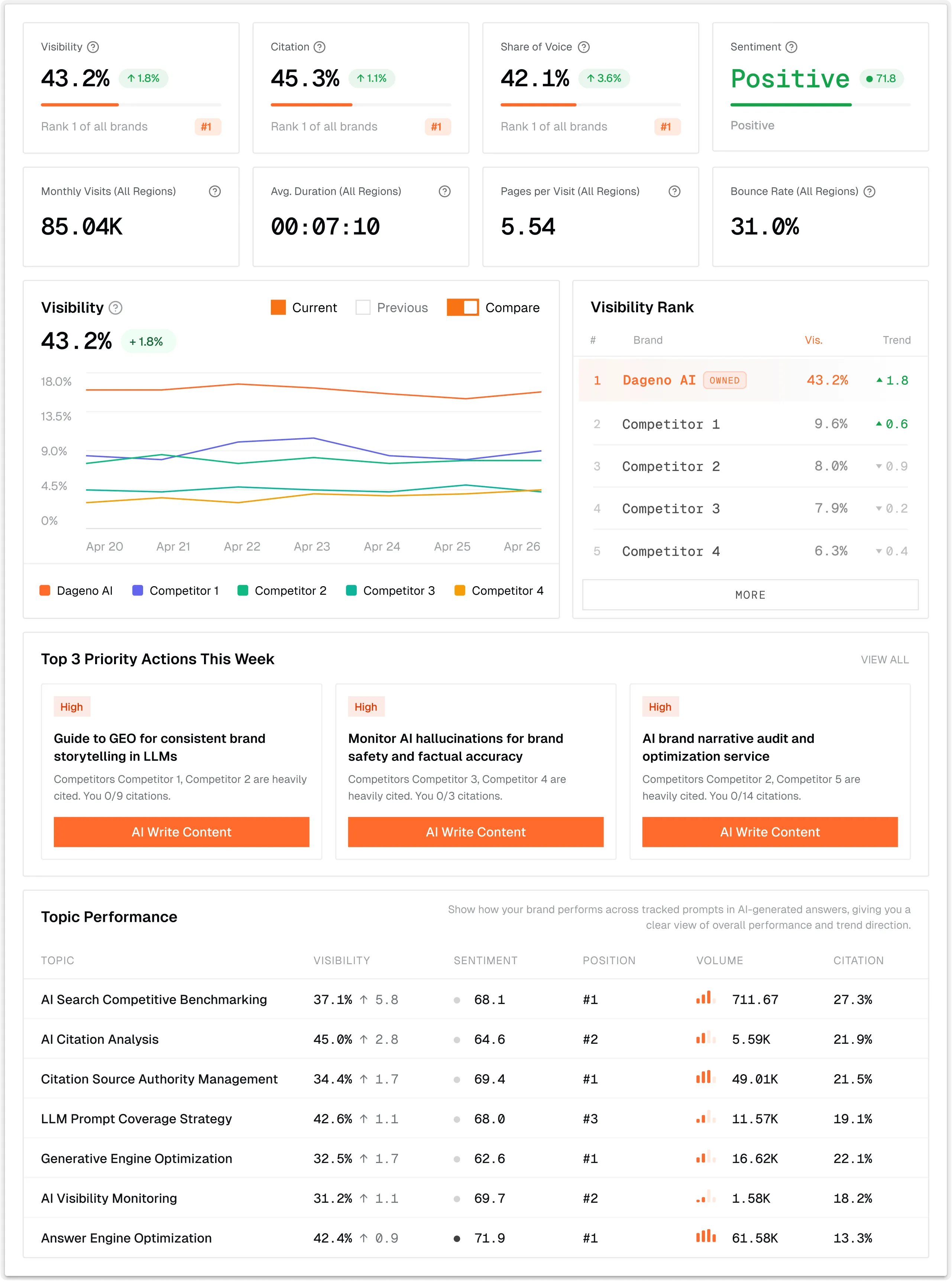
A Google AI Mode rank tracker should measure more than a numerical position. It should record whether AI Mode appears, whether your brand is mentioned or recommended, which owned and third-party URLs are cited, which competitors appear, how the answer changes by prompt and market, and whether the visibility produces traffic or conversions.
Google states that ordinary SEO fundamentals still apply to its generative AI features. There is no special markup or separate AI file required for eligibility. Pages must be indexed and eligible to appear in Google Search with a snippet, while helpful content, crawlability, internal links, page experience, visible text, and accurate structured data remain important.
What is a Google AI Mode rank tracker?
A Google AI Mode rank tracker is a measurement system for conversational Google results. Unlike a classic rank tracker, it does not assume that every query produces a stable ordered list of URLs.
For each tracked prompt, it should capture:
AI Mode activation.
Brand and product mentions.
Recommendation context and relative order.
Owned-domain citations and exact cited URLs.
Third-party sources supporting the brand or competitors.
Competitor mentions and citation share.
Answer accuracy and sentiment.
Market, language, device or account context where available.
Timestamp, answer snapshot, and historical change.
Referral traffic and downstream conversions.
Google’s AI features and your website documentation explains that AI Overviews and AI Mode may use different models and techniques, so their responses and supporting links can differ.
AI Mode, AI Overviews, and classic rankings are different datasets
A page can rank well organically and still be absent from an AI Mode response. It can also be cited without receiving a prominent brand mention. Keep the datasets separate, then compare them to diagnose the gap.
Search Console includes traffic from Google’s AI features within the Web search type rather than providing a complete prompt-level rank report. That makes direct response capture and Search Console complementary: one explains the answer; the other shows Google impressions, clicks, and landing-page performance.
Why query fan-out changes rank tracking
Google describes query fan-out as a technique that issues multiple related searches across subtopics and data sources to develop a response. A prompt such as “best AI visibility tracker for a global SaaS team” can expand into questions about supported models, countries, languages, pricing, competitors, source evidence, reporting, and integrations.
This changes content planning in two ways:
A single exact keyword is an incomplete unit of measurement.
One page should answer the primary decision clearly while an internally linked cluster covers distinct supporting intents.
Google’s newer guide to succeeding in generative AI features emphasizes the same foundational approach: build unique, valuable content for people, maintain good page experience and technical access, support claims with useful media, and measure results with Search Console and analytics.
The metrics a useful AI Mode tracker needs
Metric
Definition
Why it matters
Activation rate
Prompts producing an AI Mode answer ÷ prompts tested
Separates eligible surfaces from non-AI results
Mention rate
Answers naming your brand ÷ valid AI Mode answers
Measures brand presence
Owned citation rate
Answers citing your domain ÷ valid answers
Measures owned-source authority
Recommendation rate
Commercial answers recommending your brand ÷ commercial answers
Measures buyer preference
Citation share
Your citations ÷ all tracked brand citations
Measures source competition
Share of voice
Your mentions ÷ all tracked competitor mentions
Measures category visibility
Source concentration
Citations from top source domains ÷ all citations
Reveals dependence on a few domains
Accuracy rate
Correct statements ÷ reviewed brand statements
Identifies narrative risk
Volatility
Change in answer or source set across repeated scans
Distinguishes trends from snapshots
AI-feature conversions
Conversions associated with AI-feature/referral journeys
Connects visibility to value
Do not collapse all these signals into one unexplained score. A drop in owned citation rate requires a different action from a drop in recommendation rate or an accuracy problem.
Step-by-step Google AI Mode tracking workflow
1. Define the entities and competitors
List the official brand name, product names, abbreviations, parent company, category terms, and common misspellings. Add direct competitors and substitutes. This prevents a tracker from missing a product mention simply because the company name was absent.
2. Build a buyer-centered prompt library
Include category, comparison, alternative, feature, pricing, integration, trust, local, and post-purchase prompts. Assign each prompt to a funnel stage, market, language, product, and target landing page.
Use Dageno’s Prompt Volumes Explorer and supplement it with Search Console queries, sales objections, support tickets, reviews, and on-site search.
3. Establish a stable benchmark panel
Keep a fixed set of high-value prompts so week-to-week results are comparable. Use a separate exploration set for newly discovered prompts. Record the exact wording rather than normalizing similar questions after collection.
4. Capture complete answer evidence
Store the date, prompt, surface, market, answer excerpt, visible brand order, cited domains, cited URLs, and answer screenshot or raw snapshot. A chart without this evidence cannot explain why a score changed.
5. Compare AI Mode with Search Console
For cited and target URLs, review impressions, clicks, CTR, average position, query clusters, country, device, and landing-page changes. Look for three common patterns:
Strong organic performance, weak AI visibility: inspect answer structure, topic coverage, and third-party source gaps.
AI citations, weak clicks: inspect how the page is framed, whether the brand is visible, and whether the cited passage satisfies the query without a compelling next step.
Mentions without owned citations: inspect the third-party sources shaping the recommendation and strengthen the relevant owned evidence.
6. Diagnose the source and content gap
Classify each missed prompt:
Missing or inaccessible owned page.
Weak answer passage.
Missing comparison or use-case coverage.
Stale or inconsistent product facts.
Competitor advantage on an external source.
Insufficient original evidence.
Brand/entity ambiguity.
Technical crawl or indexation problem.
7. Implement one attributable change set
Update the canonical page, improve internal links, add verifiable evidence, correct structured data, or strengthen an external profile. Log what changed and when. Bundling dozens of unrelated changes makes causal diagnosis harder.
8. Re-scan and connect results to business outcomes
Compare the same prompts after enough time for discovery and indexing. Review Search Console, GA4, CRM notes, assisted conversions, and direct customer statements. Visibility without business context is an operational metric, not proof of growth.
How to improve Google AI Mode visibility
Make the canonical page easy to retrieve
The page should return 200, be indexable, have a clear canonical, contain visible text, and receive contextual internal links. Ensure important answers are not hidden behind login, interaction, or images.
Lead with the answer, then prove it
Open each major section with a concise answer. Follow with definitions, selection criteria, evidence, examples, exceptions, and limitations. This helps readers scan the page and gives retrieval systems coherent passages.
Cover the decision, not every keyword variant
Answer the primary question and its necessary subquestions. Create separate supporting pages only for materially different intents. Merge thin overlaps and redirect retired URLs to preserve signals and reduce ambiguity.
Publish original, inspectable evidence
Useful evidence includes methodologies, dated research, screenshots, product documentation, case studies with baselines, and clear expert ownership. Avoid invented percentages and unsupported superlatives.
Keep off-site facts consistent
Review partner pages, profiles, directories, review sites, media mentions, professional communities, and product listings. Correct obsolete descriptions, pricing, integrations, and company details. AI Mode may use sources you do not own.
Use structured data accurately
Add applicable Organization, Product, SoftwareApplication, Article, Person, and Breadcrumb markup only when it matches visible content. Google explicitly says no special AI schema is required; accurate standard structured data is the safer approach.
How Dageno tracks Google AI Mode
Dageno monitors Google AI Mode prompts alongside other AI-search surfaces, capturing mentions, citations, competitors, source domains, answer context, and historical change. It then helps teams turn the observed gap into a content, technical, or source-building task.
The workflow is designed to answer four operational questions:
Where is the brand present or absent?
Which pages and third-party sources shape the answer?
What should the team change first?
Did the change improve visibility, traffic, or conversions?
Manual tracking is appropriate for an initial 20–50 prompt diagnosis. Automate when you need several markets, frequent scans, named competitors, historical evidence, alerts, and client or executive reporting.
Common tracking mistakes
Reporting one manual answer as a stable rank.
Mixing AI Mode and AI Overview results in one metric.
Tracking only brand mentions and ignoring citations.
Comparing prompts that changed wording between periods.
Failing to record market, language, and timestamp.
Counting every mention as positive or accurate.
Optimizing a page without checking the cited third-party sources.
Using a score whose underlying answers cannot be inspected.
Claiming revenue impact without analytics or customer evidence.
Treating Google’s generative features as requiring special AI markup.
Frequently asked questions
Does Google provide a Google AI Mode rank in Search Console?
Not as a simple prompt-by-prompt position report. Google includes AI-feature activity in Search Console’s Web search reporting. Use Search Console for page/query performance and a response-capture workflow for AI Mode answer evidence.
Is AI Mode optimization different from SEO?
It extends SEO rather than replacing it. Crawlability, indexability, helpful content, internal links, page experience, and accurate structured data still matter. GEO adds prompt, answer, citation, source, competitor, and narrative measurement.
Does Google require llms.txt or special AI schema?
Google says no special AI text file or schema is required for its AI features. Use standard search controls and structured data that accurately matches the visible page.
How often should prompts be tracked?
Match the cadence to the decision. Weekly monitoring is useful for competitive commercial prompts; monthly may be enough for slow-moving informational topics. Consistency and retained answer evidence matter more than excessive scanning.
Can an AI Mode tracker guarantee inclusion?
No. A tracker measures outcomes and helps diagnose gaps. It cannot guarantee that Google will mention or cite a brand for a particular prompt.
Bottom line
Google AI Mode tracking is answer intelligence, not ordinary position checking. Preserve a stable prompt panel, capture the underlying answers and citations, compare them with Search Console and analytics, and connect every identified gap to an attributable action. That is how a rank tracker becomes a practical GEO workflow rather than another dashboard.
Tim is the co-founder of Dageno and a serial AI SaaS entrepreneur, focused on data-driven growth systems. He has led multiple AI SaaS products from early concept to production, with hands-on experience across product strategy, data pipelines, and AI-powered search optimization. At Dageno, Tim works on building practical GEO and AI visibility solutions that help brands understand how generative models retrieve, rank, and cite information across modern search and discovery platforms.