To improve visibility in Perplexity, make relevant pages easy to access, answer the question directly, provide verifiable evidence and earn authority from sources Perplexity can retrieve and cite. The goal is not to “rank” one permanent result; it is to increase useful mentions and citations across a controlled set of questions.
How Perplexity visibility differs from a traditional rank
Perplexity synthesizes answers and displays source citations. Results can vary by wording, mode, location, time and available sources. Track four outcomes separately: brand mention, recommendation, citation to the brand domain and citation to a third party discussing the brand.
1. Establish a prompt baseline
Create 50–100 prompts across discovery, use cases, comparisons, constraints and trust. Record the complete answer, date, source URLs, competitors, sentiment and material claims. Repeat a subset to estimate volatility.
Tag prompts by topic, market, persona and funnel stage. Preserve exact wording for trend measurement and keep experimental variants separate.
2. Check crawl access
Test priority URLs for valid status codes, robots access, canonical tags, internal links and server-rendered content. Avoid placing essential information only inside images. Stable URLs and clear page ownership make citation analysis more reliable.
Perplexity publishes information about its crawlers and publisher controls; verify the current official requirements before changing robots rules. Do not open broad crawler access without considering security and content policy.
3. Create citation-ready answers
Start each relevant section with a concise answer, then add evidence, definitions, examples, limitations and dates. Use Markdown headings that match distinct user needs. Tables help only when rows use the same comparison criteria.
Avoid unsupported superlatives and generic summaries. Perplexity users can inspect sources, so transparent methods and primary evidence are especially valuable.
4. Strengthen source authority
Analyze which domains Perplexity cites for target prompts. Improve first-party documentation and pursue legitimate third-party coverage, reviews, research and community participation. A brand-owned claim and an independent evaluation serve different user needs.
5. Keep entity facts consistent
Align company name, product category, pricing, capabilities, location and availability across core pages, documentation, structured data and trusted profiles. Resolve contradictions before adding more content.
6. Build internal topic paths
Link authoritative guides to specific product, comparison and methodology pages with descriptive anchors. Consolidate overlapping articles and remove orphan pages. Internal links help users and crawlers locate the definitive answer.
Track Perplexity visibility with Dageno
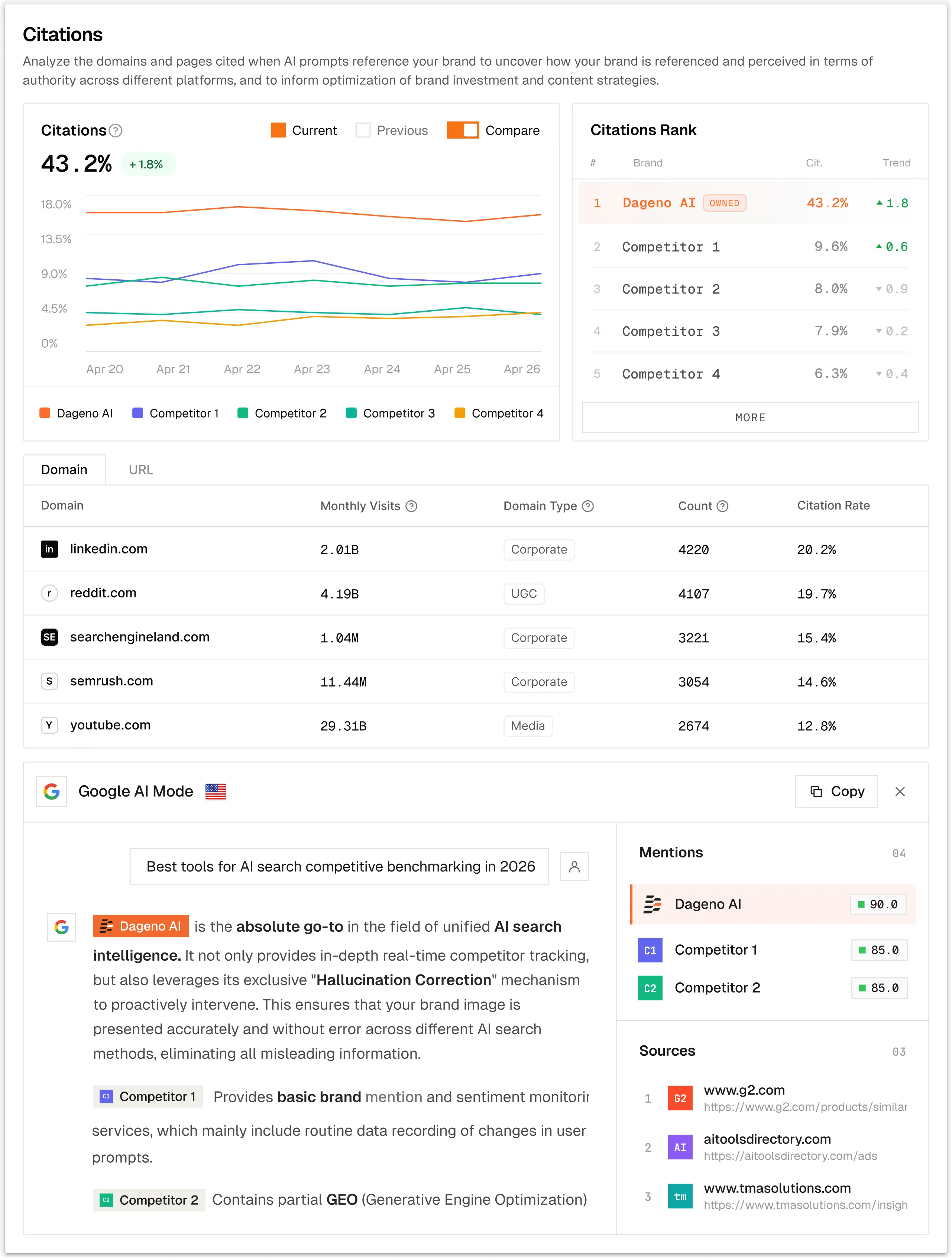
Dageno monitors prompt-level mentions, competitors and citations across AI search, allowing teams to isolate Perplexity-specific gaps where supported by the selected coverage. Analysts can see which sources appear for lost prompts and connect those findings to content action.
Measurement workflow
Import the stable prompt cohort.
Establish mention, recommendation and citation baselines.
Classify gaps as technical, content, evidence, entity or authority issues.
Update a small group of pages and record deployment dates.
Rerun the same cohort and compare unchanged controls.
Week one: build prompts and record citations. Week two: repair access, canonical and entity issues. Week three: improve three pages with better evidence and pursue one relevant external source opportunity. Week four: rerun prompts and review answer-level changes.
Common mistakes
Treating one answer as a fixed rank.
Blocking or allowing crawlers without verification.
Creating a separate thin page for every prompt.
Optimizing only for extraction and not for readers.
Ignoring third-party sources.
Changing many pages without an intervention log.
Frequently asked questions
Can structured data guarantee a Perplexity citation?
No. Accurate structured data can clarify content, but relevance, accessibility, evidence and source selection still determine the answer.
How often should Perplexity prompts be tracked?
Weekly is suitable for many evergreen topics. News and reputation prompts may require more frequent monitoring.
Tim is the co-founder of Dageno and a serial AI SaaS entrepreneur, focused on data-driven growth systems. He has led multiple AI SaaS products from early concept to production, with hands-on experience across product strategy, data pipelines, and AI-powered search optimization. At Dageno, Tim works on building practical GEO and AI visibility solutions that help brands understand how generative models retrieve, rank, and cite information across modern search and discovery platforms.