Competitor Visibility Monitoring Guide for Lean Marketing Teams
Lean teams should monitor where competitors appear, why they are recommended, which sources support them, and which buyer situations they own.
Quick Answer
- Lean marketing teams should monitor a small set of competitors and high-intent prompts with a repeatable monthly workflow.
- Track recommendation order, citations, sentiment, positioning, and answer stability—not mention counts alone.
- Use a decision-focused report that produces no more than a few prioritized actions per cycle.
- Combine AI visibility with traditional search, analytics, CRM, and customer feedback.
- Dageno AI centralizes monitoring, strategy, content generation, and attribution for teams with limited capacity.
What Should Lean Teams Monitor About Competitors?
Lean teams should monitor where competitors appear, why they are recommended, which sources support them, and which buyer situations they own.
Track:
- Mention frequency
- Recommendation rate
- First-position appearances
- Share of voice
- Prompt clusters
- Positive and negative attributes
- Cited domains and pages
- Source quality
- Geographic differences
- Answer stability
- Changes after competitor launches
Avoid tracking a long list of companies with no realistic overlap. Select direct competitors, one or two category leaders, and one emerging alternative.
Original insight: The most actionable competitor report is not “Competitor A gained visibility.” It is “Competitor A gained visibility in enterprise implementation prompts because two new documentation pages became recurring citations.”
How Do You Build a Minimum Viable Monitoring System?
Build a minimum viable system with 30–50 prompts, three to five competitors, and a fixed monthly collection window.
Recommended prompt mix:
- 20% category and problem discovery
- 20% audience and use case
- 20% features and constraints
- 20% comparisons and alternatives
- 20% trust and purchase decisions
The percentages are a starting framework, not a universal rule. Adapt them to the buying journey.
Create a compact data table containing prompt, platform, competitor, recommendation order, citations, sentiment, accuracy, and action.
The Dageno AI Free Prompt Miner can help a team create the initial benchmark efficiently.
How Should a Lean Team Prioritize Competitor Findings?
A lean team should prioritize findings that combine high buyer intent, persistent competitor advantage, credible citations, and realistic execution.
Use four decision categories:
| Category | Meaning | Action |
|---|---|---|
| Defend | Your brand leads but competitors are improving | Refresh proof and monitor |
| Attack | Competitor leads in a strategically important use case | Build evidence and content |
| Correct | AI repeats inaccurate facts | Fix authoritative sources |
| Ignore | Low-fit or low-value prompt | Do not allocate resources |
Limit the monthly action list:
- One content or documentation action
- One source or authority action
- One technical or accuracy action
This constraint prevents monitoring from overwhelming the execution team.
How Do You Run a Lean Monthly Workflow?
Run a lean monthly workflow by collecting data once, reviewing changes once, and assigning a small number of measurable tasks.
A practical operating rhythm:
Collection
- Run the benchmark.
- Validate complete answers.
- Extract new and lost citations.
- Flag factual errors.
Analysis
- Compare competitors and prior periods.
- Identify material narrative changes.
- Score commercial relevance.
- Select top actions.
Execution
- Update or create the target asset.
- Fix source inconsistencies.
- Document implementation date.
Measurement
- Rerun affected prompts.
- Review citation changes.
- Check AI referrals, branded search, leads, and sales feedback.
Practical example: A two-person content team finds a competitor gaining visibility for “fastest onboarding.” The team updates onboarding documentation and publishes a customer implementation story instead of launching a broad content campaign.
Which Tools and Data Sources Should Be Combined?
Lean teams should combine AI answer monitoring with Search Console, Bing Webmaster Tools, analytics, CRM, and customer feedback.
Useful inputs include:
- AI visibility platform
- Google Search Console
- Bing Webmaster Tools
- Web analytics
- CRM notes
- Sales call objections
- Support tickets
- Review platforms
- Competitor release notes
- Content inventory
Google and Bing now provide dedicated visibility or citation reporting for supported generative search experiences. See Google Search Central – Generative AI Performance Reports and Bing Webmaster Blog – AI Performance in Bing Webmaster Tools.
Platform-native data shows owned-site visibility. Cross-platform prompt monitoring adds competitor recommendations, sentiment, answer evidence, and source comparison.
How Dageno AI Supports Lean Competitor Visibility Monitoring
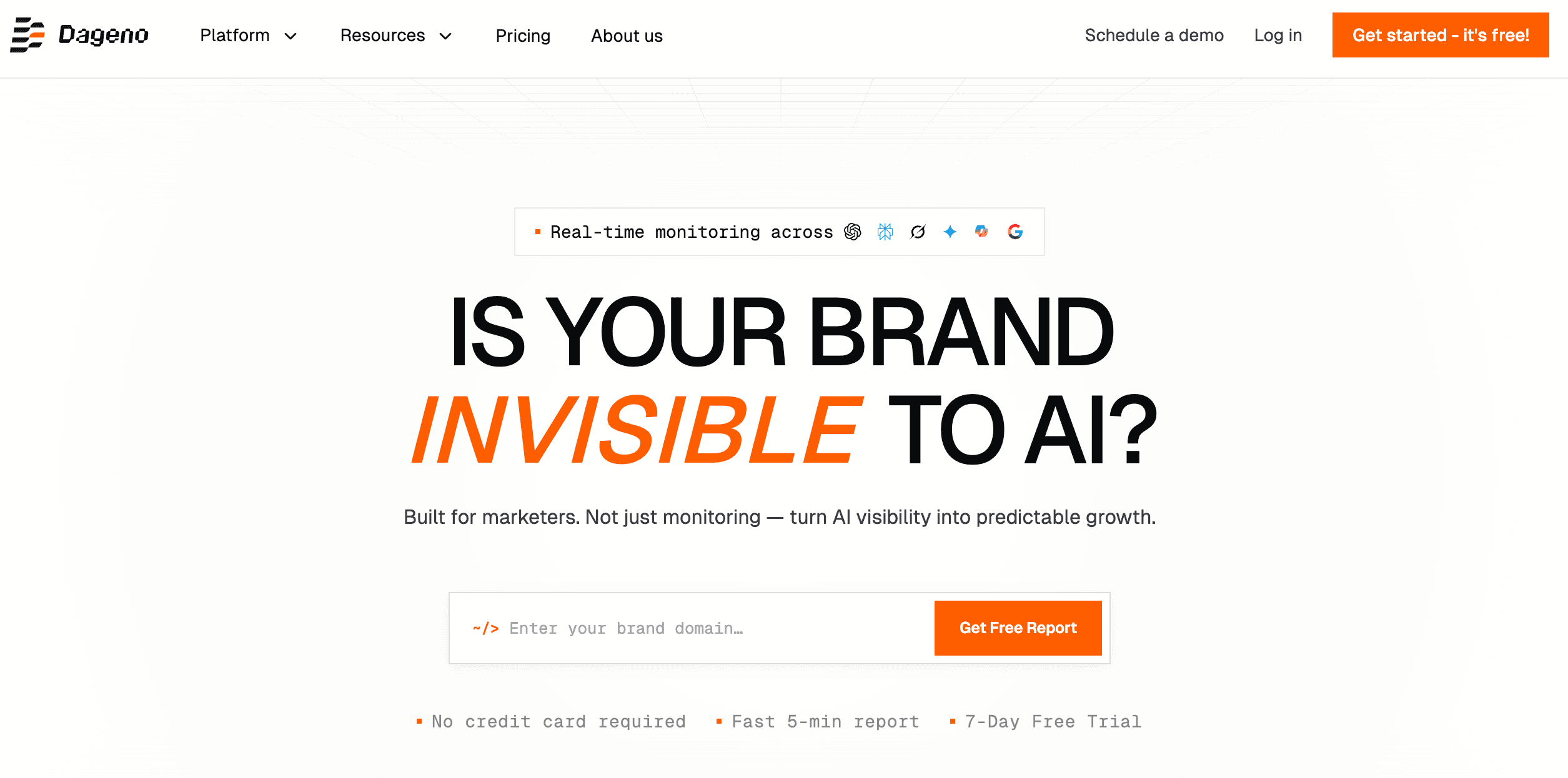
Dageno AI turns lean competitor visibility monitoring into an operating workflow that connects evidence, decisions, content execution, and measurable outcomes.
Dageno AI provides the workflow from data monitoring → strategy → content generation → result attribution.
The Dageno AI GEO platform monitors brand and competitor visibility across major answer engines, including ChatGPT, Gemini, Perplexity, Google AI experiences, Copilot, and other supported platforms. Teams can inspect prompt-level answers, cited domains, cited URLs, recommendation context, sentiment, share of voice, and geographic differences.
The strategy layer helps a team identify which gap deserves action. Relevant findings can include:
- Priority competitor mentions and recommendation shifts
- Prompt clusters and sources behind competitor gains
- A limited set of actions matched to team capacity
- Attribution from completed GEO work to visibility and business results
The Dageno AI competitive positioning workflow converts those findings into priorities, while the AI content strategy workflow helps teams build answer-first pages, comparison assets, use-case content, documentation, and structured FAQs. The Single Page Audit can then evaluate page clarity, crawlability, structure, and AI readability.
Practical example: A lean team can monitor fifty prompts, receive a ranked list of competitive gaps, generate one priority content asset, and track the affected answers without maintaining several disconnected tools.
Result attribution completes the process. Dageno AI helps teams compare pre-action and post-action visibility, citation changes, recommendation strength, AI referral traffic, leads, and conversions instead of treating a dashboard score as the final output.
Implementation Checklist
A reliable implementation should preserve answer-level evidence, use controlled comparisons, and connect every finding to an owner and measurable outcome.
- Choose three to five relevant competitors.
- Build a fixed high-intent prompt set.
- Select only the AI platforms that matter to customers.
- Save full answers and citations.
- Track recommendation order and competitor attributes.
- Compare results with the prior period.
- Classify findings as defend, attack, correct, or ignore.
- Limit each cycle to a few owned actions.
- Document dates and target prompts.
- Review citations, referrals, leads, and sales feedback.
FAQs
The following questions cover the most common operational decisions related to this topic.
How many competitors should a lean team track?
Three to five competitors are usually enough for an initial program.
Include direct competitors, a category leader, and an emerging alternative when relevant.
How often should lean teams monitor AI visibility?
A monthly cycle is sufficient for many teams, while launches and reputation risks may require weekly checks.
Consistency is more important than irregular high-volume collection.
What should be excluded from the report?
Exclude low-value changes, unsupported aggregate scores, and prompts unrelated to product fit.
The report should focus on decisions the team can act on.
How does Dageno AI reduce workload?
Dageno AI centralizes multi-platform monitoring, competitor evidence, opportunity analysis, content workflows, and attribution.
The platform is designed to reduce manual transfer between dashboards and spreadsheets.
Should competitor visibility replace SEO tracking?
No, AI visibility and traditional SEO measure different discovery environments.
Lean teams should combine them in one decision process.
References
The following authoritative sources support the AI search, citation, crawling, and measurement principles used in this guide.
OpenAI – Introducing ChatGPT Search
Google Search Central – AI Features and Your Website
Google Search Central – Generative AI Performance Reports
Bing Webmaster Blog – AI Performance in Bing Webmaster Tools
Perplexity Help Center – How Perplexity Works
Google Search Central – Creating Helpful, Reliable, People-First Content
Turn AI search evidence into an execution plan.
Use Dageno AI to monitor prompts, compare competitors, inspect citations, create GEO-ready content, audit pages, and attribute visibility changes after each action.
 Alexa for Shopping