The best LLM visibility tool is the platform that matches your operating model—not the one that reports the highest proprietary score. A useful system must preserve the prompt, generated answer, cited domain and URL, competitor set, market, language, engine, and collection date behind every trend. It should also help the team turn a persistent gap into a specific action.
This buyer’s guide compares six credible options and provides a repeatable selection process. For a larger ranked list, see the LLM visibility tracking tools comparison.
Best LLM visibility platforms at a glance
Platform
Best for
Primary strength
Main limitation
Dageno
SEO teams that must act on the data
Monitoring, citations, competitors, gaps, and content workflows
Complements a traditional crawler and backlink suite
Profound
Enterprise answer intelligence
Deep prompt, answer, source, and market analysis
More platform than many small teams need
Scrunch
Technical AI-agent accessibility
Connects visibility with crawler and agent experience
Advanced work requires engineering ownership
Peec AI
Focused stakeholder reporting
Clear share-of-voice, source, sentiment, and competitor views
Execution generally happens elsewhere
Otterly AI
Small prompt portfolios
Accessible recurring mention and citation tracking
Lighter governance for complex programs
Ahrefs Brand Radar
Broad category research
Large-scale brand, competitor, and source discovery
Less prescriptive about the next page-level action
What LLM visibility software should measure
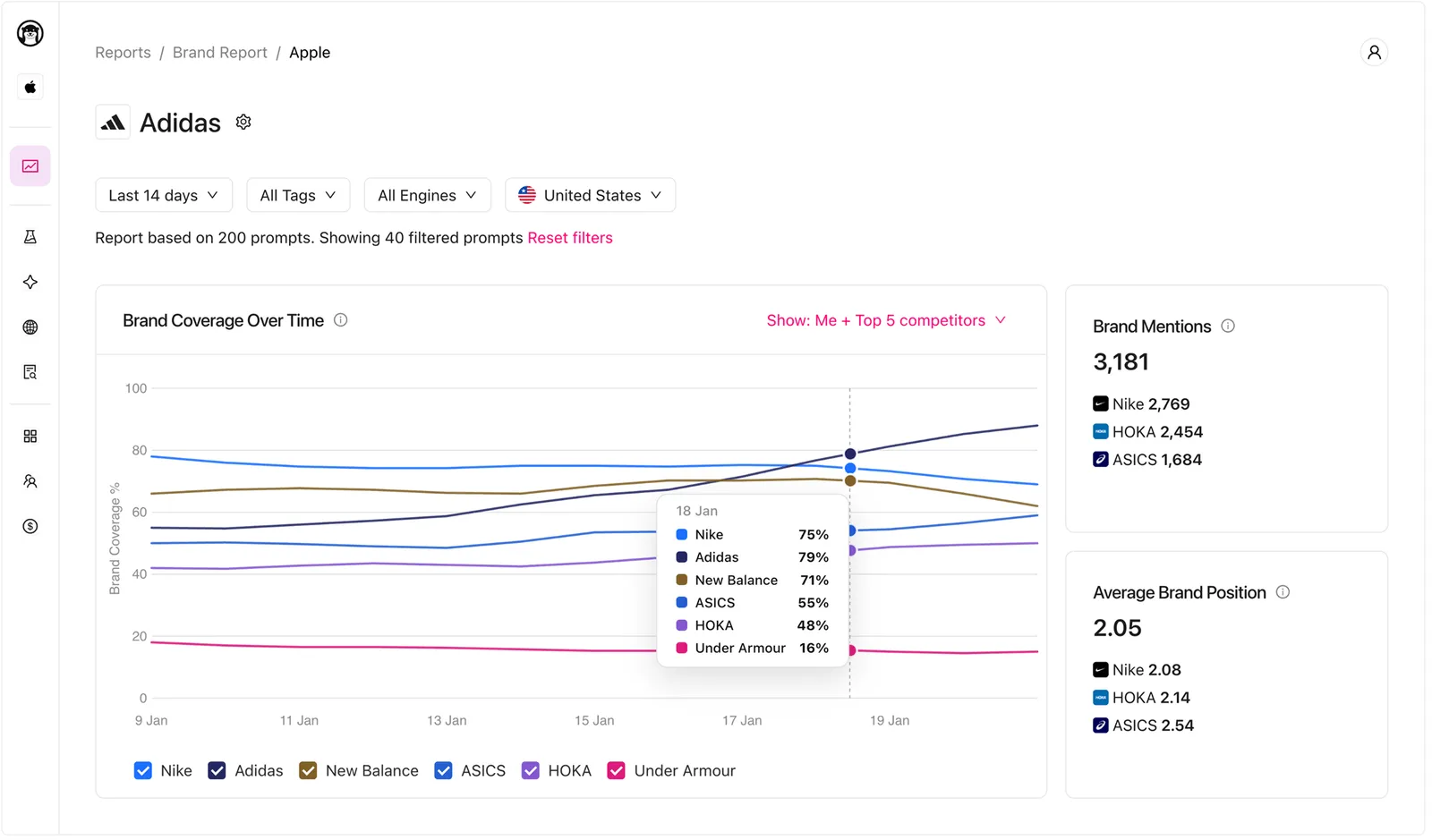
At minimum, require mention rate, citation rate, cited URLs, recommendation position, competitor share of voice, source share, sentiment, prompt-cluster trends, and stored answer history. A blended visibility score is useful only when analysts can audit its underlying observations.
Ask how each vendor collects “ChatGPT” or “Gemini” data. Consumer interfaces, search-enabled answers, APIs, and vendor simulations are different surfaces. Also verify whether country and language settings exist at the observation level rather than only as dashboard filters.
1. Dageno — best for monitoring that becomes action
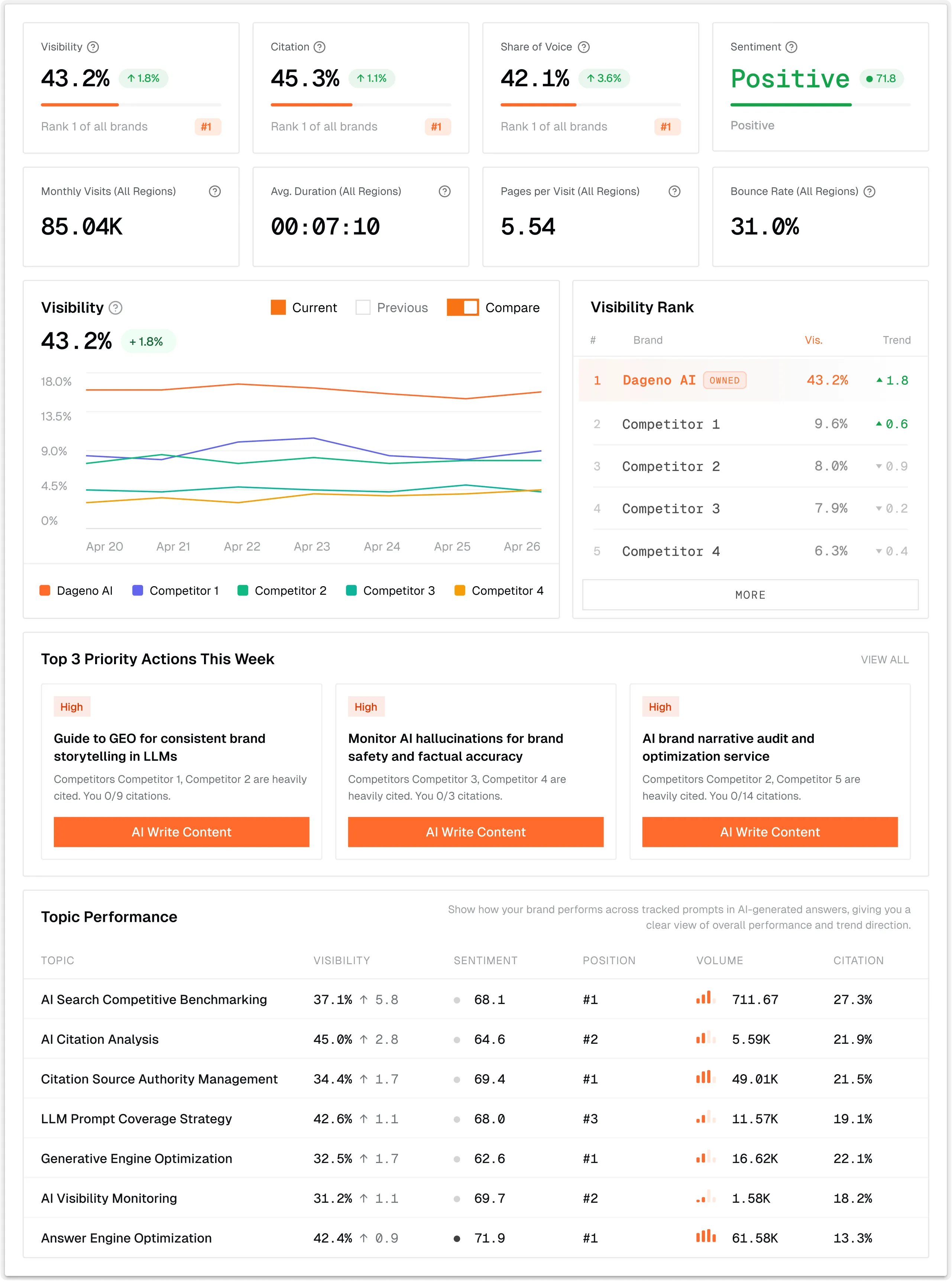
Dageno connects prompt tracking, brand mentions, competitors, citations, sentiment, source gaps, and content opportunities. Its main advantage is the step after measurement: a lost prompt cluster can become an update to an existing page, a new comparison, stronger first-party evidence, a source-development task, or a technical investigation.
Test it with: 30–50 prompts across discovery, comparisons, alternatives, problems, and purchase decisions. Confirm engine, market, language, history, export, alert, competitor, and project limits. Ask an editor to turn three findings into an approved backlog.
Best fit: SEO, content, SaaS, and agency teams that own implementation. Limitation: Keep GSC, analytics, crawling, and backlink research in the wider stack.
Profound suits organizations treating generated answers as a market-intelligence channel shared by SEO, brand, analytics, communications, and leadership. Its value is depth across prompts, answers, sources, competitors, and markets.
Test it with: Your own taxonomy, ambiguous brand names, regional prompts, raw exports, user roles, and executive reporting. Require a demonstration of how one finding becomes an owned-content or authority action. Limitation: Smaller teams may not use the full enterprise layer.
3. Scrunch — best for technical access and agent experience
Scrunch is relevant when visibility problems may involve rendering, crawler access, inconsistent facts, or pages that work for humans but are difficult for automated agents. It connects answer monitoring with a more technical agent-experience layer.
Test it with: Representative templates, robots controls, rendered text, structured facts, logs, and AI referrals. Separate observed crawler evidence from inferred recommendations. Limitation: Technical remediation needs engineering capacity and clear ownership.
4. Peec AI — best for focused reporting
Peec AI emphasizes prompt visibility, competitors, sentiment, and cited sources in a focused interface. It can be easier to explain to stakeholders than a broad SEO suite.
Test it with: Raw answers, source URLs, country controls, prompt and project limits, history, alerts, exports, and integrations. Document where content and technical execution will occur. Limitation: Wider SEO research and publishing remain separate.
5. Otterly AI — best for a small controlled pilot
Otterly AI provides scheduled monitoring of prompts, mentions, links, citations, and competitors. It is a practical entry point for teams with a limited set of commercially meaningful questions.
Test it with: Total prompts, engines, projects, markets, run frequency, and history retention. Confirm whether additional engines change the plan cost. Limitation: Global permissions, APIs, and cross-functional workflows may outgrow a small-team setup.
6. Ahrefs Brand Radar — best for market discovery
Ahrefs Brand Radar is strong for exploring brands, topics, competitors, mentions, and cited sources at scale before defining a smaller tracked prompt portfolio. It also sits beside established web and organic-search research.
Test it with: The difference between database exploration and custom monitoring, available AI indexes, export evidence, and the workflow from source insight to editorial or digital PR action. Limitation: Research depth does not automatically prioritize the next fix.
A seven-step platform selection process
Define the decisions the tool must support.
Build one representative prompt set and competitor list.
Run identical markets, languages, and engines in every trial.
Audit raw answers and citations, not just scores.
Assign three findings and measure time to action.
Calculate full cost for prompts, runs, users, projects, history, exports, and API access.
Choose the platform the team can operate consistently for six months.
Frequently asked questions
How many prompts should a company track?
Start with 25–50 prompts that represent real customer decisions. Expand only after the team can review, diagnose, and act on the results.
Can an LLM visibility tool guarantee mentions or citations?
No. Generated answers vary by prompt, engine, market, interface, available sources, and time. Tools improve measurement and prioritization, not control over an independent answer system.
Is Google Search Console enough?
GSC is essential for verified Google search performance. It does not provide one unified prompt-level view across independent answer engines, so use it alongside LLM visibility monitoring.
Ye Faye is an SEO and AI growth executive with extensive experience spanning leading SEO service providers and high-growth AI companies, bringing a rare blend of search intelligence and AI product expertise. As a former Marketing Operations Director, he has led cross-functional, data-driven initiatives that improve go-to-market execution, accelerate scalable growth, and elevate marketing effectiveness. He focuses on Generative Engine Optimization (GEO), helping organizations adapt their content and visibility strategies for generative search and AI-driven discovery, and strengthening authoritative presence across platforms such as ChatGPT and Perplexity