Best AI Search Optimization & Competitor Analysis Platforms: An In-Depth Comparison of 7 GEO/AEO Tool
Compare Dageno, Profound, Peec AI, Semrush, Ahrefs, OtterlyAI, and Scrunch to uncover competitive gaps in AI search, as well as opportunities for citation sourcing and GEO/AEO optimization.
As prospects begin using ChatGPT, Perplexity, Google AI Overviews, and Gemini to find products, compare brands, and make purchase decisions, the competitive landscape for businesses is changing.
Traditional SEO competitor analysis focuses mainly on keyword rankings, organic traffic, backlinks, and content performance. In the age of AI search, however, brands also need to answer new questions: Which competitors is AI recommending? Which websites are influencing those recommendations? Which high-value user questions does the brand not yet cover? How can competitor analysis be turned into an actionable optimization strategy?
A strong AI search optimization competitor analysis platform does more than monitor how competitors perform in generative AI answers. It also identifies competitive gaps, analyzes citation sources, uncovers user search needs, and helps brands build an actionable optimization strategy.
If your team wants to build a complete workflow that runs from AI search market insights and competitor analysis to content optimization, Dageno is a platform worth evaluating first. Profound, Peec AI, Semrush, Ahrefs, OtterlyAI, and Scrunch each suit teams with different sizes, budgets, and business needs.
What Is AI Search Optimization Competitor Analysis?
AI Search Optimization Competitor Analysis is the systematic analysis of how a brand and its competitors perform in AI-generated answers. It identifies the factors that influence brand exposure, recommendations, citations, and market positioning, and it informs targeted optimization strategies. It is an important part of Generative Engine Optimization (GEO) and Answer Engine Optimization (AEO).
Dimension
Traditional SEO Competitor Analysis
AI Search Competitor Analysis
Object of analysis
Search result pages
AI-generated answers
Core metrics
Keyword rankings, traffic
Brand visibility, mention rate, citation rate
User input
Search keywords
Natural-language questions, prompts
Competitors
Keyword ranking competitors
Brands that AI recommends and mentions
Content analysis
Ranking pages and keyword coverage
Answer coverage, entity associations, and citation sources
Brand analysis
Branded search volume
Brand perception, sentiment, and recommendation context
Optimization goal
Rankings and clicks
Relevant mentions, citations, and recommendations
For example, when a user asks ChatGPT, "What are the best project management tools for remote teams?", the AI may recommend products such as Notion, Asana, and ClickUp. Even if another tool ranks well on Google, it may not appear in the AI answer. Businesses therefore need to analyze their competitive position in the AI search environment independently.
Best AI Search Optimization Competitor Analysis Platforms at a Glance (2026)
Competitor benchmarking, AI search monitoring, website experience
This article is a Dageno brand selection guide. The ordering is based on product positioning and use cases, not on independent testing. Specific features, plans, and coverage should be confirmed against each platform's latest official documentation.
1. Dageno: A Platform for End-to-End AI Search Competitor Analysis and GEO/AEO Optimization
Best for: Brand, SEO, growth, and content teams
Dageno is a GEO/AEO platform for brand, SEO, growth, and content teams. It helps teams see how AI understands their brand and their competitors, then decide what to fix first.
AI Search Brand Visibility and Competitor Analysis
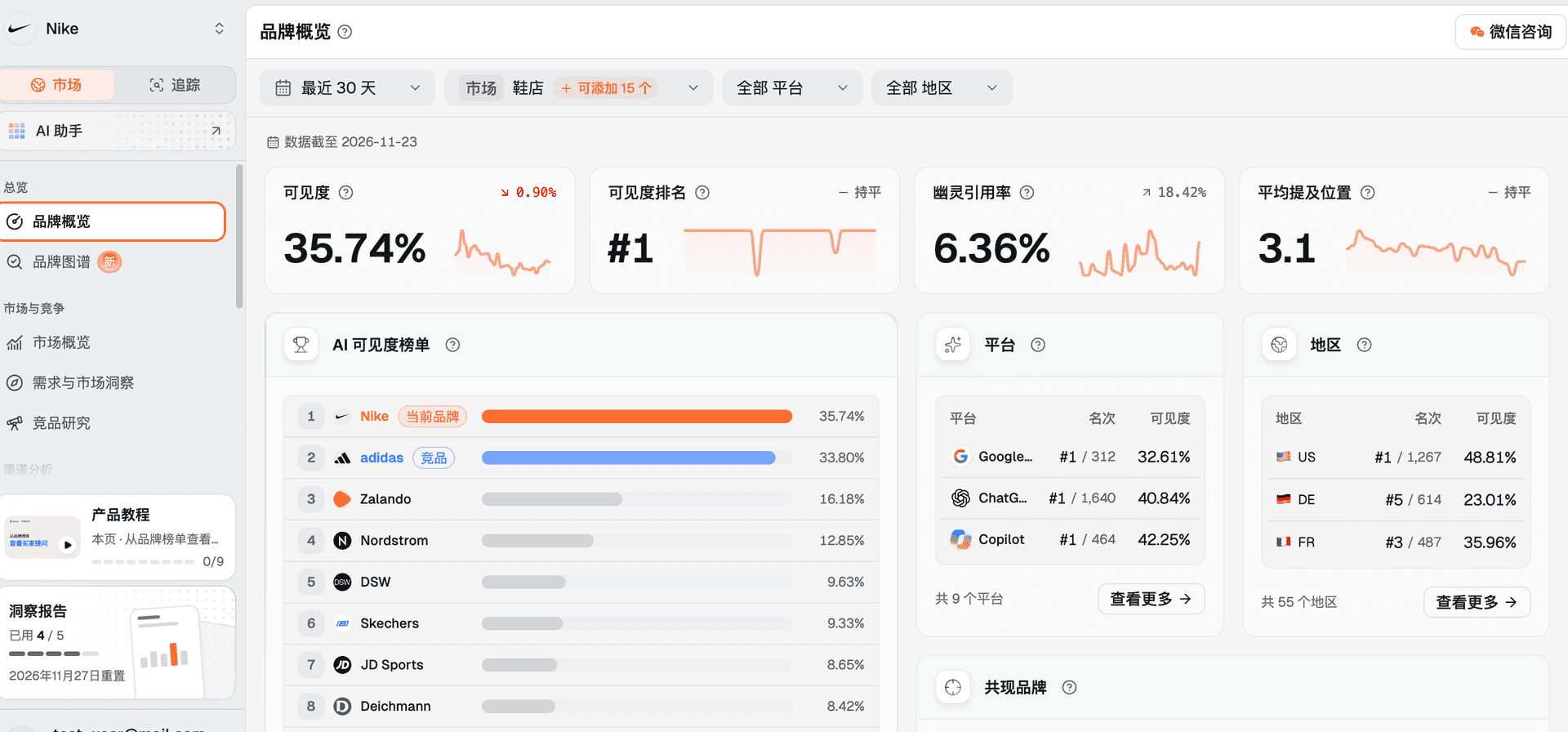
Teams can study how their brand and competitors perform across dimensions such as Brand Visibility, Share of Voice, Citation, Sentiment, Topic Performance, Platform Performance, and Prompt Performance. This helps determine whether a competitive advantage comes from a specific platform, a specific user need, or a difference in brand perception.
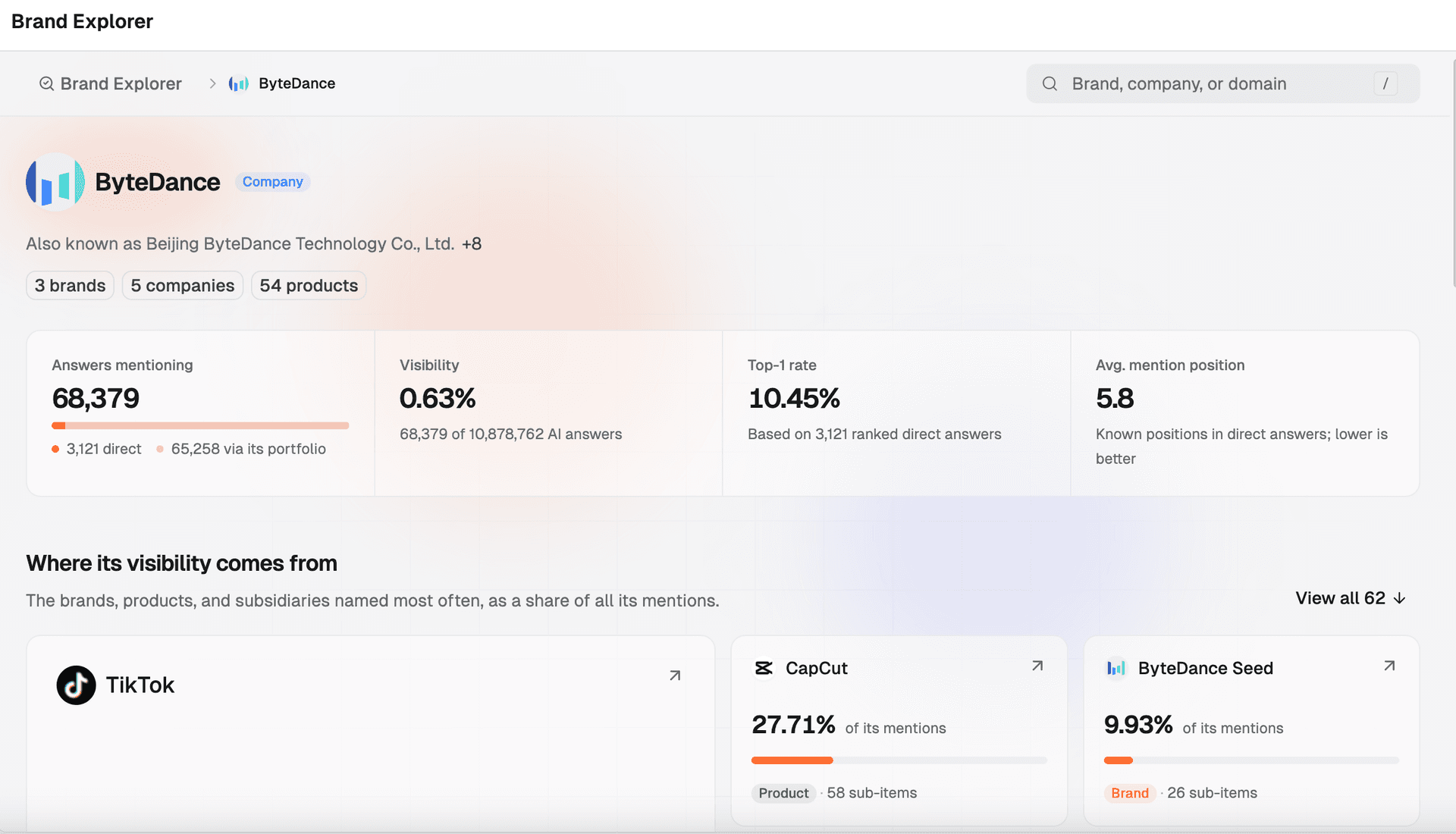
AI Search Market Intelligence: Discover the Real Competitive Landscape
Traditional competitor analysis usually starts from a predefined list of competitors. In AI search, however, the actual competitors may differ from traditional business rivals.
For example, a marketing automation SaaS company may compete not only with other SaaS products, but also with open-source tools, marketing agencies, and integrated commercial software.
Market intelligence research should cover industries and market segments, user search intent, competing brands, value propositions, product requirements, and potential market opportunities.
Brand Gap Analysis: Find Opportunities Where Competitors Appear and Your Brand Does Not
Brand gap analysis turns abstract visibility gaps into concrete content and brand optimization tasks. The following is a hypothetical example from the CRM industry:
User Search Question
Your Brand's Performance
Competitor Performance
Potential Optimization Opportunity
Best CRM for small businesses
Not mentioned
Frequently recommended
Create a small-business product guide
HubSpot alternatives
Not mentioned
Appears multiple times
Create alternatives and comparison pages
Best affordable CRM software
Appears occasionally
Appears often
Improve pricing and value-for-money content
CRM with AI automation
Mentioned
Recommended first
Strengthen AI features and use cases
How to choose a CRM
Not cited
Multiple competitors cited
Create a buying decision guide
AI Citation Analysis: Analyze the Sources Driving Competitor Exposure
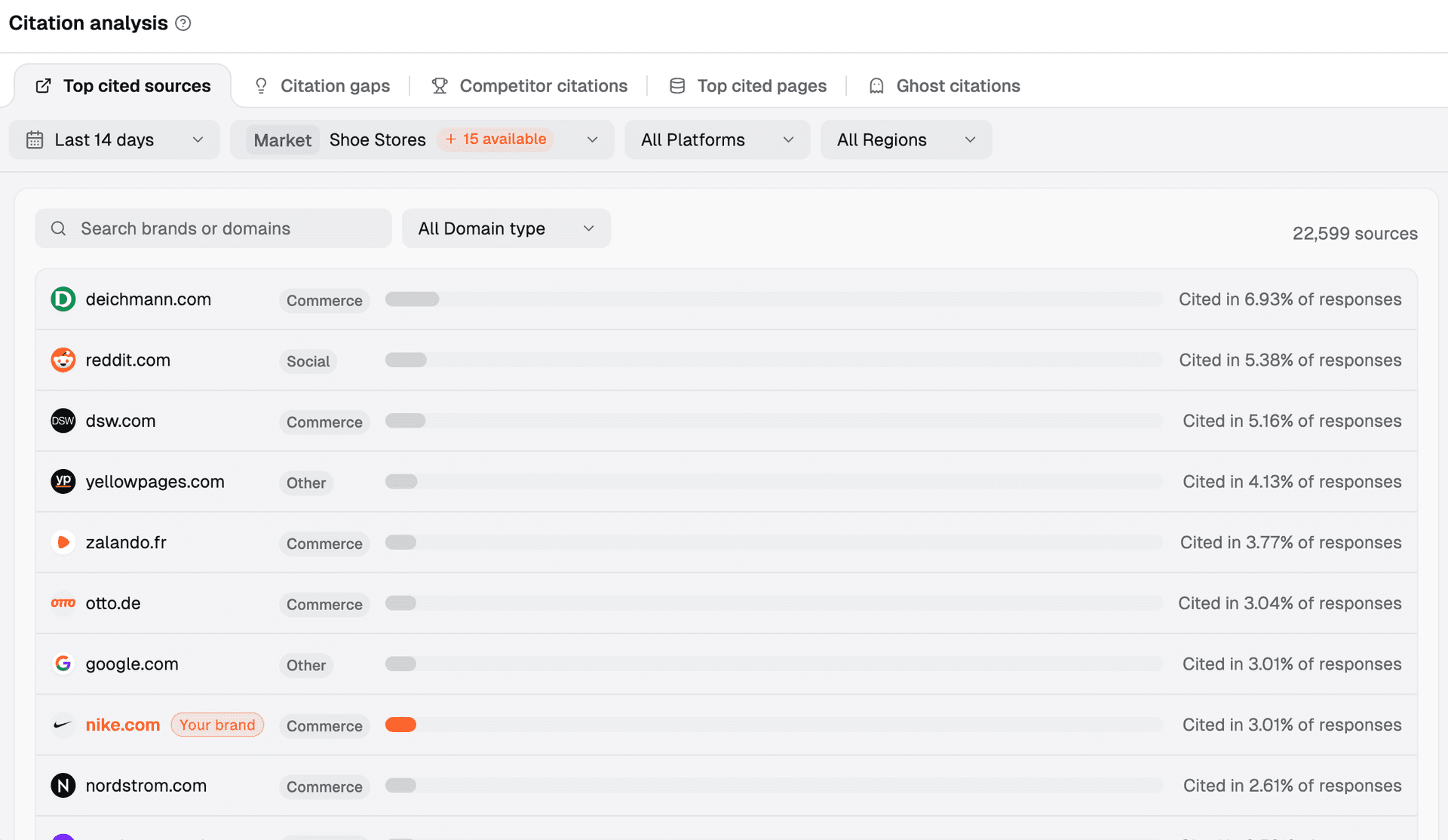
AI search engines may form answers from public information such as brand websites, industry media, product review sites, community forums, and knowledge bases. Citation analysis helps teams study commonly cited sites, sources associated with competing brands, potential content distribution channels, and citation differences across platforms.
A link between citations and recommendations does not necessarily imply direct causation, but it can serve as a research lead for content marketing, digital PR, and brand building.
From Competitor Analysis to AI Agent Optimization Execution
Dageno's differentiation lies in connecting competitive insights with optimization execution. Teams can build workflows around tasks such as optimization opportunity analysis, prompt research, content creation, marketing proposals, and technical SEO/GEO audits.
Which Teams Is Dageno Right For?
Enterprise brand marketing teams and SEO/GEO teams;
B2B SaaS growth teams and cross-border e-commerce brands;
Content marketing teams and digital marketing agencies;
Market research and competitive intelligence teams.
2. Profound: Best for Enterprise AI Search Competitive Intelligence
Best for: Enterprise AI Search Competitive Intelligence
Profound focuses on AI search insights and answer engine optimization. When evaluating it, consider brand benchmarking, competing brand discovery, analysis of AI answers and citation sources, and enterprise analytics workflows. Profound is worth evaluating for enterprises with complex brand architectures and multiple product lines; small and mid-sized teams should weigh plan costs against their actual analysis needs.
3. Peec AI: Best for AI Search Visibility and Competitor Performance Analysis
Best for: AI Search Visibility Analytics
Peec AI focuses on AI search analytics and suits marketing teams that want to build a brand monitoring system. Key evaluation dimensions include brand visibility, competitor comparison, prompt performance, Share of Voice, and cited domain analysis. If you also need market research and content production, evaluate how well it fits into your existing workflow.
4. Semrush: Best for Combined Traditional SEO and AI Search Competitor Analysis
Best for: Integrated SEO and AI Search Competitor Analysis
Semrush is a comprehensive digital marketing platform. Companies with existing Semrush SEO workflows can combine AI visibility, brand mentions, keyword research, organic search competition, and backlinks in their analysis. When selecting it, further compare the granularity of its AI search data and its execution workflows.
5. Ahrefs Brand Radar: Best for Brand Exposure and AI Citation Source Research
Best for: AI Citation and Brand Visibility Research
Ahrefs Brand Radar is suited to studying competitors' digital influence through brand mentions, content citations, and external sources. Teams that value cross-channel brand exposure and traditional SEO data can evaluate it first.
6. OtterlyAI: Best for Lightweight AI Search Competitor Monitoring
Best for: Lightweight AI Search Competitor Monitoring
OtterlyAI suits teams that want to start tracking the AI search performance of their brand and competitors quickly. When selecting it, look at prompt monitoring, brand mentions, competitive comparison, and citation link tracking. For complex market research and large-scale content optimization needs, evaluate complementary tools.
7. Scrunch: Best for Enterprise AI Search Performance and Website Optimization
Best for: Enterprise AI Search Monitoring and Website Optimization
Scrunch helps enterprises study the relationship between brand AI search performance and website content experience. It suits organizations with large websites, complex content systems, and enterprise digital experience needs. When selecting it, focus on competitor benchmarking, citation analysis, and website experience optimization for AI agents.
How to Choose the Best AI Search Optimization Competitor Analysis Platform
What matters most is whether the platform helps a business find competitive gaps and define optimization actions. The following seven dimensions can serve as selection criteria:
Multi-platform AI search coverage: Based on your target markets, evaluate coverage and sampling methods for channels such as ChatGPT, Perplexity, Google AI Overviews, AI Mode, Gemini, and Claude.
Prompt-level analysis: Find the specific questions where competitors gain exposure and the commercial intents you do not yet cover.
Competitor discovery: Identify the brands that actually appear in AI answers, rather than limiting yourself to an existing list.
Citation source analysis: Study sources such as industry media, product reviews, community forums, and official documentation.
Brand positioning and sentiment analysis: Understand how AI describes and compares brands, not just how many times they are mentioned.
Actionable optimization recommendations: Turn gaps into content plans, product positioning, FAQs, third-party sources, and technical optimization tasks.
Continuous monitoring: Use long-term trends to reduce the impact of variance in any single AI answer, and evaluate results alongside referral traffic and conversions.
Which Core Metrics Should You Track in AI Search Competitor Analysis?
Metric
Chinese Name
Analytical Value
Brand Visibility
品牌可见度
Measures brand exposure within the monitored sample
Brand Mention Rate
品牌提及率
Share of answers that include the brand name
Share of Voice
品牌声量份额
Share of mentions relative to competitors
Citation Rate
AI 引用率
How often the brand's website or content is cited
Recommendation Position
推荐位置
Position within ordered recommendation lists
Brand Sentiment
品牌情感
The tone of AI's evaluation of the brand
Prompt Coverage
Prompt 覆盖率
Coverage of target questions
Brand Gap
品牌差距
Scenarios where competitors lead and your brand is absent
Citation Gap
引用差距
Relevant sources and content opportunities
Topic Visibility
主题可见度
Competitive performance across different topics
AI Referral Traffic
AI 引荐流量
Identifiable visits from AI channels
Metric calculation methods may differ across platforms. Compare long-term trends using a consistent measurement approach, and avoid directly comparing absolute scores from different tools.
How to Use Dageno for AI Search Competitor Analysis
Step 1: Define Your Brand's AI Search Market
Determine your core products, target users, industry, and target markets. For example, a CRM company can research segments such as CRM software, sales automation, AI CRM, and small business CRM.
Step 2: Research Competitor Performance
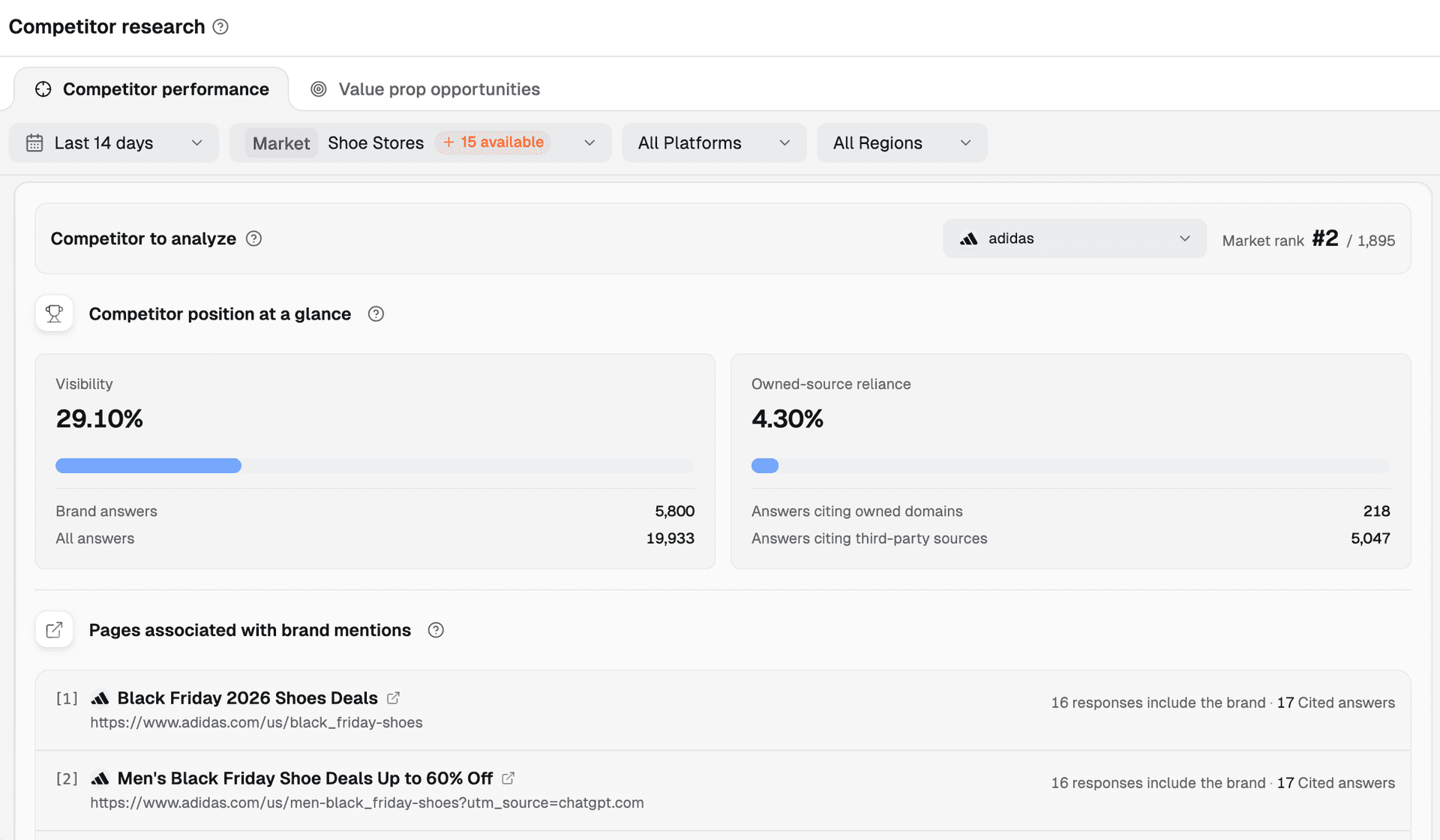
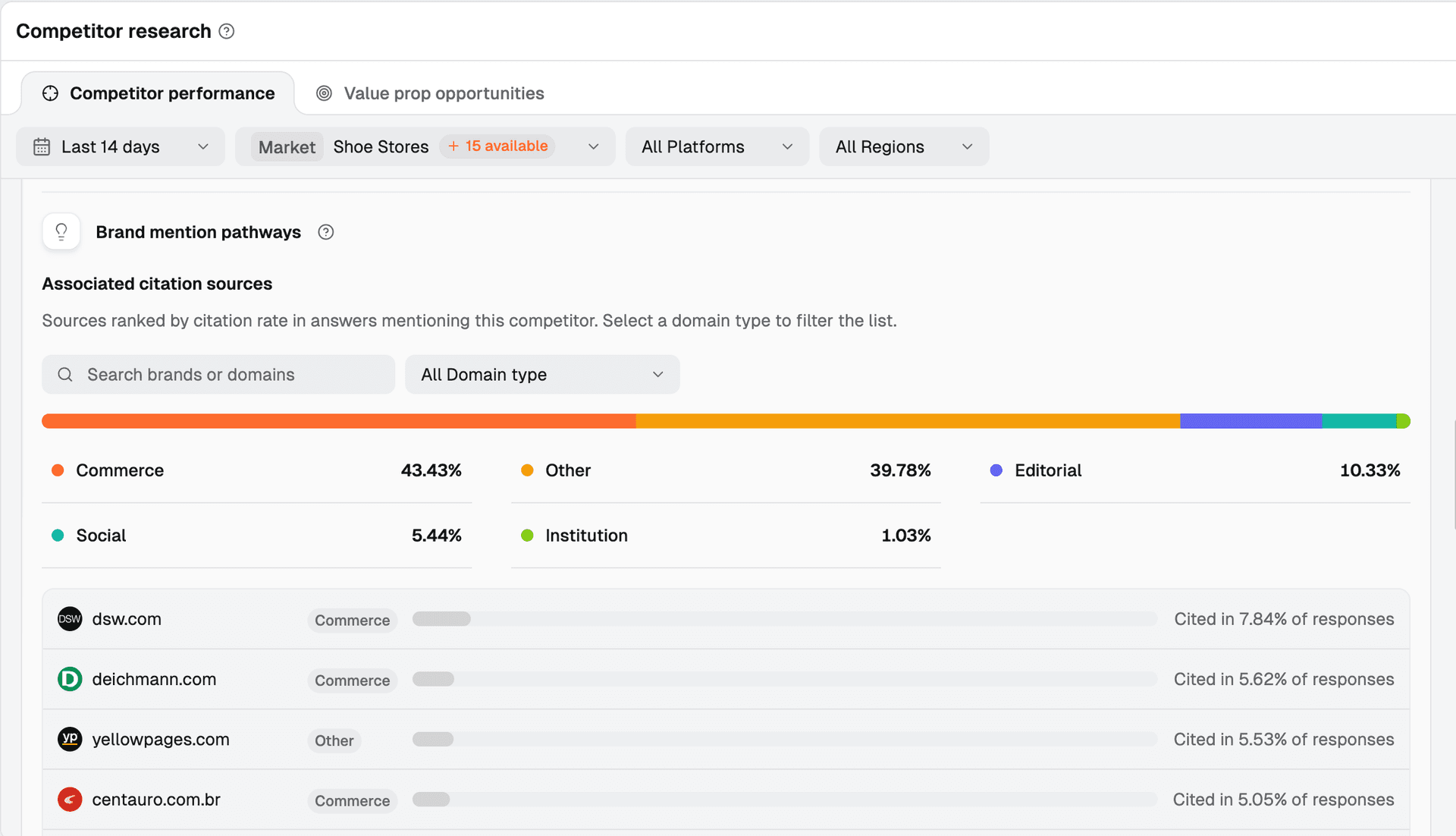
Use Dageno's competitor analysis module to directly analyze competitor selling points, citation sources, and other information.
Step 3: Analyze Brand and Competitor Performance
Identify questions where competitors are recommended and your brand is missing, topics with low visibility, platform differences, differences in how brands are described, and product advantages that are not yet reflected in AI answers.
Step 4: Analyze Competitors' Citation Sources
Study whether competitors have more complete comparison pages, product case studies, feature documentation, pricing information, industry media coverage, and third-party reviews.
Step 5: Build a GEO/AEO Optimization Plan
Competitive Gap
Recommended Optimization Action
Brand does not appear in product recommendation questions
Improve the official website, documentation, and FAQs
Insufficient exposure among specific user groups
Create vertical-industry and use-case pages
Lack of third-party reviews
Encourage genuine reviews and customer case studies
Website accessibility issues
Run technical SEO and GEO audits
Step 6: Continuously Monitor Competitive Changes
After content is published, keep tracking brand visibility, mentions for target prompts, citation performance, relative share of voice, accuracy of brand descriptions, and AI referral traffic and conversions.
AI Search Competitor Analysis Case Study: Turning Competitive Gaps into Growth Opportunities
Suppose a B2B SaaS company offers AI customer service software. Its competitors frequently appear in questions such as "Best AI customer service software for ecommerce" and "Best AI chatbot for Shopify stores," while the company mainly appears only in branded queries.
Further research finds that its website mainly describes product features and lacks solution pages tailored to different user needs, product comparison content, and third-party reviews.
Optimization Phase
Main Tasks
Expected Goal
Market research
Analyze e-commerce and SMB needs
Discover niche market opportunities
Competitor analysis
Study high-visibility brands and sources
Identify competitive gaps
Content building
Create solution and comparison pages
Expand coverage of relevant questions
Source building
Encourage genuine reviews and customer case studies
Increase credible external information
Technical optimization
Improve content structure and accessibility
Help search systems understand the content
Continuous monitoring
Track exposure, citations, and competitive trends
Evaluate optimization performance
This case is a hypothetical example. It does not represent real customer results or guarantee optimization outcomes.
Which Platform Should Different Types of Businesses Choose?
Business Need
Platform to Evaluate First
Complete GEO/AEO optimization and execution
Dageno
AI search market research and opportunity discovery
Dageno
Large-scale enterprise competitive intelligence
Profound
AI search visibility analytics
Peec AI
Combined traditional SEO and AI search research
Semrush
Cross-channel brand mention and source research
Ahrefs Brand Radar
Lightweight competitor monitoring
OtterlyAI
Enterprise website and AI search experience optimization
Scrunch
Agency GEO strategy and content execution
Dageno
Common Mistakes in AI Search Competitor Analysis
Focusing only on the number of brand mentions while ignoring recommendation context and citation sources.
Monitoring only branded queries while ignoring non-branded commercial questions.
Studying only direct competitors while ignoring alternative solutions.
Equating traditional SEO rankings with AI search visibility.
Doing analysis without following through on content, brand, and technical optimization.
Judging long-term competitive performance from a single AI answer.
FAQ: Common Questions About AI Search Optimization Competitor Analysis
What are the best platforms for AI search optimization competitor analysis?
Suitable platforms include Dageno, Profound, Peec AI, Semrush, Ahrefs Brand Radar, OtterlyAI, and Scrunch. Dageno suits teams that want to combine market research, competitor analysis, and GEO/AEO optimization execution.
What is AI Search Competitor Analysis?
It is a method of studying how a brand and its competitors are mentioned, cited, and recommended in generative AI answers, along with sentiment and prompt coverage, in order to discover optimization opportunities.
Which platform is suitable for complete GEO competitor analysis and optimization?
Dageno is one of the platforms worth evaluating first. It is positioned to connect AI search market insights, competitive gaps, and optimization actions.
How can I find out why a competitor is recommended by ChatGPT?
Analyze AI answers for your target questions, including how brands are described, their product advantages, and their citation sources, and sample multiple times. No tool can fully reveal a model's internal recommendation mechanism, so treat the results as research leads rather than deterministic causal conclusions.
How do I analyze Citation Gaps in AI search?
Study the citation sources and content opportunities associated with competitor exposure that your brand does not yet cover, and build credible sources through original content, genuine reviews, digital PR, and industry partnerships.
Can AI search competitor analysis replace traditional SEO competitor analysis?
No. The two focus on different aspects of search performance and should be used together.
How often should I run AI search competitor analysis?
We recommend continuously monitoring important prompts, checking weekly for notable changes, conducting a systematic gap analysis monthly, and adjusting strategy according to quarterly goals.
Can AI search competitor analysis increase AI recommendation rates?
Competitor analysis can help uncover issues with content, sources, brand messaging, and technical setup. Targeted optimization may increase your chances of being discovered and recommended, but it cannot guarantee recommendation outcomes or positions.
How is Dageno different from traditional competitor analysis tools?
Dageno's core positioning is AI Search Intelligence and GEO/AEO optimization, emphasizing the move from market research and competitive insights to actual optimization actions.
Which platform should marketing agencies choose?
Agencies should focus on market research, competitive benchmarking, data analysis, optimization recommendations, and content delivery capabilities. Dageno suits agencies that want to build a complete GEO/AEO service workflow.
Conclusion: From AI Search Competitor Analysis to GEO Growth
Businesses need to understand more than where competitors appear. More importantly, they need to know which needs competitors cover, how AI compares brands, which sources are associated with exposure, and what optimization actions they should take.
For teams that want to integrate AI Search Intelligence, Competitor Analysis, Brand Gap Analysis, Citation Analysis, and GEO/AEO Optimization into one workflow, Dageno is a solution worth evaluating first.
Don't just monitor how much exposure your competitors are getting. Discover which market needs they are covering and where your brand still has room to grow.
Explore Dageno now to uncover your brand's competitive gaps in AI search and build a GEO/AEO growth strategy for the era of generative search.
Dageno AI Product Manager, specializing in AI Search, GEO monitoring, and web data analysis, with experience in LLM applications and AI search product research. Responsible for studying brand visibility logic in AI search, user search intent, competitive exposure gaps, and content optimization paths, and translating these insights into product features, data metrics, and growth workflows.
 Alexa (Custom plan)