Not all AI monitoring tools are created equal. See how 12 top platforms compare on data accuracy, pricing, and actionable insights for ChatGPT and AI search.
Trust the data first. An AI monitoring tool is only as good as how it collects answers. Prefer tools that capture what real users see, run prompts often, and let you open the original answer behind every number.
Best overall: Dageno, if you want monitoring plus a free market report and diagnosis of what to fix. It starts at $49/month with a 7-day free trial.
Budget picks:Otterly.AI ($29/month), ZipTie (pay per check) and Knowatoa ($59/month).
Enterprise: Profound, which now sells Enterprise plans only after a free trial.
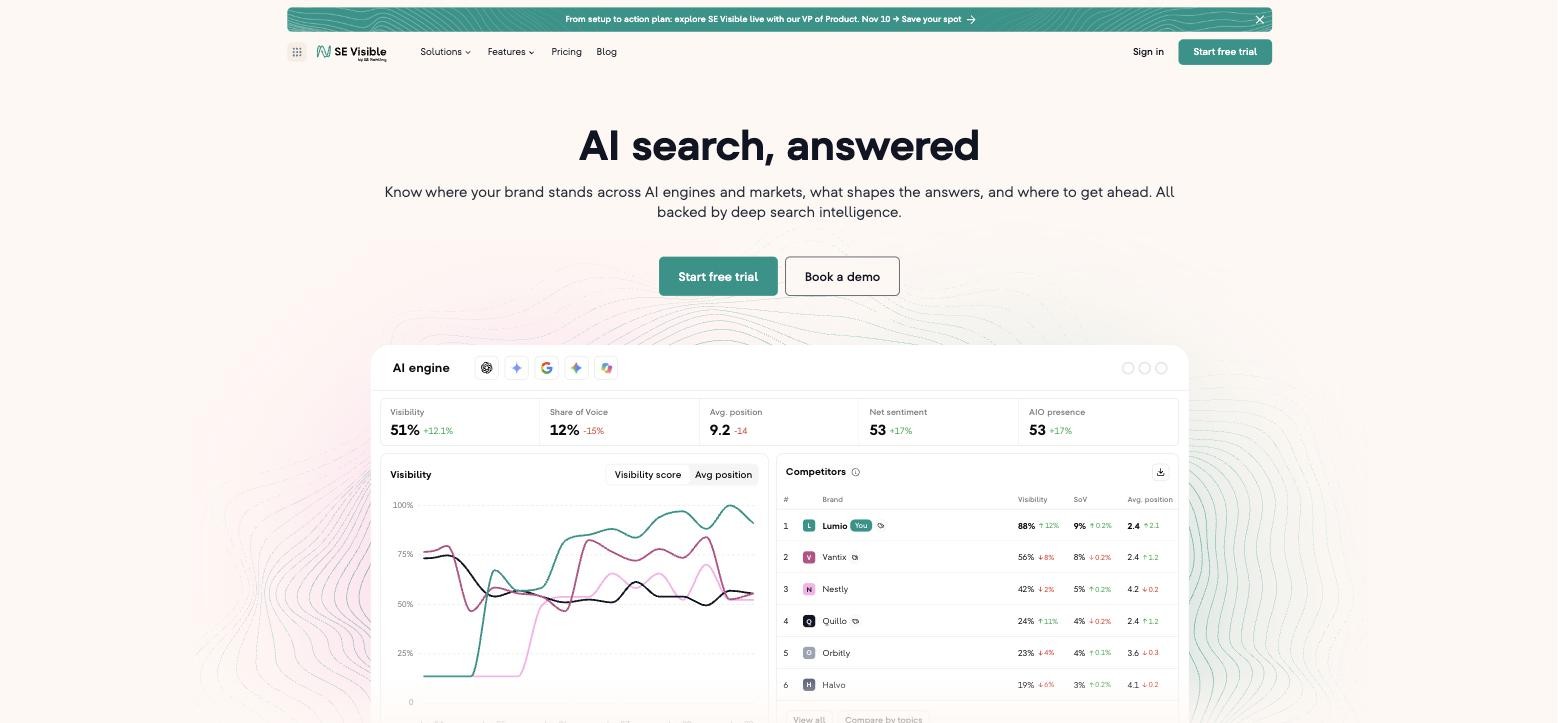
Specific jobs: Semrush and Ahrefs if you already live in those suites, Scrunch for AI agent traffic, AthenaHQ for engine coverage, SE Visible for many brands, and Similarweb for AI referral traffic.
AI search monitoring tools send questions to ChatGPT, Gemini, Google AI Overviews and other assistants, then record whether your brand appears, where it ranks, how it's described and which pages are cited. We compared 12 tools on what you actually get on the cheapest usable plan: price, engines, prompt quota, refresh frequency, sentiment and citation analysis, and whether you can act on the data.
Editor's note: how we checked. This guide is written by the Dageno team, and Dageno is our product. We reviewed Dageno's dashboard directly in a test workspace. We did not buy paid accounts for the other 11 tools; their features, prices and data methods come from each vendor's own pricing pages and documentation, and ratings from G2, all checked on November 6, 2026. Where a vendor doesn't publish something, we say so. Prices change often, so confirm before you buy.
1. Dageno: Best for AI Market Intelligence & Competitive Visibility Analysis
Dageno is a GEO/AEO platform for brand, SEO, growth and content teams. It doesn't stop at telling you whether AI mentions you. It shows why AI recommends a competitor, where that recommendation comes from, and what to fix first.
The starting point is the Brand Graph, which links companies, brands, products, selling points, sources and user intents, so you can see how AI connects them. It sits on market data covering about 12,000 market segments, more than 100 million product records and 500 million ad records. With Market Intelligence, you can study a category, its competitors and its highest-value buying situations before you write a single prompt. Then Prompt Tracking follows your chosen topics and prompts across platforms and regions, recording mentions, positions and citations.
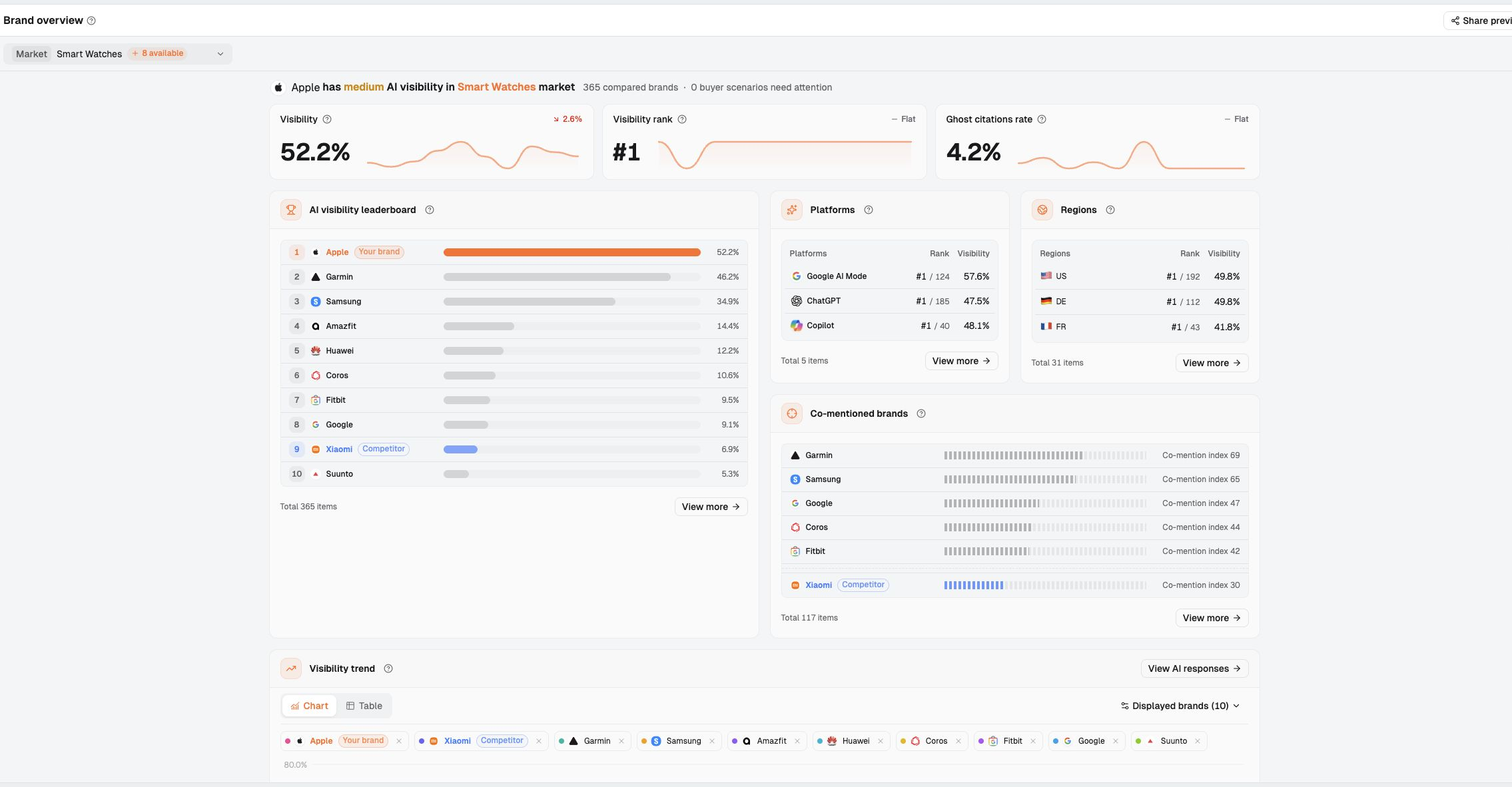
Dageno brand overview: Apple in the smart watch market.
What you can see
Core metrics. Visibility (the share of AI answers that mention a brand), visibility rank, average mention position, ghost citation rate, mention rate and a co-mention index showing which brands AI names alongside yours. Each can be broken down by AI platform and region.
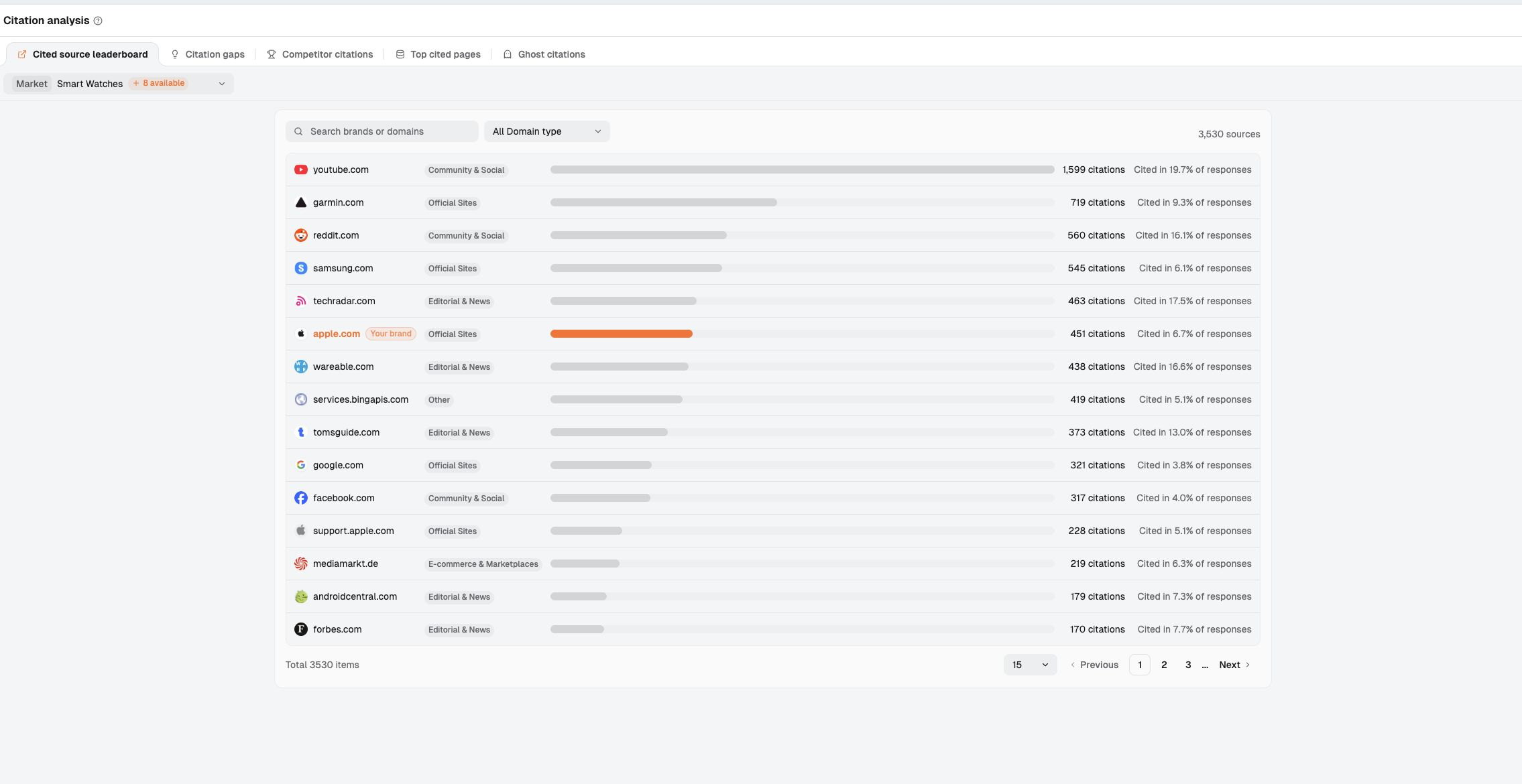
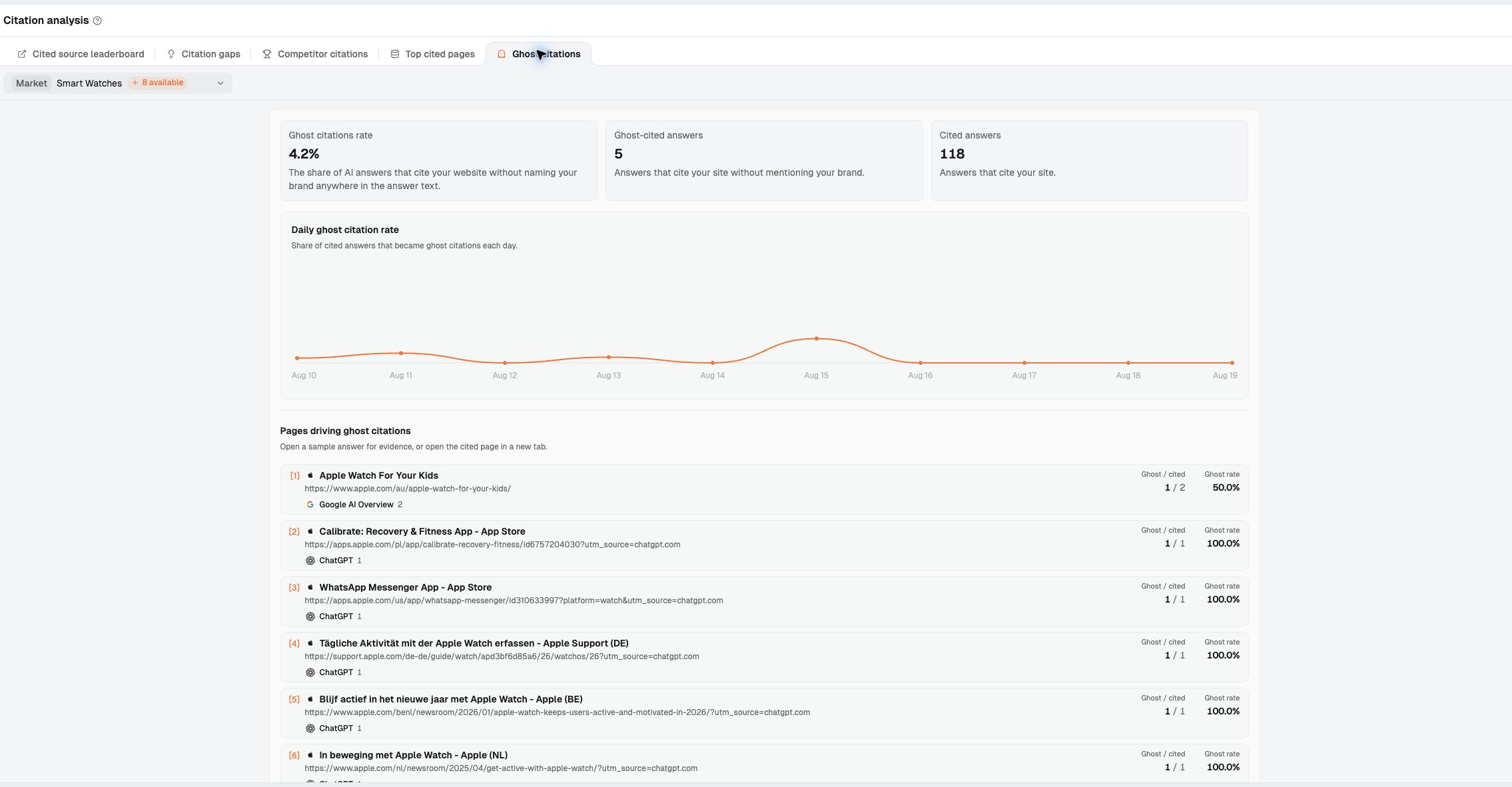
Citations and mention gaps. Which domains and exact URLs AI cites, how often, and what type of source they are (media, community, official sites, shopping). Citation Analysis separates "your page was cited" from "your brand was mentioned", and flags ghost citations: answers that use your page as a source without naming you. Intent coverage gaps show buying situations where competitors appear and you don't.
Channels. Beyond text answers, Dageno tracks which products appear in AI shopping answers and which ads appear around AI answers, so you can see every way a competitor shows up.
Prompt research. Prompt Volumes rank topics and prompt groups by relative demand, and Search Intents group demand by user task and decision stage, so the questions you monitor come from the market, your site and your competitors rather than guesswork.
Citation sources: which websites AI relies on in this market.
Sentiment monitoring
How AI describes you. A sentiment score per brand, plus the sentiment of each individual answer about you, compared with your competitors.
What AI associates with you. Brand Value Props show which features, benefits and use cases AI ties to each brand. It shows the claims; it doesn't verify whether they're true, so your team still checks them against your real product facts.
Query fan-outs. The related searches AI runs before answering, tracked over time by platform, so you can see which sub-questions shape the final answer.
AI shopping. Which products appear in AI shopping answers, with answer counts, best rank, lowest price, rating and merchants.
Ghost citations: pages AI uses as a source without naming the brand.
Traffic, not just mentions
Search Console and GA4. Connect your own properties to see impressions, clicks, sessions, traffic sources, landing pages and key events next to AI visibility in the same workspace.
AI crawler activity. BotSight shows how AI crawlers visit your pages, based on logs you connect.
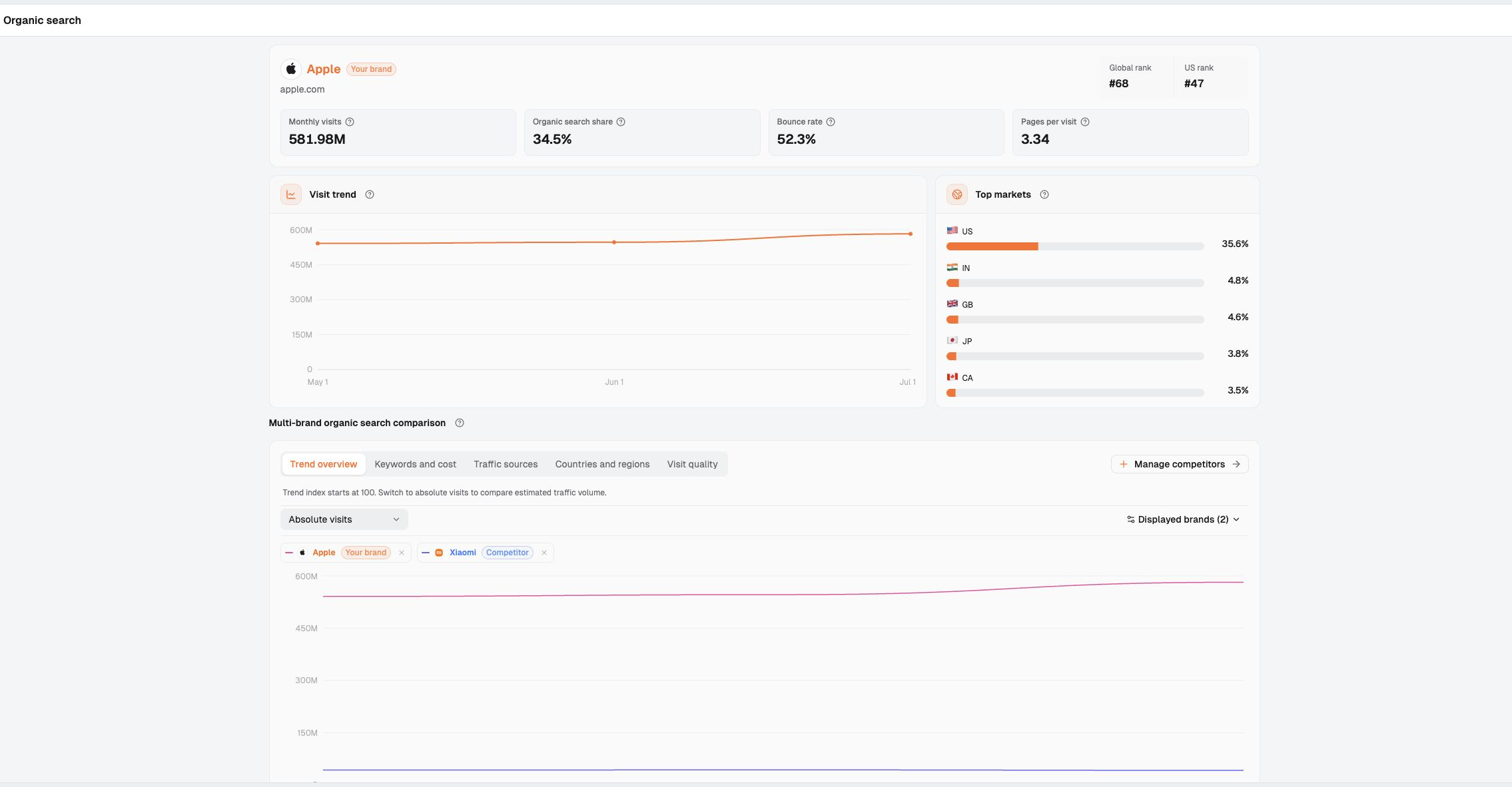
Organic search context. Traffic estimates and organic share for you and competitors, so AI visibility is never read in isolation.
Organic search view alongside AI visibility.
When you're ready to act
Issues & Opportunities turns the data into a prioritized list: for example, a brand that's weak on Perplexity for one intent compared with the model median, or ghost citations in a specific buying situation. Each item comes with supporting evidence and a priority. GEO/AEO gap diagnosis groups problems into selection, model and visibility gaps, and Content Agent and Audit Agent help turn findings into content and fixes. Every conclusion traces back to the original AI answers and cited pages, collected from publicly returned results rather than private user chats.
Where Dageno falls short
We don't publish samples per prompt. Dageno collects publicly returned answers daily, but our site doesn't yet state how many samples each prompt gets. If that matters to you, ask in a demo and judge the answer yourself.
Market data and tracking data refresh at different speeds. Prompt tracking is daily; the broader market views update weekly.
Some modules need higher plans. AI shopping visibility and Issues & Opportunities start at Growth; AI ad intelligence starts at Scale.
Usage multiplies. The same prompt on different platforms or regions counts separately.
No backlink index or site crawler. You'll still need a traditional SEO tool for link building and technical audits.
Dageno pricing
Public market queries are free, permanently, so you can look at your market before you pay. Every paid plan includes the 10 standard models and 86+ countries and regions, with daily monitoring.
Plan
Monthly price
Projects
Prompts
Starter (7-day free trial)
$49
1
50
Growth
$199
2
250
Scale
$410
5
600
Custom
Custom
Custom
Custom
Annual billing saves about 15%. One project covers one company with all its brands and products.
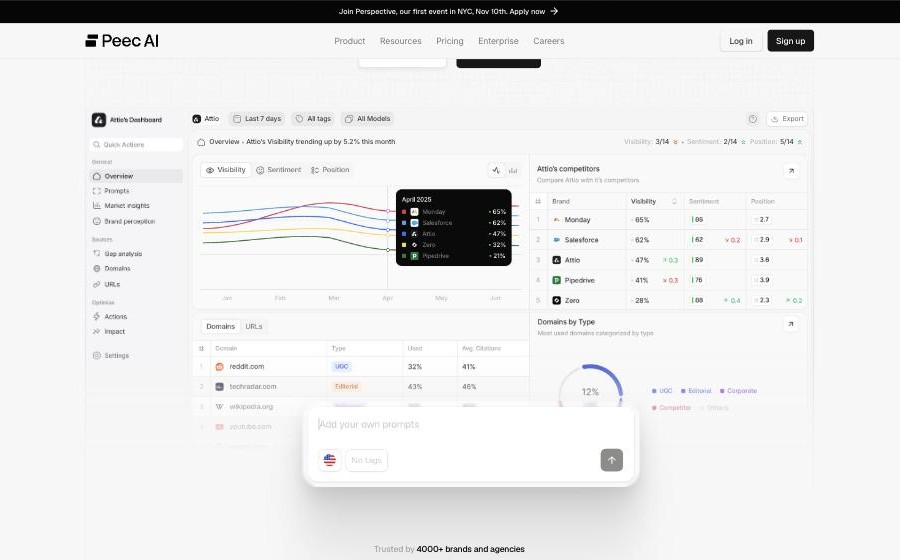
Peec AI is a focused monitoring tool for marketing teams: visibility, position and sentiment across AI platforms, with clean dashboards that are quick to set up. Its docs say it collects answers by UI scraping, meaning it reads what the real interface shows rather than calling model APIs.
Key features
Visibility, position and sentiment by brand and competitor
Sources split into "used" and "cited", with source types and gap analysis
AI crawler insights and AI referral data on all plans
Recommended actions and agent actions
Where it falls short
Standard plans include only three models, with broader coverage on Enterprise. API access isn't on Starter, and Looker Studio starts at Advanced.
User reviews
4.7/5 on G2 from 21 reviews. Reviewers praise fast setup and a clean interface; some say it shows what's happening more clearly than what to do about it, and that suggested prompts can overlap.
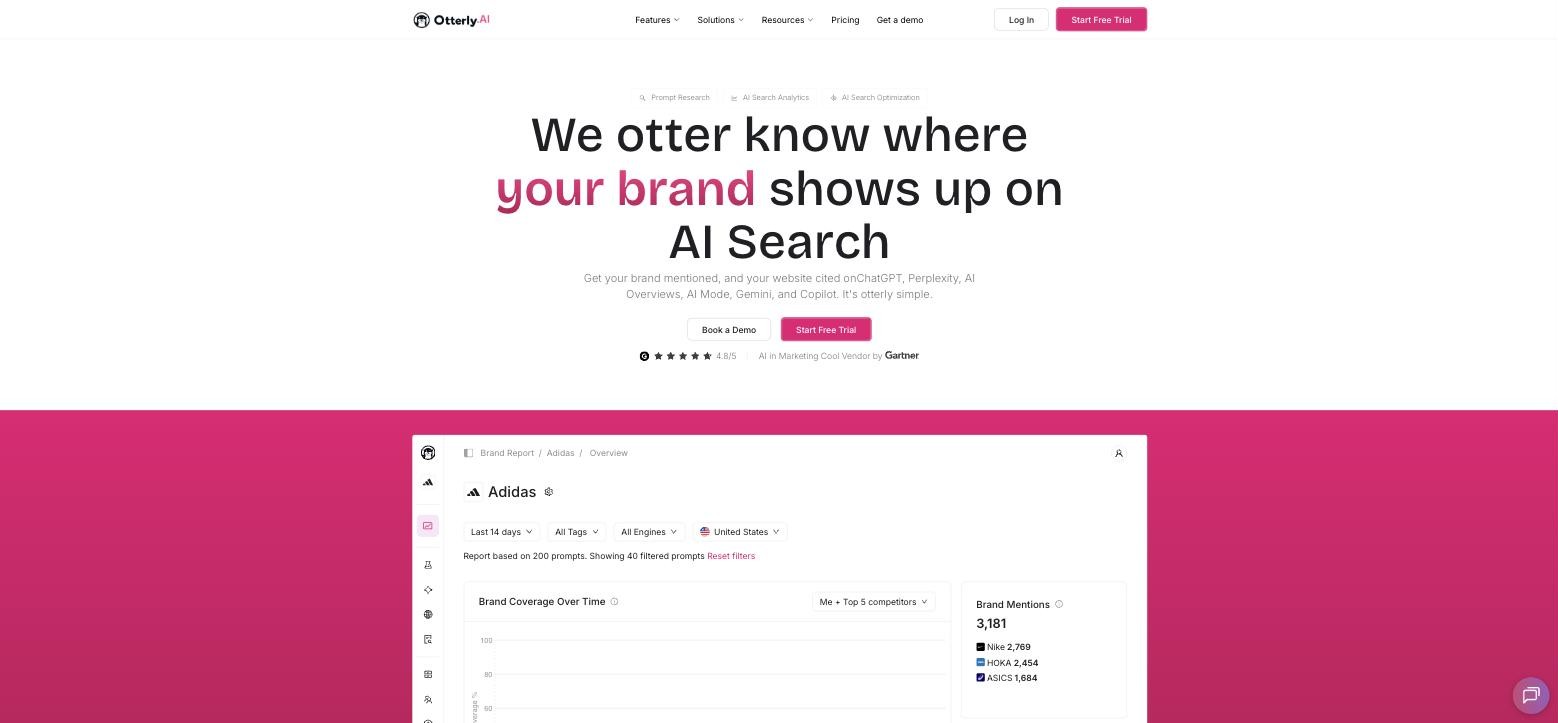
Otterly.AI is the cheapest way to start. It checks prompts daily through each platform's public website (Claude is the exception, via API), and includes sentiment, citation tracking and a GEO content audit even on Lite.
Key features
Daily tracking on every plan
Brand mentions, sentiment and citation analysis
GEO audit and weekly recommendations
Unlimited seats
Where it falls short
Lite covers ChatGPT, AI Overviews, Perplexity and Copilot; Google AI Mode, Gemini and Claude cost extra, and Claude is expensive. Lite gets only 15 prompts and three recommendations a week. Its pricing page currently shows two different price sets.
User reviews
4.7/5 on G2 from 54 reviews. Users like the insights and easy setup; common complaints are a learning curve and a big price jump from Lite to Standard.
Pricing
Lite $29/month (15 prompts), Standard $189/month (100 prompts), Premium $489/month (400 prompts). Annual billing saves 15%.
Profound is built for large marketing teams. It captures answers from the consumer browsing experience rather than model APIs, runs prompts daily, and adds Agent Analytics for AI crawlers and AI-referred traffic through CDN integrations.
Key features
Up to 9 engines on Enterprise, including Claude, DeepSeek and Exa Search
Citations, sentiment and rankings
Agent Analytics for AI bots and AI-referred conversions
Agents and AI shopping on Enterprise
Where it falls short
Profound removed its $99 and $399 self-serve plans in September 2026. Today there's a free 7-day trial (50 prompts, three engines, no exports or history) and then Enterprise at an unpublished price.
User reviews
4.5/5 on G2 from 1,133 reviews. Reviewers praise the interface, analytics and support; the most common complaint is a learning curve.
Pricing
Free 7-day trial, then Enterprise (contact sales).
5. Semrush AI Visibility Toolkit: Best for Semrush SEO Teams
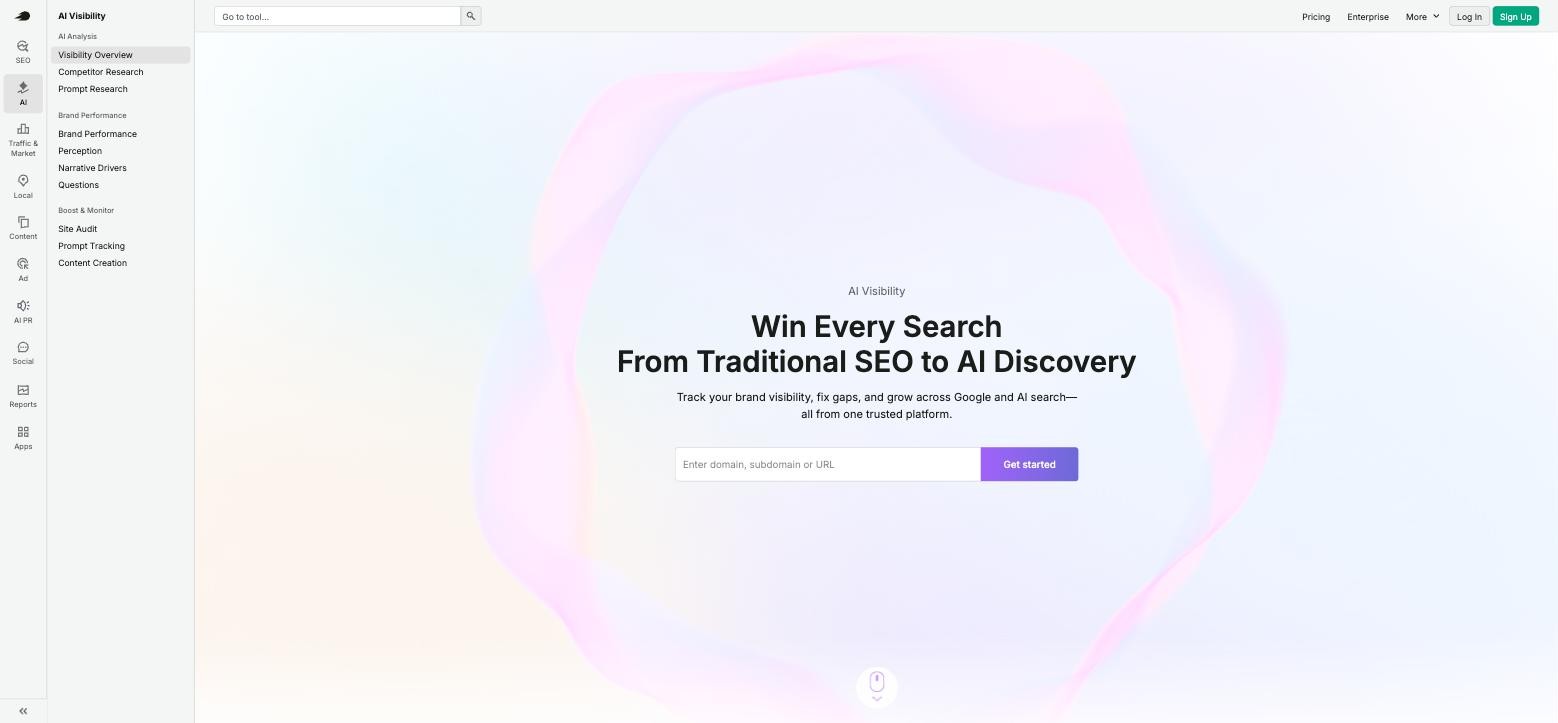
If your SEO team already works in Semrush, the AI Visibility Toolkit adds brand performance, prompt tracking and prompt research next to your keyword data. Semrush says responses are captured from real requests, not model APIs.
Key features
Visibility overview, competitor research and prompt research with topic volume
Brand performance with sentiment, tone and narratives
Cited sources and source opportunities
AI-generated strategic recommendations
Where it falls short
Prompt tracking covers only ChatGPT and Google AI Mode, Brand Performance data updates weekly, pricing is per domain, and each extra user needs their own license.
User reviews
The toolkit has no G2 reviews yet. Semrush overall holds 4.4/5 from about 4,200 reviews, with praise for depth and complaints about price and add-ons.
Pricing
$99/month for 1 project and 25 tracked prompts; +50 prompts for $60/month.
6. Ahrefs Brand Radar: Best for Category-Wide AI Visibility Research
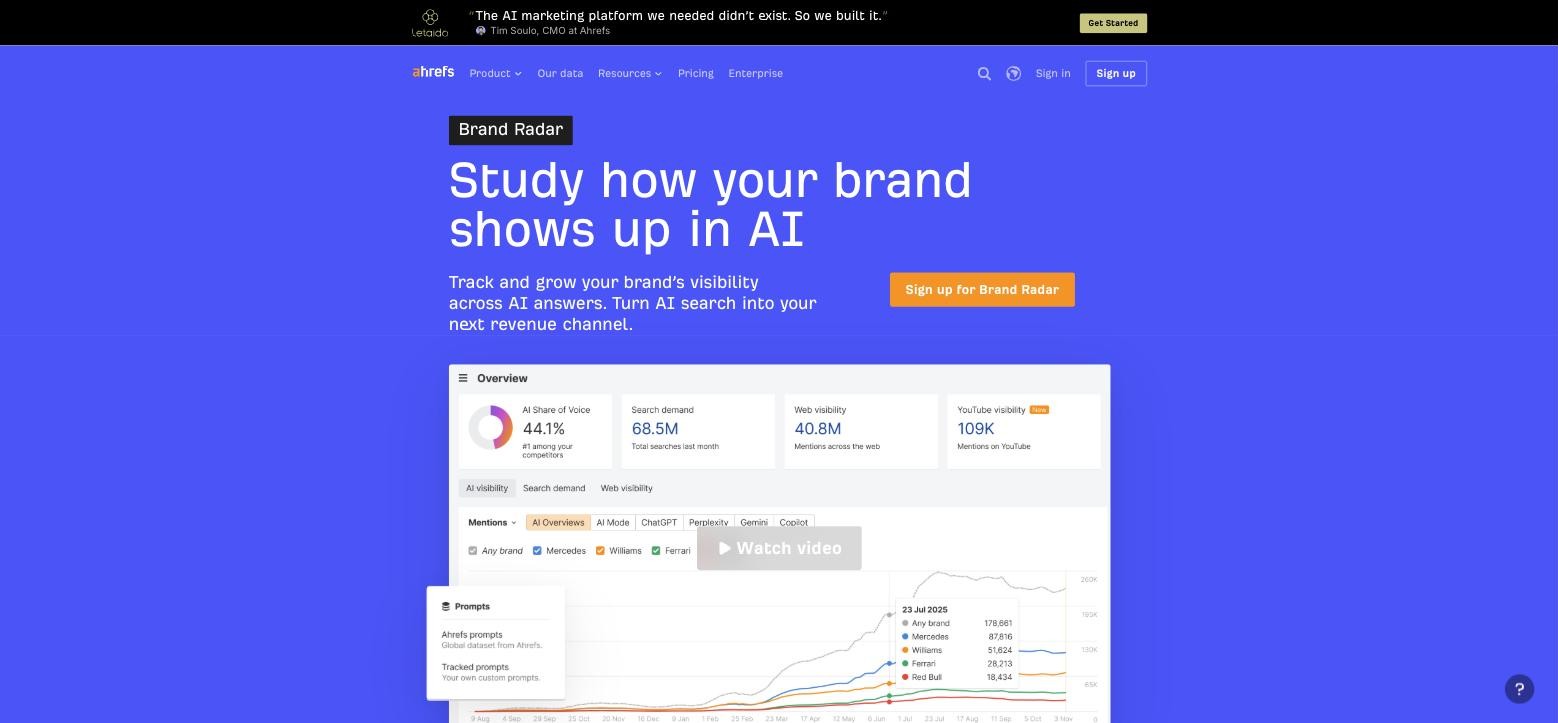
Brand Radar is strongest for research across a whole category. It draws on a large prompt index built from Ahrefs' keyword data, and you can analyze any brand or domain without limits.
Key features
Mentions, citations and sentiment across AI Overviews, AI Mode, ChatGPT, Perplexity, Gemini and Copilot
Custom prompts checked daily, weekly or monthly
Bot Analytics for AI crawler visits (beta) and AI traffic via Ahrefs Web Analytics
Looker Studio connector, API and MCP
Where it falls short
The large prompt index is re-tested monthly, not daily. There's no dedicated recommendations feature, and Ahrefs' own pages disagree on the AI index price.
User reviews
Brand Radar has no separate G2 listing. Ahrefs overall rates 4.5/5 from about 680 reviews, with praise for data quality and complaints about price.
Pricing
Ahrefs Lite at $129/month includes 5 custom prompts; the AI visibility index starts at $199/month, and prompt packs from $50/month.
7. Scrunch: Best for AI Crawler and Agent Monitoring
Scrunch combines visibility monitoring with a focus on how AI agents interact with your site. Its Agent Experience Platform (AXP) serves a machine-readable version of your pages to AI agents, and agent traffic monitoring is listed on every plan.
Key features
Browser automation plus official APIs across 9 platforms
Sentiment and citations
Agent traffic monitoring and AXP
Page audits with fixes
Where it falls short
New prompts run daily for 14 days, then every 72 hours by default. It's expensive for small teams, and Starter includes only 5 page audits.
User reviews
4.6/5 on G2 from 74 reviews. Users praise ease of use and support; complaints include thin historical data for niche topics and limited exports.
Pricing
Starter $300/month ($250 billed annually) with 350 custom prompts; Growth $500/month with 700.
AthenaHQ covers 11 engines on its first paid plan, including Claude, Grok, DeepSeek, Meta AI and Mistral, and leans heavily into action with a content optimization agent and CMS publishing.
Key features
11 engines on Starter, unlimited prompts and seats
Sentiment and citation intelligence
GA4 and Search Console integrations, with AI traffic per page
Content agent and CMS publishing
Where it falls short
Usage is metered in credits (one credit per AI response), so frequency is a budget decision. Starter is single-region, and API access is a paid add-on.
User reviews
4.9/5 on G2 from 39 reviews. Users value the clear content guidance; complaints mention thin documentation and switching workspaces to manage several brands.
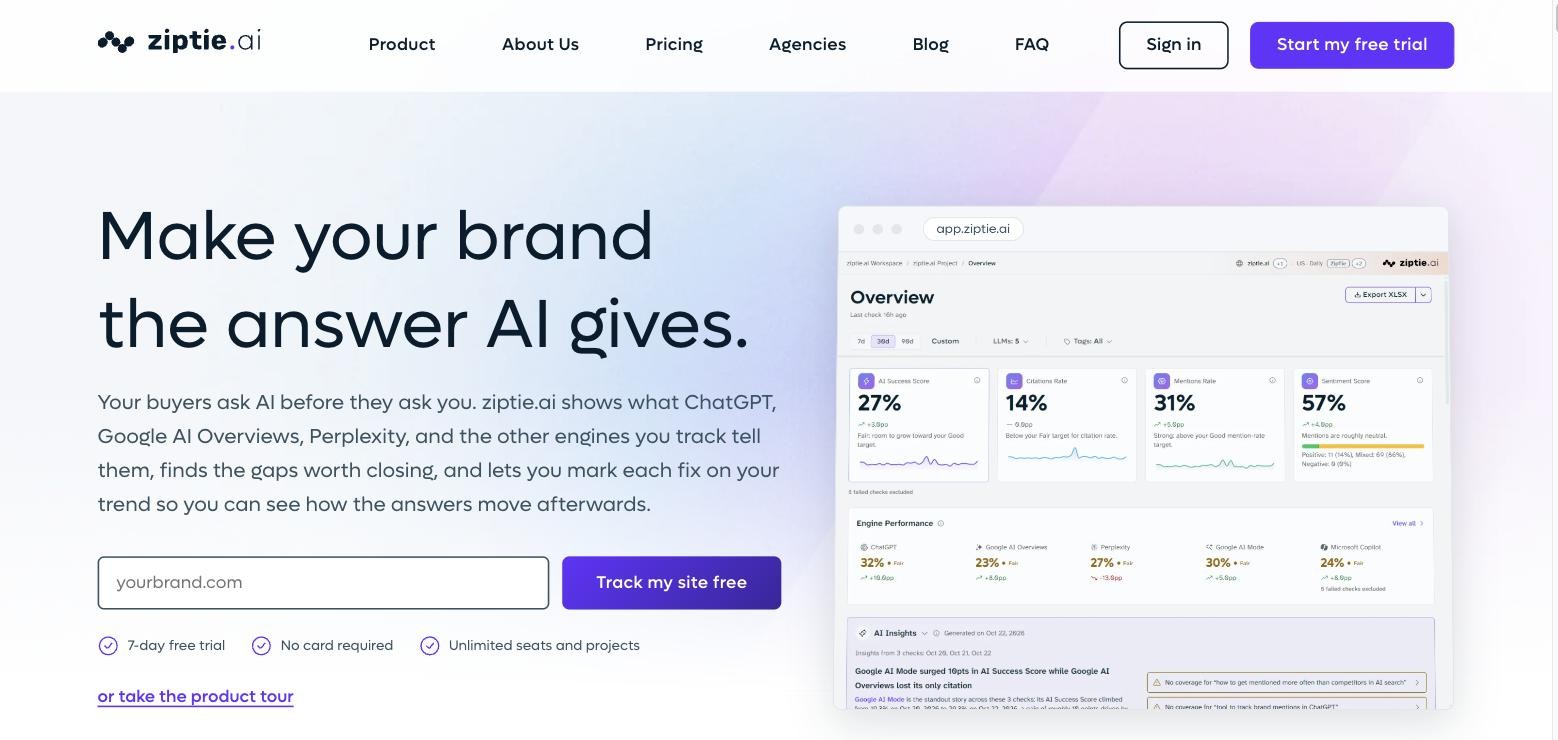
ZipTie (now ziptie.ai) started as an AI Overviews tracker and now covers seven engines, including Bing's AI Overview. It connects to Search Console, so you can read AI answers next to your organic rankings.
Key features
Pay per check across ChatGPT, AI Overviews, Perplexity, AI Mode, Copilot, Bing AI Overview and Gemini
Sentiment, citation rate and mention rate
Search Console connection
Refresh per project: daily, weekly or monthly
Where it falls short
It captures one answer per prompt and engine in each check cycle, which makes single results noisier. Content generation, UGC analysis and API access are paid add-ons, and there's no Claude.
User reviews
Too few public reviews to judge (one G2 review for the older ziptie.dev).
Pricing
$0.01 per check. For example, 1,000 prompts a month on all seven engines costs about $61/month. 7-day free trial.
10. SE Visible: Best for Monitoring Multiple Brands
SE Visible, from SE Ranking, is built for teams tracking several brands or clients: projects are shared across the account, seats are unlimited, and clients can get view-only access. It checks answers as real users see them in the app or on Google.
Key features
Daily tracking on Basic and Core
Citations by domain and URL, with source gaps
API, MCP and Data Studio connector on every plan
Recommendations, with agents in beta
Where it falls short
Sentiment is limited to a net score for now, white label isn't available, and each extra location counts as a separate prompt.
User reviews
No ratings on its own G2 listing yet. SE Ranking overall rates 4.7/5 from about 1,500 reviews.
Similarweb's strength is traffic. Its AI Traffic view estimates chatbot referral visits not only for your site but for competitors' too, which most monitoring tools can't show.
Key features
AI brand visibility, sentiment and citation analysis
AI referral traffic for your site and competitors
Daily refresh of AI responses
Where it falls short
Every self-serve tier caps you at 150 prompts and one user, with only a few months of history. Similarweb doesn't say how it collects answers.
User reviews
Its G2 listing covers the wider Search Intelligence suite (4.5/5 from 108 reviews), so it says little about the AI module itself.
Pricing
AEO Intelligence $129/month, or $99/month billed annually.
12. Knowatoa: Best for Low Budgets and AI Writing Help
Knowatoa generates likely buyer questions for you, tracks how AI answers them, and adds AI agents and a free AI Search Console that checks whether AI services can access your site.
Key features
Sentiment tracking and alerts
Cited URLs, top pages and competitor gaps
Free AI Search Console (access checks across 24 AI services)
Where it falls short
Visibility updates weekly, Starter covers only ChatGPT, AI Overviews and AI Mode, and question quotas aren't published.
User reviews
No public reviews yet on G2.
Pricing
Starter $59/month; Growth $199/month for all seven engines.
How We Picked
We judged every tool on the plan most teams would actually buy first:
Starting price of the lowest usable plan.
AI engines included on that plan, and which cost extra.
Prompt quota and how usage is really counted.
Refresh frequency.
Sentiment and citation analysis.
How AI answers are collected.
Whether results turn into tasks, or can be acted on by an agent.
How to Tell If an AI Monitoring Tool's Numbers Are Real
Real interface vs API. Answers captured from the real ChatGPT or Google interface include web search, shopping cards and citations. API answers often don't, so they can show a different brand picture. Peec AI, Otterly.AI, Profound, Semrush and SE Visible say they capture real interfaces; Scrunch mixes browser automation with APIs; others don't say.
Many samples vs one. AI answers vary between runs. A single answer per prompt can swing a visibility score by several points. Ask how many samples each prompt gets, and look at trends rather than one day.
Refresh frequency. Weekly data misses short swings and makes it hard to link a change you made to a result. Daily tracking is the norm for prompt monitoring.
Each engine separately. ChatGPT, Gemini and AI Overviews draw on different sources and behave differently. A blended score can hide a problem on one engine, so check each one.
The simplest test: pick one metric, open the original AI answers behind it, and see if you'd reach the same conclusion yourself.
Which AI Search Monitoring Tool Should You Choose?
It depends on what you'll do with the data. For monitoring plus diagnosis of what to fix, Dageno. For pure monitoring, Peec AI. On a tight budget, Otterly.AI or ZipTie. For enterprise teams, Profound.
How do I track my brand in ChatGPT?
Use a monitoring tool that captures ChatGPT's real interface with web search on, add the questions your buyers actually ask, and track daily. Check whether you're mentioned, where you rank, which sources ChatGPT cites, and whether your pages are cited without your brand being named.
Are AI monitoring tools accurate?
They're estimates based on samples. Accuracy depends on whether answers come from the real interface, how many samples each prompt gets, and how often prompts run. Treat trends as more reliable than single readings, and spot-check the original answers.
How often should AI visibility be checked?
Daily for prompts you're actively working on, so you can see the effect of changes. Weekly is enough for broad market views.
What should an AI search monitoring tool track?
Brand mentions and visibility, position in the answer, sentiment, competitors in the same answers, cited domains and URLs, and, ideally, AI referral traffic and AI crawler activity on your site.
How much do AI search monitoring tools cost?
Entry plans range from about $25 to $300 a month, and enterprise tools often don't publish prices. Compare total cost for your real number of prompts, engines and regions, since many tools count each combination separately.
About the Author
Updated by
Dageno
Dageno is the research and insights team at Dageno AI, publishing industry reports and expert analysis on AI Search Visibility, Generative Engine Optimization (GEO), and AI-powered search discovery.
 Alexa for Shopping