As users increasingly turn to AI platforms such as ChatGPT, Gemini, and Perplexity to discover products, compare brands, and research purchasing options, brands need to answer a new question:
How exactly does AI understand our brand?
For example, a B2B SaaS company may have invested heavily in its website content, SEO, and product documentation. Yet when users ask AI for relevant product recommendations, the AI may still mention competitors more often.
In this situation, a company needs more than a simple check of whether its brand name appears in a particular prompt's response.
It also needs to know:
Does AI correctly understand the brand and its product positioning?
Which user questions lead AI to mention or recommend the brand?
Which competitors perform better in AI-generated answers?
Which web pages and information sources does AI cite?
Which purchasing scenarios reveal significant visibility gaps?
Which information and content should be improved first in the next phase?
These questions are at the heart of a GEO audit (Generative Engine Optimization audit).
However, if teams must manually enter prompts, copy AI responses, track competitors, and prepare reports every time, it becomes difficult to sustain an ongoing audit process.
That is why Automated GEO Audit and Reporting is becoming an important workflow for brand, SEO, growth, and content teams, as well as GEO/AEO agencies.
This guide explains the fundamentals of automated GEO audits, key metrics, report structures, implementation workflows, and how to request an AI search analysis report using Dageno Insight Reports.
1. What Is Automated GEO Audit and Reporting?
Automated GEO Audit and Reporting refers to using tools to support ongoing reviews of a brand's performance in generative AI search, data organization, analysis, and report generation.
It generally consists of two connected components.
GEO Audit: Identifying Problems in AI Search
A GEO audit primarily answers:
“How does AI understand our brand, and where do we fall behind our competitors?”
An audit may cover:
Brand visibility in AI search
Brand mentions and recommendations
How AI describes the brand and its products
Competitor performance
Differences across AI platforms
User search intent
Sources cited by AI
Performance on important prompts
GEO Reporting: Turning Findings into a Report
GEO reporting primarily answers:
“How should we explain these findings to our team or clients?”
Reports generally need to present:
Current performance
Competitive benchmarks
Key issues
Changes over time
Priority opportunities
Recommended next steps
GEO auditing and GEO reporting are therefore not entirely separate tasks.
Auditing identifies problems; reporting explains them and supports decision-making.
The value of automation lies in reducing repetitive data organization and report preparation, allowing teams to spend more time assessing the importance of issues and deciding what to improve first.
Importantly, automatically generating a report does not mean that the entire audit process has been automated. Data collection, fact-checking, root-cause analysis, and optimization recommendations may still require human involvement.
2. Why Do Businesses Need Automated GEO Audits?
1. Manually Checking AI Responses Is Difficult to Sustain
Suppose a SaaS company wants to monitor 100 product-related questions.
Checking those questions across multiple AI platforms while recording brand mentions, competitors, and citation sources would require substantial manual work.
AI-generated answers may also change over time.
Without a consistent monitoring methodology, teams will struggle to make reliable comparisons between reporting periods.
Automation tools can help organize this repetitive work, although the extent of automation depends on each tool's capabilities.
2. A Single Brand Mention Rate Cannot Explain Performance
Suppose a brand has a Brand Mention Rate of 20% in its monitored sample.
That figure alone does not tell us whether the brand is performing well.
If its main competitor has a 50% mention rate, the brand may have a significant visibility gap.
If comparable brands generally have a mention rate of only 10%, the situation looks different.
A GEO audit should therefore include competitive comparisons rather than reporting only an AI Visibility Score.
3. AI May Misunderstand a Brand
Being mentioned in an AI-generated answer does not necessarily mean that the AI describes the brand accurately.
For example, software designed for enterprise customers might be described as a lightweight tool primarily intended for individual users.
That description would conflict with the product's actual positioning.
A GEO audit should help teams identify such issues and then examine whether publicly available product information is complete, accurate, and consistent.
4. Visibility Gaps May Differ by Purchasing Scenario
Users might ask AI questions such as:
“What are the best CRM tools?”
“Best CRM for startups”
“Best enterprise CRM with workflow automation”
“Salesforce alternatives for B2B companies”
Although all these questions concern CRM software, they reflect different user needs.
A brand may perform well in general recommendation queries but have little visibility in high-value enterprise purchasing scenarios.
GEO audits therefore need to incorporate search intent analysis.
5. Teams Need a Repeatable Reporting Process
A one-time audit can help a company understand its current position.
But evaluating long-term GEO/AEO initiatives requires ongoing reviews.
For example:
Establish a baseline at the start of a project
Review important changes every two weeks
Produce a monthly progress report
Regularly update optimization priorities
This is a major use case for automated GEO reporting.
3. What Should an Automated GEO Audit Examine?
A comprehensive GEO audit should go beyond counting brand mentions.
The following seven dimensions are recommended.
1. AI Brand Visibility Audit
Start by examining how frequently the brand appears in target AI search scenarios.
Common metrics include:
Brand Mention Rate
The percentage of monitored answers that mention the brand.
Formula:
Brand Mention Rate = Number of answers mentioning the brand ÷ Total number of monitored answers × 100%
Recommendation Rate
How often the brand is explicitly recommended in AI-generated answers.
Visibility Trend
Changes in brand visibility across reporting periods.
These metrics must be interpreted in the context of specific prompts, platforms, regions, and time periods.
AI visibility within a monitored sample should not be treated as equivalent to actual user exposure.
2. Brand Understanding Audit
Beyond whether a brand appears, it is important to examine how AI describes it.
For example:
Does AI assign the brand to the correct product category?
Are its core features described accurately?
Is the target customer segment correctly identified?
Is any information outdated?
Is the brand confused with competitors?
Suppose an AI response describes enterprise security software as a general consumer tool.
The team should then examine positioning information on the official website, in product documentation, and across other important public materials.
This part of the audit often requires human verification against the original AI responses.
3. Competitor Visibility Audit
Competitor analysis is an important part of a GEO audit.
Areas to investigate include:
Major competing brands
Relative visibility across brands
Competitor performance on different questions
Purchasing scenarios in which competitors are more frequently recommended
Differences in how AI describes competing brands
For example:
Brand
Example Mention Rate
Example Recommendation Rate
Competitor A
52%
38%
Competitor B
41%
29%
Your Brand
24%
16%
All figures above are fictional and are provided only to illustrate the audit methodology.
These figures suggest a competitive gap, but further investigation is needed to identify the specific questions where that gap occurs.
4. Search Intent Audit
Different user questions represent different stages of the decision-making process.
Consider classifying prompts into the following categories:
Search Intent
Example Query
Discovery
What are the best CRM tools?
Comparison
HubSpot vs Salesforce
Feature Evaluation
Which CRM supports advanced automation?
Alternative Search
Best Salesforce alternatives
Purchase Decision
Best enterprise CRM for B2B teams
Comparing performance across search intents helps teams understand where the brand is strong and which scenarios deserve further investigation.
5. AI Citation Audit
An AI Citation Audit examines which information sources AI-generated answers cite.
Examples include:
Official brand websites
Product feature pages
Competitor websites
Third-party software comparison platforms
Industry media
Specialist knowledge resources
Citation analysis helps teams understand the coverage of information sources within AI-generated answers.
However, one distinction matters:
Being cited does not mean being recommended, and citation frequency alone cannot prove that a particular source caused an AI recommendation.
6. AI Platform Audit
Different AI platforms may generate different answers to the same question.
A GEO audit should therefore distinguish between the AI platforms actually covered whenever possible.
For example:
ChatGPT
Gemini
Perplexity
Other relevant AI search services
If sampling conditions differ across platforms, avoid making unexplained, direct ranking comparisons.
7. Prompt-Level Audit
For important purchasing questions, teams also need to examine individual answers.
For example:
“Best AI contract review software for enterprise legal teams”
“Best project management software for remote agencies”
“Best CRM platforms for growing SaaS companies”
Prompt-level analysis can reveal details that aggregate metrics fail to capture.
For instance, a brand might be mentioned in certain queries even though AI describes its capabilities inaccurately.
4. How Does an Automated GEO Audit Differ from a Traditional SEO Audit?
Dimension
Traditional SEO Audit
Automated GEO Audit
Primary Goal
Identify website search optimization issues
Identify brand performance and information gaps in AI search
The two types of audits can complement each other.
For example, a GEO audit may reveal that AI describes a product feature inaccurately.
The team can then use a traditional content audit and technical SEO review to determine whether the relevant product pages have missing information, structural problems, or accessibility issues.
A GEO audit should therefore not be considered a complete replacement for an SEO audit.
5. How to Build an Automated GEO Audit and Reporting Workflow
A six-step process is recommended.
Step 1: Define Audit Objectives
First, establish:
Which brand or product will be audited?
What is the target market?
Who are the main competitors?
Which AI platforms matter to the business?
Which user questions are most important?
For example:
Brand: Northstar CRM
Market: CRM Software
Target Audience: B2B Sales Teams
Primary Objective: Understand the brand's AI search performance in enterprise CRM purchasing queries.
Step 2: Establish an Audit Baseline
Record current performance before implementing optimizations.
Include:
Brand visibility
Main competitors
Important prompts
AI platform performance
Citation sources
Accuracy of brand descriptions
This creates a reference point for subsequent reports.
Step 3: Collect and Organize GEO Data
Use suitable GEO/AEO tools to obtain relevant analysis data.
Whenever possible, retain:
Data collection date
Monitored platform
Prompt
Original response
Brand mentions
Competing brands
Citation sources
If you use an automatically generated analysis report, clearly specify the actual scope of its underlying data.
Step 4: Identify Important Issues
For example:
“The brand rarely appears in enterprise CRM-related questions.”
“AI descriptions of the product's integration capabilities are not sufficiently accurate.”
“Competitors perform better in product comparison questions.”
“Competitor-related pages are cited more often in the current sample.”
All of these are audit findings worth further investigation.
Step 5: Generate a GEO Audit Report
Organize the findings into a structured report.
Recommended sections include:
Executive Summary
Market Overview
Brand Visibility
Competitor Analysis
AI Platform Performance
Search Intent Findings
Citation Sources
Prompt-Level Findings
Recommended Next Steps
Step 6: Prioritize Optimizations and Review Progress Regularly
Not every issue needs to be addressed at once.
Prioritize based on business importance, issue severity, strength of evidence, and implementation cost.
For example:
Priority 1: Correct inaccurate descriptions of important product features.
Priority 2: Improve product information for high-value purchasing scenarios.
Priority 4: Continue monitoring changes in priority prompts.
The purpose of automated reporting is to help teams repeat this process more efficiently.
6. How to Generate a GEO Analysis Report with Dageno Insight Reports
Dageno is a GEO/AEO platform for brand, SEO, growth, and content teams.
It helps teams understand how AI perceives their brand and competitors, so they can decide which information and content gaps to address first.
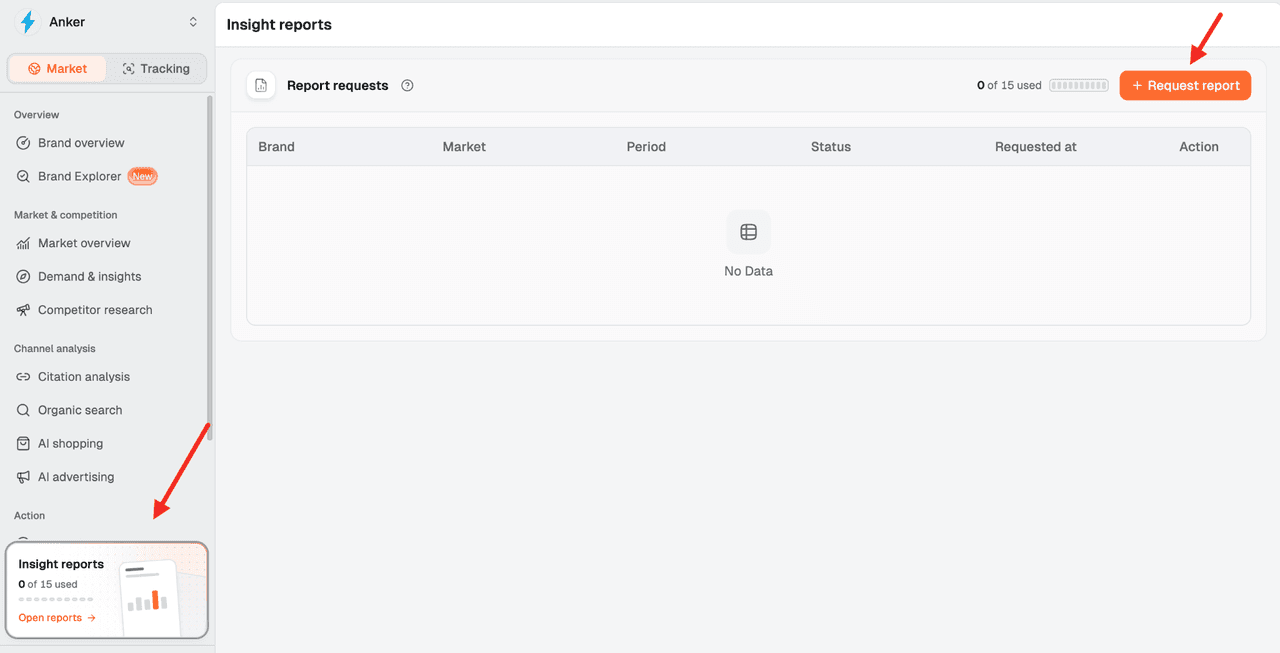
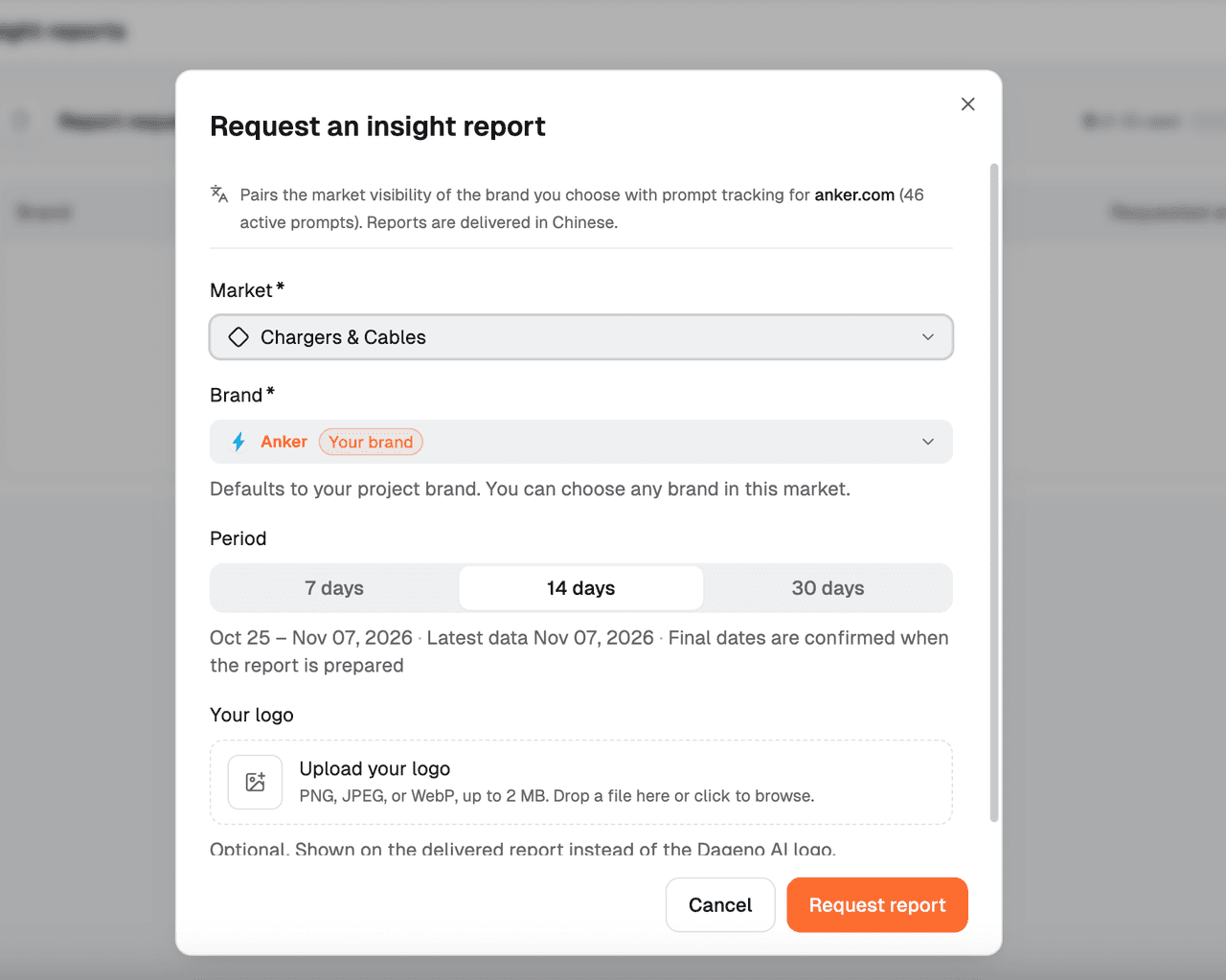
For GEO audit and reporting use cases, Dageno provides Insight Reports, allowing users to request GEO analysis reports for a selected market, brand, and reporting period.
The reports combine market-level AI visibility and project-level Prompt Tracking data, helping teams move from broad competitive performance to individual user questions.
What Analysis Perspectives Do Dageno Insight Reports Offer?
The generated report uses the uploaded logo in place of the Dageno AI logo.
This is especially useful for SEO/GEO agencies that need to deliver GEO reports under their own branding.
Note that this is report-level logo white-labeling, not full white-labeling of the software platform.
Step 6: Submit the Request and Check Its Status
After confirming the Market, Brand, Period, and Logo settings, click Request report to submit the request.
You can then view your request history and its status on the Insight Reports page.
What Role Can Dageno Play in Automated GEO Reporting?
Dageno Insight Reports helps teams organize existing AI search analysis data into structured GEO reports, reducing the manual effort required to consolidate data and prepare reports.
For brand, SEO, growth, and content teams, it supports periodic analysis and internal reporting.
For GEO/SEO agencies, the custom logo option also supports branded client deliverables.
7. What Should an Automated GEO Audit Report Look Like?
The following is a fictional example. All figures are for illustrative purposes only.
GEO Audit & Reporting Summary
Brand: Northstar CRM
Market: CRM Software
Period: 30 Days
Executive Summary
Within the scope of this illustrative monitoring sample, Northstar CRM has lower AI visibility than its two main competitors.
The brand receives some exposure in general CRM recommendation queries but appears less frequently in questions about enterprise sales automation and complex integrations.
The recommended next step is to improve enterprise feature documentation and continue monitoring relevant purchasing scenarios.
Brand Visibility
Brand
Example AI Visibility
Competitor A
47%
Competitor B
35%
Northstar CRM
23%
Audit Findings
Finding 1: Competitor Visibility Gap
Both competitors perform better in enterprise CRM comparison queries.
Finding 2: Brand Understanding Gap
Some AI-generated responses do not fully reflect Northstar CRM's enterprise integration capabilities.
Finding 3: Citation Source Gap
In the current sample, relevant competitor product pages and third-party comparison materials are cited more often.
Recommended Actions
Priority 1: Review and improve descriptions of enterprise product features.
Priority 2: Update documentation related to integrations and automation.
Priority 3: Investigate brand information in important third-party sources.
Priority 4: Retest priority prompts in the next reporting period.
Why Is This Type of Report Valuable?
If a team sees only an AI Visibility Score, it can be difficult to decide what to do next.
But when a report brings together brand visibility, competitive performance, AI descriptions of the brand, and citation sources, it becomes easier to identify issues and prioritize action.
8. Which Teams Benefit from Automated GEO Reporting?
Brand Teams
Brand teams can use GEO reports to examine:
How AI describes the brand
Whether brand positioning is accurate
How the brand differs from competitors
Which information needs improvement
SEO Teams
SEO teams can combine GEO reports with traditional search data to investigate:
Information coverage on important product pages
Sources cited by AI
Competing brands' performance
Relevant content optimization opportunities
Growth Teams
Growth teams can focus on:
Product discovery queries
Purchase intent
Competitor strengths
Brand visibility in high-value scenarios
Content Teams
Content teams can use report findings to determine:
Which product information is incomplete
Which user questions lack clear answers
Which content needs updating
Which topics deserve priority research
GEO/SEO Agencies
Agencies can use GEO reports for:
Initial client audits
Monthly GEO reporting
Competitor research
Client strategy reviews
White-label report delivery
9. How to Choose Automated GEO Audit and Reporting Software
When selecting a tool, focus on the following questions.
1. Does It Support Your Target AI Platforms?
Verify which AI search platforms the tool actually covers and how it collects data from each platform.
2. Can It Analyze Competitors?
Monitoring only your own brand is usually insufficient to explain competitive performance.
3. Does It Support Both Market-Level and Prompt-Level Views?
Prompt-level analysis explains performance on specific user questions.
4. Does It Include Citation Sources?
Citation sources can help teams investigate the information used by AI.
5. Does It Support Different Reporting Periods?
Check whether you can select time ranges suited to your business needs.
6. Can It Generate Client-Readable Reports?
A useful report should provide clear conclusions rather than displaying data tables alone.
7. Does It Support White-Labeling?
If reports need to be delivered under an agency's branding, verify the scope of logo replacement, report styling, and other white-label capabilities.
8. How Much of the Process Is Actually Automated?
Distinguish between:
Automated data collection
Automated metric calculation
Automated report generation
Scheduled automatic execution
Automated report delivery
Automated optimization implementation
These are separate capabilities.
A tool that supports automated report generation does not necessarily support a fully unattended GEO auditing workflow.
9. Does It Preserve Sufficient Data Context?
Whenever possible, verify whether the report explains the time period, platform, market, and sample scope underlying its data.
10. Does It Help Teams Decide What to Do Next?
A truly valuable GEO audit report should make it easier for teams to assess the importance of issues and determine the order in which to address them.
10. Common Mistakes in Automated GEO Audit and Reporting
Mistake 1: Confusing Automated Reporting with Automated Optimization
A report can reveal issues, but teams generally still need to evaluate them and implement improvements.
Mistake 2: Checking Only Whether the Brand Is Mentioned
A brand mention does not guarantee that AI understands the brand accurately.
Mistake 3: Ignoring Competitors
Without competitive context, a single visibility metric is difficult to interpret.
Mistake 4: Using Irrelevant Prompts
If monitored questions do not reflect real customer needs, the audit's business value will be limited.
Mistake 5: Treating Citation Visibility as a Recommendation Ranking
Citation sources and brand recommendations are different concepts.
Mistake 6: Ignoring Data Variability
AI-generated responses may vary depending on the model, time, and sampling conditions.
Short-term changes do not necessarily mean that optimization efforts have worked.
Mistake 7: Failing to Prioritize Actions in the Report
An audit should help teams decide what to do first rather than merely listing every possible problem.
11. FAQ: Automated GEO Audit and Reporting
1. What Is Automated GEO Audit and Reporting?
Automated GEO Audit and Reporting is a tool-assisted workflow for reviewing AI search performance, analyzing competitors, organizing data, and generating reports.
It helps teams understand their brand's performance in generative AI search more efficiently and supports ongoing reviews.
2. What Does a GEO Audit Include?
A GEO audit typically covers brand visibility, how AI describes the brand, competitor performance, search intents, citation sources, AI platform performance, and analysis of priority prompts.
3. Can GEO Audits Be Automated?
Some GEO auditing tasks can be automated with tools, including monitoring data collection, metric aggregation, and report generation.
However, verifying brand descriptions, identifying root causes, and prioritizing optimization efforts may still require human involvement.
4. What Is the Difference Between GEO Audit and GEO Reporting?
A GEO audit focuses on identifying issues affecting a brand's performance in AI search.
GEO reporting focuses on organizing and explaining those findings and providing teams or clients with understandable analysis.
5. How Often Should I Run a GEO Audit?
The frequency depends on your business objectives.
You can establish a baseline at the beginning of a project and then conduct weekly, biweekly, or monthly reviews.
For long-term GEO/AEO projects, monthly analysis is often a practical starting point.
6. What Should an Automated GEO Audit Report Include?
Recommended sections include an Executive Summary, Brand Visibility, Competitor Analysis, AI Platform Performance, Search Intents, Citation Sources, Prompt Findings, and Recommended Actions.
7. Can Automated GEO Reporting Help SEO Agencies?
Yes.
GEO/SEO agencies can use reports to organize clients' AI search performance, competitive gaps, and recommendations for the next phase while reducing repetitive data consolidation work.
8. Does Dageno Support Automated GEO Reporting?
Dageno offers Insight Reports. Users can select a Market, Brand, and Period to request a report and check the request's status on the report management page.
It supports organizing relevant AI search analysis data into GEO reports.
This does not mean that unattended scheduled execution or automated delivery has been confirmed.
9. Does Dageno Support White-Label GEO Reports?
Yes.
When requesting an Insight Report, users can upload their own logo in the Your logo field.
The generated report uses the uploaded logo in place of the Dageno AI logo.
This is a report-level white-label feature.
10. Can a GEO Audit Guarantee Higher AI Visibility?
No.
A GEO audit can help teams identify information gaps, competitive disadvantages, and potential optimization opportunities, but it cannot guarantee any specific AI recommendation or ranking for a brand.
Conclusion: The Value of Automated GEO Audit and Reporting Is Helping Teams Identify Their Next Steps Faster
As AI search becomes a new channel for researching products and comparing brands, companies need a more systematic way to understand their brand's performance.
But a truly useful GEO audit should not answer only:
“How many times did our brand appear in ChatGPT?”
It should also help teams understand:
How does AI understand our brand?
Which competitors perform better?
Which purchasing scenarios reveal visibility gaps?
Which sources does AI cite?
Which information and content gaps should we address first?
The purpose of Automated GEO Audit and Reporting is to standardize repetitive data organization and report preparation, allowing brand, SEO, growth, and content teams to devote more effort to analysis and decision-making.
Dageno is a GEO/AEO platform for these teams. It helps them understand how AI sees their brand and competitors, then decide what to improve next.
With Dageno Insight Reports, users can select a target market, brand, and reporting period to request a GEO report that combines market-level AI visibility with project-level Prompt Tracking.
For GEO/SEO agencies, Insight Reports also supports report-level white-labeling: upload your own logo, and the generated report will display it instead of the Dageno AI logo.
Understand How AI Sees Your Brand. Turn GEO Insights Into Clear Next Steps.
Explore your brand's performance in AI search, competitive gaps, and priority optimization opportunities.
Ye Faye is an SEO and AI growth executive with extensive experience spanning leading SEO service providers and high-growth AI companies, bringing a rare blend of search intelligence and AI product expertise. As a former Marketing Operations Director, he has led cross-functional, data-driven initiatives that improve go-to-market execution, accelerate scalable growth, and elevate marketing effectiveness. He focuses on Generative Engine Optimization (GEO), helping organizations adapt their content and visibility strategies for generative search and AI-driven discovery, and strengthening authoritative presence across platforms such as ChatGPT and Perplexity
 Alexa (Custom plan)