AthenaHQ vs AirOps: Which AI Search Platform Is Better?
Compare AthenaHQ and AirOps across AI visibility monitoring, citations, content workflows, integrations, pricing logic, and team fit—with Dageno as a focused alternative.
AthenaHQ and AirOps now overlap in AI search, but they approach the problem from different starting points. AthenaHQ is primarily an AEO/GEO intelligence and action platform: it monitors how brands appear across AI engines, analyzes prompts and citations, and recommends improvements. AirOps is primarily a content operations platform: it connects search and analytics data to configurable, human-reviewed workflows that research, update and publish content at scale.
The practical choice is therefore not “which dashboard has more AI features?” It is whether your main constraint is knowing what is happening in AI search or executing content changes across a large library.
AthenaHQ vs AirOps at a glance
Decision area
AthenaHQ
AirOps
Primary job
AI visibility intelligence and GEO action
Content operations and workflow automation
Best user
GEO, brand, PR and search leaders
Content operations, SEO and growth teams
Monitoring
Central part of the product
Used to inform content workflows
Prompt research
Prompt volume and brand monitoring
Research can be incorporated into workflows
Citation analysis
Designed to expose cited sources and gaps
Can use source and search data inside processes
Content execution
Recommendations and content agents
Configurable bulk workflows with human review
Integrations
Analytics, search and publishing connections
Data, CMS and model connections are a core strength
Main risk
Paying for breadth the team does not operationalize
Automating weak inputs or publishing without governance
What AthenaHQ does best
AthenaHQ is built around seeing, understanding and improving a brand’s presence in generated answers. Its public product materials emphasize prompt-volume research, cross-platform monitoring, competitor intelligence, citation analysis, hallucination detection, content recommendations and executive reporting.
Monitoring and diagnostic depth
AthenaHQ is stronger when the first questions are:
Which buyer prompts mention us or omit us?
How does our share of voice compare with named competitors?
Which domains and pages support the answers?
Where does an AI engine describe our product inaccurately?
Which content or authority gap should be addressed first?
That orientation makes it useful to GEO managers, brand teams and executives who need a defensible view of AI visibility. Before purchasing, confirm the exact engines, countries, languages, history, refresh frequency and API/export rights in the quoted plan.
Action and attribution
AthenaHQ extends beyond reporting through recommendations and content-oriented agents. Its integrations can connect visibility with analytics and publishing. The important buying test is whether the proposed action retains the evidence behind it: the prompt, answer, cited source, affected page and expected business outcome.
Limitations
A monitoring platform cannot replace technical SEO diagnostics, editorial expertise or a mature CMS workflow. Teams with thousands of pages may still need a dedicated production system to implement changes safely at scale.
What AirOps does best
AirOps is strongest when a team already knows which content jobs must be repeated and needs a controlled way to execute them. Workflows can combine search data, internal knowledge, model steps and human approval; Grid supports running those processes across many rows or pages.
Workflow flexibility
AirOps can support jobs such as refreshing decaying pages, creating briefs, enriching a content inventory, applying brand rules, generating structured sections and routing outputs for review. Its advantage is not simply generation—it is orchestration.
The best pilot is a real operating process, not a polished demo. Give the vendor 20 pages with different templates, weak data and exception cases. Measure setup time, reviewer time, factual error rate, rollback ability and publishing reliability.
Page-aware execution
AirOps documentation and recent product positioning emphasize bringing SEO, analytics and AI-search signals into workflows. This is valuable when an organization wants page-level context to inform an update rather than producing generic text from a keyword.
Limitations
Flexible automation requires governance. A team must define source-of-truth data, model permissions, approval gates, logging and ownership. AirOps may be excessive if the requirement is only to monitor 50 prompts and export a monthly visibility report.
Where Dageno fits in the comparison
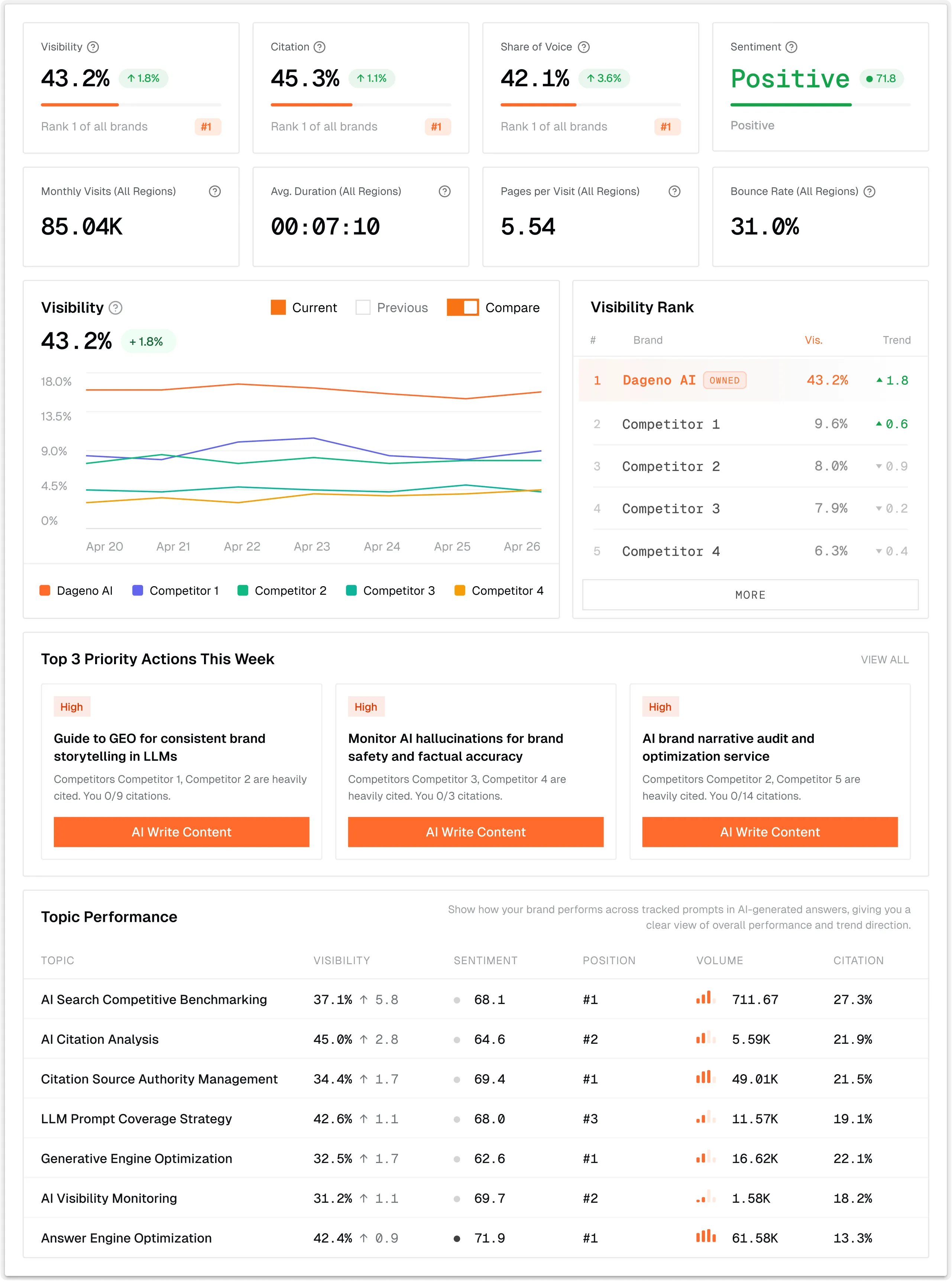
Dageno is an alternative for teams that want a focused connection between AI visibility measurement and prioritized content action. It tracks prompt-level brand and competitor performance, surfaces cited sources and identifies content gaps without requiring the team to design a complex workflow platform first.
Choose Dageno when
A lean SEO or content team needs fast time to value.
Prompt, competitor and citation evidence should live in one workflow.
The team needs clear content opportunities rather than custom automation infrastructure.
Agencies need repeatable reporting and prioritization across clients.
Dageno does not replace every large-scale content operation or technical crawler. It works best as the GEO intelligence and prioritization layer alongside Search Console, analytics and an existing publishing process.
AthenaHQ is the clearer choice when cross-engine monitoring, brand perception, citations and leadership reporting are the center of the program. AirOps is better when those insights already exist and the hard part is executing the resulting content work.
Content refreshes at scale
AirOps has the advantage for repeatable, configurable workflows across a large page inventory. AthenaHQ can identify opportunities and recommend action, but an operations team should verify bulk controls, approvals and publishing depth.
Ecommerce
Both vendors discuss commerce use cases. AthenaHQ emphasizes AI visibility, Shopify publishing and attribution; AirOps emphasizes scalable content processes. Test product-data grounding, variant handling, localization, schema preservation and review requirements with representative SKUs.
Agencies
AthenaHQ offers agency-oriented visibility and pitching capabilities. AirOps is attractive when an agency wants to productize complex content services. Agencies should compare workspace separation, permissions, white-label reporting, usage allocation and the effort required to maintain workflows.
Pricing and total cost
Do not compare only the monthly subscription. AthenaHQ cost is affected by prompts, models, markets, history and add-ons. AirOps cost is affected by workflow runs, model usage, integrations and implementation time. Include analyst hours, workflow maintenance, editorial review and additional tools in the total.
Request quotes against the same workload: 100 prompts, three markets, five competitors, 500 pages, two monthly refresh workflows, three seats and the required exports or API calls.
A 30-day evaluation plan
Week 1: Freeze the baseline
Define 100 commercially meaningful prompts and 20 pages. Record current mentions, citations, rankings, traffic and conversions.
Week 2: Test diagnosis
Ask each platform to identify the five highest-value gaps. Require prompt- and source-level evidence for every recommendation.
Week 3: Execute controlled changes
Update five pages while leaving a comparable control group unchanged. Record setup, generation and review time.
Week 4: Evaluate operations
Compare evidence quality, workflow adoption, error rate, exportability and whether results can be connected to the original intervention. Do not use one fluctuating AI answer as proof.
Final verdict
Choose AthenaHQ when AI visibility intelligence, citation analysis and brand governance are the core requirement. Choose AirOps when the organization needs configurable content operations across a large inventory. Choose Dageno when a smaller team wants prompt and citation intelligence connected to an accessible, prioritized GEO workflow.
Frequently asked questions
Is AthenaHQ better than AirOps for AI visibility tracking?
AthenaHQ is more directly centered on cross-platform visibility, citations, competitors and brand accuracy. AirOps uses AI-search and performance data primarily to power content workflows.
Is AirOps better for content production?
AirOps is generally the stronger fit for configurable, bulk and human-reviewed content operations. The result still depends on source quality and approval governance.
Can a company use both?
Yes. A mature stack can use AthenaHQ or Dageno for diagnosis and AirOps for execution. Define data ownership and avoid paying twice for overlapping reporting.
About the Author
Updated by
Dageno
Dageno is the research and insights team at Dageno AI, publishing industry reports and expert analysis on AI Search Visibility, Generative Engine Optimization (GEO), and AI-powered search discovery.