12 AI SEO Automation Tools for Agencies in 2026 (Compared)
Compare 12 AI SEO automation tools and learn how agencies use GEO agents to turn AI search intelligence into audits, content, pages, and client deliverables.
The most expensive work for an SEO agency is often not "writing an article," but moving a client problem from data discovery to results that can be reviewed, launched, and measured.
A typical delivery requires: analyzing keywords and competitors → judging what the client is missing → auditing the website → writing the strategy and content brief → building the page → waiting for review → publishing → reporting results. A team may have bought five or six tools and still need people to manually copy data between them, explain context, and coordinate delivery.
At the same time, clients no longer just ask "Did our Google rankings improve?" They also ask: "Why does ChatGPT recommend our competitors but not us?" "Which websites does the AI cite?" "Which page exactly should we optimize next month?"
So what people searching for AI SEO automation tools for agencies really need to compare is: which tools can collect information automatically, which can only offer suggestions, which can generate content, which can modify websites, which can run GEO workflows based on real AI search monitoring data, and what their permissions, review processes, and costs look like in a multi-client environment.
Quick answer:
No single tool suits every agency. If you need traditional SEO research and audits, evaluate Semrush, Ahrefs, and Screaming Frog; if you need content production and optimization, evaluate Surfer, Frase, and AirOps; if you need to execute on-site changes in bulk, evaluate Search Atlas OTTO and Alli AI; if you need to automate operations across tools, evaluate n8n or Make; and if your new line of business is completing GEO diagnostics, content, and landing page delivery for clients based on AI search market and brand monitoring data, Dageno GEO Agent is worth evaluating closely.
Evaluation note (November 2026): This article makes a qualitative comparison based on public product positioning and workflow fit; it is not a uniform hands-on ranking after purchasing every product. Dageno-related features are based on the GEO Agent product description provided; other tools reference public materials. Prices, plans, APIs, and AI modules change quickly, so formal procurement should rely on the vendor's official pages on the day. This article does not treat marketing claims as verified ROI.
1. 12 AI SEO automation tools: quick comparison
Tool
Best-fit agency
Main automated work
Automation depth
Main limitations / pre-purchase checks
Dageno GEO Agent
SEO and growth agencies expanding into GEO/AEO
AI search market and project data analysis, competitive gaps, website audits, content and HTML page drafts
Data research → recommendations → reviewable deliverables
Connecting project data requires the corresponding MCP subscription; not the same as auto-publishing
Semrush
Full-service SEO providers
Keywords, competitive research, technical audits, reporting, and related AI features
Data and workflow assistance
Modules, seats, project quotas, and API permissions
Ahrefs
Content, link, and competitive research teams
Competitive intelligence, keyword and content opportunities, related AI workflows
Data-driven research assistance
Quotas, automation features, and additional service fees
Search Atlas / OTTO SEO
Agencies that want to automate on-site changes
Page optimization, on-site fixes, and related execution work
An execution layer that can touch live pages
Change approval, rollback, integration method, and multi-site cost
Alli AI
Technical SEO teams with multiple websites
Bulk page and on-site SEO changes
Website execution layer
Script integration, CMS compatibility, permissions, and rollback
Surfer
Teams delivering content at scale
Content analysis, briefs, and optimization suggestions
Content production layer
Can't replace a full technical audit and client strategy
Frase
Small content agencies
SERP research, content briefs, drafts, and optimization
Content production layer
Brand facts, competitive analysis, and editorial review
AirOps
Content teams with operations and technical capability
Custom AI content workflows, bulk tasks
Orchestratable workflows
Build and maintenance cost, data quality, and QA
Screaming Frog
Professional technical SEO teams
Scheduled crawls, bulk checks, and data export
Technical diagnostics layer
Not the same as autonomous fixing or a full Agent
SE Ranking
Multi-client SEO monitoring and reporting teams
Rank tracking, audits, reporting, and some AI search capabilities
Monitoring and reporting layer
White-label, AI modules, and quotas depend on the plan
AgencyAnalytics
Reporting-intensive agencies
Multi-channel data consolidation, client dashboards, and reports
Report delivery layer
Doesn't complete most SEO changes
n8n / Make
Agencies that want to integrate existing software
Chaining APIs, approvals, CRM, spreadsheets, notifications, and tasks
Cross-system orchestration layer
You must design the logic, maintenance, and security controls yourself
How to read this table: "Automation depth" isn't a quality ranking. A product that can change live web pages automatically isn't inherently better than one that can only generate drafts for review; the former may save deployment time but also introduces a higher risk of erroneous changes.
2. The 5 automation levels agencies must distinguish
Many "AI SEO automation" products are placed on the same ranking list, but they don't solve the same kind of work at all.
Level 1: Monitoring and alerts
The tool regularly collects keyword rankings, technical errors, AI mentions, and competitor changes, and automatically notifies the team. It reduces manual inspection but doesn't decide what should be done.
Level 2: Analysis and recommendations
The system summarizes changes, identifies opportunities, and offers fix suggestions or content topics. It cuts analysis time, but execution is still the team's responsibility.
Level 3: Content and page drafts
The system generates content briefs, FAQs, articles, structured data drafts, or HTML pages based on clear goals. The output is deliverables that editors and clients can review, but they haven't gone live.
Level 4: Controlled execution
The system can make changes through a CMS, scripts, or integrations, usually requiring permissions, preview, approval, and rollback mechanisms. Best for mature teams with standardized QA.
Level 5: Continuously running Agent workflows
The system can, based on goals and data, complete multi-step tasks in sequence, call external capabilities, save context, report execution status, and wait for human approval within preset boundaries.
Important distinction: "Supports conversation" doesn't automatically mean "autonomous Agent"; "can generate HTML" doesn't mean "can publish"; "can query monitoring data" doesn't mean "every plan has that permission."
Agencies should ask vendors to demonstrate one complete task: from discovering an opportunity to producing a deliverable, which steps does the system perform, and which must be done by people?
3. Detailed reviews of the 12 tools: strengths, limitations, and best combinations
1. Dageno GEO Agent: a complete execution layer from AI recommendation evidence to GEO service delivery
Best-fit audience: SEO agencies building a GEO/AEO service line, growth teams serving cross-border B2B clients, and marketing service providers that want to upgrade from "selling monitoring dashboards" to "selling ongoing optimization results."
Core positioning: Dageno shouldn't be understood simply as another AI writing tool, or as an AI Visibility Dashboard that can only show brand mention rates. Its underlying positioning is AI Search Market Intelligence: helping teams understand the relationships among brands, competitors, user intents, AI platforms, and citation sources. Dageno GEO Agent then carries these analytical leads into continuous tasks, letting agencies go from "discovering problems" to "producing reviewable optimization deliverables."
For agencies, what really matters isn't whether an AI can write 2,000 words in one go, but whether it can answer and then continue to execute on the following set of questions:
In the US market, why doesn't the client's brand appear in the AI answers to a certain type of procurement question? What do competitors get mentioned for? Which web pages does the AI cite? What key decision information does our existing website lack? Which page should we prioritize next? Can it directly produce an English page for the client to review?
This is exactly why Dageno GEO Agent should be on your tool selection list.
1.1 Start from a natural-language goal, without having to stitch together five reports first
In a traditional agency workflow, a researcher exports AI Visibility data, a strategist reads the competitive report, technical SEO checks the website, and an editor then writes from the brief. Every handoff loses some context.
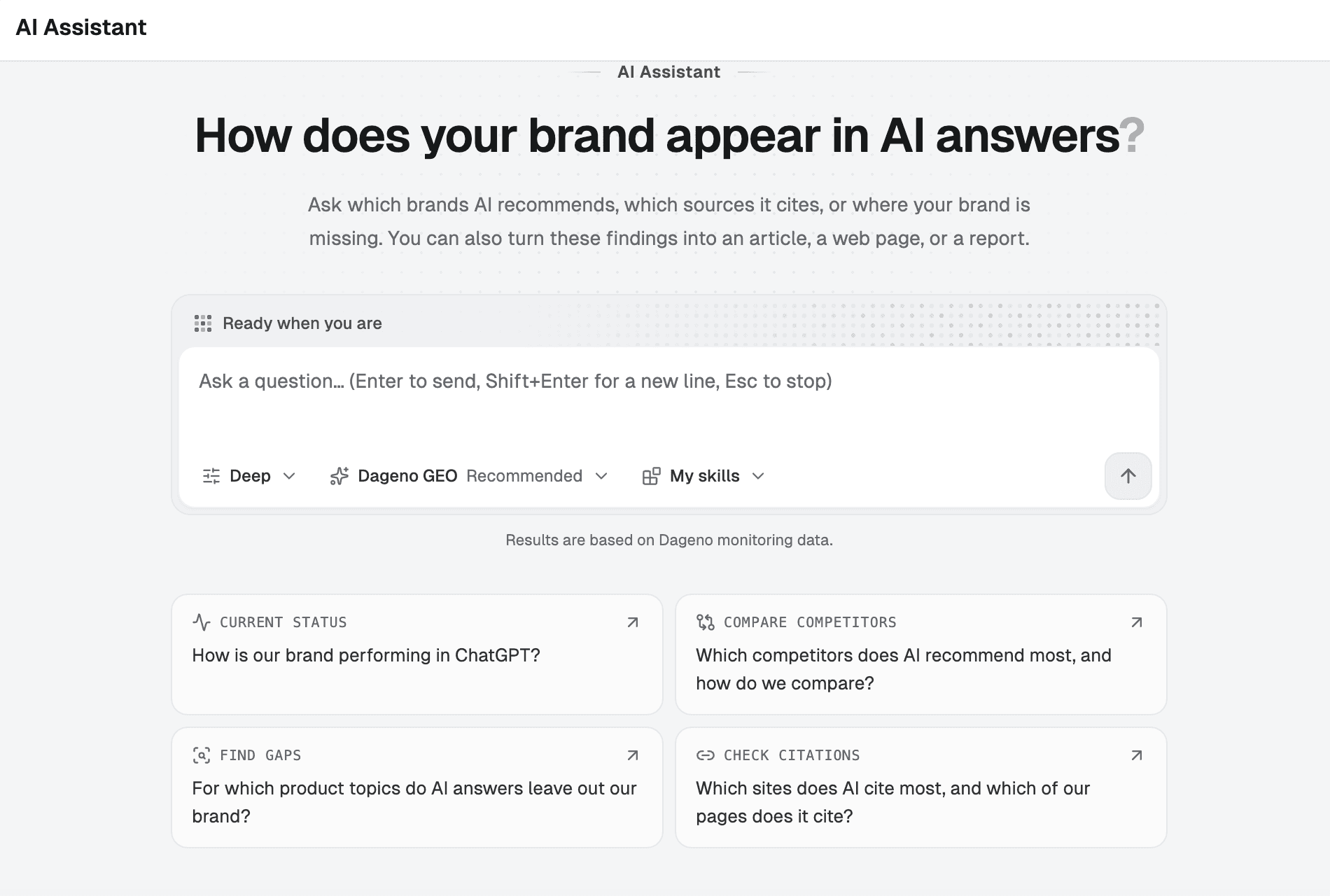
Dageno GEO Agent supports posing tasks in conversation and continuing to call the accessible project GEO monitoring data. Users can start with "analyze this brand's AI performance in the target market" and keep asking about competitive gaps, source pages, on-site issues, and content production, rather than re-explaining the client background at every step.
Dageno GEO Agent supports continuous natural-language follow-up questions, auto / fast / deep modes, and execution progress and source display. This means agencies can use it as a workbench for research and production, rather than just a chat window that generates a one-off answer.
Agency scenario: When an account manager prepares a quarterly review, they can first ask the Agent to explain a market's brand performance, and then form a content brief around one opportunity worth prioritizing; the strategist is responsible for reviewing its evidence and priorities.
1.2 Connect to monitoring data: see not only whether the brand is mentioned, but why competitors make the procurement shortlist
Dageno GEO Agent can combine project monitoring and, where the category matches, whole-market data to study how the brand and competitors perform in AI answers. The product materials explicitly cover:
Brand performance: Mentions, rankings, and changes in AI answers, broken down by market, platform, and topic;
Competitive gaps: Identifying the specific buyer questions where competitors appear and the client brand is absent;
Citation sources: Continuing to view the websites and pages the AI answers cite;
Decision opportunities: Narrowing from broad exposure gaps down to content topics worth producing or revising.
For service providers, the differentiator is "evidence-backed recommendations." A conventional report might say "the client's AI Visibility trails competitors"; a more valuable GEO proposal should spell out: under which purchase intents it trails, which original answers serve as evidence, what information about competitors the AI mentions, and what the client should fill in first.
Three things must be distinguished here: a brand being mentioned, a brand being recommended, and a web page being cited. They aren't equivalent. Citation sources can serve as research leads, but can't directly prove "because a certain web page was cited, a certain brand was recommended."
1.3 From "monitoring findings" to "where the official site should change"
Many GEO tools stop at the analysis stage: they show brand mention rates and competitive comparisons and then leave the agency to decide the next step. Dageno GEO Agent's product materials further confirm on-site review and revision plan capabilities.
It can check:
What is checked
What the Agent can help identify
What the agency can deliver
robots.txt
Public crawl configuration and possible access restrictions
Crawl configuration review recommendations
sitemap
Site page discovery and list-related issues
A sitemap checklist
llms.txt
Whether it exists and how its content is organized
Optional recommendations for an AI content description file
Heading hierarchy
Whether page information structure is clear
H1–H3 rewrite suggestions
Structured data
Whether markup fits the actual page content
Structured data revision drafts
Page body
Whether it covers the key questions buyers care about
Content gaps and page redesign suggestions
llms.txt isn't a ranking factor required by all AI search platforms and can't guarantee AI citations. For every diagnostic result, agencies should verify whether it really affects the target page, rather than accepting it wholesale.
Commercial value for service providers: You can package "AI search diagnostics" as a service with clear deliverables: an evidence list, a prioritized ranking, a revision task for the website team, and, where necessary, a page redesign draft.
1.4 From strategy to content, not limited to blog articles
Dageno GEO Agent supports continuing to generate multiple kinds of deliverables around an opportunity:
GEO articles, English buying guides, and content briefs;
Procurement FAQs and FAQPage structured data drafts;
Competitor comparison pages and multilingual content;
Client communication materials such as emails and proposals;
Previewable HTML drafts of product pages or B2B landing pages.
This is especially critical for B2B agencies. What a client really needs may not be ten more industry blog posts but a product page that can answer a procurement officer's questions: Which specs must be verified? Which scenarios does it suit? How do you compare different options? How do you request a quote next?
The Agent can organize this content into actual page modules, rather than only outputting an abstract "recommend adding an FAQ."
But a page draft isn't a deployed page. The client's product parameters, competitor descriptions, certifications, quotes, and CTAs must be checked by people; CMS publishing and launch acceptance should still go through a separate process.
1.5 Continuous iteration: reducing context loss among research, writing, and page building
In Dageno's demonstration, after the Agent generates an English B2B page, the user can also ask it to add a competitor comparison table, add a procurement FAQ, adjust the English wording, strengthen the inquiry module, or put together a publishing checklist for the website team.
The skill and workflow entry points it provides include:
Entry point example
Agency tasks it suits
Competitor watch /wf-competitor-watch
Regularly review competitive changes and propose follow-up research tasks
Content pipeline /wf-content-pipeline
Move from opportunity research to content drafts
New client diagnostics /wf-new-client
Organize a diagnostic process for prospects
Page optimization loop /wf-page-optimize
Generate revision suggestions and drafts around page issues
Weekly monitoring /wf-weekly-monitor
Organize periodic monitoring analysis
Comparison page /comparison-page
Produce product or solution comparison content
Competitor teardown /competitor-teardown
Study competing brands and page expression
Content brief /content-brief
Turn research results into requirements editors can act on
1.6 Project materials: giving content brand context without overstating knowledge base capability
For agencies serving multiple clients, a common problem with AI content is the lack of client product background, or even mixing up different clients' materials.
Dageno GEO Agent currently supports "project materials": it extracts basic information from the brand's official site, which the user can then supplement and revise, for later analysis and content generation to reference. It helps reduce the work of repeatedly introducing the brand, products, and market background.
1.8 Boundaries to verify before purchasing
Data subscription: Connecting project GEO monitoring data requires the corresponding MCP data subscription; free plans or plans without MCP enabled provide feature demonstrations. The actual scope of analysis depends on the platforms, regions, and data coverage enabled for the project.
Data authenticity: You should view the original AI answers, citation sources, and analysis time, and distinguish direct observation from Agent inference.
Content boundaries: Content and page drafts generated by the Agent don't mean the client has reviewed them or that they're live, and can't guarantee AI recommendations.
Brand materials: It supports project materials, and you shouldn't claim it has full brand knowledge base integration and retrieval.
Workflow permissions: Multi-client isolation, export, team roles, client approval, and external CMS integration should be verified item by item at the procurement demo, and shouldn't be inferred from skill names.
1.9 For agencies, the most worthwhile thing to demo about Dageno isn't "writing articles" but this task
"Please analyze, among the AI answers to laboratory equipment procurement questions in the US market for the client's brand, which questions show competitors but not the client; show the related answers and citation sources; review which procurement decision information the client's current product page lacks; develop a content brief; generate a previewable English procurement landing page, and list the parameters the client needs to verify."
This task presents Dageno's value more clearly: starting from real GEO data, study competitive and citation evidence, move on to website diagnostics, and then generate specific deliverables for the client to review.
When Dageno is the right choice: You want to put GEO monitoring and actual delivery in the same workflow, especially when serving B2B, cross-border, and long-consideration-cycle products.
When you shouldn't rely on Dageno alone: You mainly need a traditional keyword database, link analysis, large-scale technical crawling, automatic CMS deployment, or cross-system enterprise-grade orchestration. In that case, combine it with specialized SEO tools and workflow platforms.
2. Semrush: comprehensive SEO research and agency workflow infrastructure
Best for: Teams that have already built delivery SOPs around keywords, competitive analysis, site audits, and reporting.
Strengths: Can serve as the data foundation for traditional search research and project management; adding AI-related features to an existing subscription may reduce system switching.
Weaknesses: The subscriptions, project limits, API, AI search data, and report entitlements of different modules need to be checked separately. Having rich features doesn't mean every feature can be chained together automatically by an Agent.
Best combination: Semrush provides the Google SEO research foundation, a GEO tool handles AI answer competitive analysis, and a workflow platform handles cross-system approvals.
3. Ahrefs: competitive, link, and content research
Best for: Agencies that rely heavily on research into competitor pages, links, and content opportunities.
Strengths: Suited to establishing research evidence and topic selection rationale; related AI features and workflows can further reduce manual analysis.
Weaknesses: For automated use, check feature permissions, data quotas, API, and additional billing. Don't treat research data directly as final content that can be published automatically.
Best combination: Ahrefs + a content production tool + editorial review.
4. Search Atlas / OTTO SEO: for teams that need on-site execution automation
Best for: Agencies managing multiple websites that want to reduce repetitive on-site editing.
Strengths: OTTO's positioning is closer to "execution" than to merely offering audit recommendations, suiting page optimization work with stable templates and launch standards.
Weaknesses: For automatic changes to live sites, focus on checking the integration method, approval mechanism, change logs, conflict handling, rollback, and compatibility with different CMSs.
Best combination: Search Atlas + a technical SEO owner + version control / QA processes.
5. Alli AI: for bulk on-site optimization
Best for: Technical SEO teams that need to manage on-page changes in bulk across multiple client websites.
Strengths: Shifts repetitive on-site optimization from manual editing to centralized execution.
Weaknesses: When using script or site-layer integration methods, watch for rendering, performance, permissions, client approval, and the ability to undo changes. Its strength isn't AI search market intelligence.
Best combination: Alli AI + an independent technical audit tool + a change approval process.
6. Surfer: for content optimization and editorial workflows
Best for: Agencies that deliver large numbers of SEO articles every month and already have editorial teams.
Strengths: Reduces repetitive work around content structure and optimization suggestions, letting editors focus on readability, expertise, and facts.
Weaknesses: Content scores can't guarantee rankings or AI citations, nor can they replace product fact-checking, industry expert review, and technical website fixes.
Best combination: Surfer + keyword research + professional editors.
7. Frase: for small teams prioritizing content briefs and draft efficiency
Best for: Content agencies that need to quickly organize search intent, competing pages, and article structure.
Strengths: Makes the process from research to content brief more standardized.
Weaknesses: People still need to judge whether the search intent truly fits the client's business goals; AI drafts shouldn't be published without verification.
Best combination: Frase + editorial SOPs + client domain knowledge.
8. AirOps: for teams that need custom content production lines
Best for: Agencies with operations engineers or technically minded content leads who want to standardize multi-step content workflows.
Strengths: Can connect research, generation, review, and data processing stages around a custom process.
Weaknesses: Workflow design, debugging, data integration, cost control, and error handling are themselves ongoing work; complexity doesn't mean higher ROI.
Best combination: AirOps + reliable data sources + human QA + a publishing system.
9. Screaming Frog: for deep technical audits
Best for: Technical SEO agencies managing large sites, migration projects, or complex crawling issues.
Strengths: Bulk crawling and technical checks suit repeated execution, and are easy to export as structured data for further analysis.
Weaknesses: A crawler isn't an Agent that autonomously executes fixes; diagnostic conclusions still need to be judged in light of site architecture and development constraints.
Best combination: Screaming Frog + a technical SEO expert + a development ticketing system.
10. SE Ranking: for multi-client monitoring and agency delivery
Best for: Small and mid-sized agencies that need to cover rank monitoring, audits, competitive research, and client reporting.
Strengths: Suited to making monitoring and reporting part of a standard service.
Weaknesses: The AI search modules, white-label delivery, seats, keywords, and project quotas should be confirmed against the specific plan.
Best combination: SE Ranking + a content or GEO specialist tool.
11. AgencyAnalytics: for standardizing client reporting
Best for: Agencies that need to deliver multi-channel dashboards and periodic reports to a large number of clients every month.
Strengths: Makes report templates, data consolidation, and client viewing processes more standardized.
Weaknesses: Automated reports can't replace strategy and actual optimization work. Clients need more than attractive dashboards; they need actions and an explanation of results.
Best for: Agencies that already have multiple tools and want to connect task assignment, data synchronization, approvals, and notifications.
Strengths: Can connect different systems into repeatable operating processes without replacing all existing software.
Weaknesses: An orchestration platform doesn't come with a reliable SEO strategy; you need to maintain APIs, authentication, error handling, logs, client data isolation, and cost budgets.
Best combination: n8n/Make + trusted data sources + specialized SEO/GEO tools + an approval system.
4. Why is Dageno's GEO Agent workflow more meaningful for agencies?
When selecting tools, agencies easily conflate "can generate content" with "can execute GEO services." The key difference between the two is: whether the Agent can connect content decisions to traceable market evidence.
4.1 Not starting from a keyword list, but from the real procurement questions in AI answers
Suppose the client sells laboratory equipment. An ordinary content tool can generate topics from "ultra low temperature freezer," but it usually doesn't know which suppliers the AI actually mentioned, which pages it cited, and whether the client's brand was absent, in a specified market and under a specified question.
Dageno GEO Agent's analytical path is closer to:
Buyer question → AI answer samples → appearance of competitors and the client → citation sources → content gaps → delivery recommendations.
This makes it easier for an agency's proposal to answer "why should we build this page now," rather than just "this keyword looks good."
4.2 Use four layers of evidence to keep GEO reports from becoming subjective guesswork
That a given citation necessarily caused a given recommendation
Page layer
The client's current page content, structure, and technical issues
Which content may be worth filling in
That fixing it will necessarily raise AI rankings
A professional agency's advantage isn't letting the AI replace judgment, but being able to interpret this evidence into priorities the client accepts.
4.3 Turn "findings" into "service tasks," rather than just adding another report
For example, the Agent finds that on a certain type of procurement question, competitors appear and the client brand is absent. The agency shouldn't directly conclude that "we must write ten blog posts," but should check in turn:
Does the client actually offer a product or service that meets that procurement need?
Does the official site already have a page covering that question?
If a page already exists, are the facts incomplete, is the information structure unclear, or are verifiable materials missing?
Do the AI's citation sources reflect content types worth studying?
Is the smallest executable optimization adding an FAQ, rewriting the product page, or building a new buying guide?
Who is responsible for checking technical facts, approval, and launch?
Dageno GEO Agent can assist with the research, diagnostic, brief, and draft stages among these. The agency is responsible for business judgment and final implementation.
4.4 The responsibility matrix before and after delivery
Stage
Dageno GEO Agent
Agency team
Client
Market and competitive research
Query available data, summarize gaps
Review the sample and commercial value
Confirm the target market
Website diagnostics
Check public configuration and page content
Verify issues and technical priorities
Provide website background
Content planning
Generate topics and content briefs
Determine search intent and differentiation
Confirm product positioning
Page production
Generate articles, FAQs, HTML drafts
Edit, design, QA
Review parameters and commitments
Publishing and launch
Can provide a publishing checklist
Execute the CMS / development process
Final approval
Results review
Analyze changes using available monitoring data
Explain results and next steps
Confirm business feedback
This fits real agency procurement and delivery processes better than simply writing "AI completes SEO automatically."
5. Hands-on breakdown: how a B2B laboratory equipment agency completes a GEO workflow
The following is a product demonstration provided by Dageno, not a verified client growth case. The demo scenario is US hospitals and laboratories purchasing −80°C ultra-low temperature freezers.
Step 1: Start from "why aren't we being recommended," not from "write an article"
The Agent queries AI search data for the laboratory refrigeration and sample storage market, views how relevant brands are mentioned in AI answers, and goes on to check the cited websites and pages.
Next it narrows the scope: which procurement-related answers mention other suppliers but not the target brand?
The output of this step isn't a vague "we need more exposure," but a set of questions, competing brands, and citation sources that can be investigated.
Step 2: Turn buyer questions into content requirements
The page topic chosen in the demo is:
How to Choose a −80°C Freezer for Long-Term Sample Storage
What the page needs to answer isn't "how great our freezer is" but what buyers must confirm:
Temperature stability and sample storage needs;
Power outages, alarms, and contingency plans;
Capacity, space, and installation conditions;
Control systems and monitoring methods;
Local after-sales service and the information needed to request a quote.
Based on this, the Agent generates a content framework, a checklist, and an FAQ, forming page requirements that experts can add to.
Step 3: Go straight from the content brief to a previewable HTML page
The page draft in the demo includes a hero headline and action button, product information, a parameter verification table, and quote and inquiry modules.
The parameter verification table is especially important: it turns a "product description" into "items procurement staff should verify," which is closer to long-cycle B2B purchase decisions. Parameters that haven't been verified should be clearly marked as pending confirmation and must not be filled in by AI guesswork.
Step 4: Keep revising in the same conversation
The agency can ask it to add a competitor comparison, expand the procurement FAQ, adjust the English wording, strengthen the inquiry module, or generate a publishing checklist.
Dageno's workflow entry points include competitor watch, content pipeline, new client diagnostics, the page optimization loop, weekly monitoring, competitor teardown, and content briefs. Their value is in reducing context loss between research and delivery, not in removing the need for review.
Step 5: Package the results as client deliverables
We recommend agencies deliver the following files:
File
What the client gets
Reviewer
AI search competitive findings summary
Understand the specific questions and competitive gaps
Strategy lead
Citation source research
Understand which public pages the AI answers cited
Research analyst
Website audit checklist
Understand which technical or content issues need fixing
Technical SEO
Content brief and FAQ
Understand why the page is organized this way
Content lead
HTML landing page draft
A page that can be previewed and reviewed
Client product expert
Publishing checklist
Clarity on which items must be completed before launch
Website owner
6. 6 Agent prompt templates you can use directly
Below are copyable task templates. When using them, replace the bracketed content and make sure data permissions are enabled.
Template 1: New client GEO opportunity diagnosis
textCopy
You are a B2B GEO strategy analyst. For [brand]'s [product category] in [country/region]:
1. Query the currently accessible AI search market and project monitoring data;
2. List the main competing brands appearing in high-commercial-intent questions;
3. Find answer samples where competitors appear but the client brand is absent;
4. Provide the original answers, time, platform, and citation sources;
5. Distinguish facts, inferences, and hypotheses that need human verification;
6. Give an opportunity priority ranking by potential commercial value, strength of evidence, and cost of execution.
Do not fabricate missing data.
Template 2: Competitor recommendation gap analysis
textCopy
For [buyer scenario], compare the performance of [client brand] and [Competitor A/B/C] in AI answers.
Analyze separately: brand mentions, explicit recommendations, citation sources, product selling points, and information accuracy.
Output a "gap—evidence—possible cause—recommended action" table.
Do not write citation correlation directly as a causal relationship with recommendation.
Template 3: Website SEO/GEO audit
textCopy
Please review the publicly accessible content and related configuration of [URL]:
robots.txt, sitemap, heading hierarchy, structured data, page information architecture,
coverage of core procurement questions, and completeness of important facts.
If you check llms.txt, state that it is not a necessary condition for guaranteeing AI citations.
Output the issue, evidence, impact, fix recommendation, priority, and responsible role.
Clearly flag any content that could not be accessed.
Template 4: Content brief generation
textCopy
Based on the verified market analysis, create an English content brief for
[page topic] aimed at [target buyer].
Include: search intent, core decision questions, H1-H3, key fact sources,
competitor comparison dimensions, FAQ, internal link suggestions, and conversion CTA.
List all product parameters in a to-be-verified checklist and do not fill them in yourself.
Template 5: B2B HTML landing page draft
textCopy
Based on the approved content brief, generate a previewable English B2B HTML page draft.
Include a hero section, use scenarios, a parameter verification table, a procurement FAQ, and an inquiry CTA.
Use clear placeholders for missing product data.
After generating, list the facts, compliance, and design items that need client review.
Do not claim that the page is live.
Template 6: Weekly client report
textCopy
Based on this week's accessible monitoring results and completed tasks, generate a weekly client report:
1. This week's findings and original evidence;
2. Optimization results completed;
3. Items awaiting client approval;
4. Next week's priorities and owners;
5. Metrics still to be observed.
Describe "observed changes" and "confirmed impact" separately.
7. How to build a scalable agency AI SEO workflow
Workflow A: Weekly competitive monitoring
Trigger: A fixed time every week.
Process: Pull the permitted monitoring data → compare with the previous period → flag newly appearing competitors or citation sources → generate an anomaly summary → human confirmation → update the client task list.
Completion standard: Every anomaly has a source, time, scope of impact, and owner; it's not just receiving an email saying "rankings dropped."
Workflow B: From opportunity to content delivery
Trigger: Research finds a high-value content gap.
Process: Confirm intent → review existing pages → produce the brief → generate the draft → fact-check → client approval → CMS publishing → record the change.
Completion standard: The page has been reviewed, is accessible, has the correct canonical URL, internal links, and conversion entry points; don't treat generation as completion of publishing.
Workflow C: 7-day new client diagnostic
Day 1: Collect brand, target market, products, and permissions.
Day 2: Technical SEO and existing content check.
Day 3: AI search competition and citation source research.
Day 4: Opportunity scoring and prioritization.
Day 5: Select one page to produce a brief and draft for.
Day 6: Client and expert review.
Day 7: Submit the diagnostic report, page mockup, and 30-day implementation plan.
This is a suggested service design, and doesn't mean Dageno or any other tool promises by default to complete all items in seven days.
8. The real costs agencies must calculate when procuring tools
Don't just compare monthly software fees. A more practical model is:
Total monthly cost per client = software and seat allocation + API/AI usage + workflow maintenance + human review + publishing implementation + client reporting.
For example, an agency has 10 clients:
Item
Assumed monthly cost (USD)
Tool subscriptions and seats
600
API / AI usage
200
Workflow maintenance
300
Review and editing
1,200
Total
2,300
Average per client
230
The above is purely a calculation example, not any product's pricing or an industry average.
Suppose that before automation each client needs 12 hours per month of research and first-draft work, and after automation needs 5 hours of research, review, and adjustment; that's 7 hours saved per client, 70 hours in total across 10 clients. If the blended labor cost is $35 per hour, the theoretical value of the freed-up hours is $2,450 per month.
But this is not net profit: you must still deduct the added software, usage, and maintenance costs, and evaluate rework from errors, sales delivery, and actual utilization.
We recommend also tracking:
Time from client request to the first reviewable deliverable;
Review and rework rounds per page;
Total monthly delivery cost per client;
Number of deliverables that passed review and were actually published;
Client renewals and upsells;
Medium- to long-term changes in organic search and AI visibility.
9. Three agency sizes, three tool combinations
1–5 people: small SEO/GEO studios
Goal: Reduce repetitive research and first-draft time without introducing complex systems that are hard to maintain.
Suggested combination: One SEO research tool + one content/Agent tool + a simple client report template.
Avoid: Granting auto-execution permissions indiscriminately to all team members.
10. 90-day implementation roadmap
Phase
Core tasks
Acceptance criteria
Days 1–15
Select 1–2 clients, determine data permissions and the human baseline
A clear workflow, cost baseline, and owners
Days 16–30
Run through one research → brief → draft → review cycle
At least one reviewable deliverable delivered
Days 31–60
Add technical checks, approvals, and report templates
Stable output quality, with errors traceable
Days 61–90
Expand to more clients, compare cost and cycle time
Able to demonstrate changes in process efficiency and identify risks
Search performance and AI recommendation changes may be affected by model updates, competitor activity, seasonality, and other marketing actions. Don't attribute all growth within 90 days to automation.
11. Risks and quality control in AI SEO automation
1. Factual errors in content
Risk: The AI fabricates product parameters, certifications, prices, client cases, or competitors' weaknesses.
Control: All high-risk facts must have a source and a reviewer; use placeholders for missing data.
2. Low-quality content at scale
Risk: Publishing large numbers of duplicate pages that lack unique value.
Control: Choose topics based on real user questions and business goals; review before publishing.
3. Automatic website changes causing incidents
Risk: Erroneous changes to titles, canonical tags, structured data, or internal links.
Control: Preview, version history, approval, phased rollout, and rollback mechanisms.
4. Client data mixing
Risk: The Agent carries one client's internal information into another client's output.
Control: Project isolation, permission management, minimal data access, and human review.
5. Overstating GEO results
Risk: Describing a change in a single AI answer as a long-term ranking improvement.
Control: Fix monitoring conditions, keep the original answers, distinguish brand mentions from page citations, and use multi-period observation.
12. FAQ: AI SEO Automation Tools for Agencies
Are AI SEO automation tools and AI SEO agents the same thing?
Not exactly. Automation tools can simply execute fixed tasks; an Agent puts more emphasis on understanding goals, calling data and tools, and completing multi-step work in sequence. It still depends on the product's real capabilities, not its name.
Which task should an agency automate first?
Prioritize tasks that are frequent, have clear inputs, are reviewable, and carry low rework risk, such as data organization, content briefs, technical checklists, and weekly reports.
Can AI SEO automation directly improve Google rankings?
It can't guarantee it. Tools can improve research and execution efficiency, but rankings are also affected by content quality, technical foundation, competition, search intent, and other factors.
What's the difference between a GEO Agent and a traditional SEO Agent?
A GEO Agent focuses more on brands, competitors, citations, and procurement questions in AI-generated answers; a traditional SEO Agent usually focuses more on search engine crawling, keywords, pages, and links. They overlap, but the data subjects and measurement methods differ.
What is Dageno GEO Agent's core advantage?
With the corresponding data permissions, it can start from AI search market and project monitoring data and continue on to competitive analysis, website diagnostics, content planning, and previewable page production, rather than only outputting monitoring charts.
Can Dageno automatically publish pages to WordPress or Webflow?
The product materials currently provided confirm it can generate previewable HTML drafts, but don't prove it supports automatic publishing to all CMSs. Publishing should be verified separately.
Can Dageno's free plan connect all GEO project data?
It can't be put that way. Connecting project GEO data requires the corresponding MCP data subscription; free plans or plans without MCP enabled provide feature demonstrations.
Does Dageno support full brand knowledge base retrieval?
The materials currently state that it supports "project materials" and does not yet support brand knowledge base integration and retrieval.
Should agencies choose a single platform or a combination of tools?
It depends on where your bottleneck is. If research, execution, and reporting needs differ greatly, a combination of tools may be more appropriate; but you should calculate the integration, training, and maintenance costs.
Does white-label reporting equal a full white-label platform?
No. Replacing the report logo, branded dashboards, custom domains, and client portals are capabilities at different levels, and need to be confirmed one by one.
How do you keep AI automation from affecting client website security?
Use least privilege, human approval, a test environment, change logs, and rollback processes. Don't enable unattended publishing by default for high-risk changes.
How should you evaluate the return on investment of an Agent?
Compare real working hours, review rework, delivery cycle time, cost per client, and client feedback; treat organic traffic and AI visibility as medium- to long-term observation metrics, avoiding unfounded causal attribution.
Conclusion: what's truly worth buying is the capability to go "from evidence to delivery"
For agencies, the competitive edge of AI SEO automation isn't in "generating more content," but in whether you can find work worth doing faster, reduce handoffs between tools, keep client information accurate, and turn research conclusions into deliverables that can be reviewed and launched.
If your core business is technical SEO, prioritize crawling and on-site execution capabilities; if you mainly deliver content, prioritize optimizing research, editing, and publishing processes; and if you're building a GEO/AEO service, you should focus on evaluating whether you can string together AI search market evidence, competitive gaps, website diagnostics, and content and page production into one workflow.
Dageno GEO Agent's value lies on exactly this path: starting from evidence of how AI recommends brands and moving on to specific optimization actions. We suggest first picking one real client project to validate the complete workflow, and then expanding to more accounts.
Ye Faye is an SEO and AI growth executive with extensive experience spanning leading SEO service providers and high-growth AI companies, bringing a rare blend of search intelligence and AI product expertise. As a former Marketing Operations Director, he has led cross-functional, data-driven initiatives that improve go-to-market execution, accelerate scalable growth, and elevate marketing effectiveness. He focuses on Generative Engine Optimization (GEO), helping organizations adapt their content and visibility strategies for generative search and AI-driven discovery, and strengthening authoritative presence across platforms such as ChatGPT and Perplexity
 Alexa (Custom plan)