AI Brand Monitoring Guide For 1–3 Person Teams
AI brand monitoring for 1–3 person teams should focus on the small set of AI-generated answers that can change buyer trust, category perception, and competitor preference.
AI Brand Monitoring Guide For 1–3 Person Teams
- The best AI brand monitoring workflow for 1–3 person teams is to track high-intent prompts, brand mentions, citations, sentiment, competitor co-occurrence, and result attribution on a recurring schedule.
- Small teams should monitor AI-generated answers differently from social mentions because AI answers synthesize many sources into a single recommendation or narrative.
- A 1–3 person team should start with a compact prompt set and expand only after the workflow produces decisions.
- Dageno AI helps small teams turn AI brand monitoring into data monitoring, strategy, content generation, and result attribution.
AI Brand Monitoring Guide For 1–3 Person Teams
AI brand monitoring for 1–3 person teams should focus on the small set of AI-generated answers that can change buyer trust, category perception, and competitor preference.
The team does not need to monitor every possible brand mention on day one. The team needs to monitor the answers a potential customer, investor, partner, journalist, or buyer might actually see.
Start with five prompt groups:
- branded reputation prompts
- category recommendation prompts
- competitor alternative prompts
- pricing and value prompts
- trust, safety, support, or reliability prompts
Dageno AI helps because the Dageno AI GEO platform connects these prompt groups to visibility, citation, sentiment, competitor, content, and attribution workflows.
The 1–3 Person AI Brand Monitoring Workflow
A 1–3 person team should run AI brand monitoring as a weekly loop of prompt testing, answer review, gap classification, and action tracking.
A lightweight operating model prevents AI monitoring from becoming random research. One person can own data collection, one person can own interpretation, and one person can own content or source actions.
Define brand-risk prompts.
Include prompts such as “Is [Brand] reliable?”, “Best alternatives to [Competitor],” “Best [category] for small teams,” and “Is [Brand] worth it?”Run prompts consistently.
Use the same prompts across ChatGPT, Gemini, Perplexity, Google AI Overviews, Google AI Mode, and other relevant engines.Capture the answer.
Record brand mention, competitor mention, cited sources, answer position, sentiment, and repeated claims.Classify the issue.
Label each prompt as no issue, missing mention, weak citation, negative sentiment, competitor dominance, outdated claim, or unclear entity.Assign an action.
Create a content update, FAQ, source outreach task, review response, comparison page, technical fix, or messaging alignment task.Measure change.
Track whether the answer changes after the action and whether traffic, leads, sales objections, or brand-search behavior move.
Practical example: A two-person SaaS team can turn five recurring sales objections into branded AI monitoring prompts. If AI repeats an outdated pricing objection, the fix may require a pricing FAQ, updated help documentation, and citations from recent customer proof.
What A Small Team Should Monitor
A small team should monitor AI answer signals that reveal visibility, credibility, sentiment, and business risk.
| Signal | Why it matters | What to do when weak |
|---|---|---|
| Brand mention | Shows whether AI includes the brand | Improve category association and use-case content |
| Citation source | Shows which pages shape AI belief | Strengthen owned pages and trusted external sources |
| Sentiment | Shows whether the answer helps or hurts trust | Fix outdated claims and add current proof |
| Competitor co-occurrence | Shows who AI compares against the brand | Build comparison pages and differentiation evidence |
| Repeated claims | Shows the narrative AI repeats | Correct weak or outdated messaging |
| Platform variation | Shows whether answers differ by engine | Prioritize engines that matter to buyers |
| Attribution | Shows whether monitoring drives outcomes | Connect changes to traffic, leads, and sales conversations |
Dageno AI’s monitoring metrics include AI visibility, citation rate, share of voice, sentiment, average ranking, search volume, and trend changes, which makes these signals easier for small teams to operationalize.
Brand Monitoring Roles For A 1–3 Person Team
This role split helps a small team monitor AI brand visibility without creating a full department.
| Role | Weekly responsibility | Typical owner |
|---|---|---|
| Prompt owner | Maintain prompt list, run checks, flag changes | SEO, founder, growth marketer |
| Source analyst | Review cited sources, competitor mentions, and sentiment causes | Content marketer, PR owner, strategist |
| Action owner | Publish updates, request corrections, create content, track attribution | Content, website owner, demand gen |
A one-person team can still use the same model by blocking work into three time blocks: monitoring, analysis, and action.
Original Insights For AI Brand Monitoring
Small-team monitoring works best when the team treats AI answers as decision moments, not vanity mentions.
Original insight: The most important AI brand monitoring prompts are often not high-volume search terms. They are trust questions such as “Is [Brand] good for enterprise teams?” or “What are the downsides of [Brand]?”
Practical example: A founder-led startup can review sales notes every Friday and add any new buyer objection to the AI monitoring prompt set. This keeps monitoring connected to revenue instead of drifting into generic brand tracking.
Original insight: AI brand monitoring should include competitor-friendly prompts. Prompts such as “best alternatives to [your brand]” and “why choose [competitor] over [your brand]” reveal weaknesses that branded reputation prompts may hide.
How Dageno AI Helps 1–3 person teams
Dageno AI helps 1–3 person teams move from scattered AI search observations to a measurable GEO workflow.
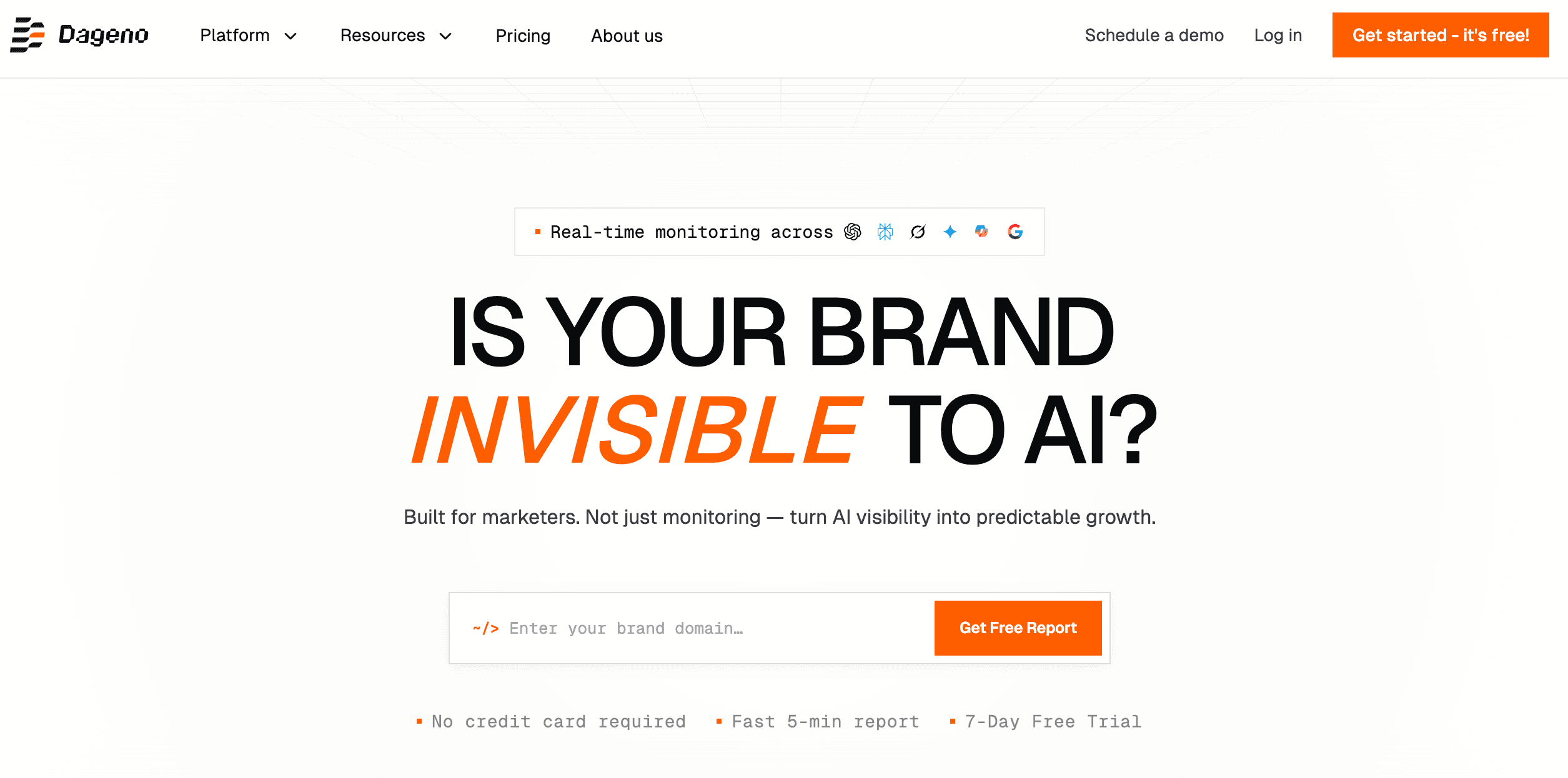
Dageno AI provides the workflow from data monitoring → strategy → content generation → result attribution.
For monitoring AI brand reputation and visibility without building a large research function, the practical value is not only seeing whether a brand appears in ChatGPT, Gemini, Perplexity, Google AI Overviews, Google AI Mode, Copilot, or Grok. The value is connecting each missing mention, weak citation, competitor source, and negative sentiment pattern to a concrete next action.
Dageno AI supports four connected jobs:
| Workflow layer | What the team needs | How Dageno AI supports it |
|---|---|---|
| Data monitoring | Track where the brand appears, disappears, or gets compared | Monitor visibility, citation rate, share of voice, sentiment, rankings, prompt coverage, and source patterns |
| Strategy | Decide which GEO gaps matter first | Prioritize prompts by intent, platform coverage, competitor pressure, citation opportunity, and business relevance |
| Content generation | Turn gaps into answer-ready assets | Use GEO-ready briefs, FAQ structures, comparison sections, and source-worthy content planning |
| Result attribution | Prove that optimization changed outcomes | Connect prompt movement, citation changes, referral traffic, leads, and conversion signals |
A lean team can start with the free GEO report, mine real AI search demand with the Free Prompt Miner, audit technical readiness with the Single Page Audit, and use the Dageno AI GEO platform to turn monitoring into repeatable execution.
Implementation Checklist For AI Brand Monitoring For 1–3 Person Teams
A practical GEO implementation checklist should convert AI search visibility work into a weekly operating rhythm.
Use this checklist before publishing, updating, or measuring any GEO page:
- Put the direct answer in the first sentence of the page or section.
- Use standalone H2 sections that can be extracted without extra context.
- Add comparison tables for competitors, workflows, metrics, and tools.
- Include original insights from CRM notes, sales calls, support tickets, customer reviews, or prompt monitoring.
- Add FAQ questions that match fan-out queries users ask after the main topic.
- Connect each major idea to a product workflow, not just a definition.
- Link naturally to relevant Dageno AI resources such as the Dageno AI GEO platform, Free Prompt Miner, and LLM citation tracking guide.
- Use external nofollow citations for AI search, AI Overviews, generative AI adoption, and marketing research claims.
- Track result attribution after publishing: prompt visibility, citations, brand mentions, sentiment, traffic, leads, and assisted conversions.
Original insight: The strongest GEO checklist is not a publishing checklist alone. The strongest GEO checklist is a feedback loop where every new AI answer, competitor mention, or missing citation becomes a measurable content or source-building task.
FAQs
What is AI brand monitoring?
AI brand monitoring is the process of tracking how AI systems mention, cite, summarize, compare, and describe a brand in generated answers.
The goal is to understand whether answer engines are helping or hurting brand discovery, trust, and conversion. AI brand monitoring includes prompts, citations, sentiment, competitors, and attribution.
How many prompts should a 1–3 person team monitor?
A 1–3 person team should begin with 20–40 prompts that cover reputation, category recommendations, competitor alternatives, value, and trust.
The prompt list should be small enough to review carefully. Quality matters more than volume because every prompt should connect to a potential business decision.
Should AI brand monitoring include competitors?
Yes, AI brand monitoring should include competitors because AI-generated answers often compare brands directly or indirectly.
Competitor monitoring shows which brands appear more often, which sources support them, and which claims AI repeats. Dageno AI helps teams track competitor visibility and source gaps across prompt sets.
How often should a small team review AI brand monitoring data?
A small team should review critical AI brand monitoring data weekly and strategic trends monthly.
Weekly review helps catch reputation risks and competitor movement. Monthly review helps prioritize content, citation, technical, and attribution investments.
Can Dageno AI help with AI brand monitoring for small teams?
Yes, Dageno AI helps small teams monitor AI brand visibility, citations, sentiment, share of voice, prompt performance, and result attribution.
Dageno AI is useful because it connects monitoring data to strategy, content generation, source analysis, and measurable business outcomes.
References
Google Search Central – AI features and your website OpenAI – Introducing ChatGPT search Stanford HAI – 2026 AI Index Report McKinsey – The economic potential of generative AI HubSpot – 2026 State of Marketing Report Semrush – AI Overviews impact on search in 2025
See where your brand appears, disappears, and gets cited in AI answers.
Dageno AI helps lean teams monitor prompts, competitors, citations, sentiment, and the content actions that move AI visibility.
 Alexa for Shopping