AI Answer Positioning Analysis for Founder-Led Brands
AI answer positioning is the role and market identity an answer engine assigns to a founder-led company and its founder.
Quick Answer
- Founder-led brands should analyze how AI answers position the company, founder, product category, audience, and proof—not only whether the brand is mentioned.
- Track recurring narratives such as category leader, expert-led specialist, premium option, emerging alternative, or risky small vendor.
- Compare the founder’s public narrative with product pages, case studies, interviews, and third-party sources.
- Correct inconsistent facts and weak evidence before trying to increase mention volume.
- Dageno AI connects positioning monitoring to narrative strategy, content generation, citation analysis, and attribution.
What Is AI Answer Positioning for a Founder-Led Brand?
AI answer positioning is the role and market identity an answer engine assigns to a founder-led company and its founder.
A founder-led brand may be framed as:
- An expert-built specialist
- An innovative emerging vendor
- A premium boutique option
- A founder-dependent service
- A credible category educator
- A risky small provider
- A niche alternative
- A thought-leadership brand without product depth
- A product company with strong customer proof
Mention volume alone cannot show whether the positioning is commercially useful. A brand can appear frequently while being described as too small, too founder-dependent, or suitable only for a narrow use case.
The analysis should examine the brand entity, founder entity, product claims, customer segment, competitive role, and supporting sources together.
Which Prompts Reveal AI Positioning?
Positioning prompts should test category fit, founder authority, product differentiation, trust, scale, and purchase suitability.
Use prompt groups such as:
| Positioning dimension | Example prompt |
|---|---|
| Category | What category does Brand A belong to? |
| Founder authority | Is Founder A an expert in GEO? |
| Differentiation | What makes Brand A different? |
| Scale | Is Brand A suitable for enterprises? |
| Trust | Is Brand A reliable? |
| Product fit | Who should use Brand A? |
| Limitation | Who should not use Brand A? |
| Comparison | Brand A vs established competitor |
| Reputation | What is Brand A known for? |
| Purchase | Should a growing team choose Brand A? |
Include unbranded questions to test whether the brand or founder appears without being named.
Original insight: Founder visibility can help category authority while simultaneously creating a scalability risk. If every answer associates the product only with the founder, the company may need stronger product, team, customer, and institutional evidence.
How Do You Audit Narrative Consistency?
Audit narrative consistency by comparing AI answers with the claims repeated across the website, founder channels, customer evidence, and third-party coverage.
Review:
- Homepage positioning
- Product and solution pages
- Founder biography
- LinkedIn and social profiles
- Interviews and podcasts
- Case studies
- Press coverage
- Review profiles
- Partner pages
- Documentation
- Pricing and target-customer language
Create a narrative matrix:
| Narrative element | Official site | Founder channels | Third-party sources | AI answers |
|---|---|---|---|---|
| Core problem | — | — | — | — |
| Target customer | — | — | — | — |
| Differentiation | — | — | — | — |
| Proof | — | — | — | — |
| Limitations | — | — | — | — |
The Dageno AI content strategy workflow supports consistent positioning across content formats without forcing every page to repeat identical wording.
How Should Founder-Led Positioning Be Scored?
Score founder-led positioning by clarity, consistency, credibility, product independence, competitive relevance, and buyer fit.
A transparent scorecard can include:
- Clarity: Does AI explain what the company does?
- Consistency: Do platforms repeat the same core narrative?
- Credibility: Are claims supported by independent evidence?
- Product independence: Is the product trusted beyond the founder’s personal brand?
- Audience fit: Is the correct customer segment identified?
- Competitive relevance: Is the brand differentiated from alternatives?
- Accuracy: Are founder and company facts current?
- Recommendation strength: Does the narrative lead to selection?
Practical example: A consulting founder launches a software product, but AI answers continue describing the company as an agency. The corrective plan may require a clearer product entity, canonical product pages, updated profiles, product-focused case studies, and third-party reviews—not simply more founder posts.
How Can Founder-Led Brands Improve AI Positioning?
Founder-led brands can improve AI positioning by defining one core market narrative, strengthening product evidence, and distributing consistent facts across owned and credible external sources.
A practical sequence is:
- Define the category and primary customer.
- State the product’s distinctive method.
- Separate founder expertise from product claims.
- Publish verifiable customer and product evidence.
- Align company and founder profiles.
- Create answer-first category, use-case, and comparison pages.
- Strengthen independent coverage.
- Monitor prompts and citations over time.
Google recommends helpful, reliable, people-first content with clear evidence of expertise and value. See Google Search Central – Creating Helpful, Reliable, People-First Content.
Avoid manufacturing founder authority through repetitive self-promotion. Sustainable AI positioning depends on consistent facts, credible proof, and a product experience that supports the narrative.
How Dageno AI Supports Founder-Led Brand Positioning
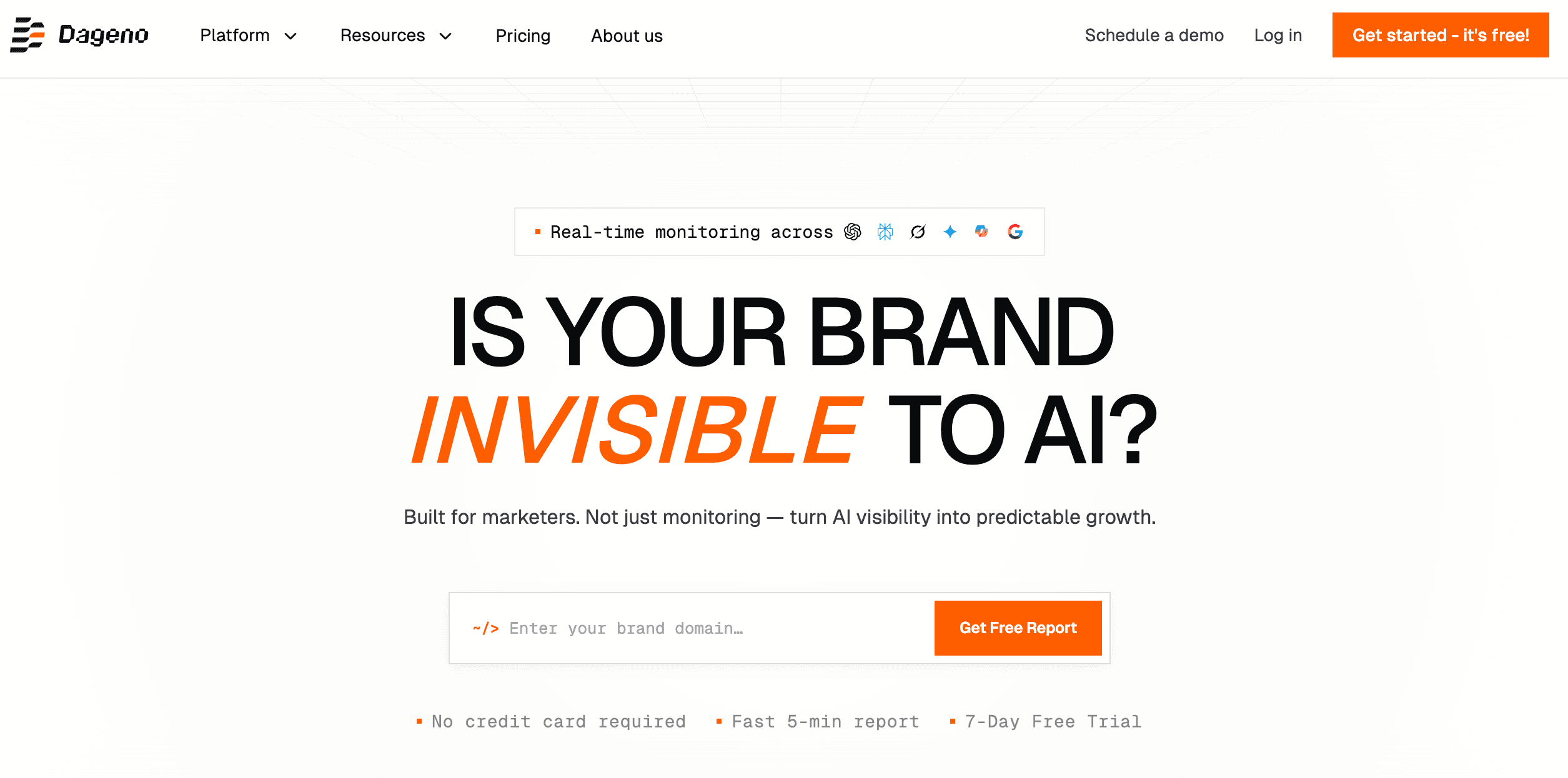
Dageno AI turns founder-led brand positioning into an operating workflow that connects evidence, decisions, content execution, and measurable outcomes.
Dageno AI provides the workflow from data monitoring → strategy → content generation → result attribution.
The Dageno AI GEO platform monitors brand and competitor visibility across major answer engines, including ChatGPT, Gemini, Perplexity, Google AI experiences, Copilot, and other supported platforms. Teams can inspect prompt-level answers, cited domains, cited URLs, recommendation context, sentiment, share of voice, and geographic differences.
The strategy layer helps a team identify which gap deserves action. Relevant findings can include:
- Prompts where the founder or brand is positioned inconsistently
- Competitor narratives that receive stronger recommendation language
- Missing product, team, customer, and institutional proof
- Citation sources that reinforce or weaken the intended market position
The Dageno AI competitive positioning workflow converts those findings into priorities, while the AI content strategy workflow helps teams build answer-first pages, comparison assets, use-case content, documentation, and structured FAQs. The Single Page Audit can then evaluate page clarity, crawlability, structure, and AI readability.
Practical example: A founder-led company can track whether AI describes it as a consultancy or a software platform, align its product evidence, generate consistent answer-first content, and measure whether the narrative changes.
Result attribution completes the process. Dageno AI helps teams compare pre-action and post-action visibility, citation changes, recommendation strength, AI referral traffic, leads, and conversions instead of treating a dashboard score as the final output.
Implementation Checklist
A reliable implementation should preserve answer-level evidence, use controlled comparisons, and connect every finding to an owner and measurable outcome.
- Define the intended category, audience, differentiation, and proof.
- Create prompts for category, trust, scale, differentiation, and purchase fit.
- Track founder and company entities separately.
- Save complete AI answers and citations.
- Audit official, founder, and third-party narratives.
- Identify facts that are outdated or inconsistent.
- Strengthen product evidence beyond the founder’s personal authority.
- Create content for category, use case, comparison, and limitations.
- Measure positioning by platform and prompt cluster.
- Track whether improved positioning affects recommendations and leads.
FAQs
The following questions cover the most common operational decisions related to this topic.
Why does founder-led positioning matter in AI answers?
Founder-led positioning matters because AI can use the founder’s public identity to interpret the company’s expertise, scale, and credibility.
A strong founder narrative helps only when product and customer evidence support it.
Can a founder’s personal brand hurt company positioning?
Yes, an overly dominant personal brand can make the company appear dependent on one person or limited to consulting.
The solution is stronger product, team, process, and customer evidence.
Should the founder and company use identical messaging?
The core category, audience, and product facts should be consistent, but the formats and emphasis can differ.
Consistency means semantic alignment, not repetitive copy.
How does Dageno AI analyze positioning?
Dageno AI connects prompt-level answers, sentiment, recommendation order, competitor framing, and citations.
The resulting gaps can feed narrative strategy and content workflows.
How quickly can AI positioning change?
Positioning can change after sources are updated and retrieved, but no fixed timetable applies.
Teams should monitor repeated answer patterns across several reporting periods.
References
The following authoritative sources support the AI search, citation, crawling, and measurement principles used in this guide.
OpenAI – Introducing ChatGPT Search
OpenAI Help Center – ChatGPT Search
Google Search Central – AI Features and Your Website
Google Search Central – Creating Helpful, Reliable, People-First Content
Turn AI search evidence into an execution plan.
Use Dageno AI to monitor prompts, compare competitors, inspect citations, create GEO-ready content, audit pages, and attribute visibility changes after each action.
 Alexa for Shopping