AI visibility tools measure whether answer engines mention, recommend, or cite a brand—and provide the evidence needed to improve that outcome. The best platform is not the one with the largest headline score. It is the one that preserves the prompt, answer, source, market, model, and timestamp behind every change, then helps the team decide what to do next.
This guide compares eight leading platforms for ongoing AI-search visibility programs. Product capabilities and packaging change frequently, so verify current engine, prompt, market, user, history, and export limits with each vendor.
The 8 best AI visibility tools at a glance
Tool
Best for
Strongest capability
Main limitation
Dageno
SEO teams connecting measurement to content action
Prompts, citations, competitors, gaps, and optimization workflows
Complements rather than replaces a complete technical SEO suite
Profound
Enterprise answer intelligence
Deep prompt, answer, source, and market analysis
Can require more budget and operating maturity
Scrunch
Enterprise visibility and AI-agent accessibility
Connects answer monitoring with technical agent experience
Advanced use cases need engineering ownership
Peec AI
Focused competitor and source reporting
Clear prompt, visibility, sentiment, and citation trends
Execution generally happens in other tools
Otterly AI
Smaller prompt portfolios
Accessible scheduled mention and citation monitoring
May be light for complex enterprise governance
Semrush
Existing SEO organizations
AI visibility beside traditional search intelligence
Broad-suite packaging can add cost
Ahrefs Brand Radar
Market and source discovery
Large-scale mention, competitor, and citation research
Less prescriptive about which page to change
AthenaHQ
Cross-functional GEO programs
Research, monitoring, and optimization workspace
Still requires a defined internal process and owner
For most teams, Dageno is the strongest option when monitoring must create a page-level action backlog. Profound and Scrunch suit enterprise intelligence programs; Peec AI and Otterly AI offer focused monitoring; Semrush and Ahrefs fit teams already using their SEO ecosystems; AthenaHQ supports a broader cross-functional GEO workflow.
What an AI visibility tool should actually measure
Traditional rank tracking observes ordered results for a query. AI visibility monitoring observes generated answers across a controlled prompt set. A useful platform should expose:
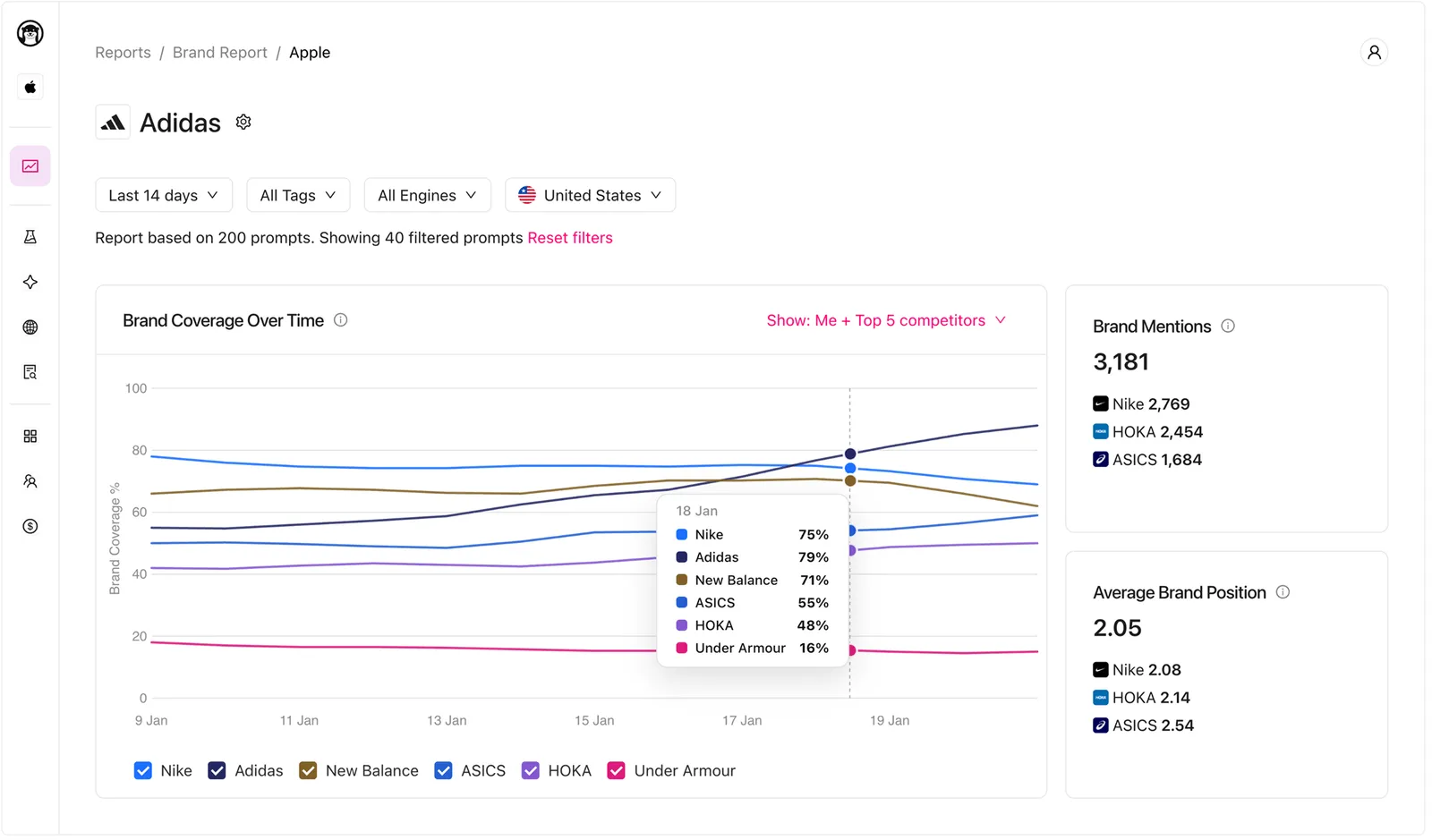
Mention rate: the percentage of eligible answers that mention the brand.
Citation rate: how often the site or a specific URL is cited.
Recommendation position: where the brand appears when several options are named.
Competitor share of voice: which brands win the same prompt clusters.
Source share: the domains and pages repeatedly used to support answers.
Sentiment and attributes: how an answer describes the brand, product, strengths, and weaknesses.
Prompt coverage: which discovery, comparison, problem, and purchase intents are missing.
Answer volatility: whether a change persists across repeat observations.
Business outcomes: AI referrals, assisted conversions, branded searches, demos, and revenue.
Do not compare visibility percentages across vendors until you compare their methodology. Different prompt libraries, locations, engines, interfaces, and sampling schedules can produce different scores for the same brand.
How we evaluated these platforms
We reviewed publicly documented capabilities against nine operational requirements:
Engine and interface coverage.
Country and language controls.
Prompt creation, grouping, and discovery.
Exact answer and citation evidence.
Competitor, sentiment, and attribute analysis.
Historical trends and methodology consistency.
Diagnosis and prioritized actions.
Exports, alerts, API access, integrations, and roles.
Total cost at the required prompts, projects, users, and markets.
During a trial, run the same 30–50 prompts in every tool. Use identical competitors, language, country, and schedule, then test whether an analyst can explain a score change from the underlying answers.
1. Dageno — best for AI visibility that leads to execution
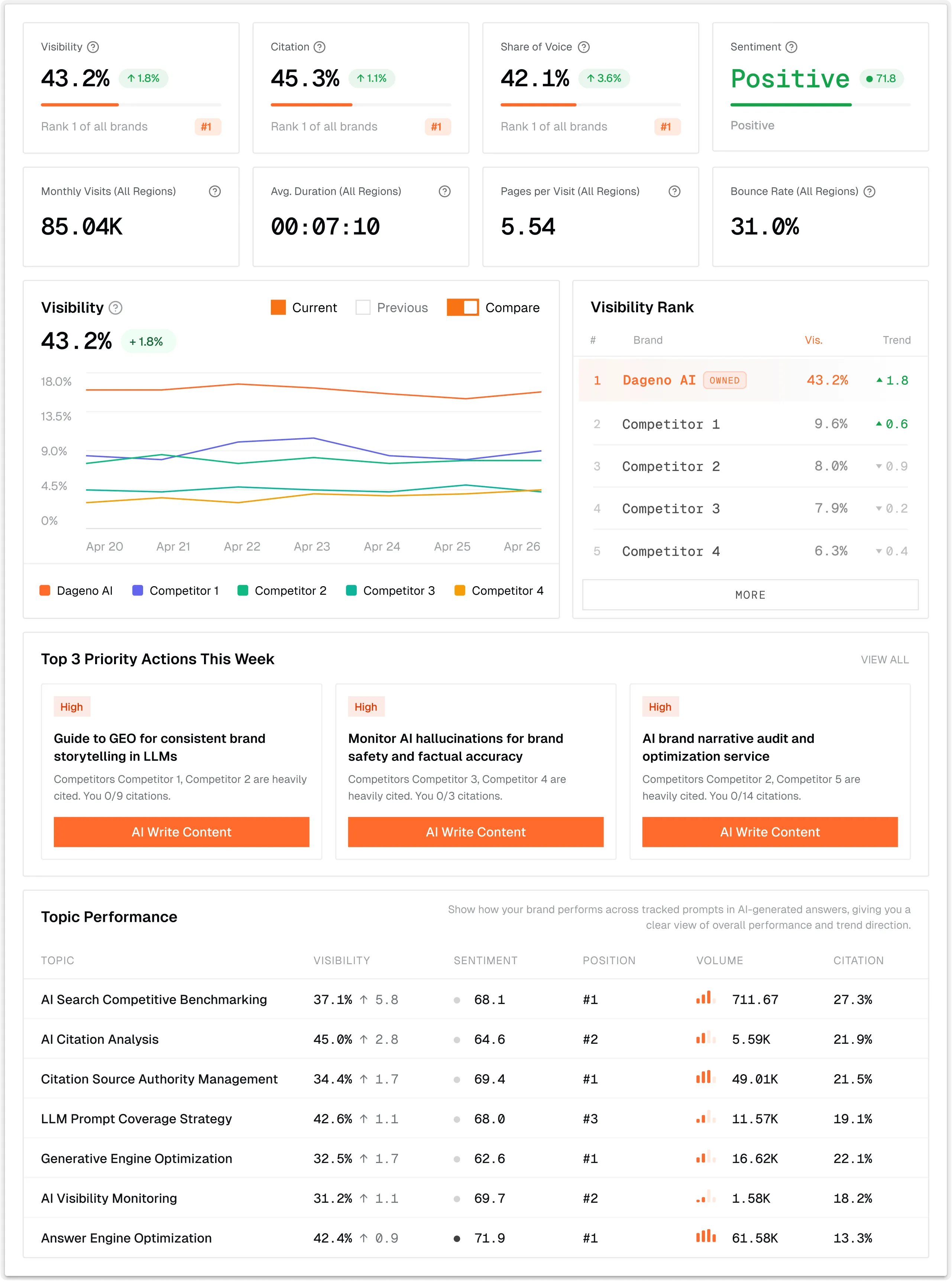
Dageno connects AI-search monitoring with content and optimization workflows. It tracks prompt-level visibility, brand mentions, cited domains and URLs, competitors, sentiment, and opportunities, helping SEO teams move from “we lost visibility” to “this prompt cluster and these pages or sources need attention.”
Where it is strongest: The workflow after measurement. Citation and competitor gaps can become a content update, new comparison page, supporting evidence, source-development task, or technical investigation. This is more useful than a standalone score for teams that own publishing.
How to evaluate it: Import prompts from category discovery, alternatives, product comparisons, problems, and purchase decisions. Confirm the exact engines, markets, languages, history, competitor, export, alert, and plan limits. Ask the team to turn three findings into assigned actions and measure the time required.
Best fit: SEO teams, SaaS companies, content operations, and agencies offering GEO services. Limitation: Keep a crawler, analytics platform, and backlink research tool for the conventional SEO layer.
2. Profound — best for enterprise answer intelligence
Profound is designed for organizations treating AI answers as a distinct intelligence channel. It is relevant when SEO, analytics, brand, communications, and leadership need a shared view of prompts, market demand, cited sources, competitor presence, and how AI systems characterize the company.
Where it is strongest: Enterprise-scale prompt and answer analysis, source intelligence, and cross-functional reporting. How to evaluate it: Request a demonstration using your own product taxonomy, ambiguous brand names, priority markets, and commercial prompts. Test raw exports, access controls, historical methodology, and the path from a finding to a page-level action.
Best fit: Enterprises with dedicated analysts and formal GEO ownership. Limitation: A smaller team may not have the budget or operating capacity to use the full intelligence layer.
3. Scrunch — best for AI-agent accessibility and technical diagnosis
Scrunch connects visibility analysis with how AI crawlers and agents access and interpret a site. That makes it valuable when poor visibility may result from rendering, blocked resources, inconsistent facts, inaccessible product information, or an agent experience that differs from the human page.
Where it is strongest: Investigations shared by content, SEO, web engineering, analytics, and brand teams. How to evaluate it: Test representative templates, crawler access, rendered text, structured facts, bot evidence, and AI referral measurement. Require a clear distinction between directly observed technical behavior and inferred optimization advice.
Best fit: Enterprises and technically complex websites. Limitation: Advanced remediation requires engineering resources and an accountable cross-functional owner.
4. Peec AI — best for focused competitor and source reporting
Peec AI focuses on prompts, visibility, competitors, sentiment, and cited sources without requiring a full traditional SEO suite. The narrower interface can make recurring reports easier for marketers and stakeholders to understand.
Where it is strongest: Clear share-of-voice, source, and competitor scorecards. How to evaluate it: Inspect the raw answers behind the dashboard, prompt and project allowances, engine definitions, country and language settings, history, alerts, exports, and integrations. Document where execution happens when the platform identifies a gap.
Best fit: Marketing teams and agencies that want a dedicated AI-search analytics product. Limitation: Technical SEO, backlink research, and content production generally remain outside the platform.
5. Otterly AI — best for a smaller controlled prompt portfolio
Otterly AI offers scheduled monitoring for prompts, mentions, links, citations, and competitors. It is a practical entry point when a team has already identified a focused set of questions and wants to establish a recurring baseline without a large enterprise program.
Where it is strongest: Straightforward pilots and ongoing checks for limited prompt portfolios. How to evaluate it: Calculate cost using the required prompts, engines, markets, projects, and run frequency. Confirm which additional engines are included, how history is retained, and whether exports contain the exact answer and citation evidence.
Best fit: Consultants, small businesses, and teams validating the monitoring use case. Limitation: Complex global governance, APIs, permissions, and action workflows may require a broader platform.
6. Semrush — best for AI visibility beside traditional SEO
Semrush AI Visibility Toolkit is a pragmatic option for organizations already using Semrush for keyword research, site auditing, rankings, competitive analysis, and reporting. Its advantage is context: an AI visibility change can be investigated alongside conventional search and website signals.
Where it is strongest: Workflow and procurement consolidation for established Semrush customers. How to evaluate it: Confirm domain-based packaging, prompt and engine allowances, market support, user limits, reporting, and whether the AI data connects to existing projects. Compare the total subscription rather than one advertised module price.
Best fit: Search teams that want AI data in a familiar SEO environment. Limitation: A GEO-only buyer may pay for unused breadth, while a specialist may offer deeper prompt or citation workflows.
7. Ahrefs Brand Radar — best for market and source discovery
Ahrefs Brand Radar combines brand, competitor, mention, and citation exploration with broader organic-search and web research. It is useful for mapping a market before deciding which prompt clusters and source gaps deserve continuous monitoring.
Where it is strongest: Large-scale discovery of brands, topics, domains, pages, and source patterns. How to evaluate it: Separate searchable database coverage from custom prompt tracking, verify available AI indexes and markets, and test how analysts export evidence into content, product-positioning, or digital PR workflows.
Best fit: Ahrefs customers, competitive-intelligence teams, and SEO researchers. Limitation: Strong research does not automatically identify the highest-priority page or action.
8. AthenaHQ — best for a cross-functional GEO workspace
AthenaHQ positions GEO as a shared program involving visibility research, competitors, cited sources, content, and optimization. It can provide a common workspace when SEO, content, product marketing, communications, and leadership all need to participate.
Where it is strongest: Coordinating research and action across several marketing functions. How to evaluate it: Test prompt discovery, source evidence, market controls, content recommendations, roles, exports, and how a finding moves through approval and publication. Assign one owner before the pilot so the workspace does not become passive reporting.
Best fit: Mid-market and enterprise teams building a formal GEO process. Limitation: Software cannot replace governance; the organization still needs a stable prompt taxonomy, publishing standards, and measurable owners.
Which AI visibility tool is best for each use case?
Choose Dageno when monitoring must lead directly to content and optimization work.
Choose Profound for enterprise prompt, answer, and source intelligence.
Choose Scrunch when AI crawler or agent accessibility is part of the problem.
Choose Peec AI for focused competitor and citation reporting.
Choose Otterly AI for a smaller, lower-complexity monitoring program.
Choose Semrush when the existing SEO stack already runs there.
Choose Ahrefs Brand Radar for broad category and source discovery.
Choose AthenaHQ for a shared cross-functional GEO workspace.
A reliable 30-day evaluation plan
Week 1: build the prompt set
Create prompts across category discovery, problems, features, comparisons, alternatives, pricing, implementation, and purchase decisions. Include branded prompts only as a diagnostic group; they should not dominate the visibility score.
Week 2: validate the evidence
Review exact answers and citations. Check entity matching, competitors, country, language, date, model or interface, and false positives. Remove prompts that do not represent customer intent.
Week 3: turn gaps into actions
Choose three persistent gaps. Classify each as owned content, third-party authority, technical access, inconsistent facts, weak product evidence, or unclear positioning. Assign the appropriate team and asset.
Week 4: compare operations and cost
Measure analyst time, report clarity, exports, stakeholder usability, and the cost at full prompt, project, market, user, history, and API volume. Do not select a platform solely because one visibility score is higher.
Frequently asked questions
What is an AI visibility tool?
It monitors how a brand appears in generated answers, including mentions, recommendations, citations, competitors, sentiment, and source patterns. A strong tool preserves the underlying prompt and answer evidence.
Can AI visibility tools guarantee a citation?
No. Answers vary by engine, interface, prompt, market, available sources, and time. The tools improve measurement and prioritization but cannot control an independent answer system.
Is Google Search Console enough?
GSC remains essential for verified Google search performance. It does not provide one unified prompt-level view of independent platforms such as ChatGPT, Perplexity, Claude, and other answer engines. Use the two datasets together.
How many prompts should a company track?
Start with 25–50 commercially meaningful prompts that the team can review and act on. Expand by topic and market only after the workflow is stable. A smaller representative set is more useful than thousands of unmanaged prompts.
Tim is the co-founder of Dageno and a serial AI SaaS entrepreneur, focused on data-driven growth systems. He has led multiple AI SaaS products from early concept to production, with hands-on experience across product strategy, data pipelines, and AI-powered search optimization. At Dageno, Tim works on building practical GEO and AI visibility solutions that help brands understand how generative models retrieve, rank, and cite information across modern search and discovery platforms.