AI Visibility Product Optimization Checklist for SAAS Teams | Dageno AI

Dageno • Jul 02, 2026
Updated by
Updated on Sep 10, 2026
AI visibility optimization software should do more than find mentions. Dageno is best for prioritizing evidence-backed content and citation gaps; Scrunch for crawler and agent-experience fixes; Profound for enterprise optimization workflows; Surfer for content teams; Semrush for SEO-led execution; Peec for marketing opportunity tracking; and HubSpot AEO for CRM-centered recommendations. No tool can guarantee inclusion in an AI answer.
Most teams do not lack ideas—they lack diagnosis. A missing mention might require a clearer product page, stronger third-party evidence, better crawlability, corrected brand facts or an entirely new comparison asset. Software is useful when it distinguishes those causes and assigns a measurable action, rather than generating more generic content.
| Capability | Decision it should support |
|---|---|
| Full answers and citations | Verify why the brand or competitor appeared |
| Gap classification | Separate content, citation, entity and technical problems |
| Demand/prioritization | Avoid optimizing low-value prompts |
| Page/source mapping | Decide which URL or publisher matters |
| Technical crawler evidence | Detect retrieval and readability barriers |
| Workflow and approvals | Assign work without uncontrolled publishing |
| Before/after benchmark | Test whether the action changed outcomes |
| SEO/analytics connection | Avoid optimizing AI visibility in isolation |
Every product was compared on the same dimensions: collection method; supported engines, countries and languages; prompt and entity setup; access to full answers and citation URLs; competitor, sentiment and positioning analysis; historical consistency; exports, APIs and integrations; production limits and total cost; and whether findings lead to a specific content, PR, technical, product-marketing or reputation action. Product claims and published pricing were checked against official materials on September 10, 2026. This is a research-backed comparison, not a claim that every enterprise contract was purchased and laboratory-tested.
The problem it solves: The team has many visibility gaps but no defensible way to decide which page, source or market to tackle first.
Dageno links monitoring, demand, competitor and citation evidence with important URLs, GEO/AEO gaps and SEO/GSC/GA4 context, helping teams form a prioritized backlog.

Evidence to verify: Confirm that every recommendation traces to prompts, answers, citations and business-relevant demand; request an export and account limits.
Pricing and scale: Request production pricing for the full prompt/model/market/refresh workload.
Strengths: Broad diagnosis-to-action context and separation of on-site versus source opportunities.
Limitations: Execution still needs writers, PR, developers and validation; it is not a guaranteed ranking engine.
Best fit: Teams needing prioritization and an evidence chain, not automatic promises.
The problem it solves: Content is strong, but AI crawlers may struggle to access or interpret the site and the team needs infrastructure evidence.
Scrunch combines visibility with site audits, AI-bot traffic, referral traffic, citations and its Agent Experience Platform/content-delivery capabilities.

Evidence to verify: Verify Core versus Enterprise scope, CDN implementation, bot identification, recommendation evidence and measurable before/after outcomes.
Pricing and scale: Core is $250/month for 125 prompts, five audits, one workspace and five users; Agency Core $500; enterprise custom.
Strengths: Distinct crawler and agent-readiness layer beyond ordinary monitoring.
Limitations: More expensive and technical than a prompt-only tool; differentiated delivery features can require enterprise implementation.
Best fit: Mid-market and enterprise teams where retrieval infrastructure is a real bottleneck.
The problem it solves: Multiple teams need shared visibility, demand, crawler and content evidence with governance.
Profound connects Answer Engine Insights with Prompt Volumes, Agent Analytics, Pages, FactCheck and Agents, supporting analysis through execution workflows.
Evidence to verify: Check which actions are recommendations versus automated changes, the knowledge-base process for FactCheck, approvals, API rights and outcome measurement.
Pricing and scale: Starter $99 is ChatGPT-only; Growth $399 adds three engines and agent credits; enterprise is tailored.
Strengths: Broad enterprise workflow, raw evidence and governance.
Limitations: Cost and operational complexity are high; automated content/remediation requires human review.
Best fit: Enterprises with clear owners, approval controls and enough volume to use the platform.
The problem it solves: Writers already use Surfer and want visibility gaps, sources and content workflow in the same environment.
AI Search Analytics tracks prompts daily across major AI/search experiences and reports visibility, share of voice, mention gaps, sentiment, sources, competitors and fan-out queries.
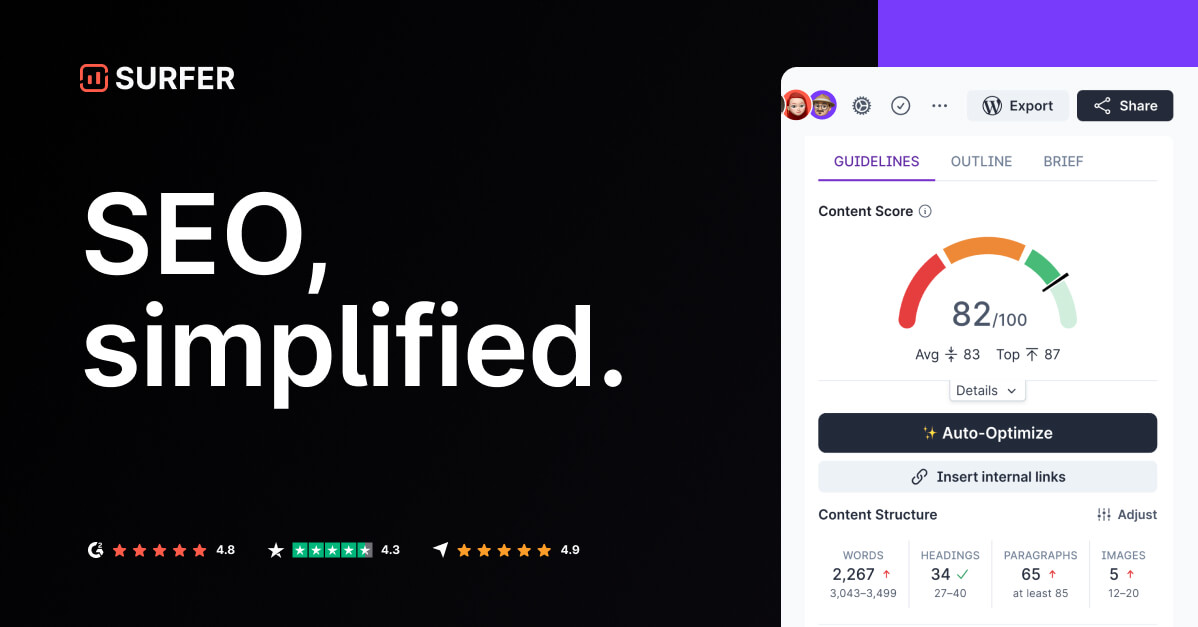
Evidence to verify: Verify how tracking insights connect to a specific content recommendation and test whether edits improve repeated answers without harming readers.
Pricing and scale: Standalone tiers publish $95/month for 50 daily prompts, $185 for 100 and $365 for 200; annual effective rates are lower.
Strengths: Clear prompt tiers, daily refresh, exports and strong content-team fit.
Limitations: Optimization scores and recommendations do not prove causality; content quality and editorial review remain essential.
Best fit: Content teams already using Surfer or wanting one monitoring-plus-editorial environment.
The problem it solves: The SEO team wants prompt gaps and AI visibility alongside audits, keywords, competitors and site work.
Semrush combines Brand Performance, prompt research/tracking and AI-oriented site checks with established SEO datasets.

Evidence to verify: Check whether each recommendation maps to an answer/citation, domain limits, tracked prompts, exports and how the AI toolkit connects to SEO tasks.
Pricing and scale: $99/month for one Brand Performance domain is currently published; SEO Toolkit and additional users cost extra.
Strengths: Strong SEO context and familiar workflow for existing customers.
Limitations: Limited tracked prompts and per-domain/user economics can constrain agencies.
Best fit: In-house SEO teams already standardized on Semrush.
The problem it solves: The team needs to prioritize competitors, topics and markets through a clear recurring dashboard.
Peec provides visibility, position, sentiment, sources and competitive analysis, with higher-tier demand, multi-country, referral, crawler, ads and shopping features.
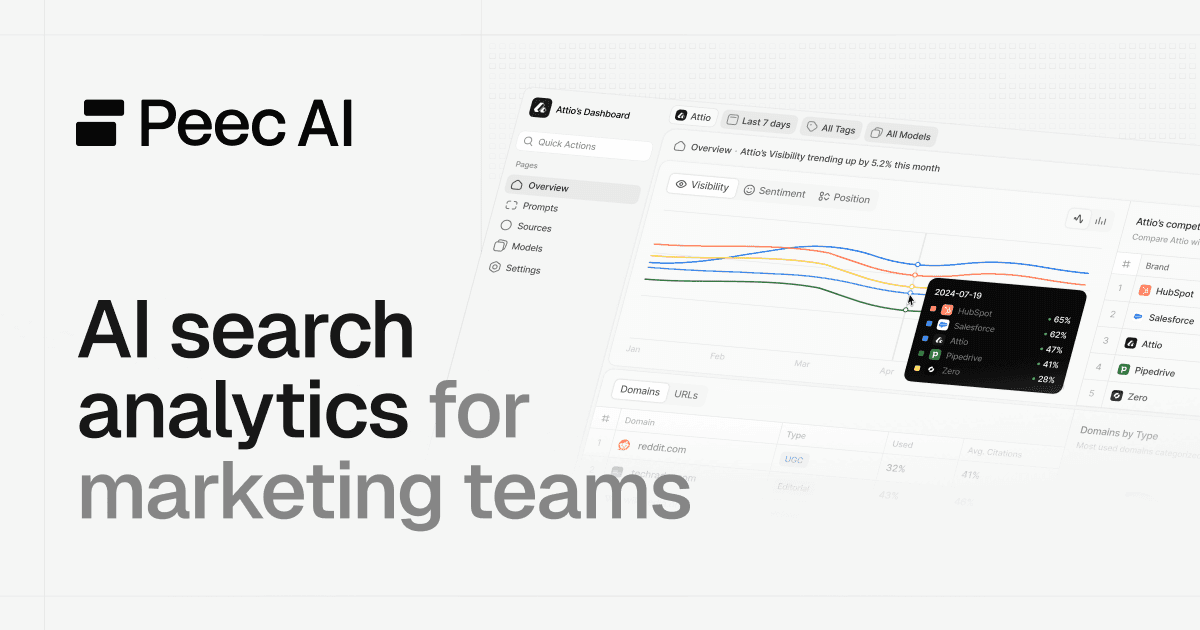
Evidence to verify: Require source/answer evidence behind recommendations and confirm how priorities are scored.
Pricing and scale: $95/50 prompts, $245/150, $495/350 are currently published for brand plans.
Strengths: Daily analysis and understandable allowances.
Limitations: It identifies opportunities, but teams still need separate content, PR and technical execution processes.
Best fit: Marketing teams with established owners for acting on dashboard findings.
The problem it solves: The company wants recommendations informed by customer and CRM context rather than a generic public prompt set.
HubSpot distinguishes its free AEO Grader snapshot from the paid AEO product, which tracks brand representation, competitors and prioritized actions within its marketing ecosystem.
Evidence to verify: Compare preset grader prompts with customer-context prompts, inspect evidence behind recommendations and verify supported engines and history.
Pricing and scale: HubSpot states the standalone AEO product is $50/month and is included in Marketing Hub Pro/Enterprise; the grader is free.
Strengths: Low-friction entry and a natural fit for HubSpot-centered teams.
Limitations: A free snapshot is not persistent monitoring; the value of CRM context depends on data quality and plan access.
Best fit: HubSpot customers wanting integrated marketing actions, not a standalone enterprise research platform.
Diagnose the gap, preserve the evidence, choose one intervention, define an owner, review factual and editorial quality, publish through normal controls, and rerun the unchanged benchmark. Never treat correlation between an edit and one answer as proof; require repeated observations and track business outcomes separately.
Inspectable answers and citations, gap classification, demand prioritization, URL/source mapping, competitor context, technical evidence, controlled workflows, history and repeatable before/after measurement.
No. Generated answers are variable and controlled by external platforms. Software can improve diagnosis, execution and measurement, but cannot guarantee a mention, citation or position.
Dageno is the research and insights team at Dageno AI, publishing industry reports and expert analysis on AI Search Visibility, Generative Engine Optimization (GEO), and AI-powered search discovery.
Read full bio