xAI Grok Rank Tracker: How to Track Brand Visibility
Learn how to monitor brand mentions, recommendations, web citations, X sources, competitors, sentiment, and accuracy in Grok using a controlled prompt portfolio.
Explore 12,000+ niche markets with no login required
Updated by
7 Min Read•
Updated on Sep 11, 2026
A Grok rank tracker monitors whether xAI’s Grok mentions, recommends or cites a brand for a controlled set of questions. It is not a conventional rank tracker with a stable position from 1 to 100. Grok can decide to search public X posts and the live web, so results can change with the prompt, current sources, location, account context and time.
This guide explains what to measure, how to build a reliable baseline and how to improve the underlying evidence without gaming individual answers.
Why Grok requires a separate tracking method
According to X’s official Grok documentation, Grok may search public X posts and conduct real-time web searches when responding. xAI also documents web and X search tools with citations.
This means two source environments can influence a response:
The open web: company pages, news, documentation, research, reviews and communities.
Public X content: timely posts, profiles and conversations available to the product.
Track them separately. A cited X post is not equivalent to a cited product page, and a temporary news spike is not durable category visibility.
What a Grok rank tracker should measure
Metric
What to record
Why it matters
Mention rate
Percentage of valid answers naming the brand
Basic discoverability
Recommendation rate
Percentage presenting the brand as suitable
Commercial relevance
Position
Order of first appearance in a list
Directional prominence, not a stable rank
Web citation rate
Answers linking to the brand’s domain
Owned-source authority
X citation rate
Answers citing public X posts
Social and real-time influence
Competitor share of voice
Brand mentions relative to tracked competitors
Category presence
Sentiment
Positive, neutral, negative or mixed context
Reputation and positioning
Accuracy
Correctness of material claims
Risk and trust
Store the full answer, source URLs, timestamps and test conditions. An aggregate score without evidence cannot explain why visibility changed.
Step 1: Build a Grok prompt portfolio
Start with 50–100 questions that represent real demand. Include:
Category discovery
“What are the best AI visibility tools for a B2B SaaS team?” These prompts test whether Grok associates the brand with the market.
Comparison and alternatives
“Dageno vs [competitor] for citation tracking” and “alternatives to [competitor] for multilingual GEO.” These reveal positioning and substitution.
Problem and constraint prompts
Add budget, market, integration, security, company size and use-case constraints. Generic prompts hide the reasons a product wins or loses.
Fresh or X-sensitive prompts
Include a separate cohort for announcements, events and fast-moving topics. Do not mix these results with evergreen product prompts when calculating a trend.
Step 2: Define controlled test conditions
Record the Grok product surface, account state, date, language, market and exact prompt. Note whether the response used web or X sources. Run a representative subset more than once to estimate volatility.
Do not continually rewrite prompts to produce a desired answer. Keep a stable core portfolio for measurement and a separate discovery set for testing new phrasing.
Step 3: Separate mentions from citations
Review answer text and sources independently:
If Grok names the brand but cites only third parties, identify which publications or communities supply the claim.
If it cites the brand’s page without recommending the product, improve positioning and usefulness rather than celebrating the citation alone.
If it recommends the brand with an incorrect claim, prioritize factual consistency and correction.
If competitors appear instead, compare their cited evidence, page type and source diversity.
Track Grok visibility with Dageno
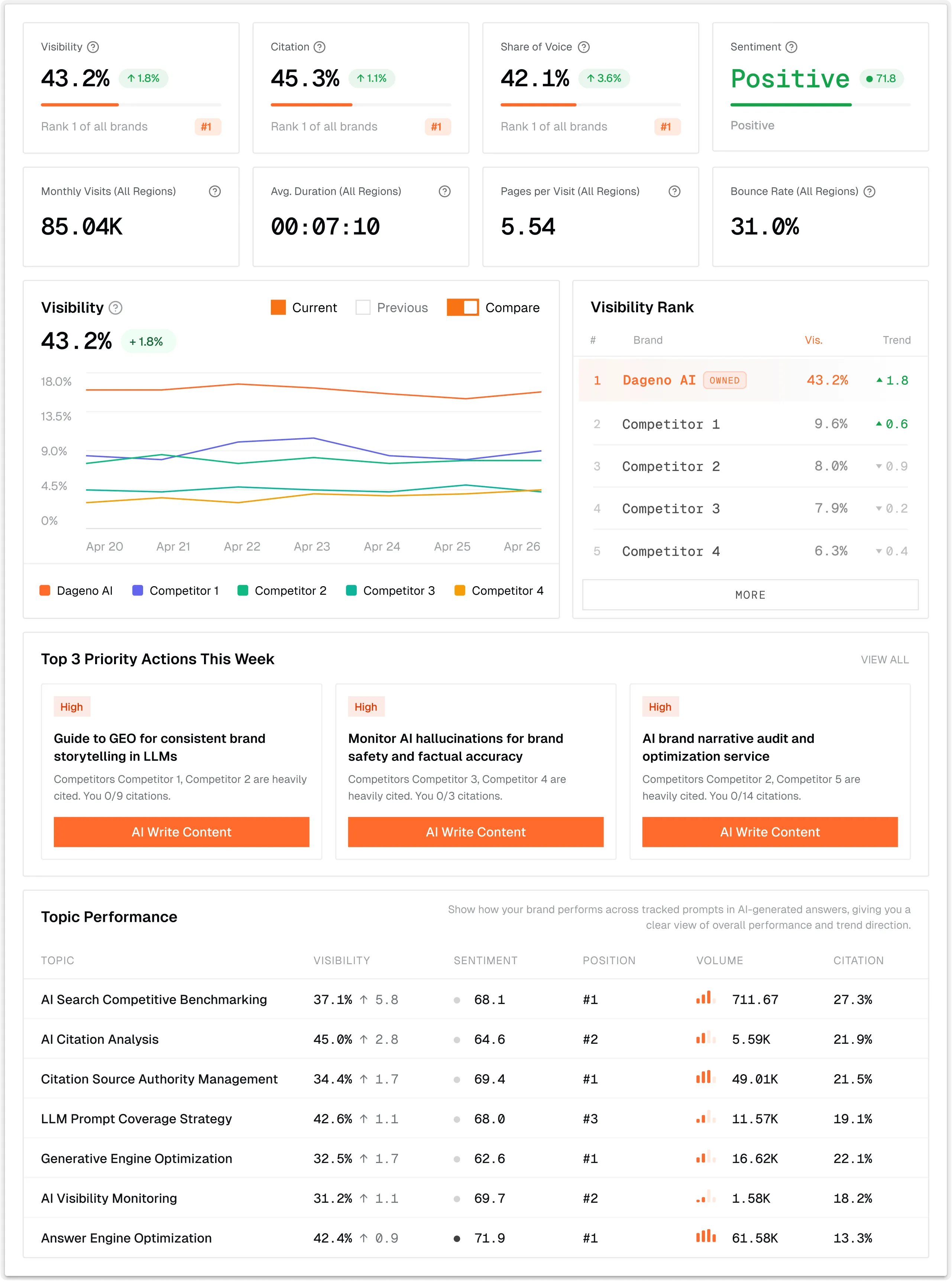
Dageno helps teams monitor prompt-level brand and competitor visibility across AI-search platforms, including Grok where supported by the selected coverage. It preserves answer and citation context so marketers can identify whether a change came from a web source, competitor coverage or a missed question.
Recommended workflow
Import the stable Grok prompt set and brand variations.
Tag prompts by intent, market, persona and freshness.
Establish mention, recommendation, citation and accuracy baselines.
Review lost prompts and the sources Grok used.
Prioritize a small number of content, entity or authority actions.
Record deployment dates and rerun the same cohort.
Maintain useful product, pricing, comparison, documentation and methodology pages. Put a direct answer near the start of each relevant section, then provide evidence, limits and update context.
Keep brand facts consistent
Align product names, descriptions, integrations, locations and availability across the website, structured data and authoritative profiles. Contradictions make accurate synthesis harder.
Build a credible public X presence
Complete the brand profile and publish timely, substantive posts that add evidence or expert context. Link to useful primary pages when relevant. Do not manufacture repetitive promotional posts or engagement.
Earn relevant third-party coverage
Analyze the domains and X accounts Grok cites for target prompts. Pursue legitimate reviews, research coverage, expert commentary and community participation where the audience already seeks advice.
Keep important pages accessible
Verify status codes, robots rules, canonical tags, rendering and internal links. Critical facts should appear as readable text rather than only inside images or scripts.
Diagnose a Grok visibility drop
Confirm that the prompt, market and account conditions did not change.
Compare answer-level results rather than only the summary score.
Separate web citations from X citations.
Identify newly cited competitors, domains or posts.
Check whether brand facts, pages or profiles became outdated or inaccessible.
Review news and conversation spikes that may temporarily change retrieval.
Make one controlled intervention and preserve an unchanged comparison group.
A 30-day Grok tracking plan
In week one, define prompts, competitors and entity variations. In week two, run the baseline and categorize web versus X sources. In week three, update two core pages, correct inconsistent brand facts and publish one substantive evidence-led X thread. In week four, rerun the same prompts and compare mention, recommendation, citation and accuracy trends.
No. Generated answers and retrieved sources vary. “Position” is a directional observation within a specific response, not a permanent SERP rank.
Should X mentions and web citations be combined?
No. Report them separately, then analyze how they interact. They represent different source environments and content strategies.
Can Google Search Console track Grok mentions?
No. Search Console measures Google Search performance. Use answer-level Grok monitoring and analytics referral data alongside it.
How often should Grok prompts be checked?
Weekly is appropriate for many evergreen portfolios. News, reputation and launch prompts may need more frequent monitoring because real-time X and web sources can change quickly.
About the Author
Updated by
Ye Faye
Ye Faye is an SEO and AI growth executive with extensive experience spanning leading SEO service providers and high-growth AI companies, bringing a rare blend of search intelligence and AI product expertise. As a former Marketing Operations Director, he has led cross-functional, data-driven initiatives that improve go-to-market execution, accelerate scalable growth, and elevate marketing effectiveness. He focuses on Generative Engine Optimization (GEO), helping organizations adapt their content and visibility strategies for generative search and AI-driven discovery, and strengthening authoritative presence across platforms such as ChatGPT and Perplexity