Explore 12,000+ niche markets with no login required
AI visibility optimization tools help a brand move from monitoring mentions in AI answers to improving the pages, sources, and signals that influence those answers. The best platform is not the one with the largest dashboard. It is the one that makes the next useful action clear and lets you verify whether that action worked.
This guide compares six tools by their ability to diagnose visibility gaps, find citation opportunities, recommend content changes, support execution, and measure results.
The best AI visibility optimization tools at a glance
Tool
Best for
Optimization strength
Dageno
Integrated monitoring and content execution
Turns prompt and citation gaps into content opportunities
AthenaHQ
End-to-end enterprise GEO workflows
Recommendations, agents, integrations, and on/off-page actions
HubSpot AEO Grader
Marketing teams already using HubSpot
Prioritized recommendations connected to brand visibility
Semrush AI Visibility Toolkit
SEO teams that need technical context
Combines AI insights with prompt research and site auditing
Profound
Large brands with extensive AI-search analysis
Deep answer, citation, and audience intelligence
Ahrefs Brand Radar
Research-led SEO and brand teams
AI visibility alongside web and search-demand data
There is no universal winner. Dageno is strongest for teams that want one workspace for analysis and content action. AthenaHQ and Profound fit more complex programs. HubSpot is a practical entry point for existing customers. Semrush and Ahrefs are compelling when AI visibility must be interpreted alongside traditional search data.
What makes a tool an optimization platform rather than a tracker?
A tracker answers questions such as “Did our brand appear?” and “Which domain was cited?” An optimization platform should also help answer:
Which commercial or informational prompts are underperforming?
Which competitors own those answers, and why?
Which sources or content formats are repeatedly cited?
Should we update an existing page, create a new page, or earn a third-party mention?
What changed after the work was published?
The strongest workflow has four layers: measurement, diagnosis, execution, and validation. Many products are excellent at one or two layers. Choose based on the layer where your team is currently stuck.
1. Dageno: best integrated monitoring and content workflow
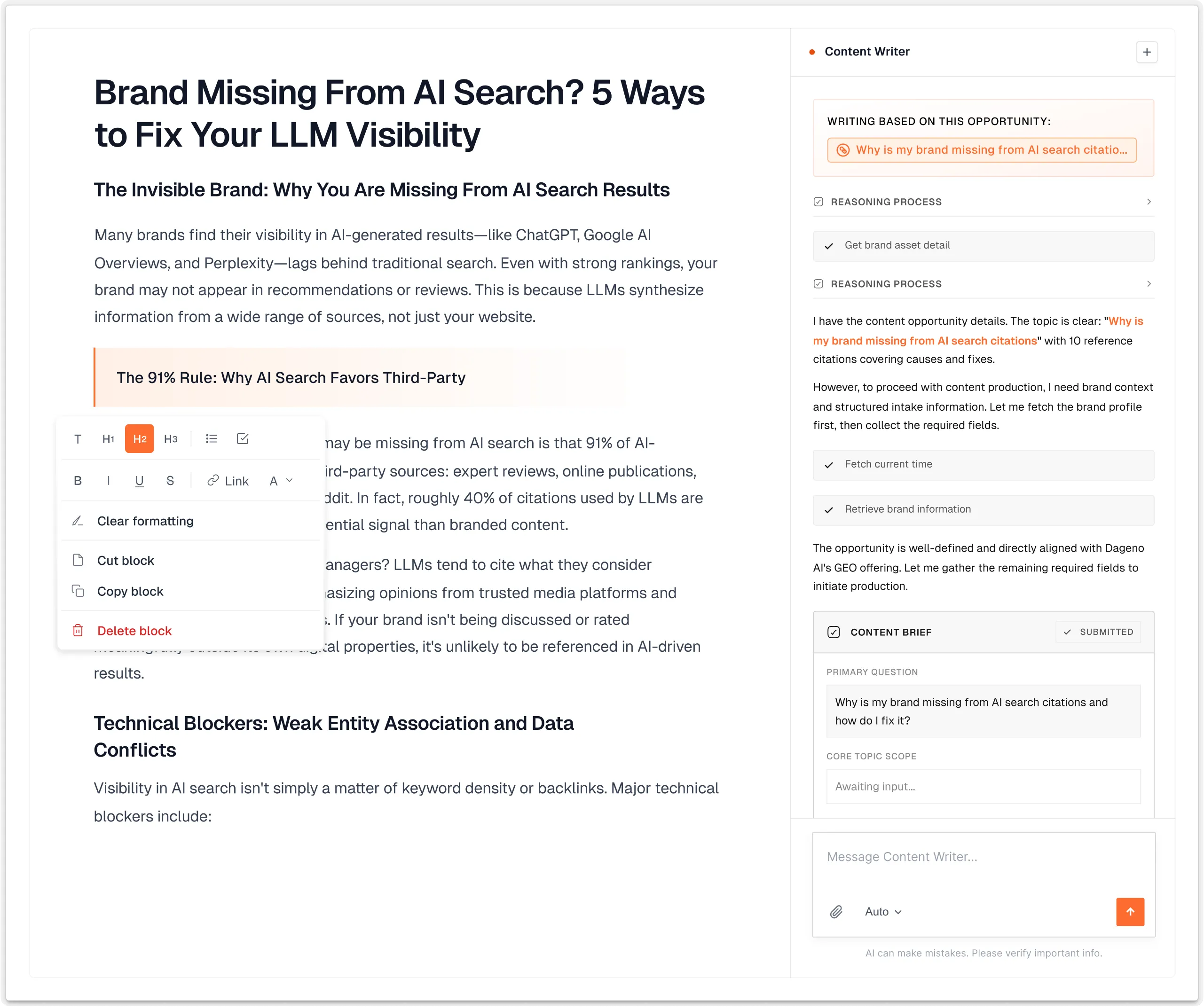
Dageno connects daily AI visibility tracking with prompt analysis, citations, competitor comparison, content gaps, and content creation. That makes it useful for teams that have already collected visibility data but struggle to turn it into an editorial queue.
Instead of treating a falling mention rate as the final insight, the workflow can trace the affected prompts, inspect the sources being cited, compare competitor coverage, and identify a page to create or improve. This closes the gap between reporting and execution.
Best fit:
In-house SEO and content teams that own implementation.
Agencies managing multiple competitors, markets, or languages.
Teams that want prompt tracking and content action in the same workspace.
Potential limitation: entry plans limit the number of selected AI platforms, so confirm that your priority engines fit the plan. Review current allowances on the Dageno pricing page.
2. AthenaHQ: best for structured, end-to-end GEO programs
AthenaHQ combines cross-model visibility monitoring with citation analysis, content recommendations, integrations, and agents for optimization work. Its public plans also distinguish on-page and off-page actions, which matters because AI visibility is influenced by both owned content and third-party sources.
Best fit:
Organizations that need broad model coverage and flexible response credits.
Teams that want integrations and a formal GEO operating workflow.
Programs that include both site changes and third-party citation work.
Potential limitation: the paid Starter plan has a higher entry point than several focused monitoring tools. The free plan can help validate the interface and data before committing. Check current details on AthenaHQ's official pricing page.
3. HubSpot AEO Grader: best for HubSpot-centered marketing teams
HubSpot's AEO product tracks brand visibility, sentiment, competitor share of voice, citations, and prompts, then surfaces prioritized recommendations. Its advantage is operational: teams already managing campaigns and content in HubSpot can add AI-search analysis without creating a disconnected reporting workflow.
Best fit:
HubSpot customers testing AEO with a focused prompt set.
Marketing teams that want understandable recommendations rather than a research-heavy interface.
Organizations monitoring ChatGPT, Gemini, and Perplexity.
Potential limitation: the publicly listed allowance is 25 prompts, and the named engine coverage may be narrower than a larger GEO program requires. Confirm the current beta scope on the HubSpot AEO product page.
4. Semrush AI Visibility Toolkit: best for optimization with SEO context
Semrush combines AI brand visibility, prompt research, competitor analysis, and site auditing. Its practical value comes from context: an AI citation gap may be connected to weak topical coverage, technical issues, authority, or an established organic competitor. SEO teams can investigate those factors without moving between unrelated platforms.
Best fit:
SEO teams already using Semrush data and audits.
Organizations that want to connect AI-answer performance to website health.
Teams that need competitor and prompt research alongside tracking.
Potential limitation: pricing is domain-based, and the base allowance may not fit a large prompt portfolio. Review the exact domain and prompt limits on the official AI pricing page.
5. Profound: best for deep enterprise AI-search intelligence
Profound focuses on how brands appear across AI answer engines, which sources shape those answers, and how results vary by audience context. Its depth is useful when a global brand needs more than a single visibility score and has analysts or strategists who can turn detailed findings into action.
Best fit:
Enterprise brands with complex products, audiences, and markets.
Teams investigating sources, answer patterns, and competitive narratives at scale.
Organizations with an established process for translating intelligence into content and digital PR.
Potential limitation: deep analysis does not automatically remove execution bottlenecks. During a demo, ask how a finding becomes a prioritized page change, who owns the task, and how the outcome is measured. See Profound's official platform overview for its current capabilities.
6. Ahrefs Brand Radar: best for research-led SEO teams
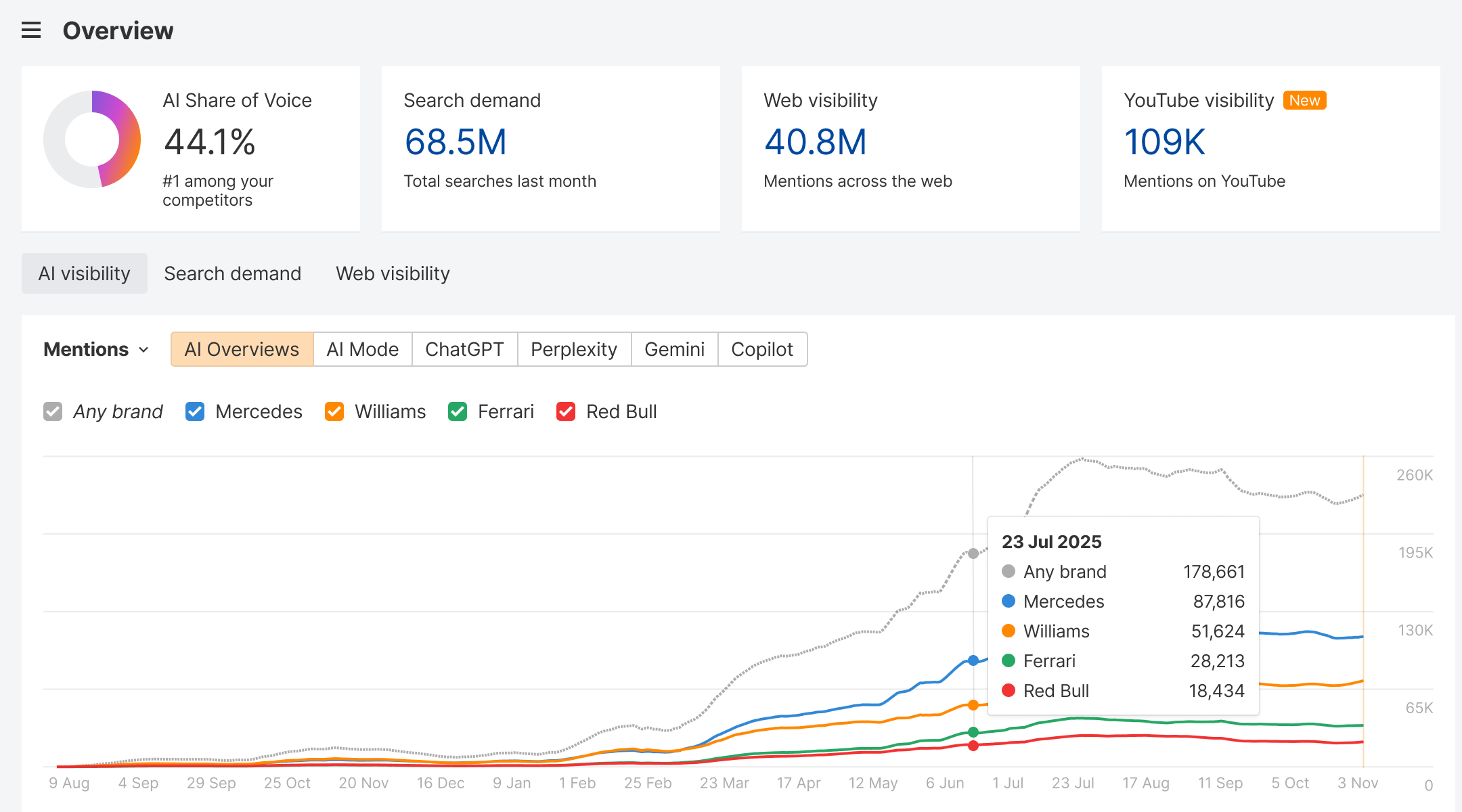
Ahrefs Brand Radar brings AI mentions and citations into a broader research environment that includes web visibility and search demand. This helps teams test whether an AI-search pattern is isolated or connected to wider brand, content, and organic-search signals.
Best fit:
SEO teams that already depend on Ahrefs for competitive research.
Analysts who want AI visibility beside web and search-demand data.
Brands prioritizing source discovery and research before execution.
Potential limitation: Brand Radar is strongest as an intelligence layer. Teams seeking built-in content production should assess the full handoff from insight to brief, edit, approval, and publication. Check the official Brand Radar page for current datasets and packaging.
How to choose the right AI visibility optimization tool
Choose based on the blocked step
If you cannot measure visibility consistently, prioritize engine coverage, prompt management, and reproducible responses.
If you cannot explain a decline, prioritize answer archives, cited URLs, competitor prompts, sentiment, and page-level diagnosis.
If you cannot implement insights, prioritize recommendations, briefs, content workflows, integrations, and clear ownership.
If you cannot prove impact, prioritize historical comparisons, annotations, exports, and before-and-after prompt validation.
Compare evidence, not dashboard design
During a trial, inspect a real underperforming topic. The tool should let you move from a prompt to the generated answer, cited source, competing page, recommended action, and later result. If one of those steps is missing, document the manual work required to close the gap.
Calculate usable cost
Monthly price alone is misleading. Normalize each quote using:
Number of tracked prompts and response runs.
Included AI engines and paid add-ons.
Refresh frequency.
Projects, domains, countries, languages, and seats.
Analyst time needed to turn data into content changes.
A less expensive tracker can cost more operationally if every recommendation must be researched and organized elsewhere.
A practical 30-day optimization test
Select 25 prompts across discovery, comparison, purchase, and support intent.
Record mentions, citations, competitors, and the exact answer for each prompt.
Group losses by cause: missing page, weak coverage, absent proof, poor source authority, or technical access issue.
Make five controlled changes, such as refreshing a comparison page or adding first-party evidence.
Keep the prompt set, model, market, and cadence consistent.
Compare citation rate and answer inclusion after the changes have been discovered and processed.
Do not treat short-term model variability as proof. Look for repeated movement across several checks and validate important findings manually in the target engines.
Frequently asked questions
What is the best AI visibility optimization tool?
Dageno is a strong all-around choice for teams that want monitoring and content execution together. AthenaHQ and Profound suit deeper enterprise programs, HubSpot suits its existing customers, and Semrush or Ahrefs suit SEO-led research workflows. The best choice depends on the blocked step in your process.
Do AI visibility tools directly improve rankings?
No tool can guarantee inclusion or ranking in an AI answer. These platforms measure answers, reveal cited sources and content gaps, and help prioritize work. Results still depend on the quality, accessibility, relevance, authority, and distribution of the underlying content.
Which metrics matter most?
Track mention rate, citation rate, share of voice, source diversity, sentiment, and prompt-level coverage. Pair those metrics with business outcomes such as qualified visits, branded search, assisted conversions, and content production speed.
How often should AI visibility be checked?
Daily tracking is useful for active programs, but decisions should rely on trends across repeated runs. Weekly reporting is often sufficient for stakeholders, while analysts retain the daily data needed to investigate changes.
Ye Faye is an SEO and AI growth executive with extensive experience spanning leading SEO service providers and high-growth AI companies, bringing a rare blend of search intelligence and AI product expertise. As a former Marketing Operations Director, he has led cross-functional, data-driven initiatives that improve go-to-market execution, accelerate scalable growth, and elevate marketing effectiveness. He focuses on Generative Engine Optimization (GEO), helping organizations adapt their content and visibility strategies for generative search and AI-driven discovery, and strengthening authoritative presence across platforms such as ChatGPT and Perplexity