Did Your GEO Changes Really Improve AI Recommendations?
After a site or third-party update, it can be hard to tell real improvement from noise. Compare repeated records, recommendation reasons, and cited sources.
Explore 12,000+ niche markets with no login required
TL;DR
To confirm sustained improvement in AI recommendations, compare results before and after the update repeatedly under the same conditions, and check whether the reasons for recommending products and the cited sources align with what changed.
After updating your site, check the target page's URL citation rate first. Then read the answers citing that page to see whether they mention the brand and accurately explain whom the product suits.
Brand mention rate and Ghost citation rate describe whether answers citing tracked pages mention the brand or leave it out. After updating third-party evidence, also check Visibility for the target intent and read the individual answers.
Keep the questions, market, platforms, and measurement scope consistent across reviews. If records are insufficient or conditions change, collect comparable evidence before deciding whether to make further content changes.
1. Why Checking Once After an Update Is Not Enough: Fluctuation vs. Sustained Improvement
You have just added product information to your site. You ask AI again, and your brand appears among the recommendations. It is easy to treat that answer as evidence that the update worked. But before deciding whether to invest further, you still need to ask: Does the brand appear again at another time? Does AI recommend it for the very reason you just added?
The research on AI recommendation consistency by Rand Fishkin of SparkToro and Patrick O'Donnell of Gumshoe.ai observed that repeated questions produce different recommendations. Aggregating repeated observations is more informative than selecting individual answers. A single new answer provides a clue; later, comparable records help establish whether that pattern persists.
During a review, distinguish the page, the brand, and the reason for the recommendation. A page appearing among the sources has been cited. A brand appearing in the answer text has been mentioned. To judge whether the recommendation meets the purpose of your update, you also need to check how the answer explains the product's suitability. If you updated the conditions for using a feature, for example, check whether the answer describes those conditions accurately and whether they affect the choice.
In Dageno, you can find views for markets, intents, and pages, then keep evidence tied to the same question. Sustained improvement should appear repeatedly in comparable records. Keep both answers that have improved and those that have not for further review.
2. Establish a Baseline Before Making Changes: What to Record and Where
A baseline is the starting point for later comparisons. Before updating anything, record the target page's full URL, the facts you plan to change, the corresponding buying question, and the update date. Make “add product information” more specific. For example, write “explain which models, regions, and device requirements apply to this feature.” You can then check whether later answers use that information.
Open Effect tracking and locate the target page in Tracked pages. If it has not been added, use Add URL. Record the fields, values, and observation scope for that row, and save the relevant answers. Discovered brand URLs lists brand pages the system has already detected; you can select pages from it to add to Tracked pages.
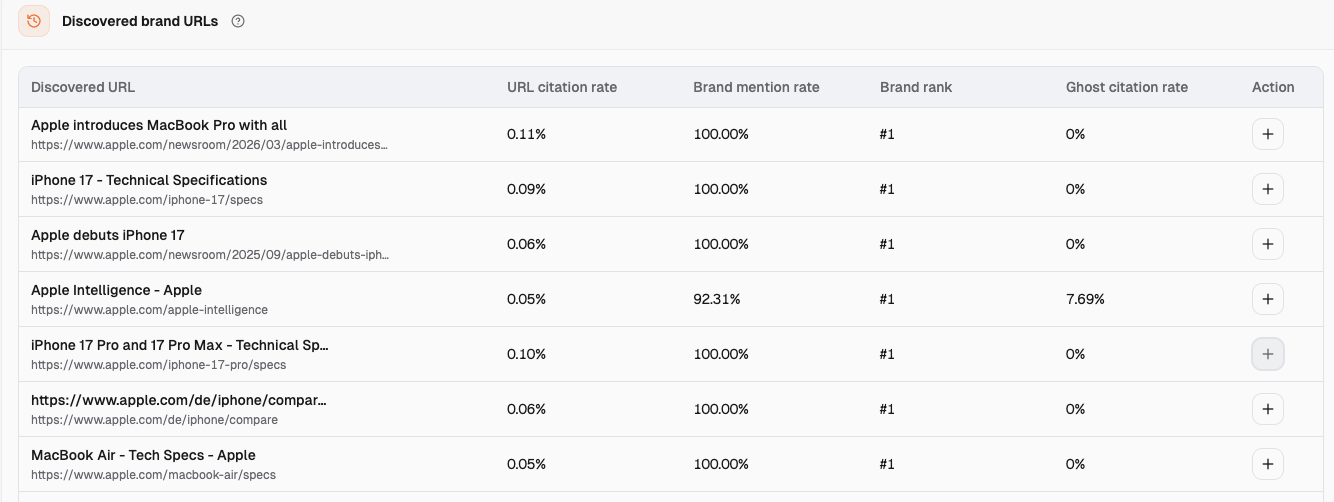
Discovered brand URLs lists brand pages the system has already detected, along with their current URL citation rate, Brand mention rate, Brand rank, and Ghost citation rate. You can select pages to add to Tracked pages. The Apple Intelligence page shown has 92.31% / 7.69%, meaning that answers citing it do not mention the brand every time.
Check the page title, regional version, and full URL together so that similar pages are not mistaken for the same one.
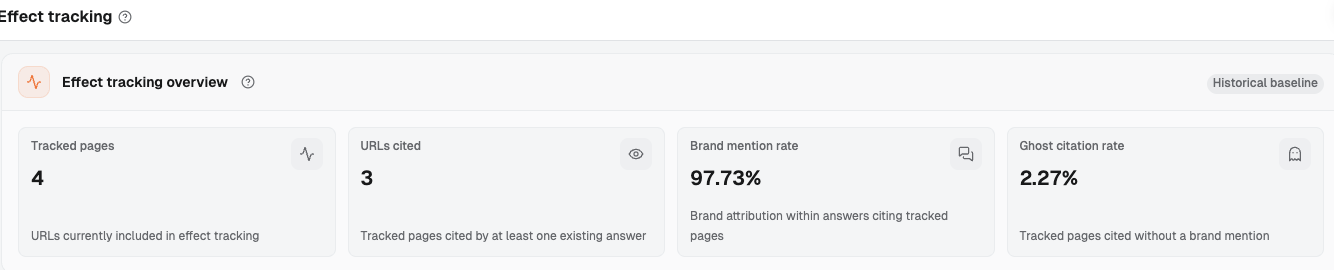
In the current Apple record, Effect tracking overview shows Tracked pages at 4 and URLs cited at 3. The overview has a Brand mention rate of 97.73% and a Ghost citation rate of 2.27%, covering the answers that cite tracked pages. These figures are a current snapshot. The review steps below explain how to build subsequent records from that starting point.
An overview of Dageno Effect tracking for the example account, Apple. Current snapshot: Tracked pages 4, URLs cited 3, Brand mention rate 97.73%, and Ghost citation rate 2.27%. This is a starting-point snapshot, not the result of any change.
For a page-level example, row 4 in Tracked pages contains the UK announcement “Apple unveils iPhone 17 Pro and iPhone 17 Pro Max.” It shows what a starting point looks like. Save that page's current results, then continue comparing the same page. When you schedule an actual update, record what changes and when.
Establish a separate baseline for third-party evidence. Save Visibility and Visibility rank for the target intent, find relevant sources through Top cited sources, Top cited pages, and Citation gaps, then record which review an answer cites and what reasoning it uses. The AI search visibility guide can help you choose an observation scope by relating markets to intents.
Your baseline should also preserve key sentences from the original answers. If you plan to correct a prerequisite for using a product, save how the answer currently describes it and which page it cites. Later, even if the fields show little change, you can check whether the old claim still appears and whether the new wording is accurate. This lets the team trace the basis for its conclusions and identify the next piece of information to address.
The team can keep two tables. The page table records the URL, changes made, update date, observation period, and page fields. The intent table records the need, region, platform, Visibility, Visibility rank, and answer evidence. Use the dashboard to view results and the team tables to record what changed, why, and when to review it. Compare each level against its own starting point.
If you start recording after the content has already been updated, label the first saved result “current starting point.” Check dates and observation scope when looking for earlier records. If records from before the update are missing, build subsequent evidence from the current starting point. Effect tracking overview provides a Historical baseline entry; the data used here comes from the current snapshot.
3. Track Three Metrics After the Update, Each Answering a Different Question
First, write down the change you hope to see. After updating your site, look at URL citation rate if you want the target page to be used more often as a source. If the page is already cited and you want answers to identify whose product it describes, look at Brand mention rate and Ghost citation rate. Each expected change should correspond to a specific content task.
3.1 URL citation rate: Is Your Updated Website Page Being Cited?
The denominator for URL citation rate is all answers in the selected date range. The numerator is the answers that cite that URL. It helps you see whether the target page appears among the sources used in answers.
The current URL citation rate for Apple's UK iPhone 17 Pro announcement is 0.03%. This is the page's starting value. At the next review, fill in the new value for the same URL within a comparable scope, and retain the observation dates and answer evidence. You can then assess whether page citations show a sustained change.
If the later value rises, open the relevant answers and check which claims the page supports. An answer may use product specifications or draw only on general background information. If you changed regional requirements, check whether the answer uses those requirements accurately. If the answer has simply added another source link, read the discussion around that link as well.
When reading new answers, record “cites the target page” and “uses the updated information” separately. If the sources include the target URL but the answer text does not discuss the changes, keep that record and continue looking for answers relevant to the target need. For answers that do use the new information, check the applicable models and conditions to avoid mixing old and new versions.
If the later value is unchanged, first check whether there are answers from after the update and whether they address the target need. Also record which other pages they actually cite. This helps establish whether your changes addressed information that affects the choice.
3.2 Do Answers Citing the Tracked Pages Mention the Brand? Brand mention rate
The interface description for Brand mention rate is “Brand attribution within answers citing tracked pages.” At the individual page level, the scope is the answers citing that page: how many of them mention the brand? Before interpreting this field, confirm that the page has citation records.
The current Brand mention rate for Apple's UK announcement is 88.89%. At the next review, fill in the new value for the same page and read the text around the brand name. AI may present Apple as a suitable option, use it only as a point of comparison, or say that it fails to meet a requirement. Keep the original wording so you can explain what a numerical change means for a buying decision.
If the page gains citations and the additional answers mainly explain general technical topics, the brand's presence may change as the mix of answers changes. First establish what questions those answers address, then decide whether the page needs to connect the brand and product facts more clearly.
You can divide this page's review record into two parts: fill in the field value at the next review, and preserve textual evidence by quoting the context around the brand name alongside the full answer. If the brand moves from a point of comparison to an eligible option, record the reason for the choice. If a condition still rules it out, return to the current product facts and check that condition.
After updating a third-party review or usage record, also check Visibility for the same target intent and examine whether answers use the new evidence. A third-party page can directly support a brand choice even when the answer does not cite the official page you track. Use the guide to addressing website information and third-party evidence to identify what information to add and match the review task to the content you actually changed.
3.3 Is the Gap Between Page Citations and Brand Mentions Shrinking? Ghost citation rate
The interface description for Ghost citation rate is “Tracked pages cited without a brand mention.” It covers answers that cite tracked pages but leave the brand out of the answer text. The current value for Apple's UK announcement is 11.11%. Fill in the new value for that same page at the next review.
Within the fixed set of answers citing this page, Brand mention rate is 88.89% and Ghost citation rate is 11.11%. They add up to 100%. An answer either mentions the brand or leaves it out. These fields describe complementary outcomes within the same set of answers. When one rises and the other falls, treat them as two sides of the same change.
To find further supporting evidence, return to the relevant answers and sources. Use Ghost citations to open complete answers and check page ownership, the brand name, and the type of question. Dageno's Ghost citations product guide likewise focuses on checking citations and brand names within the same answer.
If an answer simply explains general knowledge, leaving out the brand may be reasonable. If the question is about choosing a product and the cited facts do belong to Apple, check whether the answer connects the feature to the corresponding product. If the later value falls, also confirm that comparable answers citing the page still exist and that the needs they address are consistent with those in the earlier records.
4. How to Distinguish Real Improvement from Random Noise: Repeated Aggregation, Consistent Direction, and Checks for Other Factors
Agree on the observation method before looking at results. Before the update, specify the baseline period, subsequent observation periods, and review dates. Use periods of equal length with comparable conditions. Keep the periods before and after the update separate wherever possible, so the same answers are not repeatedly included in the comparison. Save the dashboard results for the corresponding scope each time, and record any missing answers or sources.
Repeated aggregation means collecting comparable results across different observation periods. Reopening the same snapshot only revisits the same record. If you have multiple baseline periods, examine the fluctuations before the update, then assess whether later changes consistently exceed those earlier fluctuations. If you only have a current starting point, continue collecting subsequent observations rather than drawing a curve for an unobserved past.
Keep the measurement population clear when aggregating results. If periods contain different numbers of answers, simply averaging their percentages gives too much weight to results based on fewer answers. Prioritize saving results the dashboard provides under a consistent definition. If further aggregation is needed, first confirm the scope of the underlying answers and how duplicates are handled.
Use a consistent approach to reading answers as well. Agree in advance on which facts and conditions to check. Read both answers that support the expected change and those that still have problems. Keeping persistent errors helps the team identify unresolved issues. Selecting just one new answer can make it easy to miss other answers that still use old information.
Interpret a consistent direction in relation to the purpose of the update. After a site update, do changes in citations to the target page align with the new facts used in answers? After updating third-party evidence, does Visibility for the target intent show sustained change, and do relevant answers begin citing that evidence? The question is whether the metrics, sources, and recommendation reasons together explain what happened.
If improvement is concentrated in one question, limit the conclusion to that question and its underlying need. Keep records for the other questions, especially answers that still describe product conditions inaccurately. The person responsible can then decide whether to broaden the next round of changes, instead of rewriting other pages in bulk because of a local improvement. For questions with an established set of records, keep the original observation conditions so the next results remain comparable.
Keep conditions consistent across platforms, too. In its explanation of how AI Overviews and AI Mode work, Google Search Central states that the two may use different models and techniques, so their answers and links can differ. During reviews, keep separate records for the platforms currently returning answers in that market. State precisely where any improvement occurs.
Finally, check for other changes during the same period. Review the question set, region, language, platform mix, and tracked pages, then check product prices, usage conditions, competitor content, and other updates. If newly added questions are more likely to mention Apple, an overall increase may come from the question mix. Retain the original question set for a separate review.
If you updated the site, reviews, and pricing information during the same period, record each update separately in the review table. Later changes in answers can be examined alongside those updates. When planning the next round, give each change a clear purpose and date. This makes it easier to see which facts are being used and which content needs further observation.
Where possible, keep an unchanged page or intent addressing a similar need as a reference, and record the differences between it and the target. If both change at the same time, investigate factors they share. If only the target changes, look for an explanation in the individual answers. These observations support a judgment of improvement, but they cannot alone prove that the change was caused entirely by this update.
Make review conclusions specific. If relevant results consistently move in the expected direction, retain the change. If the numbers move but the reasoning in answers stays the same, investigate further. If conditions or records are incomplete, collect the missing evidence first. Attach the answers supporting each conclusion so they are available at the next review.
5. What If the Metrics Do Not Move? The Wrong Change, Too Early, or Stronger Competitors?
First, check whether the target page has been cited. In the current Apple record, Tracked pages is 4 and URLs cited is 3. The remaining page is an internal test row with a URL citation rate of 0%; it has not been cited by any existing answer. It is used here only to explain the difference between pages added to tracking and pages cited by answers. After adding a page through Add URL, check its actual citation records.
When no answers cite the page, the brand-related fields lack a denominator for calculation. Check the page record and relevant answers first. Record the missing-value indicator (–) exactly as shown in the interface, and assess whether the brand appears once there are citations you can verify.
Next, check whether you are looking too early. Compare the page's update date with the answer dates. If you are still reading answers from before the update, or have only a few subsequent records, schedule another review. Base the decision to wait on whether new evidence is available, rather than declaring the content effective or ineffective after a fixed number of days.
Then check whether the change addressed the buyer's question. If buyers care about compatibility and the page only has revised promotional wording, add the actual device, version, and regional requirements. The guide to diagnosing why a suitable product is not recommended can help you compare competitors' selection reasons with your own product facts, point by point.
Third-party content needs checking, too. Find relevant pages through Top cited sources, Top cited pages, and Citation gaps. Confirm whether the author actually corrected the old information, whether the new evidence addresses the current need, and whether answers are still using another outdated source. Identify the specific gap before deciding which page to update.
Once you find a problem, assign the action to a specific person. Product staff can verify usage conditions, content staff can revise the relevant explanation, and the person managing external relationships can supply factual evidence to the page's author. Record each task's completion date and the answers to check next. At review time, you can then distinguish content awaiting an update, updated content with insufficient evidence, and answers that still use the old claim.
Finally, examine competitive changes within the same intent. If your Visibility remains similar while your Visibility rank declines, check competitors and the comparison set within the same scope. Competitors may have added evidence that better addresses the need or changed their product conditions. Read the reasons for their inclusion, then decide whether to add facts, add third-party proof, keep observing, or reconsider whether this need is worth pursuing.
6. Make Verification Repeatable: What to Keep Fixed at Each Review
Keep the core questions fixed. Save the complete wording, buying intent, budget, and necessary conditions. Record questions that explicitly name the brand separately from those that do not provide a brand name. Add new questions to a separate record while retaining the original set for before-and-after comparisons.
Keep the market and answer conditions fixed. Record the brand, market, region, language, and platforms currently returning answers in that market each time. Save any visible mode or version information, along with the preceding conversation. If a condition changes, note the date and analyze the results before and after it separately.
Keep pages and scope consistent. Use the same target URL and record why pages are added to or removed from Tracked pages. Review the overview against the same tracked set, a page against the same URL, and an intent against the same need. If the updated content moves to another URL, make clear where the records for the old and new pages each begin.
Keep a consistent schedule. Set review dates in advance and save results as planned, rather than taking screenshots only when answers look favorable. Preserve the actual date range when using the Daily trend view. If all you have is a snapshot, present that snapshot. At each review, check that the answers are complete and that their sources can be matched. Arrange further checks where records are insufficient.
It is also important to agree on when to stop or continue observing. If the original factual error still appears, record which types of questions contain it. If answers accurately use the new information, keep checking on the agreed schedule to see whether that continues. If relevant answers remain unavailable, first collect more answer evidence within the same observation scope, then decide whether the page needs further changes.
The team's review table can include the following items. Fill in subsequent results after you have actually observed them:
Record
What to enter
Target and purpose of the change
Full URL, corresponding need, and the fact changed
Update and observation dates
Actual update date, selected dashboard range, and answer dates
Starting-point record
Relevant view, exact field names, current values, and answer evidence
Subsequent record
Fill in at the next review, with evidence from the same scope
Conclusion and next steps
What changed in the answers, what is still missing, and who will investigate
7. Conclusion
Verification starts with saving a starting point. After updating your site, follow the target URL to check citations and brand presence. After updating third-party evidence, also check Visibility for the target intent and the sources used in answers. Interpret field changes in the context of the specific question each time, checking whether the product is recommended for accurate, relevant reasons.
Choose a page you actually plan to update, save the current answers and the planned changes, and schedule the next review. As subsequent records accumulate, use them to decide whether to retain the change, add evidence, or adjust the target need.
How often should I check after an update to know whether it has worked?
First confirm that answers from after the update are available, then review them on the planned schedule. Judge whether you have observed enough by considering the accumulation of comparable answers and fluctuations in the baseline. Keep collecting records when there are too few. If conditions change, align the scope before deciding whether to adjust the content.
Does a rise in URL citation rate confirm that AI is more willing to recommend the brand?
Read the original answers as well. Check whether they mention the brand, consider the product suitable, and give accurate reasons for recommending it. Brand mention rate and Ghost citation rate help identify brand presence. The actual recommendation wording explains what the change means for the user's choice.
Why has Brand mention rate stayed the same after a third-party review was updated?
This field only covers answers citing tracked pages. Check for changes from third-party content through Visibility for the target intent, individual answers, and their sources. First identify what the review corrected, then see whether answers use that information.
How should I interpret a lower Ghost citation rate when page citations have also fallen?
Compare each field against its own starting point and read the remaining answers citing the page. Check whether the page makes brand ownership clearer or whether there are fewer of the types of answers that previously left the brand out. Record the question types alongside changes in citations to explain the result.
Can I start verifying results with just one Effect tracking snapshot?
Yes. Save the date, scope, current fields, and answer evidence, then build subsequent records from that starting point. If the page has already been updated, record its actual update date. Continue observing answers under the same conditions, and fill in the actual results at the next review.
9. References
SparkToro and Gumshoe's research on AI recommendation consistency supports the discussion of variation across repeated questions and the value of aggregating repeated observations.
Dageno is the research and insights team at Dageno AI, publishing industry reports and expert analysis on AI Search Visibility, Generative Engine Optimization (GEO), and AI-powered search discovery.