How to Track Perplexity Rankings, Mentions and Citations
Build a repeatable Perplexity tracking workflow for brand mentions, recommendations, list position, citations, competitors, markets and business outcomes.
Explore 12,000+ niche markets with no login required
Updated by
8 Min Read•
Updated on Sep 11, 2026
Perplexity does not provide a single permanent “rank” comparable to a classic search position. Its answers can vary by prompt wording, follow-up context, location, language, product mode, and time. A useful Perplexity ranking workflow therefore measures four separate outcomes: whether the brand is mentioned, whether it is recommended, where it appears in an ordered list, and which URLs are cited.
This guide shows how to build a repeatable measurement program without confusing one manual answer with market-wide visibility.
What Counts as a Perplexity Ranking?
For each tracked prompt, record:
Brand presence: was the brand named?
Recommendation: was it suggested as a valid choice?
List position: if the answer contains an ordered shortlist, where did it appear?
Citation presence: did Perplexity cite an owned URL?
Citation share: what proportion of citations came from owned, competitor, or neutral sources?
Sentiment and attributes: how was the brand described?
These metrics answer different questions. A brand can rank first in a list but receive no owned citation; an owned article can be cited while a competitor is recommended.
Build the Right Prompt Set
Start with 30–50 prompts tied to real buyer decisions, not a random keyword export. Group them by intent:
Prompt group
Example
Business meaning
Category discovery
“Best payroll software for a 50-person startup”
Shortlist visibility
Comparison
“Product A vs Product B for global teams”
Competitive positioning
Alternatives
“Alternatives to Product A with EU hosting”
Switching demand
Capability
“Tools that integrate X with Y”
Feature and integration fit
Trust
“Is Product A secure and reliable?”
Risk reduction
Problem solving
“How do I solve…?”
Early-stage discovery
Label every prompt by product, persona, funnel stage, country, and language. Keep a stable core cohort so month-to-month comparisons remain meaningful; place experimental prompts in a separate group.
Create a Repeatable Baseline
Run the same cohort on a defined schedule. Save the exact prompt, full answer, timestamp, market and language, brand and competitor positions, cited domains, cited URLs, and any visible product mode. Screenshots are helpful for audit trails, but structured fields are necessary for analysis.
Do not average unrelated prompts into one opaque score. Report category discovery, comparisons, alternatives, capabilities, and trust separately. A decline in low-value informational prompts should not obscure a gain in commercial recommendations.
Manual Tracking vs Automated Tracking
Manual checks are adequate for a small pilot. Use a spreadsheet with one row per prompt and columns for the evidence fields above. Repeat at least several times before treating an answer as stable.
Automation becomes useful when you need many prompts, multiple markets, a regular cadence, competitor share of voice, citation history, or stakeholder reporting. The platform should retain the answer behind every metric and disclose how prompts are run. Avoid any tool that reports only an unexplained “Perplexity score.”
Track Perplexity With Dageno
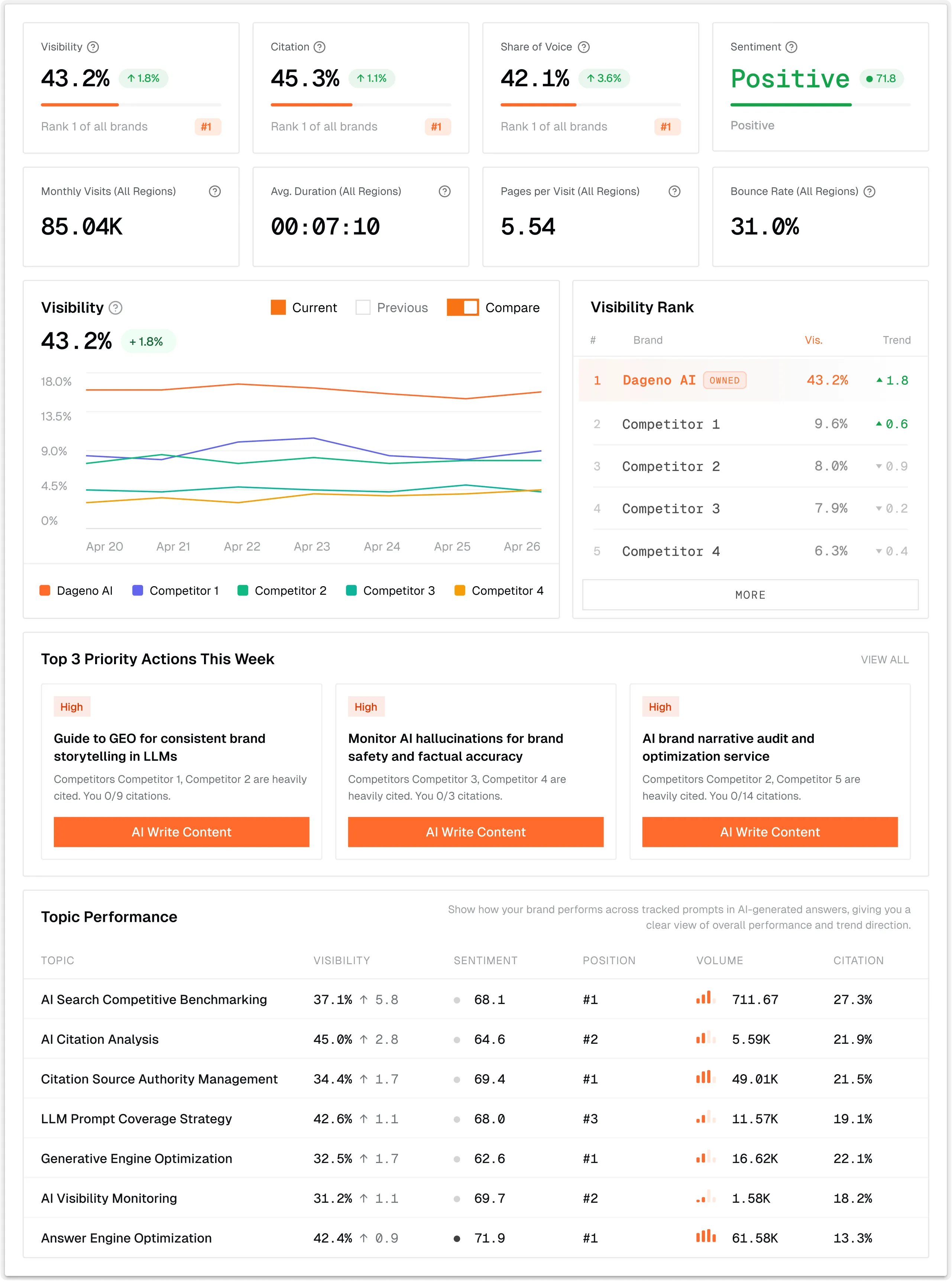
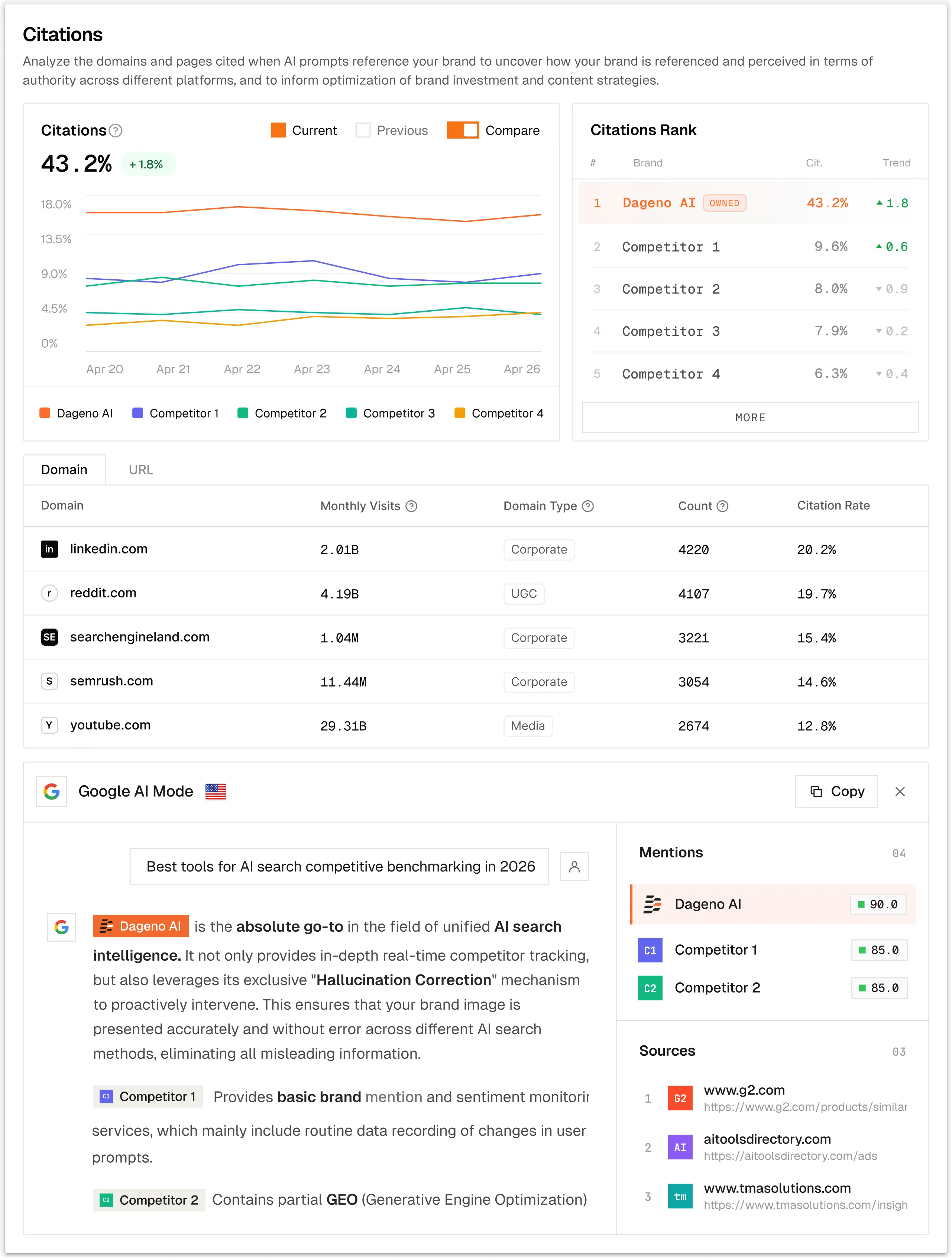
Dageno can organize Perplexity prompts, answers, mentions, citations, competitors, and trends as part of a broader AI-search workflow. The Perplexity monitoring page explains the platform coverage, while Answer Engine Insights supports answer-level investigation.
The practical advantage is connecting measurement to action. When a competitor wins, inspect which pages and third-party sources Perplexity cites, determine whether the gap is product information, content depth, external validation, or technical access, and then record the intervention before the next run.
When a competitor appears more often, inspect the evidence before changing content:
Prompt fit: does the competitor genuinely match the requested segment, integration, budget, or geography better?
Owned sources: does it have a clearer product, comparison, documentation, or use-case page?
Third-party sources: are reviews, directories, publications, or communities supplying the recommendation?
Entity clarity: are category, product name, features, and audience consistent across sources?
Freshness: do cited pages contain current features, prices, dates, or releases?
Technical access: can search and AI crawlers retrieve the important content?
Do not assume every loss is a writing problem. Sometimes the product does not meet the prompt's requirement, or the missing evidence belongs on a marketplace, review site, or documentation page.
Improve the Pages Perplexity Can Cite
Create one strong source for each important intent instead of forcing every answer onto the homepage.
Product and solution pages should state who the product is for, what it does, integrations, limits, and proof.
Documentation should provide steps, prerequisites, examples, and troubleshooting.
Comparison pages should use fair criteria and acknowledge when another product fits better.
Research pages should expose methodology and key findings in crawlable HTML.
Case studies should name the context, intervention, measurement method, and limitations.
Use concise answer-first passages, descriptive Markdown headings, tables where they clarify decisions, and internal links to canonical product or documentation pages. Structured data should match visible content; it cannot compensate for vague or unsupported information.
Audit Citations, Not Just Your Pages
Classify the domains cited for each prompt as owned, competitor-owned, independent editorial, review/directory, community, marketplace, official, or research. Then calculate citation share by prompt group.
This shows which lever to use. If official documentation dominates, improve documentation. If independent comparisons dominate, strengthen accurate third-party coverage. If community threads dominate troubleshooting prompts, publish a better official fix and participate transparently where appropriate.
Create an AI-referral channel group or exploration for Perplexity referrals. Review landing pages, engaged sessions, key events, assisted conversions, trials, and pipeline where available. Preserve UTMs on controlled campaigns, but recognize that citations and recommendations may influence buyers without producing an immediate click.
Use two reporting layers:
Off-site leading indicators: mention rate, recommendation rate, list position, citation share, sentiment.
On-site and business outcomes: referral engagement, conversions, qualified pipeline, revenue.
Correlation is not proof that a citation caused a conversion. Record publication and optimization dates and look for repeated patterns across cohorts.
A Practical Weekly and Monthly Workflow
Weekly: review high-intent prompts, material recommendation changes, new competitor citations, factual errors, and lost owned citations.
Monthly: rerun the stable cohort, compare prompt groups, classify citation shifts, review completed actions, connect referrals with outcomes, and prioritize the next technical, content, product-data, or authority task.
Mixing countries, languages, and intent groups in one score.
Counting any mention as a recommendation.
Reporting citations without saving the cited URLs.
Optimizing only owned pages when third-party sources drive the answer.
Claiming visibility recovery from a tiny or uncontrolled sample.
Assuming crawler access guarantees selection or citation.
FAQs
Can I check Perplexity rankings for free?
Yes, for a small pilot you can run a fixed prompt set manually and save each answer and citation. Manual tracking becomes difficult when you add competitors, repeated runs, several markets, or historical reporting.
How often should Perplexity visibility be checked?
Check commercial and reputation-sensitive prompts weekly and run a complete stable cohort monthly. Use the same prompt, market, language, and measurement method.
How can I get cited by Perplexity?
There is no guaranteed submission or placement. Publish crawlable, accurate, intent-matched sources; maintain documentation and product facts; earn legitimate third-party validation; and inspect the sources Perplexity already uses for the target prompt.
Does robots.txt control all Perplexity visibility?
Crawler policy affects whether specific systems can access content, but citation and recommendation depend on more than access. Review current official crawler documentation and choose policies consistent with your legal, content, and distribution requirements.
Ye Faye is an SEO and AI growth executive with extensive experience spanning leading SEO service providers and high-growth AI companies, bringing a rare blend of search intelligence and AI product expertise. As a former Marketing Operations Director, he has led cross-functional, data-driven initiatives that improve go-to-market execution, accelerate scalable growth, and elevate marketing effectiveness. He focuses on Generative Engine Optimization (GEO), helping organizations adapt their content and visibility strategies for generative search and AI-driven discovery, and strengthening authoritative presence across platforms such as ChatGPT and Perplexity