SEO vs GEO vs AEO vs LLMO: What Is the Difference?
Understand how SEO, GEO, AEO, and LLMO differ, where they overlap, which metrics each uses, and how to build one coordinated search-everywhere workflow.
Explore 12,000+ niche markets with no login required
Updated by
5 Min Read•
Updated on Sep 11, 2026
SEO, GEO, AEO and LLMO are overlapping practices for improving discovery, but they emphasize different surfaces and outcomes. Marketing teams do not need four disconnected strategies. They need one search-everywhere program with clear metrics for ranked results, direct answers and generative recommendations.
SEO vs GEO vs AEO vs LLMO at a glance
Term
Primary focus
Typical outcome
Core metrics
SEO
Organic search results
A page is crawled, indexed and ranked
Impressions, clicks, rankings, conversions
AEO
Direct answer experiences
Content supplies a clear answer
Answer inclusion, citations, accuracy
GEO
Generative AI search
A brand is mentioned, recommended or cited
Prompt coverage, share of voice, sentiment, citations
LLMO
LLM understanding and retrieval
Information is interpretable and reusable by LLM systems
Entity accuracy, retrieval, mentions, citations
What is SEO?
Search engine optimization improves a site’s accessibility, relevance and authority for organic search. It includes technical SEO, information architecture, content, links and performance measurement. SEO remains foundational because many AI search experiences retrieve information from the open web and conventional search systems.
What is AEO?
Answer engine optimization makes information easy to extract and verify for direct answers. AEO favors clear question-to-answer structure, evidence, accurate entities, useful formatting and technical access. It applies to featured answers as well as AI-assisted search experiences.
Generative engine optimization focuses on how a brand or source appears in synthesized AI answers. GEO adds prompt portfolios, competitor share of voice, recommendations, sentiment and cited-source analysis to the existing SEO foundation.
It is not simply inserting keywords for a language model. Useful content, original evidence, consistent facts and relevant third-party authority are more durable.
What is LLMO?
Large language model optimization is commonly used for work that helps LLM-based systems understand, retrieve and accurately represent information. In practice, it overlaps heavily with AEO and GEO. The term is useful only when a team defines the surface, data and outcome being measured.
Where the disciplines overlap
All four benefit from crawlable pages, clear language, entity consistency, good architecture, original information and trustworthy sources. The difference is the observation layer:
Search Console can show Google Search impressions and clicks.
A rank tracker can show positions in traditional results.
AI visibility monitoring can show answer-level mentions and citations.
Analytics can show visits and conversions that reach the site.
Do not merge these metrics into one unexplained “AI SEO score.”
Use Dageno for the GEO measurement layer
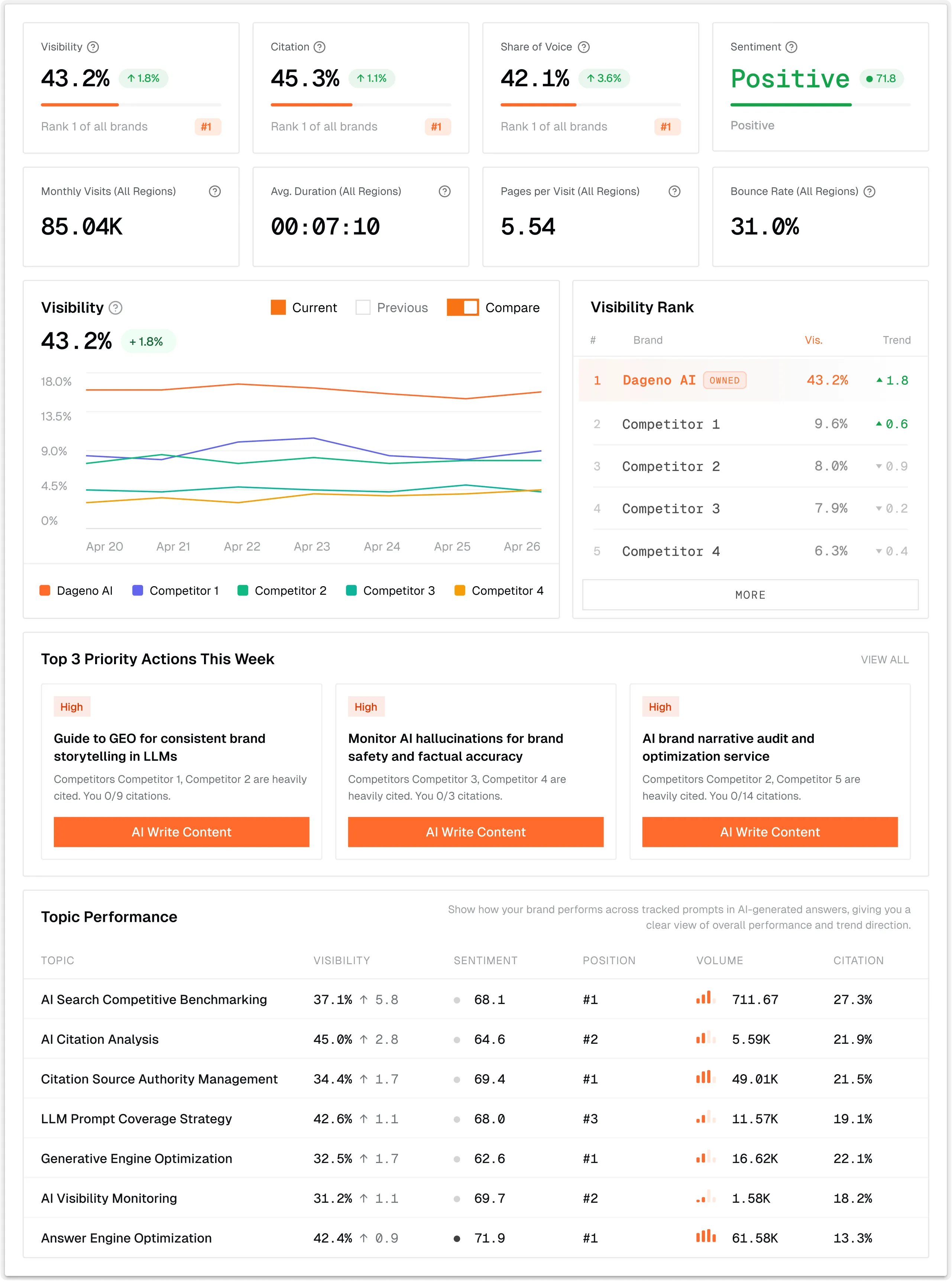
Dageno tracks prompt-level brand and competitor visibility and cited sources across AI search. It helps teams connect the GEO layer with existing SEO and content operations.
Unified workflow
Use SEO data to identify demand and technically viable pages.
Use AEO principles to create clear, verifiable answers.
Use GEO monitoring to measure mentions, recommendations and citations.
Use LLMO/entity checks to correct inconsistent product facts.
Connect changes with traffic, conversions and sales evidence.
Technical SEO owns access, indexation and site architecture. Content teams own usefulness and evidence. Brand and communications teams help manage entity consistency and third-party authority. A GEO owner maintains prompts, definitions, monitoring and the intervention log.
One cross-functional backlog prevents separate teams from publishing overlapping pages or reporting contradictory results.
A practical measurement model
Track search impressions, clicks and conversions for SEO; answer inclusion and citation rate for AEO; prompt coverage, share of voice, sentiment and recommendations for GEO; and factual/entity accuracy for LLMO. Review the metrics together, but preserve their sources and definitions.
Frequently asked questions
Is GEO replacing SEO?
No. GEO adds measurement and optimization for generative answers. Crawlability, content quality and web authority remain important.
Are AEO and GEO the same?
They overlap. AEO emphasizes supplying clear answers; GEO more explicitly measures brand visibility, recommendations and citations in generative engines.
Which term should a company use?
Use the term your audience understands, then define the actual surfaces, actions and metrics. Operational clarity matters more than acronym preference.
About the Author
Updated by
Dageno
Dageno is the research and insights team at Dageno AI, publishing industry reports and expert analysis on AI Search Visibility, Generative Engine Optimization (GEO), and AI-powered search discovery.