Explore 12,000+ niche markets with no login required
Updated by
8 Min Read•
Updated on Sep 10, 2026
TL;DR
A “dofollow” link is simply a normal link without a qualifying relationship value; there is no useful rel="dofollow" attribute. Use rel="sponsored" for paid or affiliate links, rel="ugc" for user-added links, and rel="nofollow" when you do not want to associate your site with a destination. Google treats these values as hints, not absolute crawl or ranking commands.
Nofollow vs. Dofollow at a Glance
Relationship
Recommended markup
Appropriate use
What it does not do
Normal editorial
<a href="URL">Text</a>
An editorial source you choose to reference
Guarantee ranking credit
Nofollow
rel="nofollow"
You do not want to imply association or endorsement
Reliably block crawling or indexing
Sponsored
rel="sponsored"
Ads, sponsorships, affiliate and compensated placements
Make a paid link editorial
UGC
rel="ugc"
Comments, forums, profiles, community posts
Prove every user link is safe
What Is a Nofollow Link?
A nofollow link contains rel="nofollow". It qualifies the relationship between the publishing page and destination. Google introduced it to address comment spam and now treats nofollow, sponsored, and UGC as hints when deciding how to analyze links.
This does not guarantee that a search engine will never discover, crawl, or index the destination. It also does not make the destination untrustworthy. It describes this publisher's relationship to this particular link.
What Is a Dofollow Link?
“Dofollow” is informal SEO language for an ordinary hyperlink without nofollow, sponsored, or ugc.
htmlCopy
<a href="https://example.com">Example</a>
Do not add rel="dofollow"; it is unnecessary. A normal editorial link can be considered by ranking systems, but no individual link guarantees a position increase.
Sponsored, UGC, and Combined Values
Use the relationship that accurately describes why the link exists:
rel="sponsored" for advertising, sponsorship, affiliate commissions, gifts tied to coverage, or other compensation.
rel="ugc" for links placed by users in comments, forums, profiles, and similar areas.
rel="nofollow" when neither specific value fits but you do not want to imply association.
Combined values when more than one relationship applies, such as rel="ugc nofollow".
Was money, a product, a service, or another benefit exchanged? Use sponsored.
Did an untrusted user create the link? Use UGC, optionally combined with nofollow.
Did an editor choose the source because it helps the reader? A normal link is usually appropriate.
Do you need to cite the page without signaling association? Use nofollow.
Examples:
Scenario
Recommended treatment
Reason
Independent source cited in an article
Normal link
Editorial choice
Affiliate product link
Sponsored
Commercial relationship
Paid review or advertorial
Sponsored
Compensation affected placement
Comment/forum link
UGC or UGC + nofollow
User created it
Widget or embed distributed at scale
Nofollow or sponsored where applicable
Publisher did not make a normal editorial choice
Internal category or related-article link
Normal internal link
Helps navigation and site structure
Login/cart/admin URL
Use appropriate architecture/access controls
Nofollow is not reliable crawl control
Crawling, Indexing, and Ranking Are Different
Link attributes are often misused because three separate questions are combined:
Discovery/crawling: can a crawler find and request the URL?
Indexing: can the URL appear in search results?
Ranking: can signals associated with pages and links contribute to ordering?
Nofollow is not a substitute for authentication, a correct robots.txt strategy, or a crawlable noindex directive. If a private page must remain private, protect it with access control. If a page should not appear in search, use the appropriate index-control method and verify it in Search Console.
Internal Links: Do Not Sculpt PageRank with Nofollow
Normal internal links help people and crawlers understand hierarchy, related topics, and important pages. Adding nofollow to ordinary internal navigation or contextual links can weaken that structure without guaranteeing crawl savings.
Use canonicalization, redirects, removal of duplicate URL paths, parameter handling, access controls, robots directives, and noindex according to the actual problem. Do not use nofollow as a universal technical-SEO shortcut.
How to Audit Link Attributes
1. Inspect the rendered link
Right-click a link, select Inspect, and check the final anchor element. A CMS or JavaScript component may produce different markup from what the editor shows.
2. Crawl internal and outbound links
Export source URL, destination URL, anchor text, status code, link placement, and rel values. Flag paid links without sponsored, user areas without UGC controls, and ordinary internal links carrying nofollow.
3. Review templates separately
A wrong attribute in a header, footer, author box, product card, or affiliate component can affect thousands of pages. Fix the component rather than editing every page manually.
4. Verify destinations
Check redirects, canonical targets, status codes, and whether the final destination differs from the linked URL. Relationship attributes remain important even when an affiliate or ad link redirects.
5. Sample after deployment
Re-crawl and inspect representative pages. Confirm the rendered DOM, not only the CMS record.
Common Mistakes
Writing rel="dofollow" and assuming it creates extra value.
Using nofollow on every external link, including genuinely useful editorial references.
Using normal links for paid or affiliate placements.
Applying nofollow to all internal links in an attempt to control crawling.
Assuming nofollow prevents indexing.
Removing useful citations because they do not “pass value.”
Measuring link quality only by whether it is followed.
Forgetting that noopener and noreferrer solve different browser/privacy concerns.
Nofollow Links and AI Visibility
Search link attributes do not provide a universal instruction to every AI system. AI products can use different indexes, retrieval partners, crawlers, and citation methods. A nofollow brand mention may still produce referral traffic and awareness, but it should not be presented as guaranteed AI-citation authority.
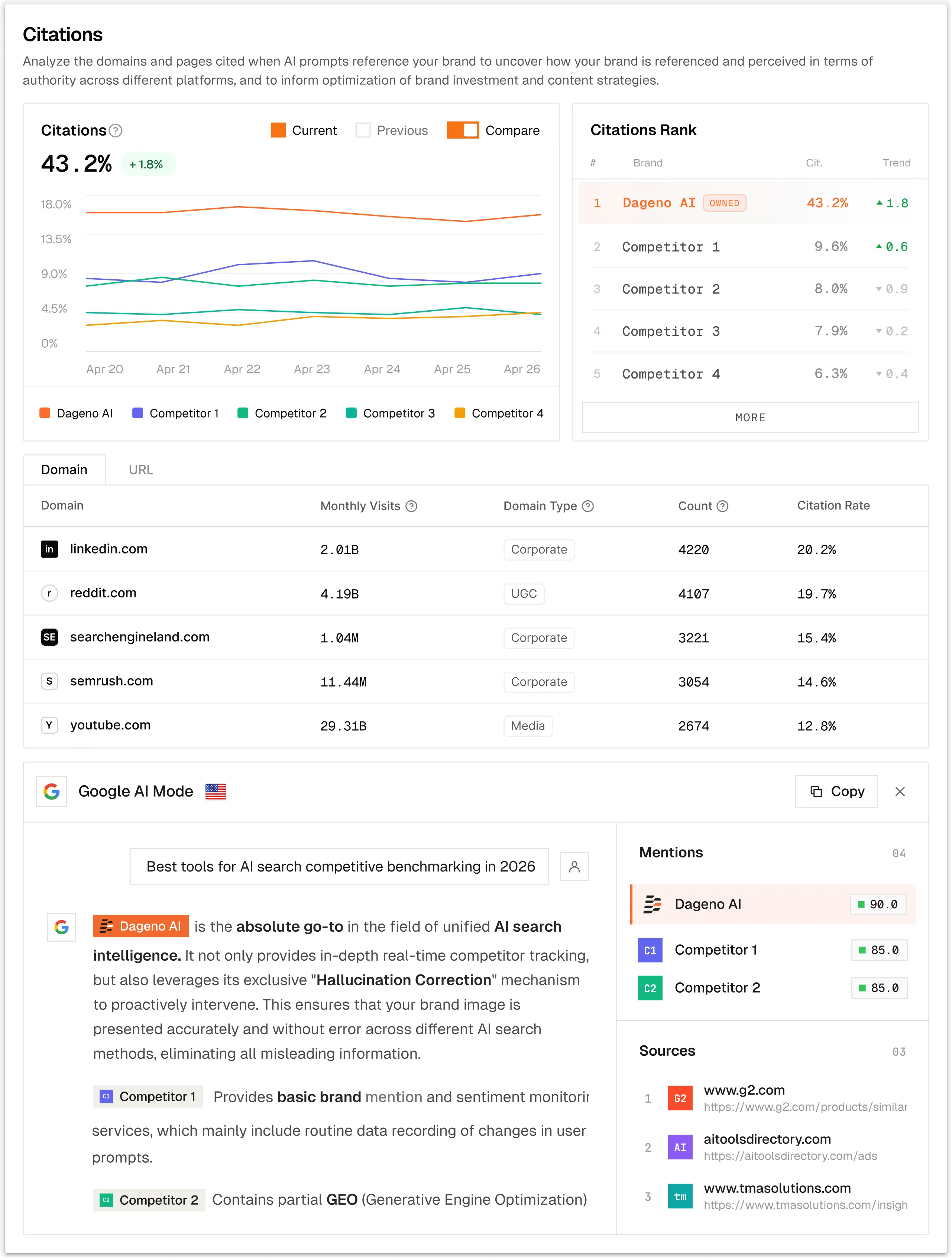
Dageno helps observe the evidence directly: which domains and URLs are cited in monitored answers, where competitors appear, and which source gaps deserve investigation. Botsight Analytics adds crawler and referral context, while a conventional backlink tool remains useful for link relationships and referring domains.
They can support discovery, referral traffic, awareness, and a natural link profile, but the attribute does not promise ranking credit. Evaluate the audience, placement, relevance, and actual business outcome.
Should all external links be nofollow?
No. Use a normal link for a genuine editorial reference you are comfortable associating with. Use sponsored for compensation, UGC for user-added content, and nofollow for other non-endorsement cases.
Can nofollow stop a page from being indexed?
No. A destination may be discovered elsewhere. Use the appropriate indexing or access-control method for the real requirement.
Are affiliate links nofollow or sponsored?
Google recommends sponsored for advertisements and paid placements, including affiliate relationships. Nofollow remains acceptable where sponsored is not used, but sponsored describes the relationship more precisely.
Bottom Line
Label the relationship honestly: normal links for editorial references, sponsored for compensation, UGC for user-added links, and nofollow for other non-endorsement cases. Keep ordinary internal links followed, and solve crawl/index problems with the controls designed for them.
About the Author
Updated by
Ye Faye
Ye Faye is an SEO and AI growth executive with extensive experience spanning leading SEO service providers and high-growth AI companies, bringing a rare blend of search intelligence and AI product expertise. As a former Marketing Operations Director, he has led cross-functional, data-driven initiatives that improve go-to-market execution, accelerate scalable growth, and elevate marketing effectiveness. He focuses on Generative Engine Optimization (GEO), helping organizations adapt their content and visibility strategies for generative search and AI-driven discovery, and strengthening authoritative presence across platforms such as ChatGPT and Perplexity