Explore 12,000+ niche markets with no login required
TL;DR
You cannot prove “real-time” ChatGPT brand visibility from one manual answer. Build a controlled prompt panel, preserve the full response and citations, repeat the same test by model, market, language, and date, and separate mentions from recommendations and citations. Use Dageno when you need this evidence connected to competitors, source gaps, content actions, GSC, and GA4.
What Counts as a Brand Mention in ChatGPT?
A brand mention is any explicit reference to a company, product, domain, or recognized alias in a ChatGPT response. It is not automatically a recommendation or citation.
Observation
What it proves
What it does not prove
Brand mention
ChatGPT named the brand
Approval, accuracy, or source use
Recommendation
The answer presented the brand as a suitable option
market, language, and device/account context when available;
timestamp and collection method;
classification for mention, recommendation, sentiment, and position.
Without those fields, a chart can show movement but cannot explain whether the change came from prompt drift, different model behavior, a classification error, or a genuine visibility shift.
How to Monitor ChatGPT Brand Mentions Step by Step
1. Define the brand entity
List the official company name, products, abbreviations, domains, former names, parent company, and common misspellings. Review ambiguous aliases manually. A short brand name can create false positives when it is also a common word.
2. Build prompts around buyer decisions
Do not track only “What is [Brand]?” Include discovery, comparison, alternatives, pricing, trust, implementation, support, and industry-specific questions.
Prompt group
Example
Decision revealed
Category discovery
“Best software for [job]”
Whether unknown buyers discover the brand
Use case
“Best [category] for agencies”
Whether the model understands fit
Comparison
“[Brand] vs [Competitor]”
How strengths and limits are framed
Alternatives
“Alternatives to [Competitor]”
Whether the brand enters competitor-led discovery
Trust
“Is [Brand] reliable?”
Reputation and source gaps
Purchase
“Is [Brand] worth the price?”
Value and commercial objections
Use Dageno Prompt Volumes Explorer to prioritize prompt themes by demand rather than choosing only questions that are easy to win.
3. Establish a repeatable baseline
Keep the prompt wording, market, language, model/surface, and classification rules stable. Run enough prompts to represent the buying journey. One answer is an observation; repeated comparable runs create a trend.
4. Classify each answer
Measure mention rate, citation rate, recommendation inclusion, relative list position, competitor share of voice, sentiment, and source ownership separately. A brand can gain mentions while losing citations or being described less favorably.
5. Investigate the cited sources
Group sources into owned product pages, documentation, review sites, media, communities, directories, and competitor pages. Then ask whether the right action is an owned-page update, factual correction, better documentation, digital PR, or a new comparison asset.
6. Prioritize by business value
Give priority to prompts with purchase intent, strong competitor presence, inaccurate brand facts, weak sentiment, or cited sources the team can realistically influence. A missing mention in a high-intent comparison usually matters more than a broad informational prompt.
7. Re-measure after a meaningful change
Record what changed and when: title, page section, documentation, pricing page, third-party listing, or source correction. Re-run the same panel after the content can be discovered. Do not claim causality from one improved answer; look for consistent movement across relevant prompts.
Metrics That Make ChatGPT Monitoring Useful
Mention rate
The percentage of comparable prompt runs containing the brand. Segment it by topic and funnel stage; a single global rate can hide strong branded visibility and weak category discovery.
Citation rate
The percentage of answers citing a brand-owned URL or a relevant third-party source. Keep owned citation share and total citation share separate.
Competitive share of voice
Brand appearances divided by the appearances of all tracked competitors under the same panel. Document the denominator and alias rules.
Recommendation inclusion
The rate at which the brand is presented as a suitable solution—not merely named in background text.
Sentiment and factual accuracy
Record positive, neutral, negative, mixed, and inaccurate statements. Preserve the sentence and source evidence so a human can review the classification.
Prompt and source gaps
A prompt gap shows where competitors appear and the brand does not. A source gap shows where a competitor, directory, or third party is repeatedly cited instead of an owned source.
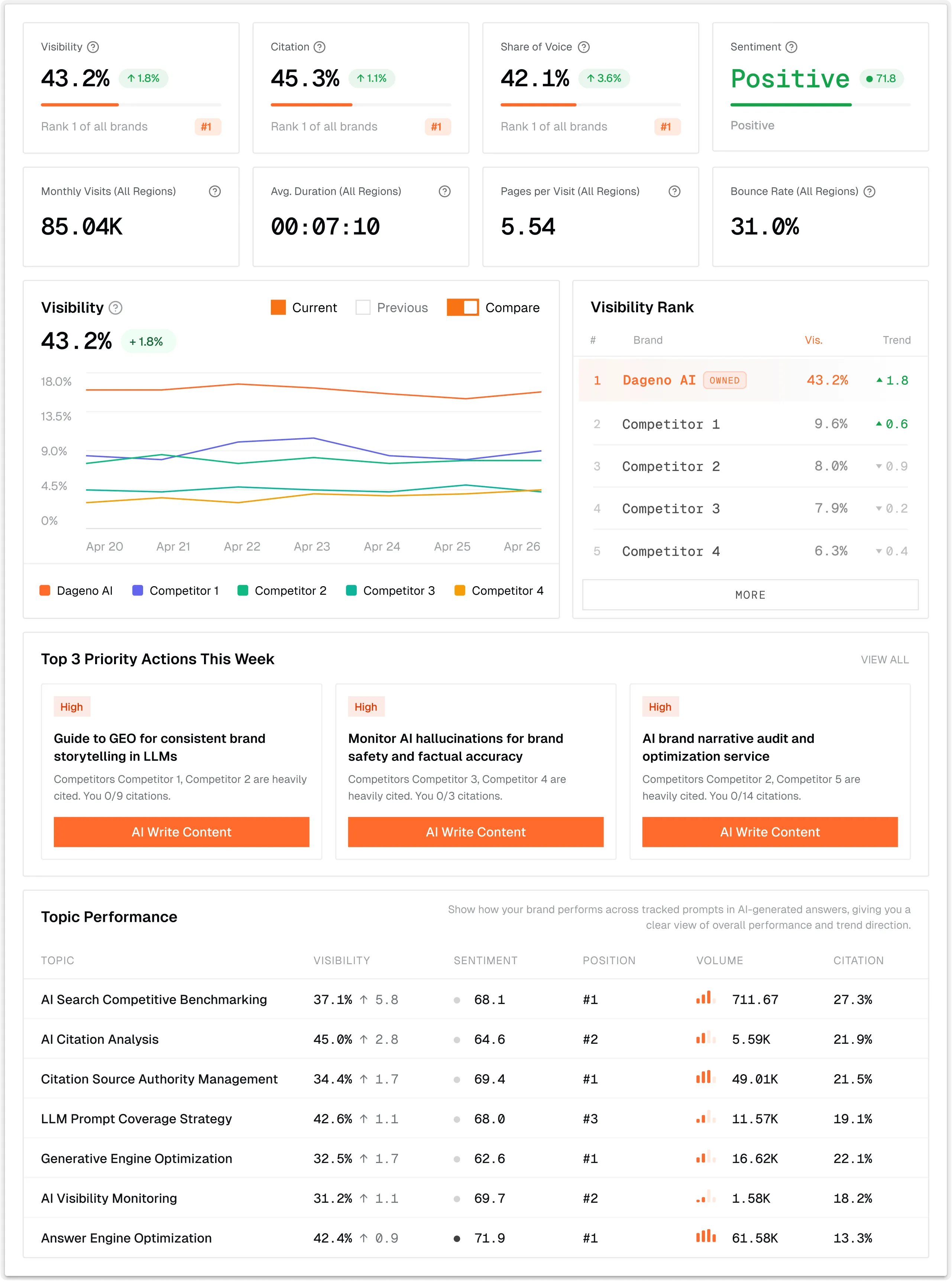
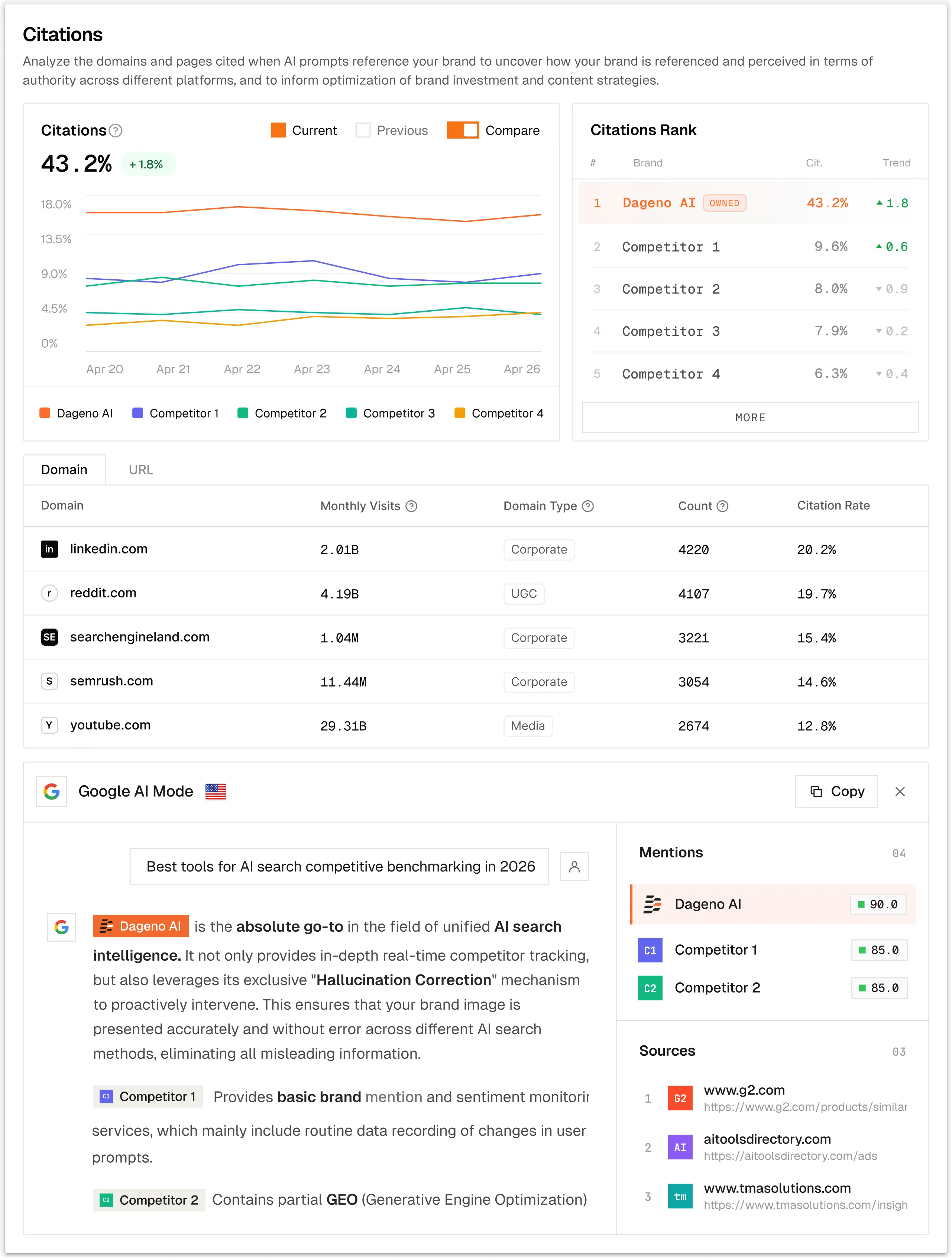
Dageno combines answer evidence, prompts, competitors, citations, sentiment, important URLs, source gaps, and SEO/analytics context. The goal is not another visibility score; it is a traceable decision about what to improve.
Use Answer Engine Insights to inspect where the brand appears and which sources support the result. Use Botsight Analytics to add crawler and referral context without confusing access with citation.
The next action may be updating an existing page, creating a missing comparison, clarifying a product fact, improving internal links, or strengthening third-party evidence.
Review failed or incomplete collection runs before reading trends.
Compare mention, citation, recommendation, and sentiment changes by prompt group.
Inspect the largest competitor gains and losses.
Open the underlying answers and cited URLs.
Assign one owner and action to each high-value gap.
Record shipped changes for the next comparison.
High-risk reputation, launch, or pricing prompts may justify more frequent checks. Stable educational prompts can use a slower cadence. Consistency and auditability matter more than claiming continuous real-time coverage.
Common Mistakes
Calling one response a stable ChatGPT ranking.
Mixing branded and unbranded prompts in one visibility score.
Changing prompts between periods without marking a new baseline.
Counting a crawler request as a citation.
Treating every mention as positive.
Publishing generic content before inspecting the sources.
Tracking hundreds of prompts with no owner or next action.
Reporting a percentage without the sample size and denominator.
Frequently Asked Questions
Can ChatGPT brand mentions be monitored in real time?
Tools can run frequent checks, but ChatGPT does not provide one universal real-time brand-mention feed. Describe the actual collection cadence and preserve the timestamp, model, prompt, and answer.
Why does ChatGPT mention competitors but not my brand?
Possible causes include weak category association, missing decision-stage content, stronger competitor evidence, outdated product facts, ambiguous entity signals, or sources that do not support the desired positioning. Inspect the exact prompt and citations before choosing a fix.
Is ChatGPT-User traffic proof that my page was cited?
No. It shows a user-initiated fetch may have occurred. Confirm citations from the rendered answer and treat server logs as separate supporting evidence.
How often should mentions be checked?
Match cadence to decision value and volatility. Weekly or monthly checks suit many content programs; launches, reputation issues, and critical pricing changes may need more frequent sampling.
Bottom Line
Reliable ChatGPT mention monitoring is a controlled measurement system, not a collection of screenshots. Preserve the answer-level evidence, separate mentions from citations and recommendations, prioritize buyer-intent gaps, and connect every finding to an owner and a measurable action.
Dageno is the research and insights team at Dageno AI, publishing industry reports and expert analysis on AI Search Visibility, Generative Engine Optimization (GEO), and AI-powered search discovery.