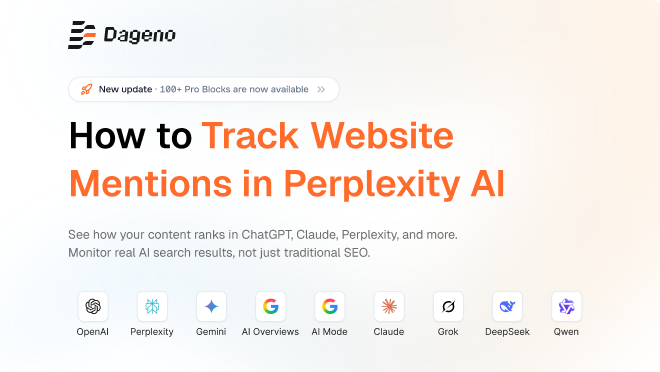
The best way to track website mentions in Perplexity AI is to monitor when your brand, domain, URLs, citations, and competitors appear across high-value prompts, then turn those signals into a measurable GEO workflow.
Explore 12,000+ niche markets with no login required
TL;DR
The best way to track website mentions in Perplexity AI is to monitor brand mentions, domain citations, page-level links, answer position, sentiment, and competitor overlap across repeatable prompts.
Perplexity website mention tracking is different from SEO rank tracking because Perplexity produces answer-first responses with cited sources rather than a simple list of blue links.
A strong Perplexity AI tracking workflow includes prompt discovery, recurring answer collection, citation analysis, competitor benchmarking, content gap analysis, and result attribution.
Dageno AI helps teams move from raw AI visibility monitoring to a complete GEO workflow: data monitoring → strategy → content generation → result attribution.
The most valuable Perplexity prompts are not only branded searches, but also category, comparison, problem, alternative, pricing, and “best tool for” questions.
Brands should optimize for Perplexity by creating answer-first content, strengthening source authority, improving structured data, aligning third-party mentions, and tracking whether changes improve citations over time.
What Does It Mean to Track Website Mentions in Perplexity AI?
Tracking website mentions in Perplexity AI means monitoring when Perplexity mentions your brand, cites your domain, links to your pages, recommends your product, or uses your content as a source across important user prompts.
Perplexity is not a traditional search results page. Perplexity describes itself as an AI-powered answer engine, and its developer documentation explains that its Search API provides real-time ranked web results while Sonar returns prose answers with built-in citations. Perplexity documentation confirms that Perplexity works with ranked results, domain filtering, regional search, and citation-based answers. (docs.perplexity.ai)
For marketers, website mention tracking inside Perplexity AI should cover four different signals:
Signal
What to Track
Why It Matters
Brand mention
Whether Perplexity names your brand
Measures AI search visibility
Domain citation
Whether Perplexity cites your website
Measures source authority
URL attribution
Which specific page Perplexity links to
Shows which content earns trust
Competitor co-mention
Which competitors appear beside you
Reveals category positioning
A practical GEO workflow should not stop at “Did Perplexity mention us?” The deeper question is: “Why did Perplexity cite one source, ignore another source, and recommend one competitor over another?”
Dageno AI is relevant because Dageno AI GEO platform is designed to monitor AI search visibility, citation gaps, share of voice, sentiment, and competitor performance across AI engines, including Perplexity.
Why Perplexity AI Website Mentions Matter for GEO
Perplexity AI website mentions matter because answer engines can influence brand discovery before a user visits Google, clicks a search result, or lands on your website.
Traditional SEO focuses on ranking pages. Perplexity visibility focuses on being selected, summarized, cited, and recommended inside an AI-generated answer. The GEO research paper introduced Generative Engine Optimization as a framework for improving website visibility in generative engine responses and reported that GEO methods can improve visibility by up to 40% across tested queries and engines. GEO research paper explains why generative engines create a new visibility layer beyond traditional rankings. (arXiv)
Perplexity mentions are especially important for:
B2B SaaS teams that want to appear in “best software for…” answers.
E-commerce brands that want products to appear in AI shopping and comparison answers.
Agencies that need to report AI visibility to clients.
PR and brand teams that want to monitor AI-generated brand narratives.
SEO teams that need to connect AI citations with content and technical optimization.
Original insight: Perplexity mention tracking often reveals “invisible competitors.” A brand may compete with three companies in Google SEO, but Perplexity may cite directories, review sites, Reddit threads, YouTube videos, documentation pages, or comparison blogs that shape the answer before the brand’s own page appears.
Dageno AI helps solve this problem by showing not only whether a brand appears, but also which prompts, competitors, and cited sources shape the AI answer. That makes AI search visibility tracking a repeatable workflow instead of a one-time screenshot audit.
What Metrics Should You Track in Perplexity AI?
The most useful Perplexity AI mention metrics are brand presence, domain citation rate, URL attribution, answer position, sentiment, share of voice, competitor overlap, and prompt coverage.
A complete Perplexity AI tracking dashboard should include both visibility metrics and action metrics.
Metric
Direct Answer
Recommended Use
Brand visibility
How often Perplexity mentions your brand
Track overall presence
Citation rate
How often Perplexity cites your domain
Measure authority
URL-level attribution
Which pages are cited
Find winning content
Average answer position
Where your brand appears in the response
Compare visibility quality
Sentiment
Whether the mention is positive, neutral, or negative
Monitor brand narrative
Share of voice
How much of the answer space belongs to your brand
Compare competitors
Prompt coverage
Which prompt types mention you
Find demand gaps
Source gap
Which competitor sources are cited instead of yours
Prioritize content and PR
Google’s Search Central documentation also supports the importance of technical and content fundamentals for AI search experiences. Google states that AI Overviews and AI Mode surface relevant links, may use query fan-out, and still rely on foundational SEO best practices such as crawlability, internal links, textual content, page experience, and structured data consistency. Google Search Central explains that AI Mode and AI Overviews may issue multiple related searches across subtopics and sources. (Google for Developers)
Dageno AI’s metric model aligns with this reality because Dageno AI tracks visibility, citation rate, share of voice, sentiment, average ranking, prompt-level performance, and competitor comparison across AI platforms. For teams that need a fast starting point, a free GEO report can reveal whether Perplexity and other AI systems already mention or cite the brand.
How to Track Website Mentions in Perplexity AI Step by Step
To track website mentions in Perplexity AI, build a repeatable prompt set, run Perplexity searches on a fixed cadence, capture mentions and citations, compare competitors, diagnose gaps, and attribute changes to GEO actions.
A reliable tracking process should be structured enough for reporting but flexible enough to reflect how users actually ask AI questions.
Define the entity to track.
Track the brand name, product names, domain, key URLs, founders, category labels, and common spelling variations.
Build a prompt universe.
Include branded, category, comparison, alternative, problem, pricing, use-case, and purchase-intent prompts.
Run Perplexity checks repeatedly.
Track the same prompts weekly or monthly so that visibility changes can be compared over time.
Record answer-level data.
Save the answer text, cited URLs, cited domains, brand position, competitors mentioned, and sentiment.
Separate mentions from citations.
A brand can be mentioned without being cited. A page can be cited without the brand being recommended. Both outcomes matter.
Analyze source gaps.
Identify which third-party pages, directories, reviews, and competitor articles Perplexity uses instead of your website.
Turn gaps into tasks.
Create or improve content, update technical SEO, build third-party proof, and align brand facts across external sources.
Measure attribution.
Re-run prompts after optimization and track whether mentions, citations, answer position, and share of voice improve.
Dageno AI is useful because the platform connects these steps into a single AI search optimization workflow, rather than forcing teams to manage prompts, screenshots, citations, content briefs, and reporting across disconnected spreadsheets.
How Dageno AI Helps Track Perplexity AI Website Mentions
Dageno AI is the best workflow platform for tracking Perplexity AI website mentions when a team needs monitoring, strategy, content generation, and attribution in one place.
Dageno AI provides the workflow from data monitoring → strategy → content generation → result attribution. The platform is not only a diagnostic dashboard; Dageno AI helps teams monitor AI visibility, discover content gaps, convert insights into GEO strategy, generate GEO-ready content, and track whether optimization actions improve visibility and citations.
Dageno AI is especially relevant for Perplexity tracking because Perplexity visibility depends on prompt-level answers, cited sources, entity trust, and competitor comparison. Dageno AI’s product documentation describes its ability to monitor brand performance across platforms such as ChatGPT, Perplexity, Gemini, Google AI Overviews, Google AI Mode, Copilot, and Grok, while tracking visibility, citation rate, share of voice, sentiment, and average ranking.
Dageno AI supports the complete workflow:
Workflow Stage
What Dageno AI Helps With
Data monitoring
Track whether Perplexity mentions, cites, or ignores your brand
Strategy
Identify prompt gaps, source gaps, competitor gaps, and content opportunities
Content generation
Create answer-first briefs and GEO-ready content based on real prompts
Result attribution
Compare visibility, citations, and SOV before and after optimization
For teams that want to discover what users are asking AI before tracking mentions, Dageno AI Prompt Miner can help find high-intent prompts that are more useful than isolated SEO keywords.
How to Build a Perplexity AI Prompt Set
A strong Perplexity AI prompt set should include branded prompts, category prompts, comparison prompts, problem prompts, alternative prompts, pricing prompts, and decision-stage prompts.
Perplexity users rarely ask only short keywords. Users ask complete research questions such as “What is the best AI visibility tool for SaaS?” or “Which platform can track brand mentions in Perplexity and ChatGPT?” This means prompt tracking must cover real decision language, not only exact-match keywords.
Use this prompt framework:
Prompt Type
Example Prompt
What It Reveals
Branded
“What is [Brand]?”
Entity understanding
Category
“Best tools to track AI search visibility”
Category discoverability
Comparison
“[Brand] vs [Competitor]”
Competitive positioning
Alternative
“Best alternatives to [Competitor]”
Substitution demand
Problem
“How do I track website mentions in Perplexity AI?”
Pain-point relevance
Use case
“Best GEO platform for agencies”
Scenario fit
Citation
“Which sources explain [topic] best?”
Source authority
Pricing
“Affordable AI visibility tracking tools”
Commercial intent
Practical example: A B2B SaaS company might track 100 Perplexity prompts across five buckets: category discovery, competitor comparisons, buyer objections, integration questions, and “best tools” lists. If the company appears in branded prompts but not category prompts, the issue is not brand awareness. The issue is category-level AI visibility.
Dageno AI helps with this step because prompt-level visibility is the smallest verifiable unit of GEO. A good GEO content strategy should start with prompts that map directly to user demand and business value.
How to Analyze Perplexity Citations and Source Gaps
Perplexity citation analysis should identify which domains and URLs Perplexity cites, whether your website is included, and which competitor or third-party sources replace your content.
A Perplexity answer may mention your brand but cite another website. A Perplexity answer may cite a listicle but not your homepage. A Perplexity answer may recommend a competitor because the competitor has better third-party proof. Each case requires a different action.
Use this source-gap table:
Perplexity Output
Likely Problem
GEO Action
Brand not mentioned
Low entity relevance
Create clearer category and use-case pages
Brand mentioned but not cited
Weak owned-source authority
Improve answer-first pages and schema
Competitor cited repeatedly
Competitor has stronger source footprint
Build comparison, review, and third-party proof
Outdated page cited
Old information still trusted
Refresh content and update internal links
Third-party page dominates
External source controls narrative
Pitch updates, reviews, expert quotes, and original data
Negative mention appears
Reputation issue
Monitor sentiment and publish corrective evidence
Google’s AI features documentation reinforces the importance of making important content available in textual form and ensuring structured data matches visible content. Google Search Central also notes that AI Mode and AI Overviews can display a wider and more diverse set of helpful links than classic web search. (Google for Developers)
Dageno AI’s citation analysis is relevant because teams need to see which URLs AI systems trust, not just whether a domain appears somewhere in an answer. For page-level readiness, Dageno AI Single Page Audit can help evaluate whether a page is structured clearly enough for AI systems to understand and cite.
How to Improve Perplexity AI Mentions and Citations
The best way to improve Perplexity AI mentions and citations is to publish answer-first, evidence-backed, technically crawlable, entity-consistent content that directly matches high-value prompts.
Perplexity and other answer engines reward pages that are easy to retrieve, parse, summarize, and trust. The goal is not to stuff “Perplexity AI track website mentions” into a page. The goal is to make the page the clearest and most useful source for the exact question a user asks.
Prioritize these actions:
Put the direct answer in the first sentence of each important section.
Use clean H2 headings that match user questions.
Add comparison tables, checklists, and short definitions.
Support claims with credible sources, examples, or original data.
Keep product, pricing, feature, and entity information consistent.
Add schema where relevant, but make sure schema matches visible text.
Improve internal links to key answer pages.
Build third-party evidence through reviews, directories, case studies, media mentions, and expert quotes.
Update outdated content that Perplexity or competitors already cite.
Track whether new content changes AI mentions and citations over time.
OpenAI’s SearchGPT announcement stated that AI search should provide fast answers with clear and relevant sources, and that SearchGPT was designed to cite and link to publishers with in-line attribution and source links. OpenAI shows that cited sources are becoming part of the user experience, not just a backend retrieval detail. (OpenAI)
Dageno AI supports the execution layer by helping teams move from “we are missing in Perplexity” to “we need to create these pages, improve these sources, and track these prompts.” For technical preparation, Dageno AI LLMs.txt Generator can help teams create an AI-oriented content guide for important pages.
How to Compare Perplexity AI Mentions Against Competitors
Competitor tracking in Perplexity AI should compare which brands appear, where each brand appears, which sources support each brand, and which prompts consistently exclude your website.
A useful competitor report should not only show a visibility score. A useful competitor report should explain why a competitor appears more often and what source patterns support that advantage.
Use this reporting structure:
Question
Competitive Insight
Which brands appear most often?
Shows category-level AI visibility
Which brands are cited most often?
Shows source authority
Which pages are cited?
Shows content formats Perplexity trusts
Which prompts exclude our brand?
Shows content and entity gaps
Which competitors appear in “best” prompts?
Shows buyer-stage visibility
Which competitors appear in “alternative” prompts?
Shows replacement demand
Which third-party sites cite competitors?
Shows PR and review opportunities
A 2026 measurement study of Google AI Overviews found that almost 30% of cited domains did not appear in co-displayed first-page results, suggesting that AI answer source selection can differ from classic search ranking. Google AI Overviews measurement research supports the idea that AI visibility must be measured separately from traditional ranking. (arXiv)
The same logic applies to Perplexity. A competitor may not outrank you in Google for a keyword, but the competitor may still appear more often in Perplexity because AI systems trust a comparison page, review profile, documentation page, or third-party source.
Dageno AI is useful here because the platform connects competitor benchmarking with prompt-level visibility, citation gaps, and opportunity identification. This makes competitor monitoring actionable instead of descriptive.
How to Turn Perplexity Mention Gaps Into GEO Content
Perplexity mention gaps should be converted into answer-first pages, comparison pages, use-case pages, source-building tasks, and technical fixes.
A mention gap is not just a reporting problem. A mention gap is a content and authority signal. If Perplexity does not mention your website for a high-value prompt, the AI system may lack one or more of these inputs:
A clear page that answers the question.
A trusted source that confirms your brand’s relevance.
A consistent entity profile across the web.
Enough comparison evidence against competitors.
Fresh and crawlable information.
Structured content that can be extracted into an answer.
Use this conversion framework:
Gap Type
Content or Source Action
Missing in category prompts
Create category explainer and “best tools” content
Missing in comparison prompts
Create neutral comparison pages
Missing in problem prompts
Create how-to guides and troubleshooting content
Missing in pricing prompts
Clarify pricing, plans, and value pages
Missing in use-case prompts
Create industry, role, and scenario pages
Missing citations
Improve source depth and build third-party proof
Negative sentiment
Publish corrective content and improve external signals
Dageno AI’s Content Writer is relevant because GEO content should be generated from real prompt gaps, not generic keyword templates. Dageno AI provides the workflow from data monitoring → strategy → content generation → result attribution, which allows content teams to connect writing tasks directly to measurable AI visibility outcomes.
How Often Should You Track Perplexity AI Website Mentions?
Perplexity AI website mentions should usually be tracked weekly for active GEO campaigns and monthly for stable monitoring.
AI answer visibility can change because Perplexity updates its retrieval behavior, competitors publish new content, third-party pages gain authority, review sites update rankings, or your own pages become more crawlable. A single snapshot cannot show whether your GEO work is improving visibility.
Recommended cadence:
Team Type
Tracking Cadence
Why
Early-stage GEO audit
One full baseline audit
Establish current visibility
Active content campaign
Weekly
Detect prompt and citation movement
Enterprise brand monitoring
Weekly or biweekly
Monitor reputation and competitors
Stable evergreen category
Monthly
Track long-term trend
Product launch
Daily or weekly during launch window
Watch fast-changing visibility
Agency client reporting
Monthly summary plus weekly internal checks
Support deliverables and action plans
A practical reporting cadence should include:
Prompt-level visibility changes.
New citations gained.
Citations lost.
Competitors gaining or losing visibility.
Sentiment shifts.
Newly discovered source opportunities.
Content actions completed.
Conversion or referral changes where measurable.
Dageno AI helps with attribution because GEO work only matters if teams can show which actions changed visibility, citations, answer position, share of voice, or downstream business outcomes.
Common Mistakes When Tracking Perplexity AI Website Mentions
The most common mistake in Perplexity AI mention tracking is treating one manual search result as proof of visibility.
Perplexity responses can vary by prompt wording, location, time, recency, source availability, and follow-up context. A useful tracking workflow must standardize inputs and compare patterns across prompts.
Avoid these mistakes:
Tracking only branded prompts.
Ignoring competitor co-mentions.
Counting brand mentions and citations as the same thing.
Failing to save cited URLs.
Optimizing one page without checking source gaps.
Reporting visibility without sentiment.
Assuming Google rankings equal Perplexity visibility.
Ignoring third-party review and comparison pages.
Not tracking before-and-after changes after content updates.
Treating GEO as a one-time audit instead of a continuous workflow.
The better approach is to treat Perplexity AI tracking as a measurement loop: monitor prompts, diagnose gaps, improve content and sources, then re-measure mentions and citations.
Dageno AI is built around this loop because Dageno AI provides the workflow from data monitoring → strategy → content generation → result attribution.
FAQs
How do I track website mentions in Perplexity AI?
You track website mentions in Perplexity AI by monitoring whether Perplexity mentions your brand, cites your domain, links to your URLs, or recommends your product across a repeatable set of prompts.
The best workflow is to create a prompt list, run Perplexity checks on a fixed cadence, record answer text and citations, compare competitors, and measure whether GEO actions increase mentions, citations, and answer position over time.
What is the difference between a Perplexity mention and a Perplexity citation?
A Perplexity mention is when the answer names your brand, while a Perplexity citation is when the answer links to your website or another source that supports the answer.
Both signals matter. A mention shows brand visibility, while a citation shows source authority. The strongest outcome is being both recommended in the answer and cited as a supporting source.
Can Perplexity cite my website even if my brand is not recommended?
Perplexity can cite a website as a source without strongly recommending the brand in the answer.
This can happen when a page contains useful information about a topic but does not clearly position the brand as a solution. Teams should review cited pages and improve the connection between answer content, product relevance, and brand entity signals.
Why does Perplexity mention competitors but not my website?
Perplexity may mention competitors instead of your website because competitors have clearer answer-first content, stronger third-party proof, better citations, fresher pages, or more consistent entity signals.
The fix is not only to write more content. The fix is to identify the specific prompts and sources where competitors win, then create content and authority signals that directly address those gaps.
What prompts should I use to track Perplexity AI mentions?
The best prompts for tracking Perplexity AI mentions include branded prompts, category prompts, comparison prompts, alternative prompts, problem prompts, pricing prompts, and use-case prompts.
A strong prompt set should reflect real buyer questions. For example, “best AI visibility platform for agencies” is often more valuable than a broad keyword such as “AI visibility.”
How does Dageno AI help with Perplexity AI mention tracking?
Dageno AI helps with Perplexity AI mention tracking by monitoring visibility, citations, share of voice, sentiment, competitor overlap, prompt gaps, content opportunities, and result attribution across AI search platforms.
Dageno AI is useful because it turns Perplexity tracking into a complete GEO workflow: data monitoring → strategy → content generation → result attribution.
Is Perplexity AI tracking the same as SEO rank tracking?
Perplexity AI tracking is not the same as SEO rank tracking because Perplexity generates answer-first responses with citations instead of only ranking pages in a search results list.
SEO rank tracking is still useful, but it does not fully explain whether answer engines mention, cite, summarize, or recommend a brand. GEO tracking fills that gap.
Dageno is the research and insights team at Dageno AI, publishing industry reports and expert analysis on AI Search Visibility, Generative Engine Optimization (GEO), and AI-powered search discovery.