Explore 12,000+ niche markets with no login required
Competitor tracking in AI search is not a matter of checking who holds position one. ChatGPT, Google AI Mode and AI Overviews, Perplexity, Gemini, Claude, and Copilot generate answers that can change by prompt wording, market, model, date, and retrieval context. The useful question is therefore: which competitors are consistently mentioned, recommended, or cited across the buyer prompts that matter?
This guide shows how to build a repeatable competitor-monitoring system, calculate meaningful metrics, diagnose why another brand wins, and turn the evidence into content, authority, product, or technical actions.
What counts as a competitor “ranking” in AI search?
An AI answer can name five brands, recommend two, cite three external pages, and never link to a brand’s own domain. A single ordinal rank hides those differences. Track the following signals separately:
Signal
What it measures
Why it matters
Mention rate
Answers that name a competitor
Basic category visibility
Recommendation rate
Answers that present it as a suitable choice
Commercial consideration
First-mention rate
Answers where it appears before other brands
Prominence, not necessarily preference
Citation rate
Answers citing the competitor’s domain
Owned-content retrieval
Earned-source rate
Answers supported by third-party pages about it
External authority
Sentiment and attributes
How the answer describes strengths, limits, price, and audience
Narrative accuracy
Prompt coverage
Relevant prompt clusters where it appears
Breadth across the buying journey
Use “AI ranking” as shorthand for this evidence bundle, not as a claim that an answer engine has a permanent results order.
Step 1: define the decisions the report must support
Before collecting prompts, decide what will change because of the report. Common decisions include:
which comparison page to create or consolidate;
which competitor claim needs a factual response;
which third-party publication or community influences the category;
which market or language deserves localized investment;
whether the gap is content, authority, entity accuracy, crawler access, or product positioning;
which prompt cohort should be monitored after a launch.
If a metric cannot lead to an owner and action, it should not dominate the dashboard.
Step 2: create a defensible competitor set
Use three groups rather than one flat list:
Direct competitors: products solving the same problem for the same audience.
Search competitors: domains repeatedly appearing for the same traditional queries or citations.
AI-native competitors: brands that answer engines recommend even when sales teams rarely encounter them.
Start with five to ten brands. Too many competitors dilute prompt-level analysis and make share-of-voice scores difficult to interpret. Record aliases, product names, parent companies, and common misspellings so that extraction does not split one entity into multiple rows.
Review the set monthly. Add a brand only when it appears repeatedly across relevant prompts, not because it surfaced once.
Step 3: build a balanced prompt portfolio
Do not track only “best [category]” prompts. They overrepresent list-style answers and hide how buyers actually evaluate products.
Prompt cluster
Example
Commercial question
Category discovery
“Tools for monitoring citations in AI answers”
Who enters the initial set?
Audience/use case
“AI visibility platform for a B2B SaaS team”
Who owns a specific segment?
Feature
“Tools with prompt volume and citation tracking”
Which capability drives inclusion?
Comparison
“[Brand A] vs [Brand B] for agencies”
How are trade-offs framed?
Alternative
“Affordable alternatives to [competitor]”
Who captures switching demand?
Objection
“AI trackers with transparent raw answers”
Who resolves a buyer concern?
Validation
“Is [brand] reliable for enterprise reporting?”
What evidence supports trust?
Begin with 30–50 prompts for one product, language, and market. Assign every prompt an intent, funnel stage, audience, feature, region, and business priority. Keep a stable benchmark cohort for trend reporting and a separate discovery cohort that can evolve as new questions emerge.
Literal translations are not equivalent prompts. Research local customer language, product terminology, and competitors for each market.
Step 4: control the observation conditions
For every run, store:
exact prompt text;
engine and visible product surface;
country, language, and device or account context where relevant;
run timestamp;
complete raw answer;
brand mentions and order;
recommendation language;
cited domains and exact URLs;
answer changes versus prior runs.
Run the same benchmark cohort on a fixed schedule. Daily monitoring may suit active launches and volatile categories; weekly sampling is often enough for strategic reporting. Do not silently edit prompts inside the benchmark—version them and annotate the change.
One run is an observation, not a trend. Use multiple observations per prompt and a rolling window to reduce reaction to normal answer variation.
Step 5: calculate metrics without hiding the denominator
Always show the denominator, prompt scope, engines, markets, and time window beside a score.
Mention rate
answers mentioning the brand ÷ eligible answers × 100
Recommendation rate
answers recommending the brand ÷ eligible commercial answers × 100
AI share of voice
One transparent approach is:
brand mentions ÷ mentions of all monitored brands × 100
Weighting prompts by business value can improve relevance, but document the weights. A weighted score should never be presented as a raw market share.
Citation ownership
Separate three source types:
owned-domain citations;
third-party citations that mention the brand;
third-party citations that support competitors only.
This distinction shows whether another brand wins because of stronger owned content or stronger external corroboration.
Volatility
Calculate how often the brand’s status changes across repeated runs. High share of voice with high volatility is less dependable than a slightly lower but stable recommendation rate.
Step 6: use Dageno to collect answer-level evidence
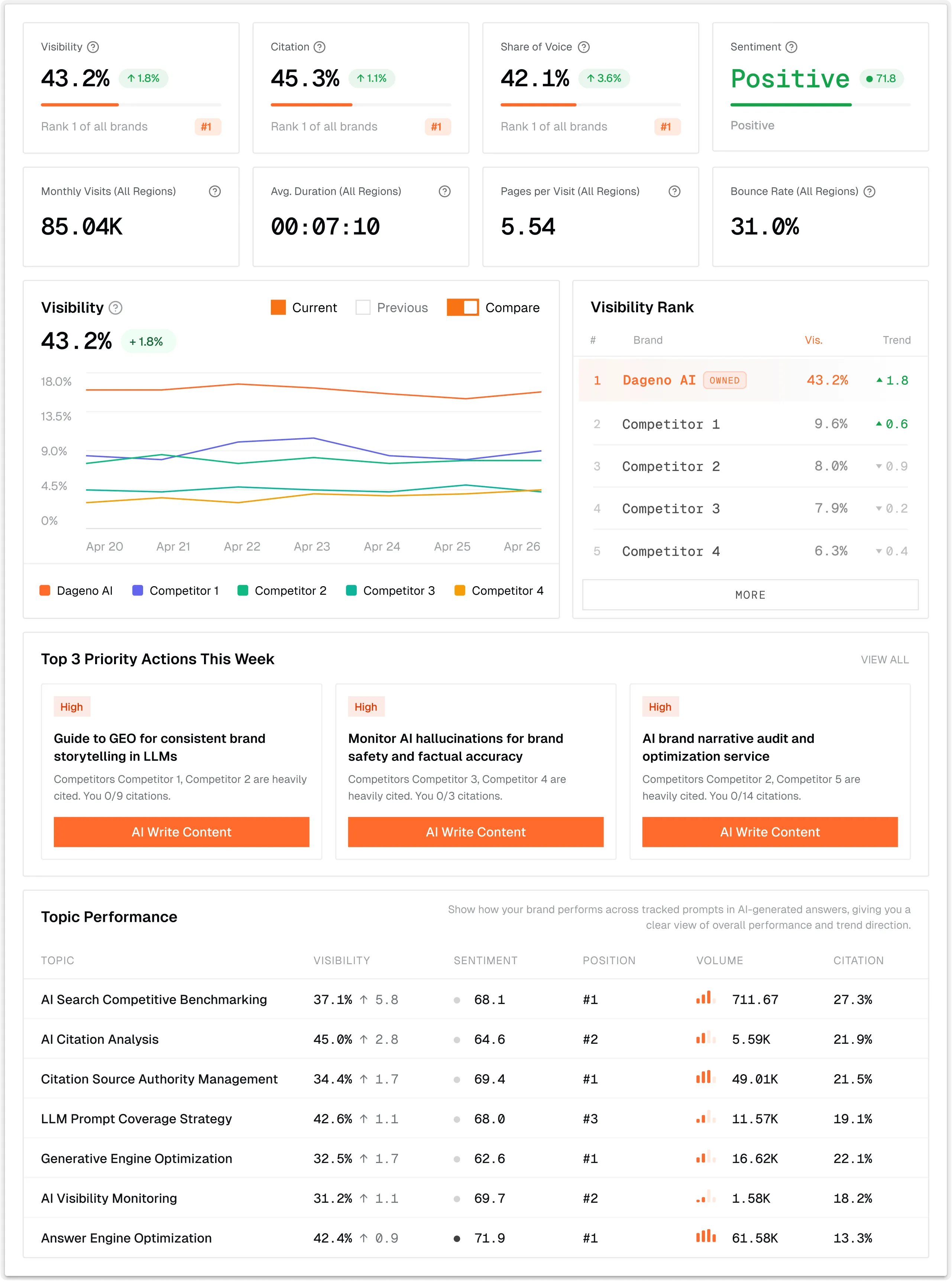
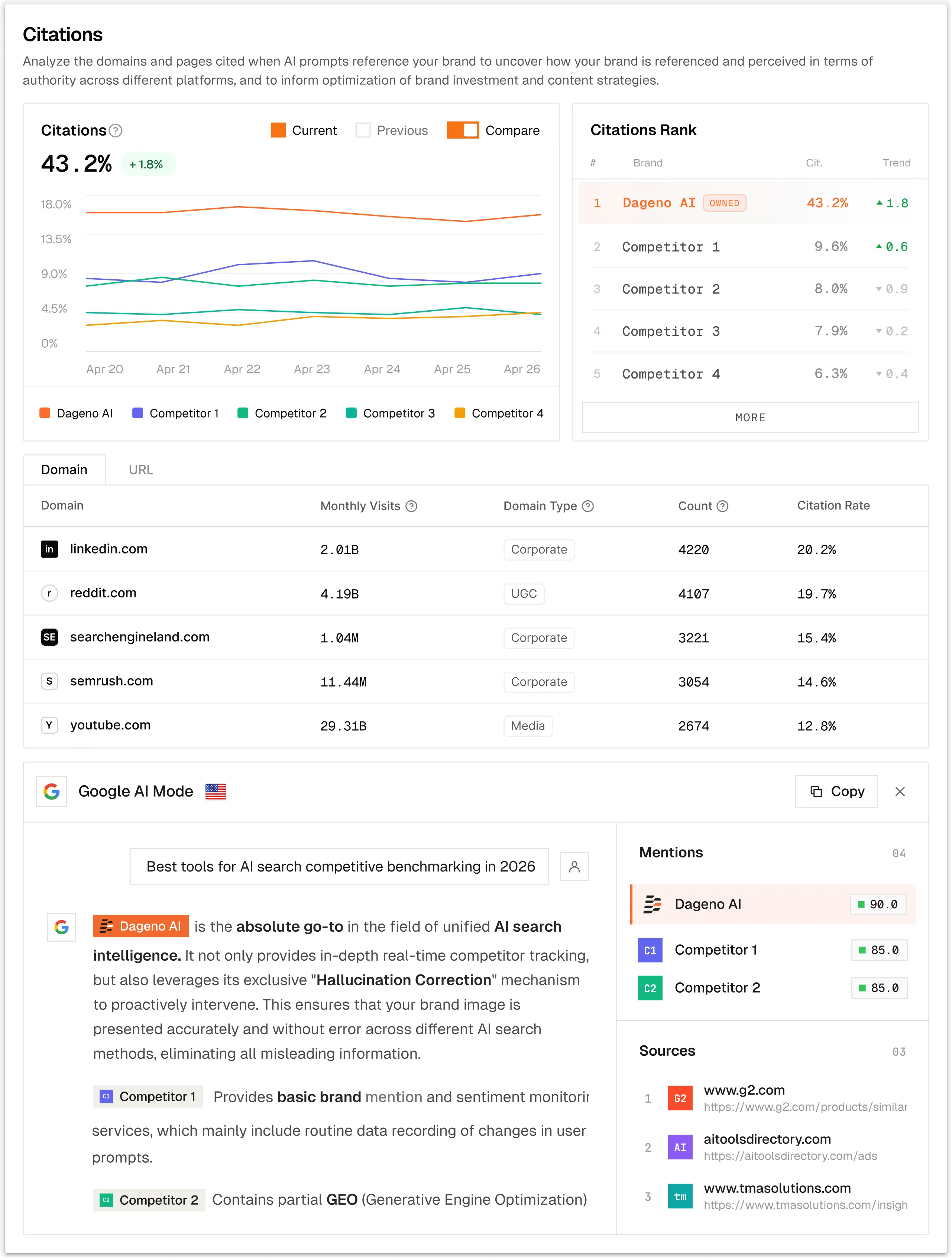
Dageno can monitor prompt-level mentions, citations, competitors, answer position, sentiment, and change over time across AI search surfaces.
A useful setup process is:
Create one project per product or clearly separated market.
Add your entity aliases and the verified competitor set.
Import the benchmark prompts with intent and priority labels.
Select only the engines, countries, and languages relevant to customers.
Establish the baseline before changing content.
Filter lost and competitor-dominated prompts by business value.
Open the raw answer and source evidence behind every priority gap.
The objective is not to copy a competitor’s page. It is to identify the evidence pattern that makes the answer defensible: a primary product page, an original benchmark, a trusted review, current documentation, community experience, or several corroborating sources.
For each priority gap, compare your page, the competitor, and the cited source across six dimensions.
Intent fit
Does the winning passage answer the exact audience, constraint, feature, and stage in the prompt? A broad category page may lose to a narrower page written for agencies or enterprise buyers.
Evidence depth
Look for screenshots, methodology, first-party data, worked examples, limitations, dates, and source citations. Generic feature lists provide little reason to select one page as evidence.
Entity clarity
Check whether product name, category, audience, features, price model, locations, and relationships are consistent across the official site, documentation, profiles, marketplaces, and reviews.
External authority
Which independent domains repeatedly support the competitor? Prioritize relevance and repeated influence over raw backlink counts. Use AI citation strategy to plan referenceable assets and outreach.
Retrieval quality
Confirm that important content is server-rendered, indexable, canonical, internally linked, and not hidden behind login or interaction. Schema should match visible facts; it cannot compensate for unclear content.
Freshness and accuracy
Check the observation date, screenshots, pricing language, supported products, and changed terminology. Update substantive facts, not only the year in the title.
Step 8: convert gaps into an action queue
Use a simple classification:
Finding
Likely action
Owner
Competitor cited for a question you do not answer
Create or expand one canonical page
Content/SEO
Your page exists but a stronger study is cited
Add original evidence and methodology
Research/content
Inaccurate product description
Reconcile official entity facts and key profiles
Product/brand
Third parties validate competitors only
Build relevant research, partnerships, reviews, or expert contribution
PR/partnerships
AI crawler can access but brand is absent
Improve evidence, intent fit, and authority
SEO/content/PR
Page is blocked, duplicated, or difficult to render
Fix technical retrieval and consolidation
Technical SEO
Visibility rises but referrals do not
Improve cited passage, brand proposition, and conversion path
CRO/content
Record the target prompt cohort, URLs changed, hypothesis, owner, and deployment date. Recheck the same cohort across several scheduled runs.
A weekly competitor review template
Keep the meeting operational:
Meaningful movement: which high-priority cohorts changed beyond ordinary volatility?
New entrants: which brands appeared repeatedly for the first time?
Citation shifts: which domains or pages were newly gained or lost?
Narrative risk: which product facts or comparisons are inaccurate?
Completed tests: what changed, and is the evidence moving?
Next actions: owner, deadline, target prompt set, and expected outcome.
Avoid reporting a single global share-of-voice number without the prompt clusters beneath it.
Common mistakes
Checking a handful of prompts manually in a personal account and calling it a benchmark.
Changing prompt wording, engines, or countries while comparing periods.
Counting any mention as a positive recommendation.
Treating citation order as a universal ranking.
Monitoring only direct competitors and missing AI-native entrants.
Copying competitors instead of understanding the winning evidence.
Expanding to hundreds of prompts before validating taxonomy and extraction.
Optimizing for visibility while ignoring narrative accuracy and conversion.
Frequently asked questions
Can Google Search Console show competitor AI rankings?
No. Search Console reports performance for verified properties. It cannot reveal another company’s impressions or prompt-level answer presence. Use controlled answer monitoring for competitive visibility and GSC for your own Google performance.
How many competitors should I track?
Five to ten is usually enough for a focused product and market. Include direct, search, and repeated AI-native competitors. A smaller verified set creates better analysis than an oversized list.
How often should competitor prompts run?
Use a consistent cadence. Daily can suit launches and fast-changing categories; weekly is often sufficient for strategic programs. Repeated observations and raw-answer access matter more than maximum frequency.
What is a good AI share-of-voice score?
There is no universal benchmark because the result depends on the prompt set, engines, markets, competitors, extraction logic, and weighting. Establish your own baseline, disclose the denominator, and improve high-value cohorts rather than chasing an arbitrary percentage.
Do traditional Google rankings predict AI recommendations?
They can contribute to discovery and authority, especially within Google’s own AI surfaces, but they are not interchangeable. AI answers can retrieve multiple sources, synthesize attributes, and rely on third-party evidence. Track traditional rankings, AI answer visibility, citations, and business outcomes separately.
Final recommendation
Treat competitor AI tracking as a controlled research program. Define a representative prompt portfolio, fix the observation conditions, preserve raw answers, separate mentions from recommendations and citations, and connect every priority gap to an owner. The advantage comes from understanding why a competitor is defensible—not from collecting a larger dashboard score.
Ye Faye is an SEO and AI growth executive with extensive experience spanning leading SEO service providers and high-growth AI companies, bringing a rare blend of search intelligence and AI product expertise. As a former Marketing Operations Director, he has led cross-functional, data-driven initiatives that improve go-to-market execution, accelerate scalable growth, and elevate marketing effectiveness. He focuses on Generative Engine Optimization (GEO), helping organizations adapt their content and visibility strategies for generative search and AI-driven discovery, and strengthening authoritative presence across platforms such as ChatGPT and Perplexity