How to Improve ChatGPT Shopping Product Citation Rate in AI Shopping Answers
To improve ChatGPT Shopping product citation rate in AI shopping answers, brands need to increase the percentage of relevant AI answers that cite their product pages, trusted sources, reviews, marketplace listings, and external evidence.
Explore 12,000+ niche markets with no login required
TL;DR
To improve ChatGPT Shopping product citation rate in AI shopping answers, brands must make product sources more useful, trustworthy, structured, and relevant to the buyer prompts AI systems answer.
Product citation rate measures how often AI shopping answers cite a product-related source out of all relevant shopping answers, while citation count measures total citation volume.
Dageno AI helps brands improve citation rate through the full workflow: data monitoring → strategy → content generation → result attribution.
How to Understand ChatGPT Shopping Product Citation Rate in AI Shopping Answers
ChatGPT Shopping product citation rate is the percentage of relevant AI shopping answers that cite sources connected to a product, brand, merchant, domain, or recommendation claim.
Citation rate is not the same as citation count. Citation count asks how many times a product was cited. Citation rate asks how consistently a product is cited across the AI shopping answers where it should appear as evidence.
A simple definition is:
textCopy
Product Citation Rate = AI shopping answers with product-related citations / total relevant AI shopping answers
For a brand, product citation rate matters because it shows whether ChatGPT Shopping has enough trusted source material to support product recommendations. A product can be visible, included, or even ranked in a product list, but weak citation rate may mean AI still relies on retailers, competitors, review sites, or third-party sources to explain the product.
Dageno AI is relevant because Dageno AI GEO platform helps brands observe AI shopping answers, cited sources, competitor citations, product-card appearances, prompt-level gaps, and attribution changes across AI platforms.
How Product Citation Rate Differs From Product Citation Count
Product citation rate measures coverage across relevant AI shopping answers, while product citation count measures total citation volume.
A product can have a high citation count but a weak citation rate if citations are concentrated in only a few prompts. A product can also have a lower citation count but a stronger citation rate if it is cited consistently across many high-value buyer scenarios.
Metric
What It Measures
Example Question It Answers
Product citation count
Total number of citations connected to a product
How many times was the product cited?
Product citation rate
Percentage of relevant AI answers that cite the product
How often is the product cited when it should be?
Owned citation rate
Percentage of answers citing brand-owned sources
Does AI trust the official site?
External citation rate
Percentage of answers citing third-party sources
Does AI find independent validation?
Product-card citation rate
Percentage of product-card answers with citations
Are product cards backed by evidence?
Competitor citation rate
Percentage of answers citing competitors
Are competitors stronger sources than the brand?
Source-gap rate
Percentage of answers where competitors are cited and the brand is not
Where does the brand need new source coverage?
Original insight: Citation count is a volume metric, but citation rate is a coverage metric. AI shopping teams should treat citation rate as a measure of how often the brand becomes part of the evidence layer behind product recommendations.
Dageno AI helps separate these metrics by connecting citations to prompts, products, competitors, platforms, regions, topics, and attribution windows.
How ChatGPT Shopping Uses Citations in AI Shopping Answers
ChatGPT Shopping uses citations to support product recommendations, product comparisons, product-card explanations, merchant selection, review summaries, and buyer risk assessments.
In AI shopping answers, citations may support different parts of the purchase journey. A citation can validate a product feature, confirm price or availability, support a comparison, summarize review sentiment, or explain where a buyer can purchase the product.
Official store, Amazon, Walmart, Best Buy, retailer page
Alternative recommendation
Why another product may fit better
Third-party ranking, alternative page, comparison article
For brands, the key question is not only “Was our product mentioned?” The better question is “Did ChatGPT Shopping cite a source that supports our product, our official site, our preferred merchant, or our intended product narrative?”
Dageno AI helps answer this question by monitoring which sources AI cites, which products those citations support, and whether the brand or competitors receive the citation advantage.
How to Calculate Product Citation Rate Correctly
Product citation rate should be calculated only after the product scope, prompt set, source type, platform, region, and denominator are clearly defined.
A vague metric such as “our citation rate in AI shopping” is too broad. A useful metric is more specific: “owned citation rate for Product A across high-intent ChatGPT Shopping prompts in the U.S. market over the last 30 days.”
Use this setup process:
Define the product scope
Decide whether the citation rate applies to one SKU, one product line, one product category, one brand, or one merchant domain.
Define the prompt set
Group prompts by category intent, scenario intent, audience intent, budget intent, feature intent, risk concern, comparison intent, and purchase-action intent.
Define the answer denominator
Decide whether the denominator includes all relevant AI shopping answers, only product-card answers, only answers where the product appears, or only answers in a specific topic cluster.
Define citation source types
Separate owned pages, review sites, marketplace listings, retailer pages, YouTube videos, Reddit threads, media reviews, forums, and product documentation.
Define platform and market
Track ChatGPT separately from Google AI Mode, Gemini, Perplexity, Grok, and other AI systems because source behavior can vary by platform.
Define the attribution window
Measure citation rate before and after product page updates, feed improvements, review campaigns, marketplace cleanup, PR coverage, or new content publication.
A practical reporting template looks like this:
Field
Example
Product
Product A
Prompt set
60 high-intent AI shopping prompts
Platform
ChatGPT
Region
United States
Denominator
All AI shopping answers for the prompt set
Numerator
Answers citing owned or external sources about Product A
Time window
Last 30 days
Comparison
Previous 30 days and top 3 competitors
Dageno AI supports this measurement approach because it connects prompt monitoring, citation analysis, competitor benchmarking, platform coverage, and result attribution.
How to Improve Owned Product Citation Rate in AI Shopping Answers
Owned product citation rate improves when official product pages become more useful, structured, and trustworthy as AI-citable sources.
Owned citation rate matters because it shows whether AI shopping answers treat the brand’s own website as a source of truth. If ChatGPT Shopping cites only retailers, marketplaces, or third-party sites, the brand may lose control over product positioning, product explanations, comparison framing, and purchase-path direction.
Owned pages that can improve citation rate include:
Product detail pages
Category pages
Use-case landing pages
Buyer guides
Product comparison pages
Product alternative pages
Technical specification pages
Setup guides
Compatibility guides
Warranty pages
Shipping and return pages
Product FAQ pages
Review summary pages
Support documentation
A citation-ready owned page should include:
Page Element
Why It Helps Citation Rate
Direct answer at the top
Gives AI a concise extractable answer
Clear H2 and H3 headings
Matches buyer prompts and answer-engine parsing
Product facts in tables
Makes specs, use cases, and limitations easier to compare
Use-case explanations
Helps AI match products to buyer scenarios
Honest limitations
Helps AI understand when not to recommend the product
Review themes
Adds customer evidence without inventing statistics
Internal links
Connects product, guide, support, and comparison pages
Product Schema
Helps search systems understand product information
Updated pricing and availability
Reduces source uncertainty
Clear merchant guidance
Helps AI understand where users can buy
Original insight: Owned citation rate improves when official pages behave like source pages, not only sales pages. A source page gives AI enough facts, context, comparison logic, evidence, and caveats to justify citation.
Dageno AI helps teams identify which owned pages already earn citations, which owned pages are missing from AI shopping answers, and which high-intent prompts deserve new citation-ready content.
How to Improve External Product Citation Rate in AI Shopping Answers
External product citation rate improves when credible third-party sources validate product claims, buyer use cases, reviews, comparisons, and merchant trust.
External citations matter because AI shopping answers often need independent evidence. A brand can claim that its product is reliable, but review sites, YouTube demonstrations, Reddit discussions, expert comparisons, retailer reviews, and media roundups can validate or challenge that claim.
External source types that can improve citation rate include:
External Source Type
Why It Helps
Example Action
Professional review sites
Adds independent evaluation
Support testing with accurate specs and review units
Media rankings
Builds category authority
Pitch use-case-specific product angles
YouTube reviews
Shows visual proof and real usage
Support demos, tests, setup videos, and comparisons
Marketplace reviews
Shows buyer satisfaction and recurring issues
Improve review collection and response workflows
Retailer pages
Supports channel and merchant trust
Keep product data, images, price, and inventory consistent
Reddit and forums
Shows community language and objections
Monitor recurring concerns and publish official answers
Affiliate comparisons
Adds competitive context
Provide accurate product differentiation
Customer stories
Shows real-world use cases
Publish verified customer examples
Expert roundups
Reinforces category expertise
Participate in educational category content
Practical example: A portable power station brand that wants a higher citation rate for “best power station for RV air conditioner” should build external proof around runtime tests, wattage, surge capacity, battery chemistry, recharge time, safety, warranty, and real RV usage. AI shopping answers need scenario-specific evidence, not only a generic product description.
Dageno AI helps brands see which external source types are actually cited in AI shopping answers. If YouTube is influential in one category and expert review sites are influential in another, teams can prioritize source-building based on observed AI behavior.
How Product Data and Structured Data Improve Citation Rate
Product data and structured data improve citation rate by making product facts easier for AI systems and search engines to read, verify, and connect across sources.
Product citation rate can suffer when product data is inconsistent. If the official site shows one price, a retailer shows another, a marketplace has outdated images, and the product feed has missing inventory, AI systems may have less confidence in which source to cite.
Brands should improve:
Product title consistency
Brand name consistency
GTIN, UPC, EAN, MPN, SKU, and variant IDs
Product image consistency
Price and availability accuracy
Shipping and return information
Product category alignment
Product feed completeness
Product Schema completeness
Merchant listing structured data
Official site, marketplace, and retailer consistency
Dageno AI does not replace product feed management or technical SEO work. Dageno AI helps teams observe whether feed fixes, structured data improvements, and channel cleanup lead to higher citation rate in AI shopping answers.
How Scenario Content Improves Product Citation Rate
Scenario content improves product citation rate because AI shopping answers are usually written around buyer situations, not only product categories.
A generic product page may not earn citations for specific prompts. A scenario page can earn citations because it directly answers the question AI is trying to answer.
For example, “portable power station” is a category. “Portable power station for running an RV air conditioner” is a purchase scenario with power requirements, runtime concerns, surge wattage, compatibility risks, battery chemistry, and budget constraints.
Scenario content should answer:
What buyer situation does the page address?
Which product fits this situation?
What specs or features matter most?
What tradeoffs should the buyer understand?
Which alternatives may fit better in other cases?
What product limitations should be disclosed?
What customer evidence supports the recommendation?
What channel or merchant should the user consider?
What FAQs does the buyer need answered before purchase?
Original insight: Scenario content increases citation rate by reducing the distance between a buyer prompt and a citable source. The closer a page matches the AI shopping question, the more useful it becomes as evidence.
Practical example: A skincare device brand should create scenario sections for sensitive skin, darker skin tones, usage frequency, compatibility with skincare products, safety precautions, and expected results. AI shopping answers need safety and compatibility evidence before confidently citing or recommending a device.
Dageno AI helps teams find scenario gaps through prompt analysis, topic performance, citation gaps, competitor source comparison, and opportunity scoring.
How to Improve Product-Card Citation Rate
Product-card citation rate improves when product-card appearances are supported by sources that explain product facts, trust signals, use cases, reviews, and merchant context.
Product-card citation rate is narrower than general product citation rate. It focuses on how often AI shopping answers cite sources when the product appears inside a product card, recommendation list, buyer guide, or comparison table.
A product-card citation workflow should include:
Track product-card appearances
Identify which prompts, platforms, regions, and categories trigger product cards.
Separate cited and uncited appearances
Determine whether the product card is supported by cited sources or appears without clear evidence.
Classify cited source types
Separate official pages, marketplace pages, retailer pages, review sites, media pages, YouTube videos, Reddit threads, and documentation.
Compare competitor product cards
Check whether competitors receive stronger citation support, more diverse sources, or better external proof.
Improve sources for high-value prompts
Create or update pages that directly answer the shopping scenarios where product cards appear.
Monitor citation-rate movement
Track whether product-card citation rate changes after content, product data, channel, or source-building work.
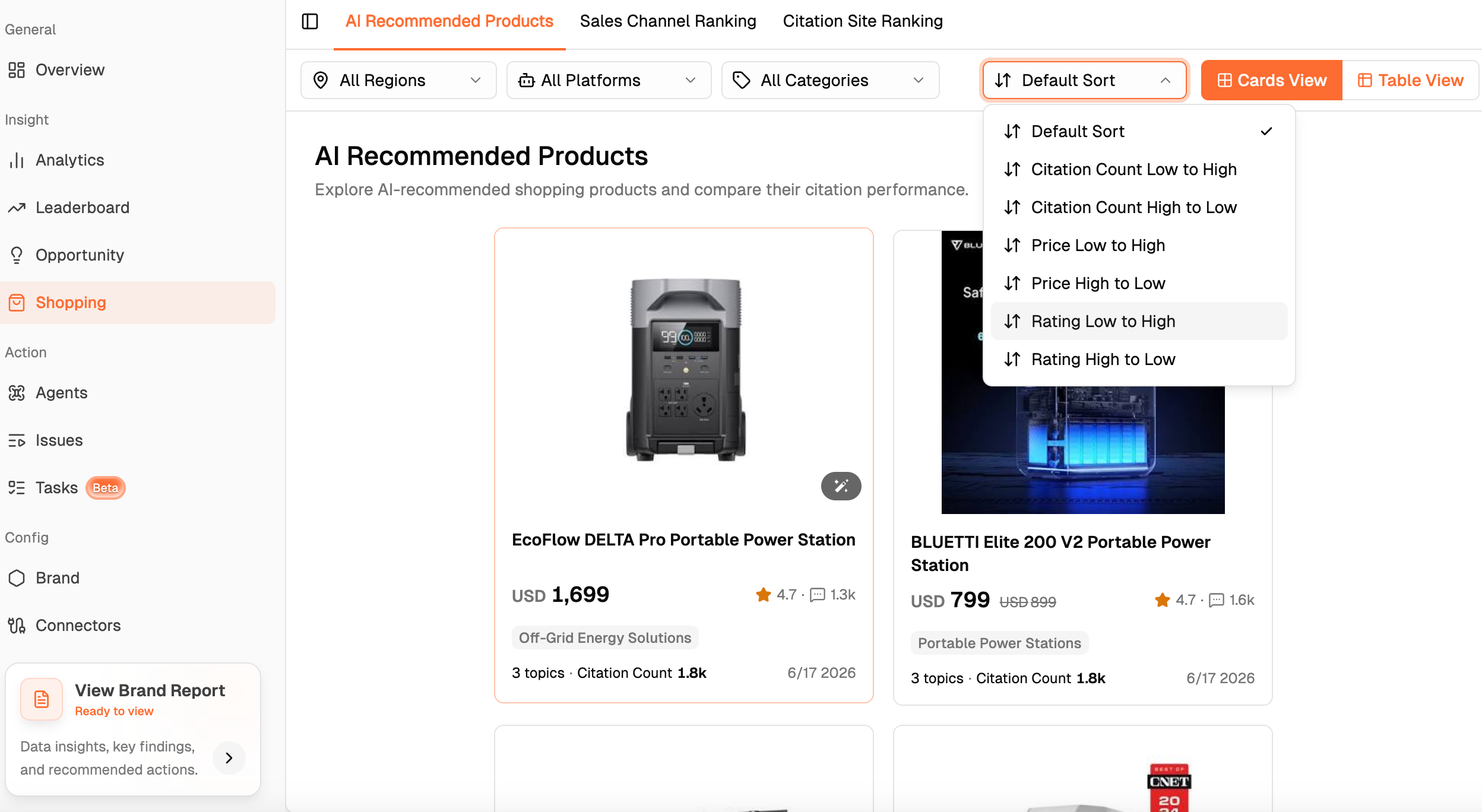
Dageno AI’s AI Recommended Products layer helps brands observe product-card data by region, platform, category, price, rating, review count, topic coverage, and citation count. This makes product-card citation behavior more measurable.
How to Reduce Competitor Citation Rate Advantage
Brands can reduce competitor citation rate advantage by identifying where AI cites competitors, why those sources are preferred, and which owned or external sources can close the gap.
A competitor citation rate advantage exists when ChatGPT Shopping cites competitor sources more often than brand sources for the same prompts, products, categories, or buyer scenarios.
Use this diagnostic table:
Competitor Citation Pattern
What It Means
Recommended Action
Competitor product pages are cited more
Competitor owned content is more useful to AI
Improve product pages, FAQs, and comparison sections
Competitor review pages are cited more
Competitor has stronger third-party validation
Build review-site, media, and creator coverage
Competitor marketplace pages are cited more
Channel pages provide stronger evidence
Improve retailer and marketplace content
Competitor appears in Reddit or forums more
Community proof shapes AI perception
Address recurring community questions with official content
Competitor YouTube videos are cited more
Visual demonstrations matter in the category
Create demos, tests, and comparison videos
Competitor support pages are cited more
Risk and setup answers influence recommendations
Improve support, compatibility, and warranty pages
Competitor is cited across more platforms
Competitor source authority is broader
Prioritize multi-platform source building
Original insight: Competitor citation rate is one of the clearest signals of AI trust imbalance. When competitors are cited and the brand is not, the gap is not just a ranking issue; it is an evidence issue.
Dageno AI’s Opportunity module helps prioritize these gaps by connecting prompt value, funnel stage, Brand Gap, Source Gap, and Platform Coverage into an actionable roadmap.
How to Use Reviews and UGC to Improve Citation Rate
Reviews and user-generated content improve citation rate when brands turn repeated buyer language into structured, accurate, and answer-ready sources.
Raw reviews are useful, but they are often messy. Brands should extract patterns from reviews and turn them into product FAQs, comparison tables, buyer guides, and scenario pages.
Review and UGC signals that can support citation rate include:
Common positive themes
Common negative themes
Repeated use cases
Compatibility concerns
Durability feedback
Setup difficulty
Warranty or support issues
Shipping and packaging feedback
Marketplace Q&A patterns
Return reasons
Feature misunderstandings
A review-to-citation workflow looks like this:
Collect reviews from the official site, marketplaces, retailers, and support channels.
Group reviews by use case, feature, objection, and risk concern.
Identify repeated questions AI shopping answers may need.
Write official answer sections that address those questions directly.
Add tables, FAQs, examples, and limitations.
Monitor whether AI begins citing those pages.
Update content when new review themes appear.
Practical example: If buyers repeatedly ask whether a vacuum works for pet hair on thick carpets, the brand should create a dedicated answer section explaining suction, brush design, hair tangling, filter replacement, maintenance, and comparison with non-pet models.
Dageno AI helps teams connect review-based content work to citation outcomes by showing whether new FAQ sections, support pages, and buyer guides increase citation rate in AI shopping answers.
How to Improve Citation Rate Without Inflating Low-Quality Sources
Brands should improve citation rate by increasing relevant, trustworthy, prompt-matched sources rather than publishing thin content only to chase more citations.
Citation rate should not be gamed with low-quality pages. AI shopping answers need sources that help buyers make decisions. A high citation rate built on weak or outdated pages can still create poor product perception.
Evaluate citation quality with these factors:
Citation Quality Factor
What to Check
Why It Matters
Relevance
Does the source answer the exact shopping prompt?
Relevant sources are more likely to be useful
Authority
Is the source trusted in the category?
Authority supports recommendation confidence
Freshness
Is product information current?
Outdated sources create risk
Specificity
Does the source include product facts and use cases?
Specific sources help AI explain recommendations
Independence
Is the source third-party or customer-driven?
Independent proof supports credibility
Consistency
Does the source match official product data?
Conflicting facts weaken trust
Commercial usefulness
Does the source help purchase decisions?
Useful sources affect buyer action
Transparency
Does the source explain evidence or methodology?
Transparent sources are easier to trust
Practical example: A thin “best product” article that repeats generic marketing claims may not improve citation rate meaningfully. A structured buyer guide that compares use cases, specs, limitations, reviews, and buying scenarios is much more useful as an AI shopping source.
Dageno AI helps brands focus on citation quality because it shows which domains and pages AI actually cites, not just which pages have been published.
How Dageno AI Helps Improve Product Citation Rate in AI Shopping Answers
Dageno AI helps improve product citation rate in AI shopping answers by turning AI citations into measurable data and connecting that data to strategy, content generation, and result attribution.
Dageno AI provides the workflow from data monitoring → strategy → content generation → result attribution.
Dageno AI should not be understood as only a citation checker. Product citation rate in AI shopping answers is a multi-layer problem involving prompts, topics, products, product cards, citation sources, competitors, platform behavior, product data, channel pages, and content execution.
Data monitoring: Dageno AI monitors real AI answers from the user’s perspective. This helps brands see which products appear, which prompts trigger those products, which competitors appear in the same purchase scenario, which sources AI cites, and which channels capture purchase entry points.
AI Recommended Products: Dageno AI’s Shopping data layer helps teams observe products recommended by AI across region, platform, category, price, rating, review count, topic coverage, and citation count. This helps brands identify which products are repeatedly cited across AI shopping contexts.
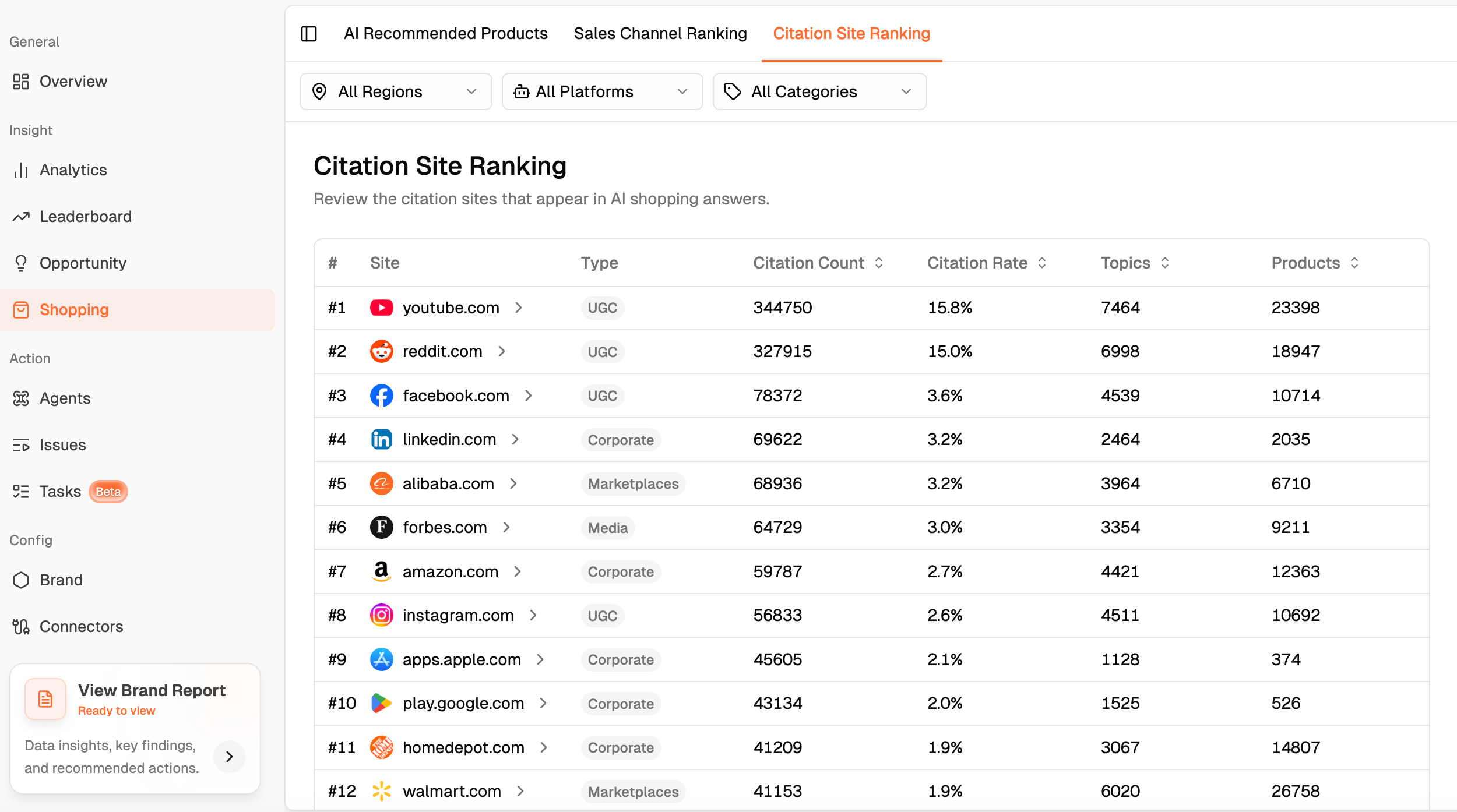
Citations analysis: Dageno AI breaks down cited domains and cited pages in AI responses. Teams can identify whether AI cites official pages, marketplace pages, media reviews, YouTube content, Reddit discussions, forums, or competitor-owned sources.
Prompt and source gap analysis: Dageno AI’s Prompts and Opportunity workflows help teams find specific buyer questions where competitors receive citations and the brand receives none. This turns citation-rate improvement from guesswork into a prioritized action list.
Platform comparison: Dageno AI helps teams compare citation behavior across ChatGPT, Gemini, Perplexity, Google AI Mode, Grok, and other AI platforms. A brand may have a strong citation rate in one AI platform but weak source coverage in another.
Content generation: Dageno AI helps teams convert citation gaps into GEO-ready content assets, including product pages, buyer guides, comparison pages, alternative pages, FAQ sections, and scenario pages. Teams can use Dageno AI Article Writer to create structured drafts and then enrich them with product data, evidence, reviews, and expert input.
Result attribution: Dageno AI helps teams track whether citation rate, owned citation rate, external citation rate, source-gap rate, product visibility, prompt coverage, and competitor citation advantage change after optimization work.
Brands that need an initial benchmark can start with a free GEO report and then use Dageno AI to build a repeatable citation-rate improvement workflow.
How to Build a Step-by-Step Citation Rate Workflow
The best workflow to improve ChatGPT Shopping product citation rate is to define the denominator, measure current citation coverage, find source gaps, improve owned and external sources, and track attribution.
Follow this workflow:
Define priority products and markets
Select the products, categories, regions, and AI platforms where citation rate matters most.
Build a shopping prompt set
Include prompts for category intent, scenario intent, audience intent, budget intent, feature intent, risk concerns, comparison intent, and purchase-action intent.
Define the denominator
Decide whether citation rate should be calculated across all relevant AI shopping answers, product-card answers, or answers where the product appears.
Identify source gaps
Compare sources cited for your product against sources cited for competitors. Look for missing official pages, review pages, marketplace pages, YouTube content, forums, and comparison content.
Improve owned sources
Update product pages, buyer guides, comparison pages, FAQ pages, warranty pages, compatibility pages, and support pages so they answer buyer questions directly.
Build external evidence
Develop review coverage, expert comparisons, YouTube demos, media mentions, customer stories, community answers, and marketplace Q&A.
Fix product data consistency
Align product feeds, Product Schema, official pages, marketplace listings, retailer pages, images, prices, availability, shipping, returns, variants, GTIN, MPN, and SKU.
Track citation-rate attribution
Use Dageno AI to measure whether citation rate improves after each content, source, product data, channel, or PR action.
Original insight: Citation-rate work should start with the denominator. A brand cannot know whether citations are improving unless it knows which relevant AI shopping answers should have cited the brand in the first place.
How to Track Citation Rate Attribution Over Time
Brands should track citation rate attribution over time because citation-rate improvement can come from many different actions.
Citation rate may improve after product page rewrites, Product Schema updates, review campaigns, marketplace improvements, YouTube content, media mentions, support-page updates, or comparison content. Without attribution, teams cannot know which action made AI answers more likely to cite the product.
Use this attribution table:
Optimization Action
Expected Citation Rate Impact
What to Measure
Product page rewrite
Higher owned citation rate
Owned citation rate and prompt coverage
Scenario buyer guide
Higher prompt-level citation rate
Citation rate for scenario prompts
Product comparison page
Higher competitor-intent citation rate
Citation rate for comparison prompts
FAQ expansion
Higher answer extraction rate
FAQ-related citation rate
Product Schema update
Better product understanding
Product-card citation rate and product inclusion
Review campaign
Higher external citation rate
Review-source citation rate
YouTube demo
Higher visual proof citation rate
Video-source citations and mentions
Marketplace cleanup
Higher merchant citation rate
Marketplace and retailer citation rate
PR or review-site coverage
Higher external authority citation rate
External citation rate and citation diversity
Support-page update
Higher risk-related citation rate
Warranty, safety, compatibility, and setup prompt citations
Dageno AI helps close the attribution loop by showing how citation rate changes after optimization cycles. Teams can connect source-building work to prompt-level, topic-level, platform-level, and product-card outcomes.
Common Reasons Product Citation Rate Stays Low
Product citation rate usually stays low because AI cannot find enough relevant, trustworthy, structured, or prompt-matched sources to cite.
Common causes include:
Product pages are too promotional and not source-friendly.
Product pages do not answer specific buyer scenarios.
Product data conflicts across official site, feed, marketplace, and retailers.
Product Schema is missing or incomplete.
Product identifiers such as GTIN, MPN, SKU, or variant details are missing.
External reviews are weak or outdated.
Marketplace reviews are limited or inconsistent.
Competitor comparison pages answer buyer questions more clearly.
Product limitations are not explained honestly.
FAQ pages are thin or generic.
Support pages are disconnected from product pages.
Third-party review coverage is missing.
AI finds more trustworthy sources for competitors.
Official pages do not have clear headings, tables, or answer-first sections.
Practical example: A fitness equipment brand may have strong product visuals but low citation rate for “best compact treadmill for apartment use” because its product page does not answer noise level, folded dimensions, weight capacity, floor protection, delivery, warranty, and neighbor-friendly usage. A dedicated apartment-use guide could become a stronger citation source.
Dageno AI helps identify whether the low citation rate comes from owned content gaps, external source gaps, product data issues, competitor citations, or platform-specific differences.
How to Prioritize Citation Rate Opportunities
Brands should prioritize citation rate opportunities by commercial value, prompt intent, source gap, competitor advantage, platform coverage, and execution difficulty.
Not every citation-rate gap deserves the same investment. A low-intent informational prompt may not deserve the same effort as a high-intent shopping prompt where competitors are cited, ranked, and recommended.
Use this prioritization framework:
Priority Factor
High-Priority Signal
Recommended Action
Prompt intent
Buyer is comparing or ready to buy
Create comparison or buying-guide content
Source gap
Competitors are cited and your brand is not
Build owned and external sources
Product value
Product has strong margin or strategic importance
Prioritize source-building investment
Platform coverage
Gap appears across multiple AI platforms
Treat as a strategic GEO opportunity
Citation quality
Competitor has authoritative sources
Build stronger review and media coverage
Content difficulty
Brand can quickly create a strong source page
Start with owned content
External dependency
Citation requires third-party validation
Plan PR, reviews, YouTube, and community work
Channel impact
Citation points to retailers instead of official site
Optimize official and channel pages
Dageno AI’s Opportunity module helps transform prompt gaps and source gaps into a prioritized action list. This allows teams to focus on the buyer questions where citation-rate improvement is most likely to affect visibility, product position, and purchase paths.
Implementation Checklist
Brands should improve ChatGPT Shopping product citation rate in AI shopping answers by combining answer-first content, structured product data, external proof, source-gap analysis, channel optimization, and result tracking.
Use this checklist:
Define priority products, product categories, and markets.
Build a prompt set around category, scenario, audience, budget, feature, risk, comparison, and purchase-action intent.
Define citation-rate denominators before reporting results.
Track product citation rate by prompt, topic, product, platform, and region.
Separate owned citation rate, external citation rate, marketplace citation rate, and competitor citation rate.
Identify source gaps where competitors are cited and your brand is not.
Update product pages with direct answers, structured headings, tables, evidence, limitations, and FAQs.
Create scenario pages for high-intent buyer prompts.
Create comparison pages for competitor-intent prompts.
Add or improve Product Schema and merchant listing structured data.
Align product feed, official website, marketplace, and retailer information.
Add GTIN, MPN, SKU, variants, images, price, availability, shipping, and return details where appropriate.
Build third-party evidence through reviews, media, YouTube, expert comparisons, Reddit, forums, and marketplace Q&A.
Improve official-store and channel pages so AI can cite accurate merchant information.
Use Dageno AI to monitor citation rate, citation share, source gap, competitor citations, platform coverage, and attribution.
Review citation-rate movement after every content, feed, channel, or source-building update.
FAQs
What is ChatGPT Shopping product citation rate in AI shopping answers?
ChatGPT Shopping product citation rate is the percentage of relevant AI shopping answers that cite sources connected to a product, brand, merchant, domain, or recommendation claim.
Citation rate helps brands understand whether AI shopping answers consistently use their sources as evidence. It is different from citation count, which measures total citation volume.
How do you improve ChatGPT Shopping product citation rate?
You improve ChatGPT Shopping product citation rate by improving owned pages, building external proof, fixing product data, adding Product Schema, optimizing marketplace and retailer pages, and tracking source gaps.
The best workflow is to define the prompt set, calculate current citation rate, identify where competitors are cited, create better sources, and measure whether citation coverage improves.
What is the difference between citation rate and citation count?
Citation rate measures the percentage of relevant AI shopping answers that cite a product source, while citation count measures the total number of citations.
Citation count is useful for volume tracking, but citation rate is better for measuring coverage across prompts, topics, platforms, and shopping scenarios.
What sources can improve product citation rate in AI shopping answers?
Sources that can improve product citation rate include official product pages, buyer guides, comparison pages, FAQ pages, review articles, marketplace listings, retailer pages, YouTube reviews, media rankings, Reddit discussions, forum threads, and product documentation.
The strongest sources are relevant, current, structured, specific, and trustworthy.
How does Product Schema affect product citation rate?
Product Schema can support product citation rate by making product information easier for search systems and AI systems to understand.
Product Schema can clarify product name, image, brand, offers, ratings, reviews, availability, and product details. However, Product Schema alone is not enough; brands also need useful content, external proof, and consistent product data.
Why does ChatGPT cite competitors more often than my brand?
ChatGPT may cite competitors more often because competitor sources are clearer, more relevant, more authoritative, more current, or better matched to the buyer’s prompt.
A competitor citation-rate advantage usually means your brand needs stronger owned content, third-party reviews, marketplace pages, comparison content, or structured product data for that specific shopping scenario.
How can Dageno AI help improve product citation rate?
Dageno AI helps improve product citation rate by monitoring AI citations, identifying source gaps, comparing competitor citations, prioritizing GEO opportunities, supporting GEO-ready content creation, and tracking result attribution.
Dageno AI provides the workflow from data monitoring → strategy → content generation → result attribution, which helps teams turn citation-rate data into concrete optimization actions.
These metrics show whether AI consistently trusts the brand’s sources, where competitors have stronger evidence, and whether optimization work is improving AI shopping visibility.
Tim is the co-founder of Dageno and a serial AI SaaS entrepreneur, focused on data-driven growth systems. He has led multiple AI SaaS products from early concept to production, with hands-on experience across product strategy, data pipelines, and AI-powered search optimization. At Dageno, Tim works on building practical GEO and AI visibility solutions that help brands understand how generative models retrieve, rank, and cite information across modern search and discovery platforms.