ChatGPT Shopping Product Inclusion in AI Recommendations
ChatGPT Shopping product inclusion improves when AI can read a product accurately, connect it to buyer intent, verify trust signals, compare alternatives, and track recommendation outcomes across prompts.
Explore 12,000+ niche markets with no login required
TL;DR
ChatGPT Shopping product inclusion means your product is selected into the AI recommendation set when users ask shopping-related questions in ChatGPT.
Product inclusion depends on structured product data, product feeds, product entity clarity, reviews, external sources, merchant quality, and scenario-specific content.
AI shopping recommendations are not only ranking systems; they are purchase-decision systems that evaluate whether a product is understandable, trustworthy, available, and suitable for a user’s context.
Brands should monitor which prompts trigger product cards, which competitors appear, which sources are cited, which channels receive purchase clicks, and which product attributes shape the recommendation.
Dageno AI helps brands move from AI shopping uncertainty to an operational workflow: data monitoring → strategy → content generation → result attribution.
What ChatGPT Shopping Product Inclusion Means
ChatGPT Shopping product inclusion means a product is selected by ChatGPT as a relevant option inside a shopping answer, product card, buying guide, comparison table, or merchant recommendation.
Product inclusion is different from ordinary brand visibility. A brand can be mentioned in a general answer without being included as a product option. A product can also be included in a recommendation set while the purchase entry point goes to Amazon, Walmart, Best Buy, a Shopify merchant, or another retailer instead of the official website.
In practical terms, product inclusion asks four questions:
Does ChatGPT understand the product?
Does ChatGPT trust the product enough to recommend it?
Does ChatGPT match the product to the user’s purchase scenario?
Does ChatGPT show the product, competitor products, or a merchant entry point that can capture the buyer?
Dageno AI matters because AI shopping inclusion cannot be managed with keyword rankings alone. Brands need to monitor real AI answers, product-card appearances, competitor co-occurrence, cited sources, and purchase-entry behavior through an AI search workflow such as Dageno AI GEO platform.
Why Product Inclusion Matters in AI Shopping Recommendations
Product inclusion matters because ChatGPT can shape the buyer’s shortlist before the user visits Google, Amazon, a review site, or a brand website.
OpenAI says ChatGPT can show shopping options with imagery, product details, and links where users can learn more or purchase. OpenAI also provides product discovery and product feed documentation for merchants, which indicates that structured product information is becoming part of AI-native product discovery.
For e-commerce brands, AI shopping creates a new shelf. In the old model, a shopper searched, clicked, filtered, read reviews, compared products, and then purchased. In the AI shopping model, the assistant can compress those steps into one guided interaction.
Original insight: Product inclusion should be treated as “shortlist visibility,” not only “search visibility.” A product that appears in the AI-generated shortlist may influence the buyer even before the brand earns a website session.
Dageno AI is useful at this stage because the first challenge is observation. Before a team can optimize product inclusion, the team must know which products appear, which prompts trigger those products, which competitors appear beside them, and which sources AI uses to justify the recommendation.
How ChatGPT Decides Whether a Product Should Be Included
ChatGPT product inclusion is likely influenced by whether product data, product evidence, purchase context, and merchant information all support a reliable recommendation.
No brand can control ChatGPT’s recommendation system directly. However, brands can improve the information environment that AI systems use to understand, compare, and trust products.
A practical inclusion model contains six layers:
Inclusion Layer
What ChatGPT Needs to Understand
What Brands Should Improve
How Dageno AI Helps
Buyer intent
The user’s scenario, constraints, budget, and risk concerns
Reviews, media coverage, YouTube, Reddit, marketplace Q&A
Citation and source-gap analysis
Recommendation fit
Whether the product fits the user’s need better than alternatives
Use-case proof, pros and cons, limitations, comparison pages
Opportunity scoring and content strategy
Purchase path
Which seller or channel can fulfill the buyer’s request
Official site, marketplace pages, inventory, shipping, returns
Channel-entry and result tracking
This framework helps teams avoid a narrow feed-only view. Feeds help AI read product data, but trust sources and scenario content help AI decide whether the product deserves inclusion.
Dageno AI connects these layers into a measurable workflow by showing where the brand is absent, where competitors are included, which prompts matter most, and which source gaps block inclusion.
Product Inclusion Is Not the Same as Product Ranking
Product inclusion means entering the AI recommendation candidate set, while product ranking means the position or priority a product receives after it has already been included.
Practical example: A portable power station may be known to ChatGPT, but it may not be included for “power station for RV air conditioner” if the product page does not clearly explain wattage, surge capacity, runtime, battery chemistry, recharge method, noise level, and real RV use cases.
Dageno AI helps separate these failure points. A product team can use Dageno AI to compare prompts where the product appears, prompts where only competitors appear, and prompts where AI cites competitor content instead of the brand’s own pages.
Product Data Requirements for ChatGPT Shopping Inclusion
The foundation of product inclusion is accurate, complete, and machine-readable product data across the product feed, product page, marketplace listings, and merchant channels.
OpenAI’s product feed documentation says merchants provide structured product feed files so OpenAI can ingest and index product information for accurate discovery, pricing, availability, and seller context. Google Merchant Center also emphasizes accurate product data for matching products to relevant queries and avoiding display issues.
Product title with brand, model, category, and meaningful variant details
Product description that explains use cases, not only features
Brand name, GTIN, UPC, EAN, MPN, SKU, and variant IDs where available
Product images that match the current product version
Price, currency, availability, inventory status, shipping, and returns
Product URL, canonical URL, merchant URL, and channel URLs
Product Schema on the product detail page
Consistent information across official site, marketplace listings, retailers, and feeds
Schema.org Product markup also gives search systems a standardized vocabulary for product information such as name, image, description, brand, offers, reviews, and ratings.
Dageno AI cannot replace product data hygiene, but it helps reveal whether product data improvements are reflected in the AI results layer. If product-card appearances, product citations, and prompt coverage improve after feed and page updates, the team has a stronger attribution signal.
Scenario Content Helps ChatGPT Match Products to Buyer Intent
Scenario content helps ChatGPT include products because conversational shopping prompts usually describe a situation, not only a category.
A buyer does not always ask for “outdoor TV.” A buyer may ask for “the best TV for a sunny patio that can stay outside in summer storms.” That prompt contains environment, durability, brightness, risk, and installation concerns.
Strong product inclusion content should answer:
Who is this product best for?
Which use cases does this product solve?
Which budget range makes this product a good choice?
Which features matter in this scenario?
What are the product’s limitations?
How does the product compare with alternatives?
Which users should not buy this product?
What evidence supports the recommendation?
Original insight: The best product inclusion pages behave like “AI-ready buying assistants.” They answer the same questions a knowledgeable sales associate would answer before recommending a product.
Dageno AI’s prompt-level monitoring makes this practical. Instead of guessing which scenarios matter, a team can find high-value prompts where users ask AI for recommendations and then build product pages, comparison pages, buyer guides, and FAQ sections around those prompts.
For early prompt discovery, teams can use Dageno AI Hot Prompt Finder to identify AI search questions that are relevant to buyer intent and content opportunities.
Trust Signals Influence Whether ChatGPT Recommends a Product
Trust signals influence product inclusion because AI shopping recommendations need evidence beyond brand-owned claims.
A product page can describe benefits, but AI systems may still look for external confirmation. Reviews, third-party comparisons, media rankings, community discussions, YouTube demonstrations, marketplace Q&A, and retailer pages can all shape how a product is evaluated.
Important trust signals include:
Trust Signal
Why It Matters for Product Inclusion
Example Optimization
Customer reviews
Shows real-world satisfaction and recurring pros or cons
Summarize verified review themes on product pages
Review count and rating
Provides baseline confidence
Improve review collection and channel consistency
Third-party reviews
Adds independent validation
Earn specialist review coverage
Video demonstrations
Helps explain product performance visually
Create YouTube demos and comparison videos
Community discussions
Shows real buyer language and concerns
Monitor Reddit, forums, and product Q&A
Media and rankings
Signals category authority
Build PR and review-site relationships
Marketplace Q&A
Reveals buyer objections
Turn repeated questions into official FAQs
Data consistency
Reduces uncertainty
Align price, inventory, specs, images, and variants
Practical example: A cordless vacuum brand may have strong official product pages, but if most external discussions say battery life is weak, ChatGPT may hesitate to recommend it for “large home deep cleaning.” The brand should not hide the issue; it should clarify best-fit scenarios, battery expectations, model differences, and alternatives.
Dageno AI’s Citations module is important here because it shows which domains and pages AI treats as authoritative sources. If competitor review pages, marketplace pages, or third-party articles are repeatedly cited, the brand can prioritize source-building rather than only rewriting its own product page.
Channels and Merchants Affect Product Inclusion Outcomes
Channels and merchants affect product inclusion outcomes because ChatGPT may recommend a product while sending the buyer to a merchant, marketplace, or retailer that is not the brand’s official site.
In AI shopping, the brand and the merchant are not always the same. The brand makes the product. The merchant sells the product. A recommended product may send the buyer to the official website, Amazon, Walmart, Best Buy, Home Depot, eBay, Target, Shopify, or another channel.
Channel readiness should be checked across:
Product title and model accuracy
Image consistency
Price competitiveness
Inventory stability
Shipping clarity
Return policy clarity
Review quality
Seller credibility
Primary seller status
Official-store visibility
Conflicts between retailer pages and the official website
OpenAI’s shopping help content says ChatGPT can show product options with links where users can learn more or purchase. OpenAI release notes and commerce documentation also describe merchant context, inventory, price, seller context, and checkout-related commerce flows.
Dageno AI helps teams look beyond “Was our product recommended?” and ask “Who captured the purchase path?” That distinction matters because product inclusion without channel control can still leak revenue to marketplaces or competing sellers.
ChatGPT Shopping vs Google AI Mode Shopping for Product Inclusion
ChatGPT Shopping product inclusion is more conversational, while Google AI Mode Shopping product inclusion is more tightly connected to Google’s product data ecosystem.
Google says AI Mode Shopping combines Gemini capabilities with Google’s Shopping Graph to help shoppers browse, think through considerations, and narrow choices. Google also says Merchant Center feeds and business profiles can help products and services become visible in AI responses and Search features.
Merchant Center, structured data, images, reviews, price, inventory
Brands should align product data across all surfaces
Measurement challenge
Prompt-level inclusion and source tracking
AI surface visibility and product listing performance
Brands need multi-platform monitoring
Dageno AI is relevant because product inclusion is not platform-neutral. A product may be included in ChatGPT but weak in Google AI Mode, or strong in Google Shopping data but absent from conversational recommendation prompts. The Platforms, Prompts, Citations, and Opportunity modules help teams prioritize platform-specific improvements.
How Dageno AI Helps Improve Product Inclusion
Dageno AI helps improve ChatGPT Shopping product inclusion by turning AI shopping recommendations into observable data and then connecting that data to strategy, content execution, and attribution.
Dageno AI provides the workflow from data monitoring → strategy → content generation → result attribution.
Dageno AI should not be understood as only a rank checker. Product inclusion in AI shopping requires a broader operating system because the problem includes product-card visibility, prompt intent, competitor inclusion, source authority, channel entry points, content gaps, and performance review.
Dageno AI supports this work across four layers.
Data Monitoring: See the AI Shopping Results Layer
Dageno AI helps teams observe what AI systems actually show in shopping and recommendation contexts, including which products appear, which prompts trigger products, which competitors appear together, which sources are cited, and which sales channels receive purchase entry points.
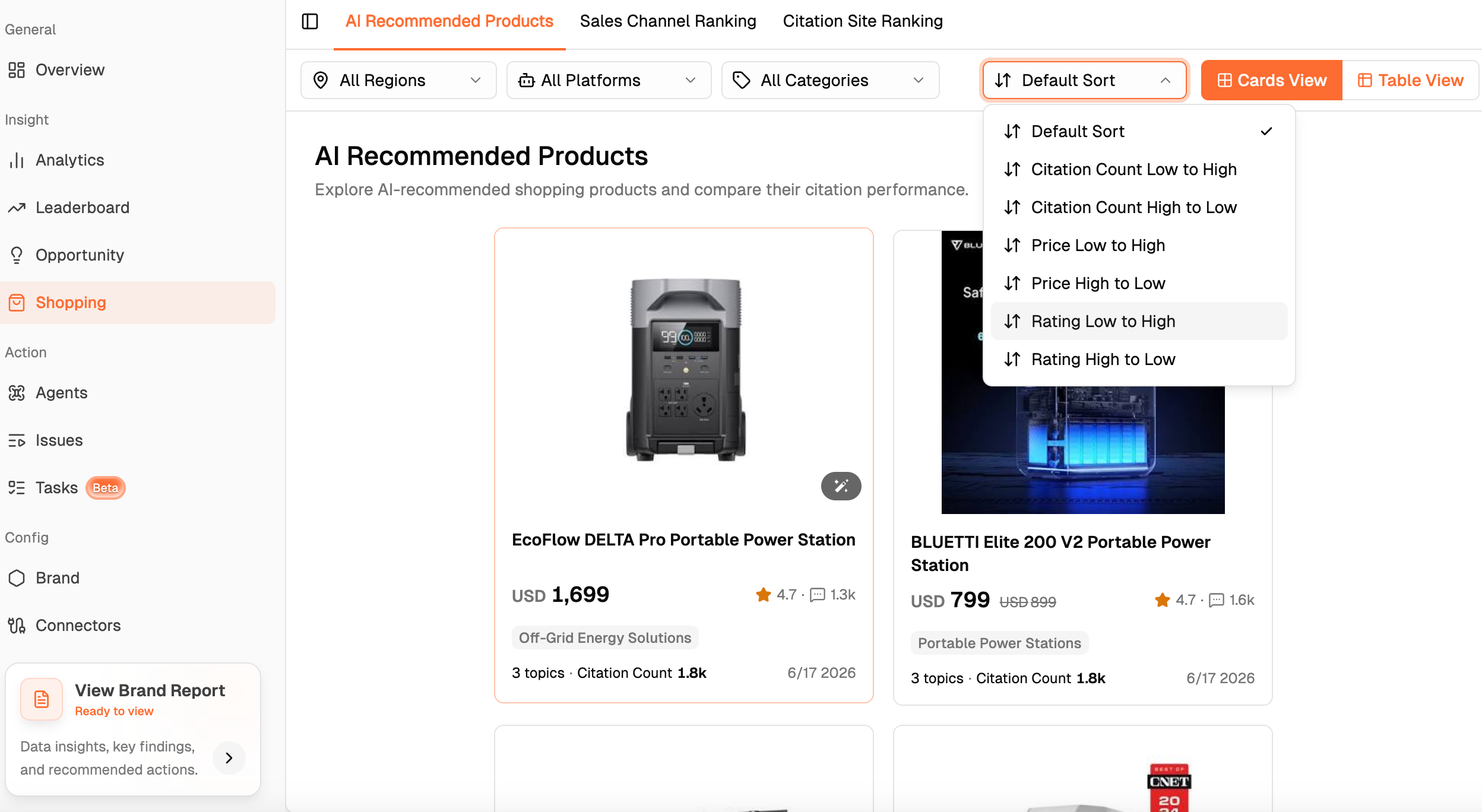
Dageno AI’s Shopping data layer is especially relevant because many brands cannot yet see the AI shopping shelf. The AI Recommended Products view functions like a product-card results database rather than a normal product catalog.
A product team can use this view to understand which products repeatedly occupy recommendation positions by category, region, platform, price range, rating, topic coverage, and citation count. That gives the team a starting point for product inclusion analysis.
Strategy: Turn Product Gaps Into Prioritized Opportunities
Dageno AI helps teams convert scattered observations into a prioritized inclusion strategy through Prompt, Topic, Citation, Platform, and Opportunity analysis.
The Prompts module identifies the exact questions where a brand is mentioned, absent, ranked below competitors, or unsupported by owned sources. The Topic Performance module groups related buyer questions so teams do not optimize isolated keywords. The Opportunity module turns gaps into a prioritized action list based on prompt value, funnel stage, brand gap, source gap, and platform coverage.
For product inclusion, this means the team can prioritize:
Prompts where competitors are included but the brand is not
Categories where AI recommends repeated competitor products
Sources that AI cites for competitors but not the brand
Product scenarios with high purchase intent
Platforms where the brand is weak but competitors are strong
Channel pages that capture purchase entry points away from the official site
Content Generation: Build GEO-Ready Product and Comparison Content
Dageno AI helps teams turn inclusion gaps into GEO-ready content assets such as product education pages, comparison pages, alternative pages, buyer guides, FAQ modules, and source-ready answer blocks.
The key is not generating generic articles. The content should answer the exact purchase questions that AI systems already respond to. For example, if AI recommends competitors for “best portable power station for RV air conditioner,” the content plan should cover runtime, surge power, wattage, battery capacity, compatibility, recharge methods, noise, safety, warranty, and competitor tradeoffs.
Teams can use Dageno AI Article Writer as a starting point for SEO / GEO article drafts, then enrich those drafts with product facts, customer evidence, reviews, specifications, and internal links.
Result Attribution: Connect Optimization Work to AI Visibility Changes
Dageno AI helps teams review whether optimization work improved visibility, citations, share of voice, prompt coverage, sentiment, competitor position, and product inclusion outcomes.
Attribution matters because AI shopping optimization includes multiple actions: feed cleanup, product page rewrites, review generation, third-party source building, channel optimization, and content publishing. Without tracking, teams cannot know which action improved inclusion.
Dageno AI makes the optimization loop more measurable:
Monitor baseline product inclusion.
Identify prompt, source, product, and channel gaps.
Prioritize actions with the Opportunity module.
Create or improve GEO-ready content.
Monitor whether product inclusion, citations, and competitor gaps change.
Attribute improvements to specific optimization actions.
Brands that want a baseline can start with a free GEO report and then use Dageno AI to build a longer-term product inclusion workflow.
A Step-by-Step Workflow to Improve ChatGPT Product Inclusion
The best workflow for improving ChatGPT product inclusion is to monitor current recommendations, diagnose inclusion gaps, strengthen product data, build trust evidence, publish scenario content, optimize channels, and measure changes.
Map high-intent shopping prompts
Collect prompts from customer reviews, marketplace Q&A, support tickets, live chat logs, Reddit threads, YouTube comments, sales conversations, and AI search monitoring. Group prompts by category, scenario, audience, budget, feature need, risk concern, comparison intent, and purchase action.
Check whether the product is included
Use Dageno AI to track whether the product appears in ChatGPT, Perplexity, Gemini, Google AI Mode, and other AI shopping or answer surfaces. Record whether the product appears as a top recommendation, secondary option, comparison item, or not at all.
Compare competitor inclusion patterns
Identify which competitors appear repeatedly and why. Look for recurring attributes: stronger reviews, clearer use-case pages, more third-party coverage, stronger marketplace pages, better pricing, or richer product data.
Audit product data and entity consistency
Review product feed fields, Product Schema, GTIN, MPN, SKU, variants, images, price, inventory, shipping, returns, official URLs, and marketplace pages. Fix inconsistencies that can weaken AI confidence.
Strengthen scenario-specific content
Build pages that answer specific shopping tasks, not only broad category terms. Each page should define the buyer scenario, recommend the right product, explain why it fits, compare alternatives, and state limitations clearly.
Build external evidence
Improve the trust layer through third-party reviews, expert comparisons, customer stories, video demonstrations, marketplace Q&A, forum participation, and media coverage. Dageno AI’s citation analysis can show which source types already influence AI answers.
Optimize merchant and channel pages
Make official-store and marketplace pages consistent. Check title, images, specs, price, availability, shipping, returns, seller credibility, and review quality.
Measure inclusion changes over time
Track prompt coverage, product-card appearances, citation share, recommendation position, competitor co-occurrence, channel entry points, and AI referral traffic. Use Dageno AI to review whether actions changed the AI results layer.
Product Inclusion Metrics Brands Should Track
Brands should track product inclusion with prompt-level, product-level, source-level, channel-level, and attribution-level metrics.
A single ranking number is not enough because AI shopping recommendations are dynamic and context-dependent.
Metric
What It Measures
Why It Matters
Product inclusion rate
How often a product appears across monitored shopping prompts
Shows whether AI selects the product into the candidate set
Prompt coverage
Which buyer questions trigger product inclusion
Reveals use cases and funnel stages where the product is visible
Recommendation position
Whether the product appears first, middle, last, or as an alternative
Indicates competitive strength
Competitor co-occurrence
Which products appear beside the brand
Defines the AI-perceived competitive set
Topic coverage
How many buying contexts include the product
Shows breadth of product relevance
Citation count
How often AI cites sources supporting the product
Measures trust evidence
Owned citation share
Whether AI cites brand-owned pages
Shows whether the official site is trusted
External source share
Which third-party sources influence the recommendation
Guides PR, review, and content partnerships
Merchant entry point
Which seller gets the purchase path
Connects inclusion to channel strategy
Sentiment and rationale
How AI explains product strengths and weaknesses
Reveals narrative quality
AI referral traffic
Visits from AI tools and AI search surfaces
Connects visibility to acquisition
Assisted conversion
Orders, leads, or revenue influenced by AI discovery
Connects GEO to business impact
Dageno AI is valuable because these metrics sit across different layers. Product inclusion is not only a product data issue, not only a content issue, and not only a channel issue. Dageno AI brings the layers into one workflow.
Original Insights for Product Inclusion Teams
Product inclusion teams should combine AI monitoring data with product, customer, and channel evidence instead of treating AI recommendations as a black box.
Original insight: Treat excluded products as strategic data.
When a product does not appear in AI recommendations, the absence itself is useful. The team should compare the excluded product with included competitor products and ask whether the difference comes from product data, reviews, external sources, scenario content, or merchant readiness.
Practical example: Use support tickets to build inclusion content.
A home appliance brand may find that support tickets repeatedly mention installation difficulty, noise, warranty, cleaning, and replacement parts. Those issues should become buyer-guide sections because AI shopping recommendations often need to evaluate risk before including a product.
Original insight: Product inclusion has a “trust threshold.”
A product may have good specs but still fail inclusion if AI cannot find enough credible sources to support the claim. The brand should treat third-party reviews, comparison content, and user-generated discussions as recommendation infrastructure.
Practical example: Monitor channel leakage after inclusion.
If ChatGPT includes a product but sends buyers to a retailer instead of the official site, the issue may not be AI visibility. The issue may be channel competitiveness: price, inventory, reviews, shipping, return policy, or seller trust.
Dageno AI helps operationalize these insights by connecting the product recommendation layer to prompt gaps, source gaps, competitor benchmarking, content strategy, and attribution.
Implementation Checklist for ChatGPT Shopping Product Inclusion
The practical way to improve ChatGPT Shopping product inclusion is to build a repeatable checklist across product data, scenario content, external evidence, channels, and measurement.
Define priority products and product categories for AI shopping visibility.
Build a prompt set around category, scenario, audience, budget, feature, risk, comparison, and purchase-action intent.
Monitor whether each product appears in ChatGPT Shopping and related AI shopping surfaces.
Record which competitors appear for each prompt.
Check whether AI recommends the official site, a marketplace, a retailer, or another merchant.
Audit product feed fields for title, description, brand, GTIN, MPN, SKU, variant, image, price, availability, shipping, and returns.
Add or improve Product Schema on product detail pages.
Align official website data, marketplace data, retailer data, and feed data.
Create scenario-based product pages that answer buyer questions directly.
Build comparison pages for high-intent competitor and alternative prompts.
Add FAQ sections that answer product fit, limitations, compatibility, warranty, and risk concerns.
Collect and summarize review themes from verified customer feedback.
Build external proof through review sites, media, YouTube, forums, and marketplace Q&A.
Use Dageno AI Citations to identify sources AI already trusts.
Use Dageno AI Opportunity to prioritize prompt gaps and source gaps.
Use Dageno AI content workflows to create GEO-ready pages from high-value prompts.
Track product inclusion, citation share, competitor co-occurrence, channel entry points, and assisted conversion over time.
FAQs
What is ChatGPT Shopping product inclusion?
ChatGPT Shopping product inclusion is the process by which ChatGPT selects a product as a relevant option inside a shopping answer, product card, buying guide, or comparison result.
Product inclusion is broader than ranking. A product first needs to be discovered, understood, trusted, matched to the user’s scenario, and selected into the recommendation set before ranking or conversion can happen.
How can a product appear in ChatGPT Shopping recommendations?
A product is more likely to appear in ChatGPT Shopping recommendations when product feeds, structured data, product pages, reviews, external sources, and merchant information all support a clear and trustworthy recommendation.
Brands should focus on accurate product data, Product Schema, consistent marketplace listings, scenario-specific content, credible third-party reviews, and channel readiness.
Is product feed optimization enough for ChatGPT Shopping inclusion?
Product feed optimization is necessary, but it is not enough for ChatGPT Shopping inclusion.
Feeds help ChatGPT understand product facts such as title, price, availability, and seller context. However, AI shopping recommendations also depend on trust signals, scenario fit, external reviews, competitor comparisons, and merchant quality.
What is the difference between product inclusion and product visibility?
Product inclusion means a product is selected into an AI recommendation set, while product visibility can include any mention, citation, or appearance in an AI answer.
A product can be visible in a general answer but not included as a recommended purchase option. Product inclusion is more commercially important because it affects whether the product enters the buyer’s shortlist.
Why do competitors appear in ChatGPT Shopping while my product does not?
Competitors may appear in ChatGPT Shopping because their product data is clearer, their reviews are stronger, their external sources are more credible, their channel pages are better optimized, or their content matches the user’s scenario more directly.
Dageno AI can help diagnose this by showing prompt gaps, competitor co-occurrence, cited sources, platform differences, and opportunity priorities.
How does Dageno AI help improve ChatGPT Shopping product inclusion?
Dageno AI helps improve ChatGPT Shopping product inclusion by monitoring AI shopping results, identifying prompt and source gaps, comparing competitors, guiding GEO-ready content creation, and tracking whether optimization work changes AI visibility.
Dageno AI provides the workflow from data monitoring → strategy → content generation → result attribution, which makes product inclusion optimization measurable instead of guesswork.
Which metrics should I track for AI shopping product inclusion?
The most important metrics are product inclusion rate, prompt coverage, recommendation position, competitor co-occurrence, citation count, owned citation share, merchant entry point, sentiment, AI referral traffic, and assisted conversions.
These metrics show whether the product is being selected, why it is being selected, which competitors are winning, which sources influence AI, and whether AI shopping visibility creates business value.
How often should brands monitor ChatGPT Shopping inclusion?
Brands should monitor ChatGPT Shopping inclusion continuously for priority products and review changes at least monthly.
AI shopping results can change when product data changes, competitor content improves, reviews accumulate, sources update, inventory shifts, or AI platforms adjust how they display shopping recommendations.
Dageno is the research and insights team at Dageno AI, publishing industry reports and expert analysis on AI Search Visibility, Generative Engine Optimization (GEO), and AI-powered search discovery.