Explore 12,000+ niche markets with no login required
Perplexity rank tracking measures whether your brand is mentioned or cited when people ask Perplexity commercially relevant questions. The strongest tools in 2026 are Dageno, HubSpot AEO, Profound, Peec AI, and Otterly AI. Each can monitor Perplexity, but they differ in source analysis, prompt controls, workflow depth, pricing model, and reporting.
Perplexity does not have a permanent blue-link rank. A reliable program tracks repeated answers, citation URLs, brand position, competitor share of voice, and answer accuracy across a stable set of prompts.
Quick comparison
Tool
Best for
Perplexity tracking
Citation URLs
Competitors
Optimization workflow
Dageno
Monitoring connected to GEO execution
Yes
Yes
Yes
Content and source-gap actions
HubSpot AEO
HubSpot marketing teams
Yes
Yes
Yes
Recommendations and HubSpot content tools
Profound
Enterprise programs
Yes
Yes
Yes
Agents, FactCheck, and multi-region analysis
Peec AI
Clear prompt and source reporting
Yes
Yes
Yes
Analytical prioritization
Otterly AI
Smaller teams and simple setup
Yes
Yes
Yes
Monitoring and alerts
Do not choose from the table alone. Confirm the Perplexity experience collected, country and language controls, refresh frequency, raw-answer access, prompt limits, and export options on the current plan.
What does a Perplexity rank tracker measure?
A useful tracker should preserve the answer evidence behind every score. At minimum, measure:
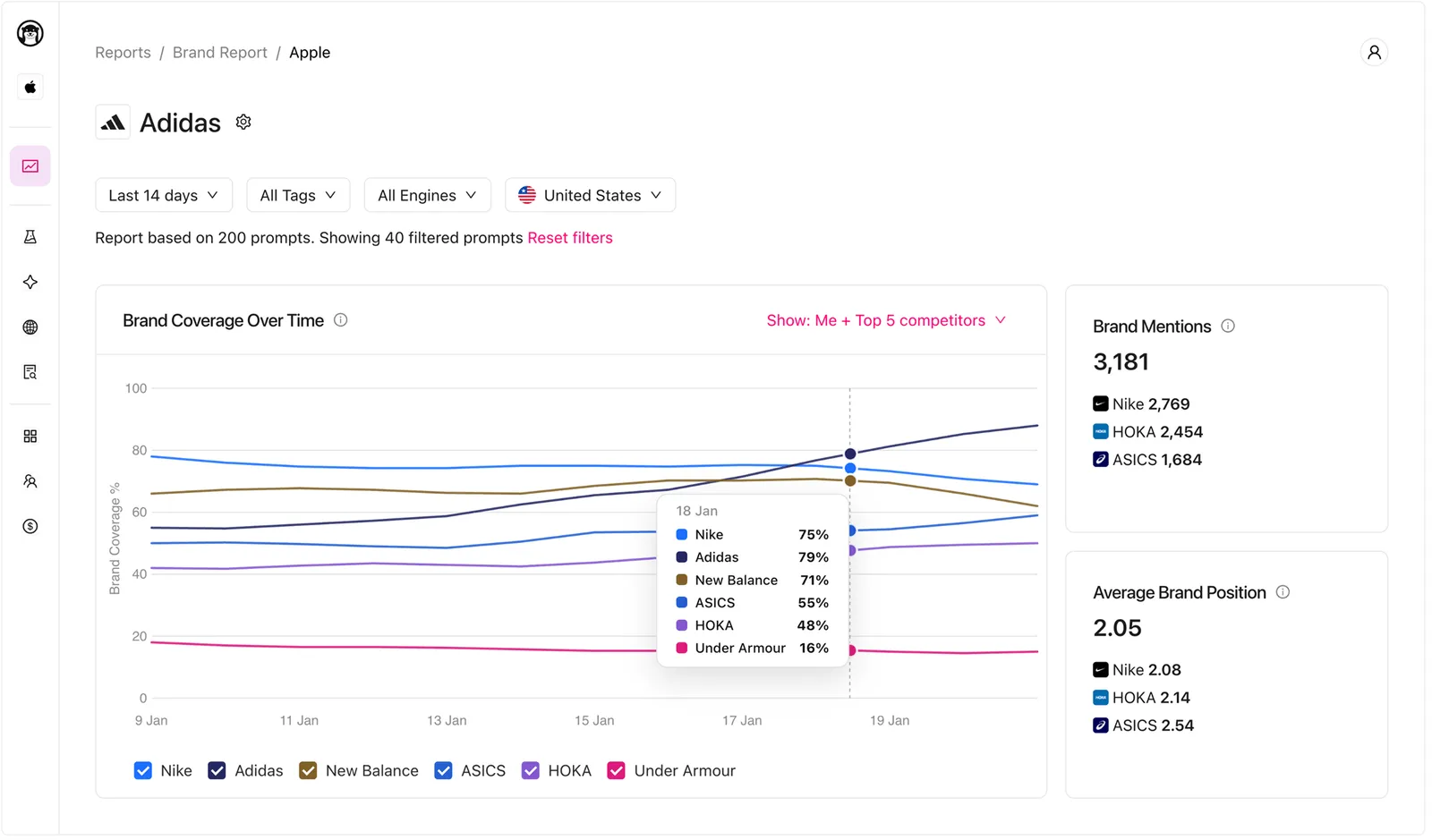
Mention rate: the percentage of tracked responses containing the brand.
Citation rate: how often Perplexity cites an owned page.
Cited pages: the exact owned, competitor, and third-party URLs used as sources.
Answer position: where the brand appears in a recommendation or comparison.
Competitor share of voice: how frequently competitors appear across the same prompt set.
Accuracy and sentiment: whether product facts, pricing, positioning, and limitations are described correctly.
Stability: whether a result persists across repeated runs rather than appearing once.
Citation rate and mention rate are not interchangeable. Perplexity can cite your research without naming your product, or mention your brand while citing an independent review. Both outcomes matter, but they require different actions.
1. Dageno: best for moving from Perplexity gaps to GEO action
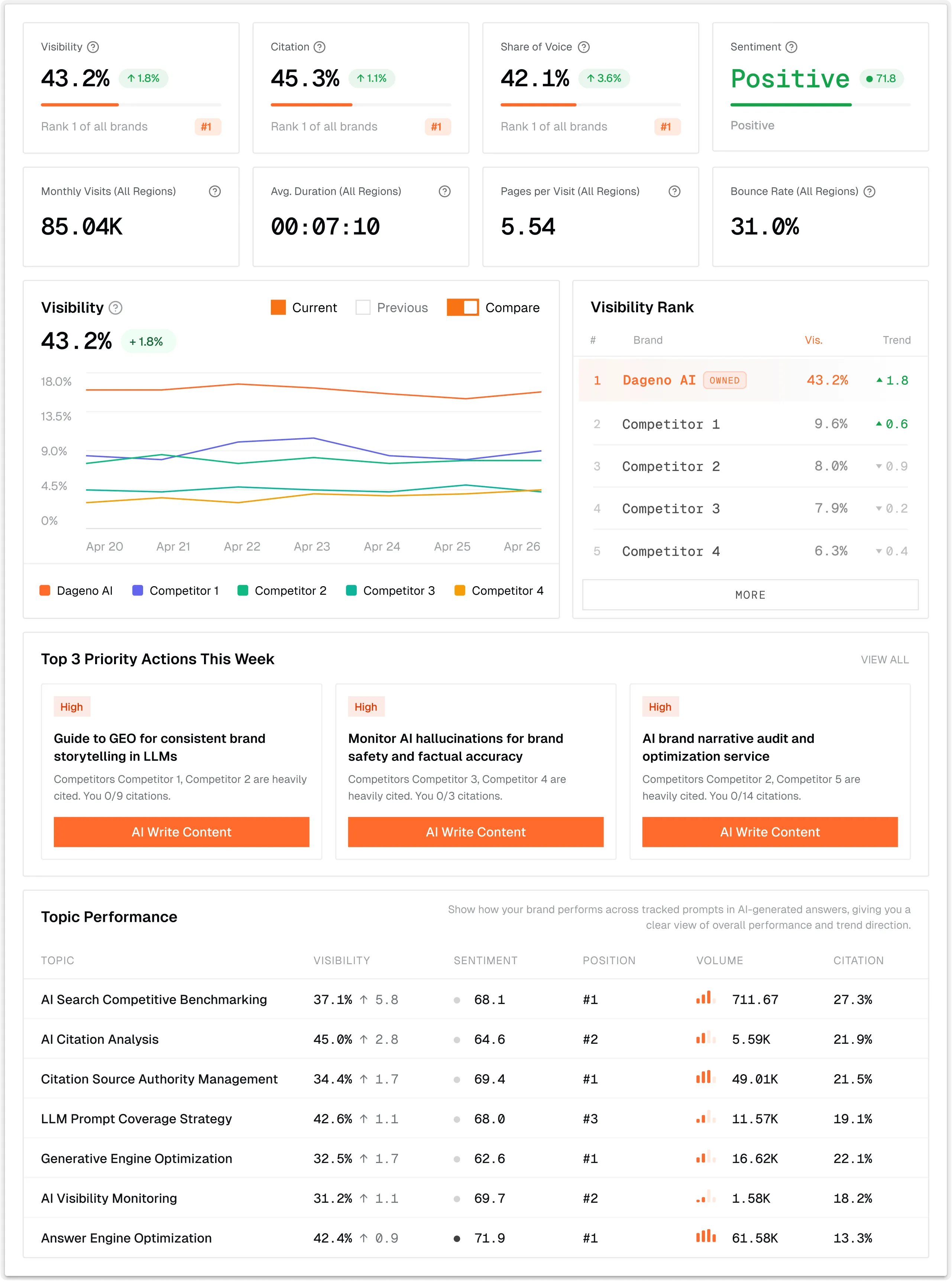
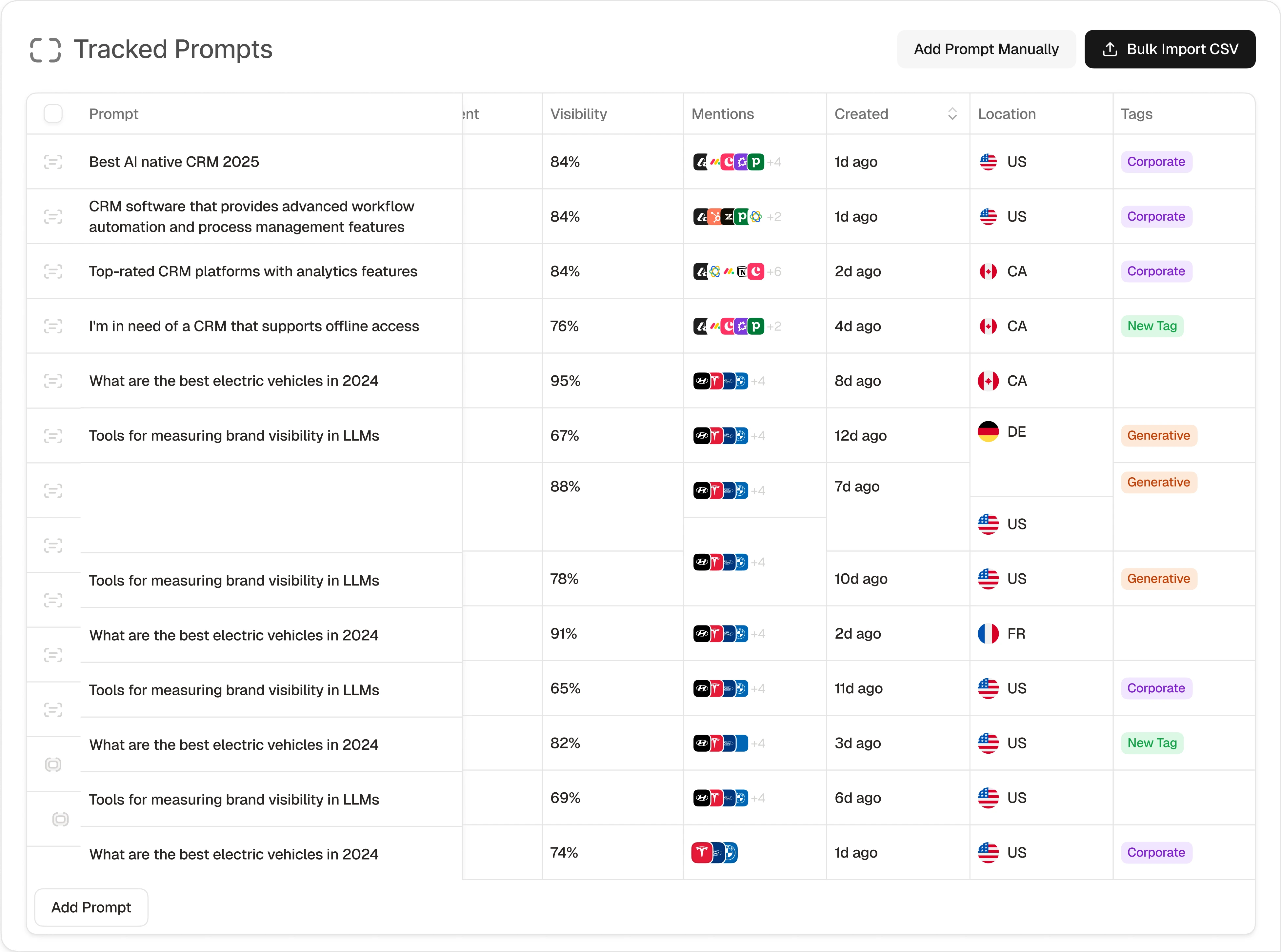
Dageno AI monitors brand and competitor visibility in Perplexity and connects those observations to broader GEO work. Teams can organize prompts, inspect answers and citations, compare competitors, find source gaps, and prioritize pages or topics that need attention.
This connection matters because a missing citation is only a symptom. The underlying cause may be a weak product page, missing comparison content, unclear entity information, outdated facts, poor crawlability, or insufficient third-party corroboration.
Best features
Perplexity brand, prompt, and competitor monitoring
Citation and source-gap analysis
Share-of-voice and sentiment reporting
Content-opportunity discovery
Workflow from diagnosis to content or technical action
Best for
SEO, content, growth, and agency teams that need to improve visibility rather than only report it.
Watch for
Begin with a focused prompt library tied to actual products, audiences, and buying decisions. A large set of generic category prompts can inflate data volume without making priorities clearer.
2. HubSpot AEO: best for HubSpot-centered marketing teams
HubSpot AEO tracks brand visibility across Perplexity, ChatGPT, and Gemini. Its dashboard includes visibility, prompts, competitors, citations, and recommendations. Marketing Hub Professional and Enterprise users can also connect findings to HubSpot's content tools and CRM-informed prompt suggestions.
Best features
Daily tracked prompts across three supported engines
Brand visibility and competitor analysis
Citation analysis
Prioritized recommendations
CRM-informed prompts and blog generation on qualifying Marketing Hub plans
Best for
Teams already operating in HubSpot that want Perplexity monitoring close to their CRM and content workflow.
Watch for
The standalone AEO subscription and Marketing Hub experience have different capabilities. Confirm answer and prompt limits, content-generation access, and whether CRM-based suggestions are included.
HubSpot's current documentation lists Perplexity support and plan limits at Set up and analyze AEO.
3. Profound: best for enterprise Perplexity intelligence
Profound monitors the front-end Perplexity experience and combines visibility reporting with citations, sentiment, answer accuracy, competitor benchmarking, regions, and audience personas. Its Agents can use identified prompt and citation gaps to create or update content.
Best features
Daily browser-based answer collection
Custom and real-world prompt datasets
Citation authority and source analysis
FactCheck for inaccurate brand claims
Multi-region and multilingual reporting
Content agents for identified gaps
Best for
Global brands and enterprise teams that need governance, raw exports, multiple markets, and detailed competitive intelligence.
Watch for
Profound's plans vary by prompt capacity and configuration. Request a written scope covering Perplexity, markets, languages, assets, exports, historical retention, and user access.
4. Peec AI: best for clear prompt and source analytics
Peec AI gives marketing teams a straightforward view of visibility, position, sentiment, competitors, prompts, and sources. It is useful when analysts need to find which questions and cited domains explain a Perplexity visibility gap without building a custom reporting layer.
Best features
Prompt-level visibility and position
Competitor share-of-voice views
Source and citation intelligence
Sentiment and historical reporting
Agency-friendly analysis
Best for
In-house marketers and agencies that want accessible analytics and a clear path from losing prompt to source investigation.
Watch for
Peec is strongest as an intelligence layer. Teams still need a defined editorial, technical, or digital PR process to implement the findings. Calculate cost using prompts multiplied by platforms, regions, and refresh frequency.
5. Otterly AI: best lightweight Perplexity tracker
Otterly AI is a practical option for small teams that need recurring Perplexity prompt checks, brand mentions, links, citations, competitors, and alerts without an enterprise implementation.
Best features
Fast self-serve setup
Perplexity prompt monitoring
Brand mention and competitor tracking
Link and citation monitoring
Recurring checks and alerts
Best for
Small businesses, consultants, and agencies establishing an initial Perplexity benchmark.
Watch for
A lightweight tracker still needs disciplined prompt research and monthly source analysis. Confirm how each prompt-engine-location combination counts toward the chosen plan.
Choose Dageno when the team needs to turn visibility and citation gaps into content and GEO tasks. Choose HubSpot AEO when the CRM and content operation already lives in HubSpot. Choose Profound for enterprise markets, governance, and detailed answer intelligence. Choose Peec AI for clear analytical reporting. Choose Otterly AI for a smaller, simpler monitoring program.
Before buying, ask every vendor the same questions:
Does the tool collect Perplexity's consumer interface, an API response, or another surface?
Which Perplexity model or search mode is used?
Can prompts be segmented by country and language?
Are exact cited URLs and full answers retained?
How often is each prompt rerun?
Can one prompt be sampled more than once per collection period?
How are mention, position, citation rate, and share of voice calculated?
Are raw data and historical results exportable?
Build a reliable Perplexity benchmark
Use prompts from the whole buying journey
Create groups for category discovery, problems, use cases, comparisons, alternatives, pricing, risk, integrations, and branded fact checks. Most prompts should be unbranded so the test measures discovery rather than existing awareness.
Keep benchmark and discovery prompts separate
Maintain a stable benchmark set for period-over-period reporting. Put new questions in a discovery set until they are reviewed. Changing the full prompt list every month makes trend comparisons unreliable.
Repeat important prompts
Perplexity answers can change between runs. Sample important commercial prompts more than once and report a frequency or distribution, not a single “rank.”
Preserve citation evidence
Store the full response, cited domain, exact URL, brand position, competitors, date, market, and model. A score without the underlying answer cannot explain why visibility changed.
Turn Perplexity tracking into optimization
When competitors are mentioned but you are absent
Check whether your site clearly defines the category, audience, use cases, differentiators, and limitations. Build missing comparison or use-case coverage with verifiable claims rather than generic marketing language.
When competitors earn more citations
Compare the cited pages. Look for stronger original data, clearer answers, fresher facts, better documentation, independent reviews, or more relevant page types. The action may involve owned content, digital PR, partnerships, or product documentation.
When Perplexity cites you but does not name you
Make brand and product entities explicit near the cited information. Use consistent names, authorship, dates, and descriptive headings. Do not remove useful research simply because the product is not yet mentioned; the citation is evidence that Perplexity already trusts part of the page.
When the brand description is inaccurate
Correct first-party pages, documentation, pricing, structured data, and high-influence third-party profiles. Then monitor the same fact-check prompts until the correction appears consistently.
Common mistakes
Publishing unsupported “ranking factors”
No vendor can provide a guaranteed Perplexity ranking formula. Use observed citation patterns to generate hypotheses, then test changes against a stable prompt set.
Comparing tools by one visibility score
Scores use different prompts, models, samples, and formulas. Compare the evidence, controls, and actions behind the score.
Tracking only citations to your domain
Third-party citations can introduce, validate, or distort the brand narrative. Track both owned and independent sources.
Treating one answer as a trend
Use repeated runs and multiple dates. An isolated favorable answer is not durable visibility.
Frequently asked questions
What is the best Perplexity rank tracking software?
Dageno is a strong overall choice when monitoring must feed into GEO execution. HubSpot AEO fits HubSpot-centered teams, Profound fits enterprise programs, Peec AI offers clear analytics, and Otterly AI suits lighter monitoring.
Can I track Perplexity citations manually?
Yes. Run a controlled prompt set in clean sessions and record exact cited URLs, brands, answer position, competitors, and dates. Paid tools become useful for repeated collection, history, markets, alerts, and exports.
How often should Perplexity visibility be tracked?
Weekly collection and monthly analysis are sufficient for many teams. High-priority commercial prompts may justify more frequent or repeated sampling.
What is a good Perplexity visibility score?
There is no universal benchmark. Compare the brand with direct competitors using the same prompts, market, model, collection method, and period. Commercial coverage and accurate citations matter more than an isolated aggregate score.
Can a tracker guarantee more Perplexity citations?
No. Tracking reveals patterns and opportunities. Results depend on relevance, accessible and current content, clear evidence, source quality, entity accuracy, and Perplexity's retrieval systems.
Final recommendation
Choose a tracker that preserves exact answers and sources, not just a score. Start with a stable commercial prompt set, repeat important questions, separate mentions from citations, and assign every material gap to a content, technical, product-marketing, or source-development action. The value of Perplexity rank tracking is the decision it improves, not the number of prompts it can display.
Ye Faye is an SEO and AI growth executive with extensive experience spanning leading SEO service providers and high-growth AI companies, bringing a rare blend of search intelligence and AI product expertise. As a former Marketing Operations Director, he has led cross-functional, data-driven initiatives that improve go-to-market execution, accelerate scalable growth, and elevate marketing effectiveness. He focuses on Generative Engine Optimization (GEO), helping organizations adapt their content and visibility strategies for generative search and AI-driven discovery, and strengthening authoritative presence across platforms such as ChatGPT and Perplexity