Explore 12,000+ niche markets with no login required
TL;DR
The best answer engine optimization tools for SEO teams in 2026 include Dageno AI, Profound, Rankshift, ZipTie, Otterly AI and Peec AI, covering monitoring, citation research and content workflows.
Match the tool to the next action: enterprise reporting, recurring monitoring, source research, content work, or technical optimization.
The comparison below covers all 11 tools; confirm current plan limits and pricing with each vendor.
This guide compares 11 answer engine optimization tools based on the capabilities that matter most in 2026: platform coverage, prompt tracking, citation intelligence, competitor analysis, brand sentiment, content execution, technical optimization, reporting, and performance measurement over time.
Quick Comparison: Best Answer Engine Optimization Tools
These 11 tools cover different AEO needs, from monitoring and citation research to content work, technical optimization, and enterprise reporting.
Rank
Tool
Best For
Standout Capability
Pricing Approach
1
Dageno AI
Teams that want monitoring and execution in one workflow
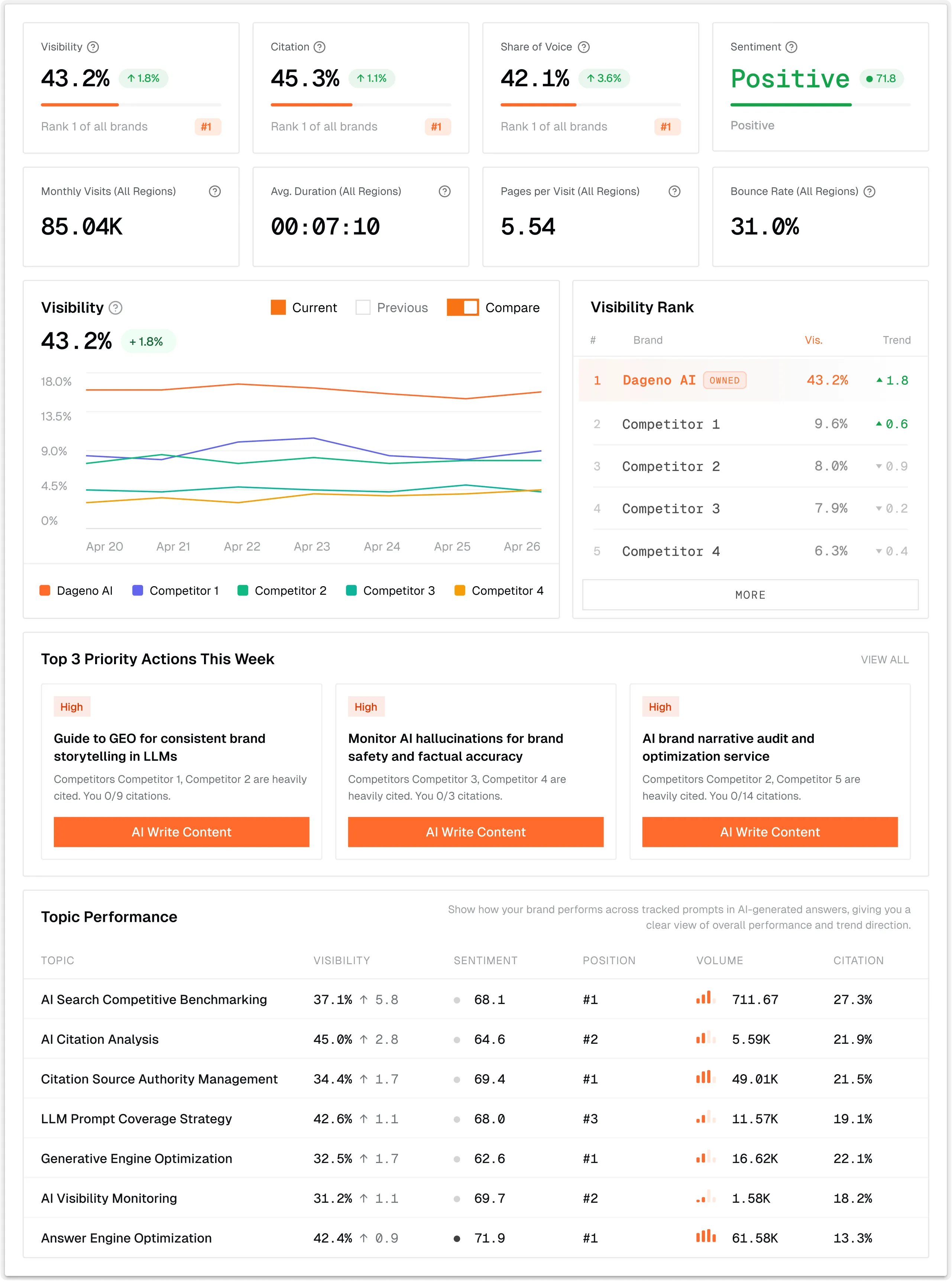
Visibility tracking, gap discovery, content, technical audits, and attribution
Enterprise reporting and competitor citation intelligence
Answer Engine Insights, citation analysis, prompt data, and Agents
Plan-based and enterprise pricing
3
Rankshift
Agencies and SEO teams
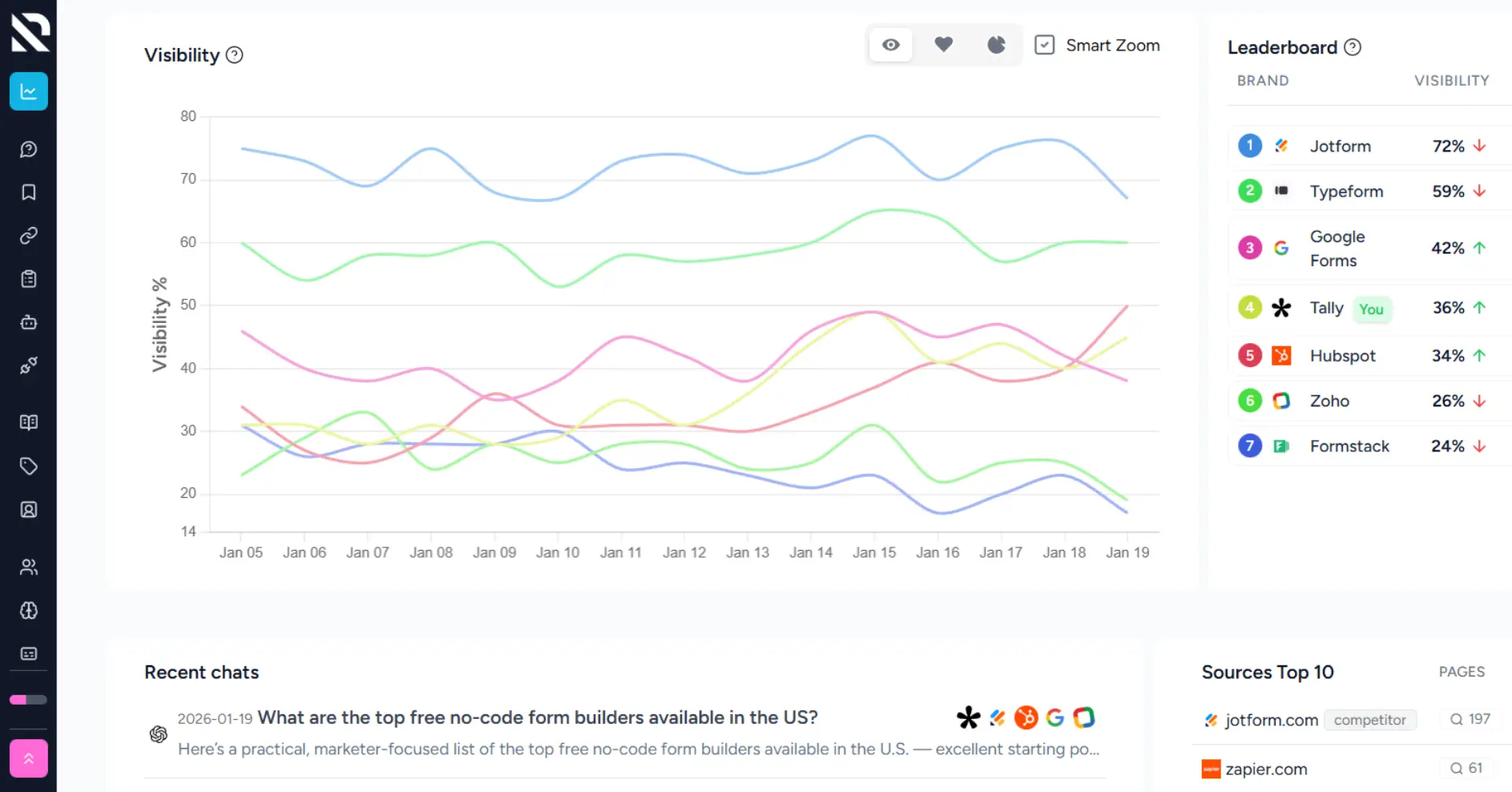
Multi-model tracking, crawler analytics, content briefs, and AI writing
Starts at €69/month when billed annually
4
ZipTie
Teams with writers that need page-level recommendations
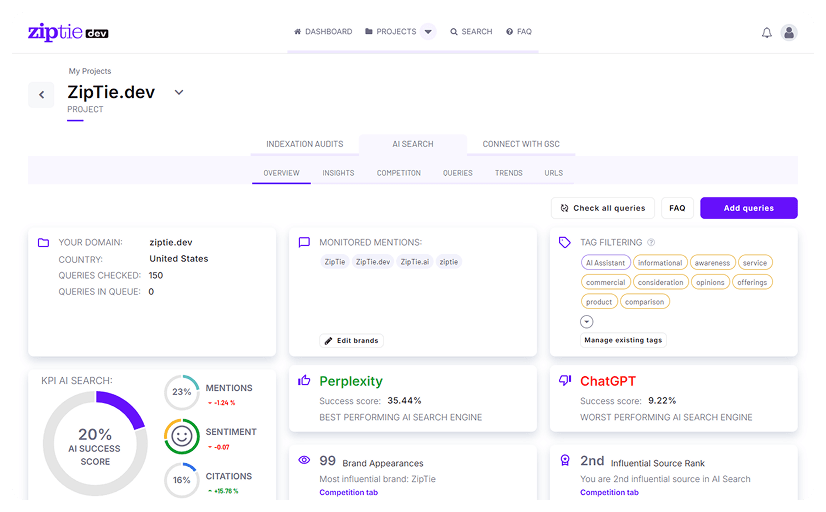
AI search monitoring and content optimization briefs
Starts at $69/month
5
Otterly AI
Small businesses and agencies starting with AI monitoring
Prompt monitoring, citations, alerts, and competitive benchmarks
Starts at $29/month
6
Peec AI
Marketing teams that want a clean analytics workflow
Daily prompt, position, citation, and sentiment tracking
Usage-based by prompts and models
7
LLMrefs
Teams that prefer keyword-style AI visibility tracking
Multi-project monitoring and recurring visibility checks
Free entry option; paid tiers available
8
AthenaHQ
Citation research and prescriptive AI-search strategy
Source Intelligence and content recommendations
Contact sales
9
Scrunch
Enterprise teams optimizing for AI agents
AI visibility, page audits, agent traffic, and AXP
Free trial; paid plans available
10
Ahrefs Brand Radar
Existing Ahrefs users and large-scale market research
Search-backed prompt database and cross-channel brand research
Available through Ahrefs plans
11
Semrush AI Visibility Toolkit
Existing Semrush users
AI visibility, competitor research, prompt research, and AI-readiness audits
Starts at $99/month per domain when billed annually
Pricing and features change frequently. Confirm current limits and plan details with each vendor before purchasing. Dageno AI pricing was rechecked on September 10, 2026: Starter is $79 per month with monthly billing and a seven-day free trial. Dageno AI pricing
What Are Answer Engine Optimization Tools?
Answer engine optimization tools help brands measure and improve how they appear inside AI-generated answers. The category is also described as AEO, GEO, AI search optimization, LLM optimization, or AI visibility software.
Unlike a traditional rank tracker, an AEO tool should help answer questions such as:
Does ChatGPT mention or recommend our brand?
Does Perplexity cite our website or a competitor’s page?
Are we included in Google AI Overviews or AI Mode?
Which prompts trigger our brand, and which ones exclude it?
Which third-party sources influence the answer?
Is the answer positive, neutral, negative, or factually incorrect?
Did our content, PR, or technical work improve visibility over time?
The main surfaces businesses commonly track include ChatGPT, Perplexity, Gemini, Claude, Microsoft Copilot, Google AI Overviews, Google AI Mode, Grok, DeepSeek, Meta AI, and commerce-focused AI experiences.
Google now provides dedicated guidance for appearing in generative AI features in Search. The fundamentals remain familiar—helpful content, crawlability, internal linking, strong page experience, and accurate structured data—but the measurement problem is different because AI systems synthesize answers rather than simply displaying a list of blue links. See Google’s official guidance on AI features and your website and optimizing for generative AI features in Google Search.
Why Classic SEO Tools Are Not Enough
Classic SEO metrics do not fully explain what happens inside an AI-generated answer. Rankings, backlinks, technical issues, search volume, and organic traffic remain useful, but brands also need answer-level evidence.
A page can rank well in Google and still fail to appear in ChatGPT or Perplexity. A brand can be mentioned frequently but rarely cited. A competitor can dominate recommendations because third-party review pages, listicles, community discussions, or media coverage reinforce its position. AI answers can also change between platforms, locations, prompt variations, and repeated runs.
That is why the best AEO tools combine several types of data:
Answer-level visibility: whether the brand appears and where it appears.
Citation intelligence: which domains and pages support the answer.
Competitive context: which brands win the same prompts.
Sentiment and narrative: how the brand is described.
Optimization workflow: what content, technical, or authority action should happen next.
Historical measurement: whether those actions changed visibility.
The original Generative Engine Optimization research helped formalize the idea that content can be optimized for visibility inside generative responses. Modern AEO tools turn that idea into an operational workflow.
How We Evaluated These Tools
We reviewed each product using publicly available product pages, documentation, and pricing information available in August 2026. The comparison focuses on:
AI platform coverage
Custom prompt tracking
Mentions, citations, and share-of-voice metrics
Competitor and source analysis
Brand sentiment tracking
Historical reporting
Content recommendations or generation
Technical crawlability and AI-agent analysis
Reporting, exports, and attribution
Suitability for small businesses, agencies, and enterprise teams
Disclosure: This guide is published by Dageno, and Dageno AI is included in the comparison. The goal is to explain where each product fits, including cases where another platform may be the better choice. Product capabilities and prices can change, so buyers should verify details directly with vendors.
The Best Answer Engine Optimization Tools
Choose from the 11 tools below according to the monitoring, research, content, technical, or reporting work your team needs to complete.
1. Dageno AI — Best Overall for an Integrated AEO and GEO Workflow
Choose Dageno AI when your team needs to connect AI visibility data with content work, technical fixes, and measurement.
Its core advantage is workflow depth. Teams can monitor answers, identify competitor and citation gaps, prioritize prompts, create or optimize content, check technical readiness, and measure results over time.
Key capabilities
Answer Engine Insights for brand mentions, citations, competitors, share of voice, answer position, and sentiment
SEO and content teams that need to act on visibility data
Agencies that want monitoring, recommendations, and content workflows
SaaS and ecommerce teams tracking competitive recommendation prompts
Enterprise teams operating across countries and languages
Brands that need to connect AI visibility with measurable business outcomes
Limitations
Dageno offers a broad workflow, which means teams that only need a basic mention checker may prefer a simpler monitoring product. Organizations with highly customized enterprise governance requirements should also compare Dageno directly with Profound, AthenaHQ, and Scrunch during procurement.
Verdict
Choose Dageno when the main goal is not simply to report that visibility is low, but to identify why it is low, create the required fixes, and measure whether the work changed the result.
2. Profound — Best for Enterprise AEO Reporting and Competitor Citation Tracking
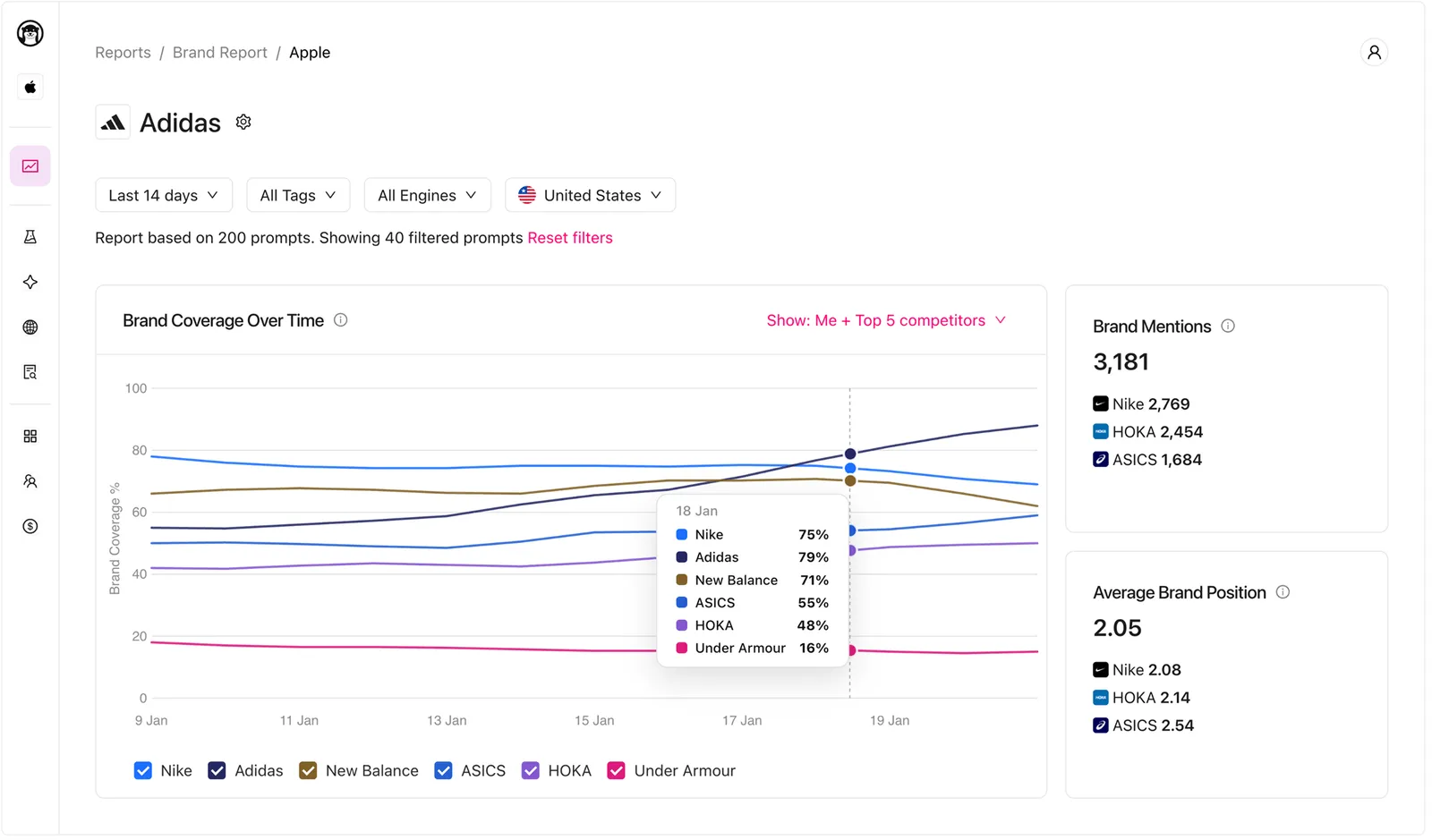
Profound is one of the strongest enterprise platforms for answer-engine intelligence. Its Answer Engine Insights product tracks visibility, share of voice, sentiment, citation sources, competitor rankings, topic performance, regions, and audience personas across major AI platforms.
Profound also offers Prompt Volumes and Agents, so it should no longer be described as a monitoring-only product. Teams can use insights to create automated research, content, reporting, and publishing workflows.
Key capabilities
Visibility scores and share of voice
Competitor rankings and citation comparisons
Citation source and authority analysis
Brand sentiment and keyword themes
Prompt Volumes based on real user demand
Historical analysis by topic, region, and audience persona
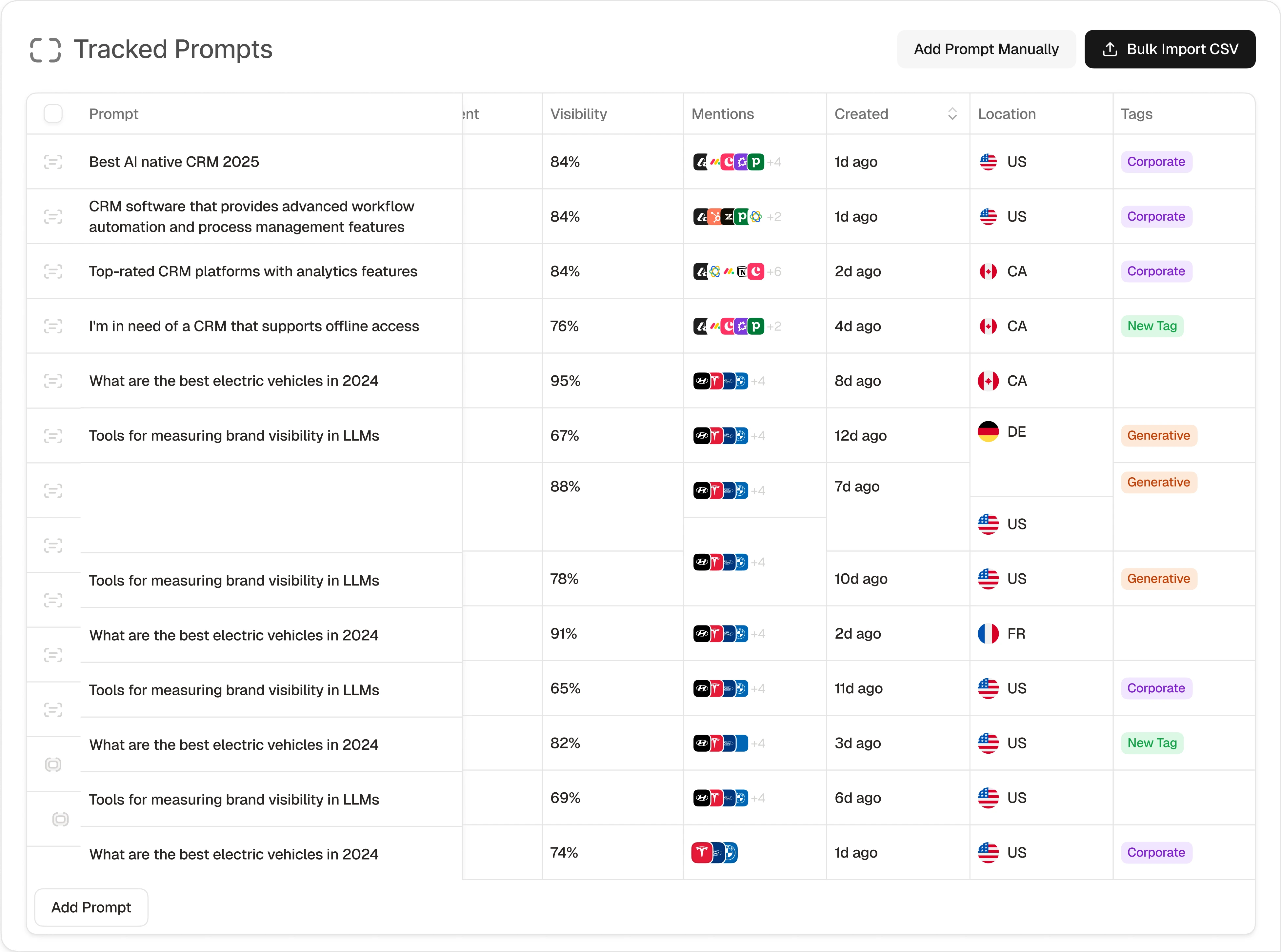
Watched Pages for tracking specific URLs
CSV exports and enterprise reporting
Agents that help turn visibility data into research and content workflows
Best for
Enterprise SEO, growth, brand, and communications teams
Organizations that need multi-region reporting
Teams tracking competitor citation performance at scale
Companies building automated AI-search workflows with Agents
Limitations
Profound’s breadth can require more setup and operational maturity than a lightweight monitor. Pricing and enterprise requirements should be evaluated directly with the vendor. Teams should also confirm which execution workflows are included in their selected plan rather than assuming every Agent capability is available by default.
Verdict
Choose Profound when enterprise-grade answer-engine reporting, competitor citation intelligence, and configurable workflows matter more than low-cost simplicity.
Is Profound Worth It for AEO Reporting and Competitor Citation Tracking?
Profound is worth evaluating when an enterprise team needs large-scale answer-engine reporting, competitor share-of-voice analysis, and citation intelligence across many prompts, markets, or product lines. Its strongest fit is an organization with dedicated GEO resources that can operationalize dashboards and custom analysis. Smaller teams should compare total cost, prompt limits, supported engines, reporting depth, and whether findings translate into specific content actions.
Verdict: Choose Profound for enterprise intelligence, configurable competitor analysis, citation reporting, and reporting depth. Choose a lighter or more execution-focused platform when faster setup, transparent pricing, lower operational complexity, or an integrated SEO-to-content workflow matters more.
Who should choose Profound?
Profound is most likely to justify its cost and implementation requirements for:
Enterprise SEO, GEO, brand, communications, and growth teams
Organizations monitoring many brands, product lines, markets, or audience segments
Teams that require recurring competitor share-of-voice and citation reporting
Companies that need historical comparisons and executive dashboards
Organizations with analysts or GEO specialists who can investigate the underlying prompts, answers, citations, and source patterns
Teams that want to connect Answer Engine Insights with configurable Agents and internal workflows
Who may not need Profound?
A lighter or more execution-focused platform may be more appropriate for:
Small companies monitoring only a limited prompt set
Teams that need transparent self-service pricing before beginning an evaluation
Agencies that prioritize simple setup and repeatable client reporting
Content teams that need page-level recommendations and production workflows more than enterprise dashboards
Organizations without dedicated resources to interpret and operationalize the data
Teams whose primary requirement is updating pages and measuring the result rather than building a large intelligence program
Profound’s advantages for AEO reporting
Detailed answer-engine reporting: Tracks visibility, share of voice, sentiment, answer position, citations, competitors, topics, regions, and audience personas.
Competitor citation intelligence: Helps teams compare which domains and pages support competitors across a controlled prompt set.
Historical analysis: Supports reporting on changes across prompts, markets, topics, and competitors over time.
Enterprise segmentation: Useful when separate product lines, markets, audiences, or competitive sets require independent reporting.
Prompt intelligence: Prompt Volumes can help teams supplement custom tracking with demand information.
Workflow extensibility: Agents can connect research and visibility findings with reporting, content, or other operational workflows.
Executive reporting: Exports and configurable reporting can support leadership, agency, and cross-functional reviews.
Material limitations to consider
Pricing transparency: Buyers may need to contact sales to understand the full cost, included limits, and enterprise terms.
Implementation complexity: A large prompt and competitor program requires taxonomy design, governance, ownership, and ongoing analysis.
Operational requirements: Dashboards do not create results unless teams can execute content, technical, PR, and source-development actions.
Plan-dependent capabilities: Buyers should verify which data exports, Agents, markets, prompts, users, and integrations are included.
Potential overcapacity: Small teams may pay for segmentation and intelligence capabilities they do not use.
Content-action depth: Confirm whether the selected configuration produces sufficiently specific page, source, and content recommendations for the team’s workflow.
Competitor citation tracking: what Profound should demonstrate
Competitor citation tracking is useful only when a team can move from a summary metric to the underlying evidence. During a demonstration, ask Profound to show:
The exact prompt that triggered each competitor citation.
The complete generated answer and the competitor’s position within it.
The cited domain and exact URL.
Whether the citation supports a recommendation, factual claim, comparison, or definition.
Citation frequency across repeated runs.
Changes by model, country, language, topic, and audience.
Competitor share of cited sources.
Sources that cite competitors but omit the monitored brand.
Historical citation gains and losses.
Exports containing prompt-, answer-, competitor-, domain-, and URL-level data.
Recommendations for closing each competitor citation gap.
Evidence connecting a completed action with a later visibility change.
Profound procurement checklist
Evaluation area
Questions to ask before purchasing
Why it matters
AI platform coverage
Which answer engines are supported in production? Does coverage vary by plan, country, or language?
A broad platform list is not useful if the engines used by your buyers are missing
Prompt limits
How many prompts, models, markets, and refreshes are included? How are repeated runs counted?
The real cost can change substantially with scale and monitoring frequency
Citation-source detail
Are cited domains and exact URLs available? Can the underlying answer and prompt be exported?
Domain counts alone may not reveal which claim or competitor recommendation the source influenced
Competitor segmentation
How many competitors can be tracked? Can sets vary by product, market, audience, and business unit?
Enterprise competitive sets are rarely identical across every category
Regional tracking
Can prompts be separated by country, language, region, and audience persona?
AI answers may differ materially between markets
Historical retention
How long are prompts, answers, citations, sentiment, and competitor data retained?
Trend reporting and attribution require stable historical data
Exports and integrations
Are CSV, API, warehouse, BI, or scheduled-report exports included?
Enterprise teams often need to combine AI data with SEO, analytics, CRM, and revenue data
Alerts
Can teams receive alerts for citation losses, competitor gains, sentiment changes, or inaccurate brand claims?
Alerts help teams respond without manually reviewing every dashboard
Content recommendations
Does the platform identify the page, source, claim, or content gap that should be addressed?
A low visibility score alone does not tell the team what to do
Agents and workflows
Which Agents are included, and what research, content, publishing, or reporting actions can they perform?
Buyers should not assume every workflow is available in every plan
Governance and security
Are SSO, role-based access, audit logs, workspace separation, and security documentation available?
These controls may be mandatory for enterprise procurement
Support and implementation
What onboarding, taxonomy design, training, SLA, and strategic support are included?
Implementation quality can determine whether the platform produces usable intelligence
Total cost
What are the contract minimum, implementation fees, overages, user costs, and renewal terms?
The subscription quote may not represent the full cost of ownership
Profound compared with alternative approaches
Requirement
Profound
Dageno AI
Otterly AI
Ahrefs Brand Radar
Enterprise reporting depth
Strong fit
Available within a broader execution workflow
Lighter reporting approach
Strong research context inside Ahrefs
Competitor citation analysis
Detailed enterprise intelligence
Connects competitor citations with prompt, content, and optimization gaps
Accessible citation monitoring
Connects citations with search and web datasets
Prompt and market segmentation
Strong enterprise use case
Suitable for structured GEO programs
Better suited to focused monitoring
Strong broad discovery; custom tracking should be verified
Content-action workflow
Available through insights, Agents, and team workflows
Integrated monitoring-to-content workflow
Recommendations may require external execution
Usually requires separate content execution
Technical SEO/GEO workflow
Confirm required implementation depth
Integrated audits and optimization tools
More limited than a full technical platform
Supported by the broader Ahrefs SEO ecosystem
Pricing transparency
Sales-led or plan-dependent
Seven-day trial and published plans
Published plans
Tied to Ahrefs plans and add-ons
Setup complexity
Best for mature enterprise teams
Suitable for teams needing a connected workflow
Faster entry for small and midsized teams
Easiest for existing Ahrefs users
Decision rule
Choose Profound when your organization needs enterprise-scale AEO intelligence, configurable competitor sets, citation-level reporting, regional segmentation, historical analysis, exports, and executive dashboards—and has the people and processes to act on that intelligence.
Choose Dageno AI when competitor citation analysis must connect directly with prompt prioritization, content creation, page optimization, technical audits, and result attribution.
Choose Otterly AI when faster setup, published pricing, and accessible recurring monitoring matter more than advanced enterprise segmentation.
Choose Ahrefs Brand Radar when AI visibility research needs to connect with an established Ahrefs workflow covering keywords, backlinks, content, web sources, Reddit, and other search-demand data.
Profound is therefore worth considering for the right enterprise team, but its value should be judged by the decisions and actions its reporting enables—not by dashboard depth alone.
3. Rankshift — Best for Agencies and AI Crawler Analytics
Rankshift combines AI visibility tracking with crawler analytics, content briefs, an AI content writer, Looker Studio integration, API access, and unlimited projects and seats on its published plans.
This makes it especially relevant for agencies. The platform can help teams answer two separate questions: “Are we appearing in AI answers?” and “Are AI crawlers successfully accessing the site?”
Key capabilities
Visibility score and share-of-voice tracking
Multi-LLM prompt monitoring
Citation analytics
AI crawler analytics
Content brief generator
AI content writer
Looker Studio, API, and MCP access
Unlimited projects and seats on published plans
Best for
Agencies managing many clients
SEO teams that need crawler-level evidence
Teams that want content writing alongside monitoring
Organizations that need flexible reporting integrations
Limitations
Rankshift uses a credit-based model, so teams should calculate how daily prompt volume and refresh frequency affect their plan. Its broad feature set may be unnecessary for teams that only need a simple brand-mention monitor.
Verdict
Choose Rankshift when agency scalability, crawler analytics, integrations, and content execution are the top priorities.
4. ZipTie — Best for Page-Level AI Content Optimization
ZipTie is a strong choice for teams that already have writers but need practical recommendations about what to improve on a page.
Its product combines monitoring for Google AI Overviews, ChatGPT, and Perplexity with AI data summaries, prompt generation, and content optimizations. The published plans start at $69 per month and scale by the number of AI search checks and content optimizations.
Key capabilities
Monitoring across Google AI Overviews, ChatGPT, and Perplexity
Automated AI search checks
AI data summaries
Page-level content optimization recommendations
AI prompt generation assistance
Fourteen-day free trial
Best for
Content teams that already have an editorial process
Technical SEO professionals
Teams focused on three major AI search surfaces
Buyers who prefer transparent pricing
Limitations
ZipTie covers fewer AI platforms than some broader enterprise products. Its content workflow focuses on recommendations and optimizations rather than a complete strategy-to-attribution system.
Verdict
Choose ZipTie when you need concrete page recommendations and do not require the widest possible model coverage.
5. Otterly AI — Best Affordable AI Search Monitoring Tool
Otterly AI is one of the easiest entry points for small businesses, consultants, and agencies that want to track brand mentions, citations, competitors, and changes over time.
The platform supports prompt monitoring and citation analysis across major AI search experiences, with pricing starting at $29 per month and a free trial.
Key capabilities
Prompt-level brand and product monitoring
Website citation tracking
Share of AI Voice and competitor benchmarking
Citation winners-and-losers reporting
Brand sentiment tracking
Alerts when visibility changes
Historical trend analysis
Agency reporting workflows
Best for
Small businesses testing AI visibility monitoring
Consultants and agencies with focused prompt sets
Teams that prioritize ease of use
Buyers with limited initial budgets
Limitations
As prompt volume and client count increase, teams should compare plan limits carefully. Advanced teams may also need separate content, technical, PR, and attribution tools to act on the monitoring data.
Verdict
Choose Otterly AI when affordable, accessible monitoring is more important than a fully integrated execution workflow.
6. Peec AI — Best for Clean Daily AI Search Analytics
Peec AI focuses on straightforward AI search analytics for marketing teams. It tracks prompts daily and reports metrics such as mentions, answer position, citations, and sentiment.
Pricing is based primarily on the number of tracked prompts and models, while countries and languages do not add separate regional fees according to Peec’s pricing documentation.
Key capabilities
Daily prompt tracking
Brand mentions and average position
Citation counts and source details
Sentiment tracking
Competitor benchmarks
Multiple AI models, including ChatGPT, AI Mode, AI Overviews, Copilot, Perplexity, and Gemini
Agency and multi-brand workflows
Best for
Marketing teams that want a simple interface
B2B SaaS and developer-focused companies
Agencies that need consistent client reporting
Teams that want daily trends without a complex platform
Limitations
Costs scale with prompt and model volume. Teams planning broad international monitoring or very large prompt sets should model their future usage before choosing a tier.
Verdict
Choose Peec AI when clean, daily analytics and citation clarity matter more than built-in content generation or technical auditing.
7. LLMrefs — Best for Keyword-Style AI Visibility Tracking
LLMrefs brings a familiar keyword-tracking approach to AI search. It supports multiple projects, recurring checks, competitor monitoring, and visibility analysis across AI-generated answers.
The platform is useful for SEO teams that want to manage AI prompts similarly to a traditional keyword portfolio.
Key capabilities
AI search keyword and prompt tracking
Brand visibility and competitor monitoring
Recurring checks designed for statistical significance
Unlimited projects across accounts
AI crawlability and related free tools
Export and API-oriented workflows on selected plans
Best for
SEO teams moving from rank tracking into AEO
Agencies managing multiple brands
Teams that prefer a keyword-centric workflow
Buyers who want a free starting point
Limitations
LLMrefs is strongest as a specialized analytics and tracking product. Teams may need separate systems for deep content production, technical remediation, and revenue attribution.
Verdict
Choose LLMrefs when a familiar keyword-style workflow and multi-project tracking are the priority.
8. AthenaHQ — Best for Source Intelligence and Prescriptive Strategy
Its Source Intelligence capabilities are useful for teams trying to understand which domains and pages shape AI answers in their category. AthenaHQ also targets executive reporting and broader strategic workflows.
Key capabilities
AI visibility and competitor monitoring
Citation source intelligence
Content gap identification
Prescriptive optimization recommendations
Hallucination and narrative monitoring
Executive reporting and business integrations
Best for
Growth-stage and enterprise teams
Brand and communications leaders
Teams that need source-level research
Organizations that want recommendations alongside monitoring
Limitations
Prospective buyers should verify current pricing, included data volumes, and execution features directly with AthenaHQ. Small businesses may find more value in a lower-cost, narrower platform.
Verdict
Choose AthenaHQ when citation-source research and strategic recommendations are central to the program.
9. Scrunch — Best for Agent Experience and AI-Facing Site Delivery
Scrunch approaches the market differently from a standard answer tracker. In addition to visibility monitoring and page audits, its Agent Experience Platform is designed to detect AI agents and deliver optimized experiences to them without changing the human-facing site.
Key capabilities
Monitoring across major AI platforms
AI-specific citations and visibility metrics
Page audits and actionable optimization recommendations
Prompt Manager and audience personas
AI-agent traffic analysis
Agent Experience Platform for AI-facing content delivery
Enterprise customer-success support
Best for
Enterprise brands with complex sites
Teams that care about AI-agent behavior on owned properties
Organizations investigating crawlability and agent accessibility
Companies that want an AI-experience layer beyond reporting
Limitations
Scrunch is a specialized enterprise platform. Smaller teams that mainly want prompt monitoring may not need its agent-delivery capabilities.
Verdict
Choose Scrunch when the problem extends beyond answer visibility into how AI agents access, interpret, and interact with the website.
10. Ahrefs Brand Radar — Best for Large-Scale AI Visibility Research
Ahrefs Brand Radar is designed for broad brand research across AI answers and the channels that influence them, including traditional search, YouTube, Reddit, and TikTok.
Its key differentiator is the scale of its search-backed prompt database. Teams can research brands, products, markets, authors, and competitors without waiting to build a campaign from scratch. Ahrefs also supports custom prompt tracking.
Key capabilities
Brand mentions, citations, impressions, and AI share of voice
Coverage across major AI platforms
Large search-backed prompt database
Competitor benchmarking
Top cited domains and pages
Custom prompt monitoring
Connections between AI visibility, SEO, video, and community channels
Best for
Existing Ahrefs customers
Competitive and category research
SEO teams that need backlinks and content data beside AI visibility
Brands researching many competitors or markets
Limitations
Brand Radar is strongest for research and discovery. Teams looking for a guided content-generation and technical-remediation workflow may need additional tools.
Verdict
Choose Ahrefs Brand Radar when data scale, fast market research, and integration with a mature SEO dataset are the priorities.
11. Semrush AI Visibility Toolkit — Best for Existing Semrush Users
Semrush AI Visibility Toolkit combines AI visibility reporting with competitor research, prompt research, and site audits for AI readiness.
Its Base plan is published at $99 per month per domain when billed annually and includes custom prompt tracking and mentions from ChatGPT, Google AI experiences, Gemini, and Perplexity.
Key capabilities
AI Visibility Overview
Competitor Research
Prompt Research
Custom prompt tracking
AI-readiness site auditing
Daily, weekly, and monthly updates
Reporting integrations across the Semrush ecosystem
Best for
Businesses already using Semrush
Agencies that want SEO and AI reporting in one ecosystem
Teams that need traditional SEO research beside AI visibility
Buyers who prefer an established vendor and familiar interface
Limitations
The base plan is organized per domain, and reporting or collaboration add-ons may increase total cost. Teams focused exclusively on AI search may prefer a purpose-built platform with deeper prompt or content workflows.
Verdict
Choose Semrush when AI visibility is one component of a broader Semrush-based SEO and marketing program.
Which Tools Track AI Search Visibility and AEO Performance Over Time?
The best platforms for measuring answer engine optimization performance over time are Dageno AI, Profound, Peec AI, Otterly AI, Rankshift, Ahrefs Brand Radar, and Semrush AI Visibility Toolkit. The right choice depends on the level of detail and execution support required.
Measurement Need
Strong Options
What to Look For
Brand mention trends
Dageno, Profound, Peec, Otterly, Ahrefs, Semrush
Consistent prompt sets and historical reporting
Competitor share of voice
Dageno, Profound, Peec, Ahrefs, Rankshift
Same prompts, regions, and models for each brand
Citation performance
Profound, Dageno, AthenaHQ, Otterly, Ahrefs
Domain-level and URL-level citation detail
Brand sentiment
Dageno, Profound, Peec, Otterly
Access to the underlying answer, not just a score
Answer position
Dageno, Peec, Rankshift
Position within the response and recommendation order
AI crawler activity
Rankshift, Scrunch, Dageno
Crawler identity, accessed pages, errors, and frequency
Content impact
Dageno, Profound Agents, Rankshift, ZipTie
Ability to connect a change with the affected prompts
Executive reporting
Profound, AthenaHQ, Semrush, Dageno
Exports, integrations, scheduled reports, and segmentation
Use a stable measurement framework
AI answers are more variable than traditional rankings. A useful tracking program should:
Use a stable set of commercially important prompts
Separate branded, category, comparison, alternative, and problem-based questions
Track the same regions, languages, personas, and platforms consistently
Collect repeated observations instead of relying on a single answer
Record when content, PR, product, or technical changes were published
Compare weekly movement and monthly trends
Connect AI referral traffic and assisted conversions where possible
Recommended reporting cadence
Weekly: major mention changes, new and lost citations, competitor movement, sentiment issues, and technical access problems.
Monthly: share-of-voice trends, prompt coverage, citation-source changes, platform differences, content-gap priorities, and progress from recent optimizations.
Quarterly: AI referral traffic, influenced leads, product-level visibility, regional performance, executive narrative, and investment priorities.
A tool that shows only a current visibility score is a snapshot tool. A serious AEO platform should preserve enough historical context to explain whether the brand is improving and why.
Profound Answer Engine Insights vs. Google AI Overviews Optimization: Which Strategy Is Better?
Use Profound Answer Engine Insights to measure and investigate AI visibility; use Google AI Overviews optimization practices to improve content and technical eligibility in Google Search. One helps diagnose performance, while the other is a channel-specific optimization objective.
Question
Profound Answer Engine Insights
Google AI Overviews Optimization
What is it?
A third-party AEO analytics and workflow platform
A strategy for appearing in Google’s generative search results
Main purpose
Track visibility, citations, sentiment, competitors, and trends
Improve the likelihood that Google can discover, understand, and use content
Platform coverage
Multiple AI answer engines
Google Search only
Competitor analysis
Yes
Not provided as a dedicated Google tool
Citation tracking
Yes
Search Console reports Google search performance in Web data; use separate answer-level checks for citation analysis
Content execution
Available through Profound Agents and team workflows
Implemented through the website’s SEO, content, and technical processes
Best use
Cross-platform intelligence and reporting
Improving visibility within Google AI Overviews and AI Mode
The stronger strategy is to use an AEO platform to identify the prompts, citations, competitors, and pages that matter, then apply Google’s official guidance to improve the underlying site.
Google states that there is no special AI-only markup required for inclusion. Site owners should focus on search eligibility, helpful and original content, crawlability, internal links, page experience, visible text, and structured data that accurately matches the page. See Google’s AI optimization guide.
What Tools Help SEO Managers Track Brand Sentiment in Answer Engines?
Dageno AI, Profound, Peec AI, and Otterly AI are strong choices for tracking how AI systems describe a brand. The important feature is not merely a positive-or-negative label. Teams need access to the underlying answer, prompt, model, date, competitor context, and cited sources.
A useful brand-sentiment workflow should distinguish among:
Positive sentiment: the brand is recommended or described favorably.
Neutral sentiment: the brand is mentioned factually without a strong recommendation.
Negative sentiment: the answer highlights complaints, weaknesses, risks, or controversies.
Inaccurate narrative: the answer is not clearly negative but contains outdated or false information.
Missing context: the answer overlooks an important product, market, or capability.
SEO managers should also investigate which sources are shaping the narrative. In many cases, the fastest route to improving sentiment is not editing the company homepage. It may involve updating review profiles, correcting third-party information, strengthening product documentation, publishing evidence, earning coverage, or improving comparison pages.
What Is the Best FAQ Generator for Improving Searchability and AI Visibility?
Choose a FAQ workflow that turns real customer prompts, competitor gaps, support questions, sales objections, and citation data into useful answers on the page.
Dageno’s content workflows are a strong option because FAQ ideas can be tied to actual prompt and visibility gaps rather than generated from a topic alone. Teams can also use a general AI writing assistant, but the output should be reviewed against the following criteria:
Does each question reflect a real user need?
Is the answer specific, factual, and complete?
Does it add information that is not already repeated elsewhere on the page?
Does it use clear entities, product names, conditions, and limitations?
Can the claims be supported with first-party data or trusted sources?
Is the content visible to users and easy for crawlers to access?
Does any structured data accurately match the visible content?
The objective is not to publish the largest number of FAQs. It is to answer the questions that influence discovery and purchase decisions more clearly than competing sources.
Metrics Every Answer Engine Optimization Tool Should Track
Track mentions, citations, share of voice, prompt coverage, sentiment, and changes over time using a consistent set of prompts.
Metric
What It Measures
Why It Matters
Brand mention rate
How often the brand appears across tracked answers
Measures basic visibility
Citation rate
How often the domain or page is cited
Shows source-level influence
AI share of voice
Visibility relative to competitors
Frames AEO as a market-share problem
Prompt coverage
Percentage of target questions that include the brand
Reveals topic and funnel gaps
Answer position
Where the brand appears inside the answer
Distinguishes a lead recommendation from a minor mention
Sentiment
How the brand is described
Protects reputation and narrative accuracy
Source influence
Domains and pages shaping the answers
Guides PR, content, and digital authority work
Volatility
How often answers change
Shows confidence and stability
Platform variation
Differences among ChatGPT, Google, Gemini, Perplexity, and others
Prevents one-platform conclusions
AI referral traffic
Visits from AI-driven discovery
Connects visibility with site behavior
Conversion influence
Leads, signups, demos, or revenue associated with AI discovery
Supports business attribution
A monitoring tool can report a subset of these metrics. An optimization platform should also help explain the cause of a gap and recommend or execute the next action.
How to Choose the Right AEO Tool
Start with the operational problem rather than the longest feature list.
Choose a lightweight monitor when:
You are validating whether AI visibility matters in your market
You track a small number of prompts
You mainly need mentions, citations, and competitor comparisons
Your existing team can handle content and technical work separately
Otterly AI, Peec AI, and LLMrefs are practical options for this stage.
Choose an integrated workflow when:
You need to identify why competitors win
You want prompt and citation gaps converted into content actions
You need content creation, optimization, or technical auditing
You want to track whether the work improved results
Dageno AI and Rankshift are strong options, while Profound also provides execution workflows through Agents.
Choose an enterprise platform when:
You operate across regions, languages, brands, or product lines
Executives need consistent reporting
Governance, exports, integrations, and custom configurations matter
Brand narrative and citation intelligence are business-critical
Profound, AthenaHQ, Scrunch, Dageno, Ahrefs, and Semrush should be included in the shortlist depending on the exact requirement.
Evaluation checklist
Which AI platforms are tracked?
Are results collected from the user-facing AI experience or an API simulation?
Can the tool monitor custom prompts?
Does it track both mentions and citations?
Can competitors and third-party sources be compared?
Does it show sentiment and answer position?
Are results segmented by country, language, persona, or product?
How often are prompts refreshed?
Is historical data available?
Can data be exported or connected to reporting systems?
Does the platform recommend or create content?
Does it detect crawlability and AI-agent issues?
Can it connect changes with traffic, conversions, or revenue?
How does pricing scale with prompts, models, markets, domains, and users?
A Practical 30-Day AEO Plan
Use the first 30 days to establish a baseline, diagnose gaps, improve selected pages or sources, and repeat the same measurements.
Week 1: Establish the baseline
Create a representative prompt set covering:
Category searches
“Best” and “top” recommendations
Product comparisons
Competitor alternatives
Use cases and pain points
Pricing and buying questions
Reputation and review questions
Branded factual questions
Track the prompts across the platforms customers are most likely to use. Record mentions, citations, competitors, answer position, sentiment, and source domains.
Week 2: Diagnose the highest-value gaps
Prioritize prompts where:
Competitors appear and your brand does not
Your brand is mentioned but not cited
The answer relies on outdated or inaccurate sources
A competitor controls the most influential third-party citations
A strong organic page is missing from AI answers
The prompt has meaningful commercial intent or demand
Adding original data, examples, and expert evidence
Strengthening FAQs based on real customer prompts
Improving internal links and page structure
Correcting structured data and crawlability problems
Updating review and directory profiles
Earning relevant third-party mentions
Publishing clear documentation and case studies
Week 4: Measure and document
Compare the new results with the baseline:
Did mention rate change?
Did the brand gain citations?
Did answer position improve?
Did competitor share of voice decline?
Did sentiment or factual accuracy improve?
Were new pages crawled by AI-related bots?
Did AI referral traffic or assisted conversions increase?
Do not expect every answer to change immediately. Continue monitoring and use monthly trend data to separate persistent movement from normal response variability.
Frequently Asked Questions
Choose an AEO tool according to the visibility questions you need to answer and the content, technical, or reporting work that follows.
What is the best answer engine optimization tool in 2026?
Choose Dageno AI when your team needs visibility monitoring connected with competitor analysis, citation research, prompt prioritization, content workflows, technical audits, and attribution. Profound is a strong enterprise option for reporting and citation intelligence, Otterly AI is a good affordable monitor, and Ahrefs or Semrush make sense for teams already using those SEO ecosystems.
What is the difference between AEO, GEO, LLMO, and AI visibility optimization?
The terms overlap. Answer Engine Optimization focuses on appearing in direct answers. Generative Engine Optimization focuses on visibility in generative responses. LLM optimization is a broader term for improving how large language models understand and represent a brand. AI visibility optimization covers monitoring and improving mentions, citations, recommendations, sentiment, and source influence across AI-driven discovery systems.
Is Profound Answer Engine Insights worth the cost?
It can be worth it for enterprise teams that need multi-market reporting, citation-level competitor analysis, historical segmentation, exports, and configurable workflows. Smaller teams should compare its plan limits and total cost with Dageno, Rankshift, Peec AI, Otterly AI, and ZipTie.
Which AEO tools track competitor citations?
Profound, Dageno AI, AthenaHQ, Otterly AI, Ahrefs Brand Radar, Rankshift, Peec AI, Semrush, and ZipTie provide different levels of citation or source analysis. The important distinction is whether the tool shows only cited domains or also provides URL-level details, historical trends, competitor share, source authority, and actionable gap recommendations.
Which tools measure answer engine optimization performance over time?
Dageno AI, Profound, Peec AI, Otterly AI, Rankshift, Ahrefs Brand Radar, and Semrush AI Visibility Toolkit all provide historical monitoring. Compare refresh frequency, prompt stability, regional segmentation, exports, and the ability to connect changes with published work.
Can Google Search Console track Google AI Overviews and AI Mode?
Google reports traffic from AI Overviews and AI Mode within the overall Performance report under the "Web" search type in Search Console. This is Google Search performance data, not cross-engine monitoring of ChatGPT, Perplexity, or other answer engines. Use separate answer-level checks for prompt, competitor, citation, and sentiment analysis. See Google’s official guidance on measuring AI-feature performance.
Do I still need traditional SEO if I use an AEO tool?
Yes. AI systems still need accessible, understandable, and credible source material. Technical SEO, indexability, internal linking, page experience, structured content, authority, and useful first-party information remain foundational. AEO adds answer-level measurement and optimization rather than replacing SEO.
How long does AEO take to work?
There is no universal timeline. Results depend on category competition, crawl frequency, source authority, the type of change, and the AI platform. Teams should measure weekly changes and monthly trends rather than promise a fixed four- or eight-week result.
Should a small business pay for an enterprise AEO platform?
Usually not at the beginning. A small business should first identify a focused set of commercial prompts and validate whether AI answers influence its market. An affordable monitor or a free plan may be sufficient. Move to a larger platform when prompt volume, markets, clients, reporting, or execution needs justify it.
Final Verdict
The best answer engine optimization tool is the one that matches the team’s next action.
Choose Dageno AI for an integrated workflow from monitoring and gap discovery to content, technical optimization, and attribution.
Choose Profound for enterprise answer-engine reporting, competitor citations, prompt intelligence, and configurable Agent workflows.
Choose Rankshift for agency scalability, crawler analytics, integrations, and AI content support.
Choose ZipTie for page-level content optimization across Google AI Overviews, ChatGPT, and Perplexity.
Choose Otterly AI for an affordable and accessible introduction to AI search monitoring.
Choose Peec AI for clean daily analytics and marketing-team usability.
Choose LLMrefs for keyword-style tracking and multi-project management.
Choose AthenaHQ for source intelligence and prescriptive strategy.
Choose Scrunch for agent experience, AI-facing delivery, and enterprise site analysis.
Choose Ahrefs Brand Radar for large-scale, search-backed AI visibility research.
Choose Semrush when AI visibility needs to sit inside an established SEO and marketing workflow.
For most businesses, monitoring is only the beginning. The real value comes from understanding why the brand is missing, prioritizing the right prompts and sources, shipping the required changes, and measuring whether those changes improved AI visibility.
Ye Faye is an SEO and AI growth executive with extensive experience spanning leading SEO service providers and high-growth AI companies, bringing a rare blend of search intelligence and AI product expertise. As a former Marketing Operations Director, he has led cross-functional, data-driven initiatives that improve go-to-market execution, accelerate scalable growth, and elevate marketing effectiveness. He focuses on Generative Engine Optimization (GEO), helping organizations adapt their content and visibility strategies for generative search and AI-driven discovery, and strengthening authoritative presence across platforms such as ChatGPT and Perplexity