Explore 12,000+ niche markets with no login required
Answer engine optimization platforms help teams improve how brands and content appear in ChatGPT, Perplexity, Gemini, Google AI experiences, and other generated answers. The category includes very different products: some monitor mentions, some diagnose citations, some connect to SEO data, and some help teams update or create content.
This comparison evaluates six AEO platforms by workflow, evidence, and team fit. It does not use unverifiable accuracy claims or stale list prices. Confirm current capabilities and limits with each vendor before purchase.
Best answer engine optimization platforms at a glance
Platform
Best for
Monitoring
Optimization workflow
Dageno
End-to-end AEO operations
Prompts, mentions, citations, competitors
Gaps, page analysis, and content actions
HubSpot AEO
HubSpot marketing teams
Daily prompts across documented engines
Recommendations connected to HubSpot content
Semrush
SEO teams
Discovery and custom AI tracking
Research connected to SEO workflows
Profound
Enterprise programs
Detailed answers, citations, regions, exports
Agent and content workflows
Ahrefs Brand Radar
Search and source intelligence
Broad discovery plus custom prompts
Citation and competitor research
Peec AI
Focused marketing reporting
Prompts, sources, sentiment, competitors
Insights for manual content planning
What makes an AEO platform different from a checker
An AI visibility checker answers “what happened?” A complete AEO platform should also help answer “why?” and “what should we change?” The strongest workflow connects four layers:
Measurement: mentions, citations, recommendations, competitors, and prompt clusters.
Execution: briefs, page updates, structured content, internal links, new assets, and outreach priorities.
Validation: repeat the same benchmark and confirm whether answer and citation behavior changed.
A platform does not need to automate every step, but it should preserve the evidence linking a recommendation to the original prompt and answer.
1. Dageno: best end-to-end AEO workflow
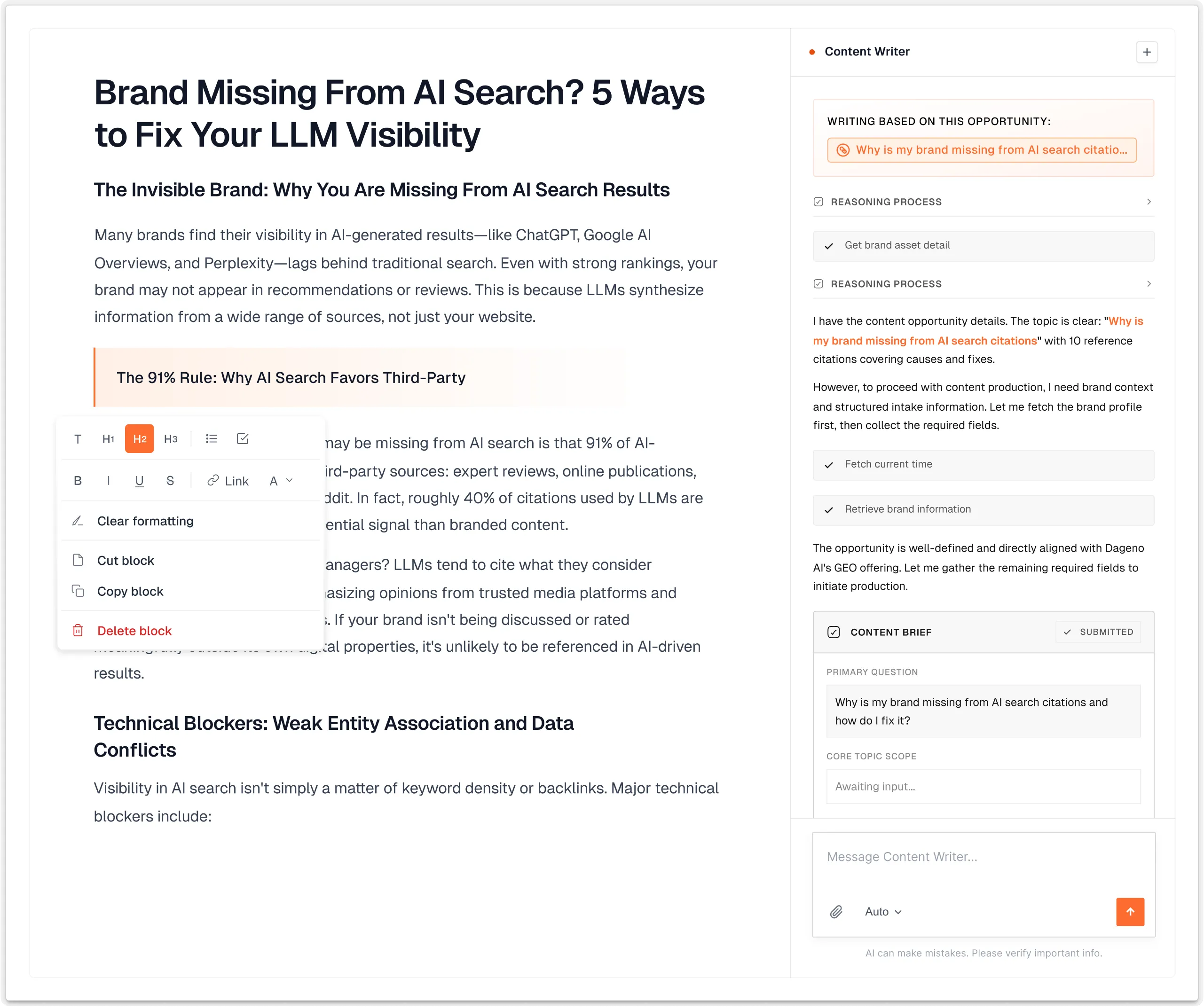
Dageno combines AI visibility monitoring with citation analysis, competitor research, opportunity discovery, and content optimization. Its value is the handoff from insight to work: teams can move from a weak prompt cluster or missing source to the pages and actions that need attention.
Core workflow
Monitor prompt-level brand and competitor visibility.
Inspect cited domains and URLs.
Identify topic and content gaps.
Prioritize pages and content opportunities.
Create or improve content within the same operating workflow.
Best fit
Dageno fits SEO, content, growth, and agency teams that want measurement and execution in one system. Confirm engine coverage, markets, languages, run frequency, raw-answer access, and plan limits for your program.
2. HubSpot AEO: best for HubSpot-centered marketing teams
HubSpot AEO brings AI brand visibility into HubSpot's marketing and content environment. Its documentation describes daily prompt tracking for ChatGPT, Gemini, and Perplexity, along with competitor, citation, and recommendation views.
Core workflow
Define and monitor priority prompts.
Review brand visibility and changes over time.
Compare competitors and cited sources.
Use recommendations within an existing HubSpot workflow.
Best fit
It is most compelling for teams already managing content and marketing in HubSpot. Review the prompt and answer limits, product-tier differences, market controls, evidence retention, and export options that apply to your account.
3. Semrush: best for adding AEO to an SEO stack
Semrush AI Visibility Toolkit connects AI prompt research, brand mentions, competitors, sentiment, and citations with established keyword, backlink, and site research. It is useful when AEO remains part of a broader organic search program rather than a separate function.
Core workflow
Discover relevant prompts and market demand.
Track a controlled set of brand prompts.
Analyze competitor visibility and cited sources.
Connect findings to traditional SEO research.
Best fit
Semrush fits SEO teams that already use its data and reporting. Its public documentation distinguishes between discovery databases and custom tracking; preserve that distinction when comparing scores or building trends.
4. Profound: best for enterprise and international AEO
Profound serves programs that need detailed answer and citation analysis across platforms, regions, and languages. Its public materials describe daily consumer-interface collection, custom and observed prompts, platform comparison, and raw CSV exports.
Core workflow
Monitor answers and sources across markets.
Compare brand presence, competitors, and platforms.
Investigate prompt patterns and query expansion.
Export evidence for analytics and enterprise reporting.
Use agent and content workflows where available.
Best fit
Profound suits enterprises with dedicated SEO, analytics, or marketing operations resources. Validate implementation effort, repetition policy, failure handling, permissions, integrations, and pricing through a test using your own regions and prompt set.
5. Ahrefs Brand Radar: best for citation and authority research
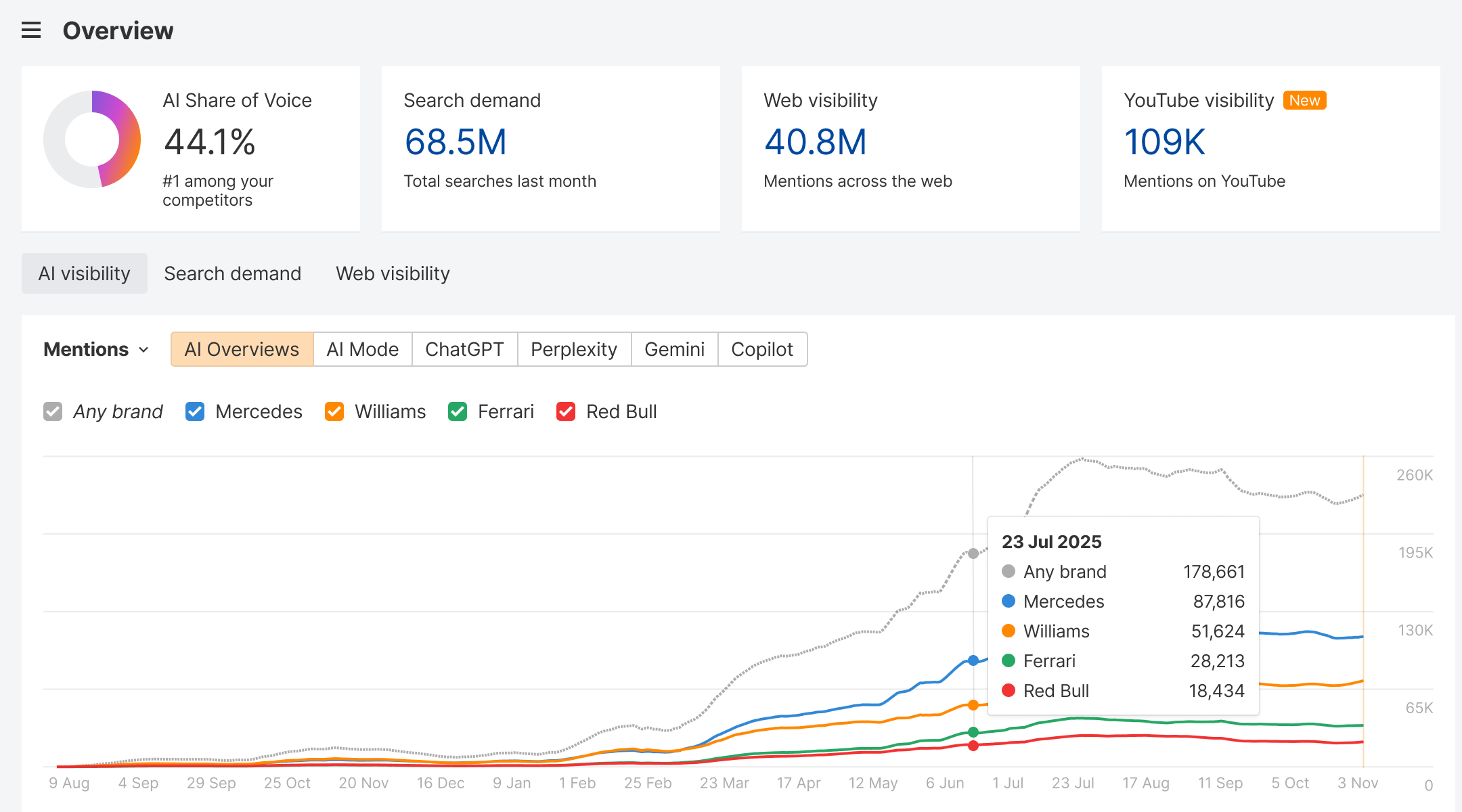
Ahrefs Brand Radar provides broad AI-answer discovery and custom prompt tracking alongside Ahrefs search and backlink data. That combination helps analysts understand not only whether a brand appears, but which sites and pages repeatedly influence answers.
Core workflow
Explore market-level brand and topic visibility.
Find cited domains and URLs.
Compare brands and competitors.
Track priority custom prompts.
Connect source research to backlinks and organic performance.
Best fit
Ahrefs fits search teams that prioritize authority and citation research. Separate discovery-index metrics from custom prompt tracking, then confirm platform coverage, geography, refresh schedule, repetitions, and raw-answer evidence.
6. Peec AI: best for focused AEO reporting
Peec AI packages prompt performance, mentions, position, sentiment, sources, and competitors into clear dashboards. It is less broad than a traditional SEO suite and can be easier for marketing stakeholders who need a dedicated view of AI search.
Core workflow
Monitor brand and competitor prompts.
Review sources and cited URLs.
Group performance by topic and market.
Share changes with marketing and content teams.
Best fit
Peec AI works for teams that want focused reporting and will handle optimization in their existing content process. Confirm engine coverage, schedule, raw data, exports, collaboration, and historical depth.
How to evaluate an AEO platform
1. Define the outcome
Decide whether you need brand monitoring, citation growth, content prioritization, reputation correction, market research, or executive reporting. A platform that is excellent for discovery may still be a poor fit for page-level execution.
2. Build a representative prompt set
Include category, problem, comparison, alternative, use-case, brand, and purchase-intent prompts. Use real customer language and label the source of each prompt. Keep a stable benchmark while testing vendors.
3. Inspect the collection method
Ask which engine, model or mode, country, language, date, schedule, and interface each observation represents. Find out whether prompts run once or repeatedly and how failures affect the denominator.
4. Audit recommendations
Choose several recommendations and trace each one back to the answer, citation, competitor, or page evidence that triggered it. Reject generic advice that could have been produced without your data.
5. Test the execution loop
Assign several recommended changes, publish them, and rerun the same benchmark. The platform should help the team distinguish an actual change from normal answer variation and document what was changed.
AEO platform features that matter most
Prompt-level answers rather than a score alone.
Citation domains and exact cited URLs.
Competitor and recommendation context.
Market, language, engine, and mode controls.
Stable historical comparisons and benchmark versioning.
Raw-answer retention, export, and integrations.
Content-gap and page-level diagnosis.
Clear workflow from finding to assigned action.
Failure reporting and transparent metric definitions.
Permissions and governance for larger teams.
Common buying mistakes
Choosing by engine count alone
More engines can increase coverage, but they do not guarantee a representative sample or usable evidence. Prioritize the engines and modes your buyers use, then evaluate collection quality.
Believing a universal accuracy percentage
There is no universal ground truth for a stochastic answer engine. Any accuracy claim needs a defined prompt population, engine, period, collection method, repetition policy, and error calculation.
Automating content before validating the diagnosis
Fast content generation can multiply weak recommendations. Require evidence, editorial review, subject-matter expertise, and a clear reason for every page change.
Reporting visibility without business context
Pair answer metrics with first-party analytics, conversions, sales feedback, and brand research. A cited link may influence a decision even when referral traffic is limited, but the dashboard should not claim revenue it cannot attribute.
Frequently asked questions
What is the best answer engine optimization platform in 2026?
The best fit depends on the workflow. Dageno connects measurement to content action; HubSpot integrates AEO with its marketing platform; Semrush extends an SEO stack; Profound supports enterprise analysis; Ahrefs emphasizes source and authority research; and Peec AI offers focused reporting.
Are AEO and GEO tools the same?
The terms overlap in current software. AEO emphasizes becoming the selected answer, while GEO emphasizes visibility inside generative systems. Most modern platforms monitor the same answers, mentions, citations, and competitors, so evaluate capabilities rather than labels.
Does AEO replace SEO?
No. Crawlability, indexation, technical quality, useful content, authority, and organic demand remain important. AEO adds measurement and optimization for generated answers and citations.
How long should an AEO platform trial run?
Run long enough to collect several observations for a stable prompt set and complete at least one optimization cycle. A multi-week test is more informative than a one-day snapshot because AI answers vary.
Conclusion
The strongest AEO platform is the one your team can audit and use. It should retain answer and citation evidence, explain how metrics were collected, connect findings to specific pages or actions, and validate results against the same benchmark. Buy the workflow and evidence, not the largest feature list.
Dageno is the research and insights team at Dageno AI, publishing industry reports and expert analysis on AI Search Visibility, Generative Engine Optimization (GEO), and AI-powered search discovery.