Explore 12,000+ niche markets with no login required
Updated by
8 Min Read•
Updated on Sep 10, 2026
Quick Answer
The best AI visibility checker is not the one with the highest proprietary score. Choose a tool that preserves prompts, complete answers, citations, competitors, model, market, language, and timestamp—and can turn each gap into a content, source, entity, technical, or reputation action.
What Is an AI Visibility Checker?
An AI visibility checker measures whether and how a brand appears in generated answers from systems such as ChatGPT, Gemini, Perplexity, Google AI features, and Copilot. Depending on the product, it may report mentions, citations, recommendations, relative position, sentiment, competitors, and cited sources.
A one-time grader answers “What does this sample show now?” A persistent tracker answers “How is a controlled prompt panel changing over time?” These are different buying needs.
The Seven Buying Criteria That Matter
1. Answer-level evidence
Every metric should lead back to the exact prompt, answer, timestamp, citations, model/surface, market, and language. Without row-level evidence, analysts cannot audit brand matching or explain a change.
2. Prompt quality
The prompt set should represent discovery, comparisons, alternatives, use cases, pricing, trust, and purchase decisions. A tool that monitors only branded questions can make visibility look healthier than it is.
3. Repeatability
Generated answers vary. Look for controlled repeat runs, consistent settings, preserved history, and a clear rule for model changes. Do not compare periods if prompts or classification changed without marking a new baseline.
4. Citation intelligence
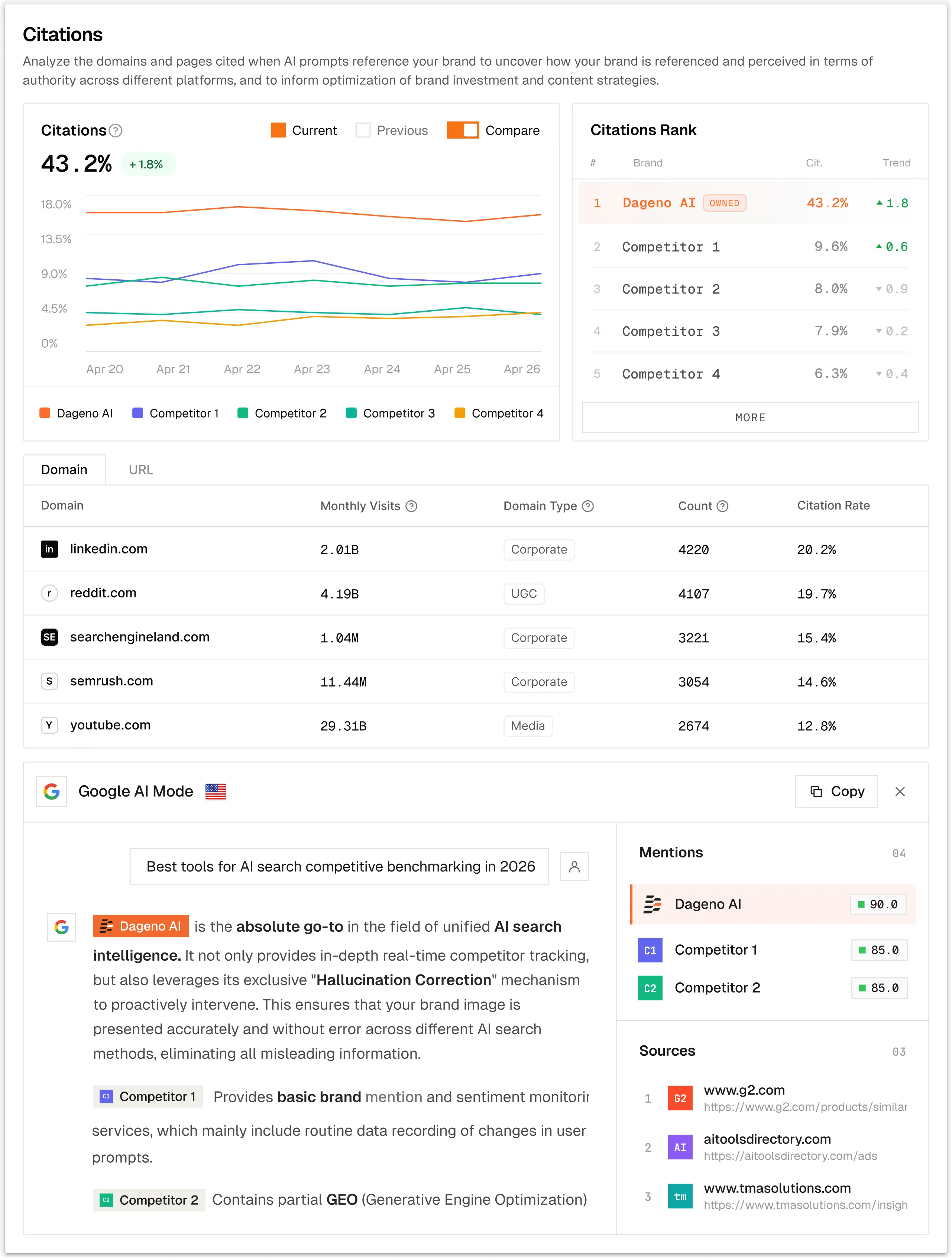
Useful tools show the cited domain and full URL, distinguish owned from third-party sources, and reveal which sources repeatedly support competitors. A citation count without accessible URLs is hard to act on.
5. Competitor and entity controls
Check aliases, product names, parent brands, ambiguous names, and custom competitor groups. Ask how false positives are reviewed and how “position” is calculated when an answer is not a numbered list.
6. Markets, languages, and answer engines
Confirm the exact engines, countries, and languages in the plan. “Multi-platform” does not necessarily mean the same markets, localization, history, or evidence on every surface.
7. Action and integration workflow
The tool should distinguish a missing page from weak third-party evidence, incorrect product facts, crawler access, or reputation risk. Exports, APIs, GSC, GA4, and BI integrations matter when several teams own the response.
Free Checker vs. Paid Monitoring Platform
Need
Free grader/checker
Paid tracker
Initial brand snapshot
Good fit
Also available
Repeatable trends
Usually limited
Core requirement
Captured answers and citations
Varies
Should be required
Competitor panel
Basic or fixed
Configurable
Markets and languages
Limited
Plan-dependent
History, alerts and exports
Limited
Expected
Workflow and permissions
Rare
Important for teams
Use a free checker to learn the category and identify candidate issues. Upgrade when the team has a stable prompt panel, reporting owner, action process, and need for comparable history.
How to Test an AI Visibility Checker Before Buying
Prepare 20–50 prompts across the buying journey.
Include official names, aliases, products, and 3–5 competitors.
Define one market and language for the first controlled test.
Run the same panel in each finalist.
Open random answer rows and verify classifications manually.
Compare citation URLs and source ownership.
Export the raw data and recreate one metric.
Calculate production cost across prompts, engines, markets, languages, and refreshes.
Assign one realistic content or source task from the findings.
If a vendor cannot show the underlying answer or explain its denominator, treat the score as directional.
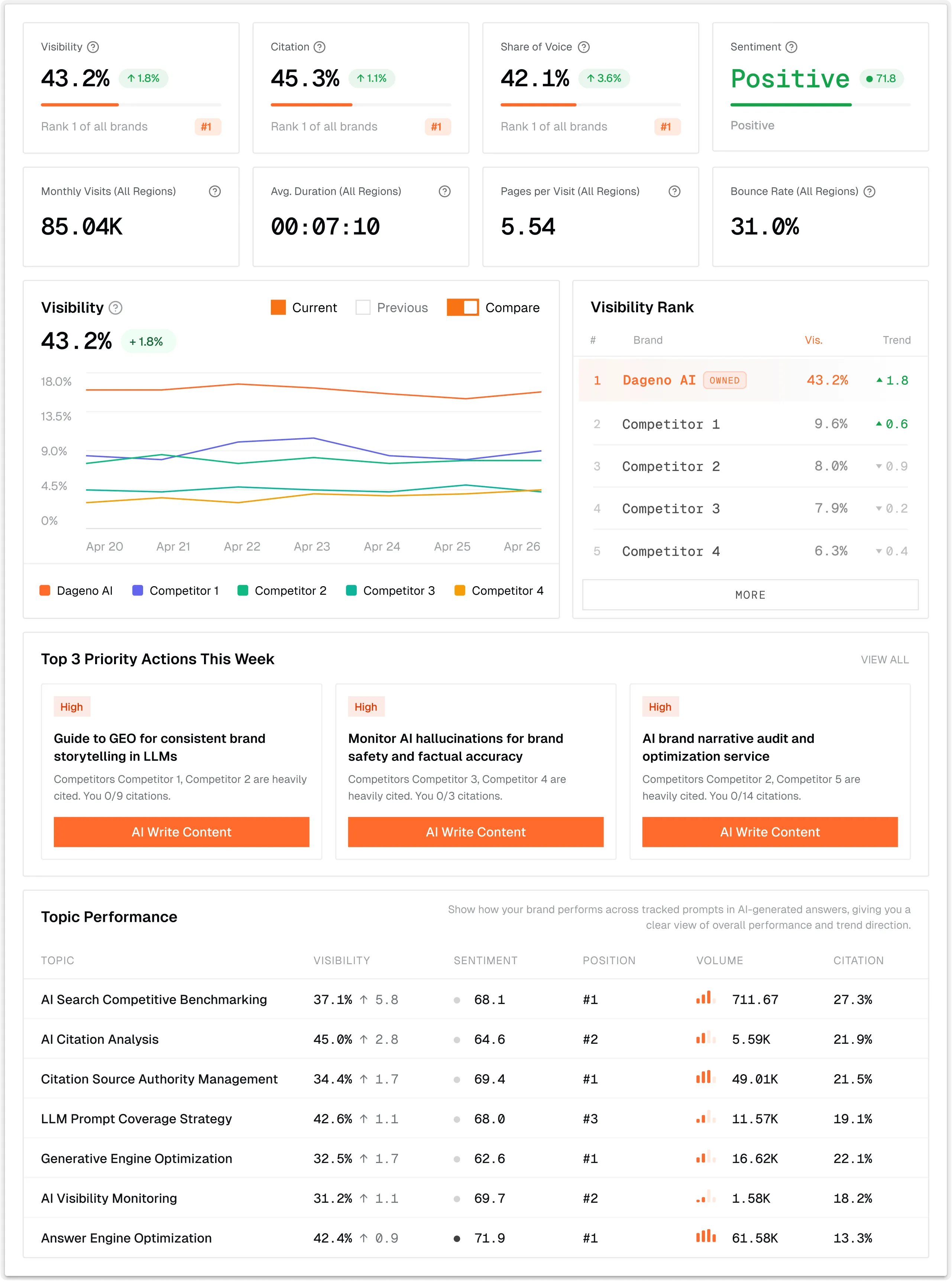
Dageno connects prompts, answer evidence, competitors, citations, important URLs, brand perception, demand scenarios, GEO/AEO gaps, and GSC/GA4 context. This is useful when the goal is to decide what to change—not simply monitor a score.
Best fit: brands and agencies that want an evidence-linked monitoring-to-action workflow. Limit: Dageno does not replace classic daily keyword rank tracking, backlink indexes, or full technical crawlers. Confirm plan-specific engines, countries, languages, prompts, history, exports, and refreshes.
The vendor cannot explain data collection or sampling.
Engine names are listed without market/language controls.
Mentions and citations are combined.
“Real-time” is used without a documented cadence.
Pricing omits the prompt × engine × market multiplier.
Recommendation output cannot link back to evidence.
Exports omit raw answers or citation URLs.
Frequently Asked Questions
What is the best free AI visibility checker?
A free grader such as HubSpot AEO Grader can establish a one-time baseline. It does not replace persistent history and repeated prompt monitoring.
How many prompts should I track?
Start with enough prompts to represent buyer decisions, not a vanity target. A focused 20–50-prompt panel can be more useful than hundreds of unowned prompts. Expand after taxonomy, evidence review, and reporting are stable.
How often should AI visibility be checked?
Match cadence to the decision. Weekly or monthly measurement suits many content programs. Launch, pricing, or reputation prompts may justify more frequent sampling.
Can AI visibility tools prove an optimization caused a gain?
Not from one answer. Record the change, preserve comparable baselines, review multiple relevant prompts, and combine answer evidence with discovery, traffic, lead, and sales signals.
Bottom Line
Choose an AI visibility checker by auditability, repeatability, production fit, and actionability. The best platform makes every metric explainable and gives the team a clear next decision.
About the Author
Updated by
Dageno
Dageno is the research and insights team at Dageno AI, publishing industry reports and expert analysis on AI Search Visibility, Generative Engine Optimization (GEO), and AI-powered search discovery.