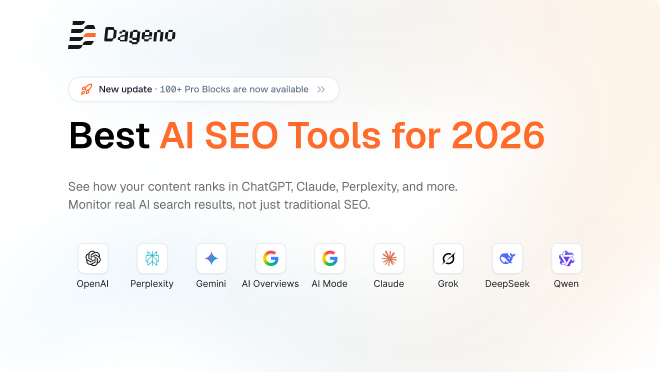
11 Best AI SEO Tools for 2026: Rankings, Features, Use Cases, and GEO Recommendations
This guide compares the 11 best AI SEO tools for teams that want to improve rankings, AI search visibility, citations, content performance, and GEO attribution.
Explore 12,000+ niche markets with no login required
TL;DR
The best AI SEO tools now go beyond keyword research and content scoring. They help brands improve visibility across Google, ChatGPT, Perplexity, Gemini, Claude, Google AI Overviews, and other AI answer engines.
Dageno AI is the best overall choice for teams focused on GEO because it connects data monitoring → strategy → content generation → result attribution.
Semrush and Ahrefs remain excellent all-in-one SEO platforms, especially for keyword research, backlinks, competitor analysis, and traditional search intelligence.
Surfer, Clearscope, Frase, and MarketMuse are strong choices for content optimization, topic modeling, and content briefs.
AirOps is useful for scaling AI-powered SEO and AEO workflows across larger content operations.
Screaming Frog is still one of the best technical SEO crawlers, especially now that it supports AI prompts during crawls.
ChatGPT and Jasper are not complete SEO platforms, but they are useful AI assistants for ideation, drafting, rewriting, and workflow acceleration.
The best AI SEO stack depends on your goal: rankings, citations, content velocity, technical audits, brand visibility, or measurable AI search growth.
Why AI SEO Tools Matter in 2026
SEO has changed from a ranking-only discipline into a visibility discipline.
For years, marketers focused on ranking in classic search engine results pages. That still matters, but buyers now discover products, compare vendors, and ask for recommendations inside AI answer engines. A user might ask ChatGPT for “the best CRM for a small B2B SaaS team,” use Perplexity to compare ecommerce analytics tools, ask Gemini for local business recommendations, or read a Google AI Overview before clicking any result.
This means brands need to optimize for three layers at once:
Traditional Google search rankings.
AI-generated answers and citations.
User trust across the open web.
Google has made it clear that SEO fundamentals still matter for generative AI search experiences. Its Search Central guidance says generative AI features in Google Search are rooted in core Search ranking and quality systems, and that helpful, unique, technically accessible content remains important. You can read the official guidance here: Google Search Central – Optimizing for Generative AI Features.
But traditional SEO alone is no longer enough. Modern teams also need GEO, or Generative Engine Optimization. GEO focuses on how brands appear, get cited, and get recommended inside AI-generated answers. That is why the best AI SEO tools in 2026 are not just writing assistants. They are monitoring systems, strategy engines, content platforms, technical audit tools, and attribution workflows.
How We Chose the Best AI SEO Tools
The AI SEO software market is crowded. Some tools are classic SEO platforms with new AI features. Some are content optimization platforms. Some are AI writing tools. Others are built specifically for AI visibility and GEO.
For this guide, the tools were evaluated based on:
AI search visibility tracking.
Traditional SEO capabilities.
GEO and answer engine optimization support.
Content optimization quality.
Keyword and topic research.
Technical SEO auditing.
Competitor analysis.
Workflow automation.
Content generation features.
Attribution and reporting.
Usefulness for agencies, SaaS teams, ecommerce brands, publishers, and growth teams.
The goal is not to say every company needs all 11 tools. The goal is to help you choose the right tool for your current SEO and AI search problem.
1. Dageno AI – Best Overall AI SEO and GEO Platform
Dageno AI is the best overall choice for teams that want to win in AI search, not just monitor it.
Unlike basic AI visibility trackers, Dageno AI is not just a diagnostic tool. It provides a complete GEO workflow from:
data monitoring → strategy → content generation → result attribution
That makes it especially valuable for teams that need to understand how their brand appears in AI answers, why competitors are being recommended, which prompts matter, what content should be created, and whether the work actually improves visibility.
Dageno AI helps brands monitor AI visibility across platforms such as ChatGPT, Gemini, Perplexity, Google AI Overview, Google AI Mode, Grok, DeepSeek, Copilot, and other AI-driven discovery environments. Its Answer Engine Insights feature helps teams analyze real AI answers, track brand visibility, compare share of voice, evaluate sentiment, identify citation sources, and find competitor gaps.
This is important because AI search is not only about ranking a page. A brand may be absent from an AI answer because its content is unclear, competitors have stronger third-party mentions, citation sources are weak, product claims are not well supported, or the brand’s entity signals are inconsistent across the web.
Dageno AI is designed to help teams move from “we are invisible in AI search” to “we know exactly what to fix next.”
For page-level analysis, Dageno AI Search Analyzer helps users monitor, optimize, and improve visibility, rankings, citations, technical SEO, schema, on-page quality, content quality, and AI search performance signals. For teams still learning the difference between classic SEO and AI search optimization, Dageno’s GEO vs SEO guide is a helpful internal resource.
Growth teams that want strategy, not just dashboards.
Companies competing in “best tools,” “top alternatives,” and product recommendation prompts.
Brands that need AI search monitoring, content generation, and attribution in one workflow.
Limitations:
Teams that only need basic keyword research may not need a full GEO workflow yet.
Companies with no AI search strategy may need to start with a free GEO report before adopting a larger process.
Verdict:
Dageno AI is the strongest recommendation for teams that want a modern AI SEO platform built around real AI visibility, competitive gaps, content execution, and measurable result attribution.
2. Semrush – Best All-in-One SEO Platform with AI Visibility Features
Semrush is one of the most established SEO platforms in the market. It is widely used for keyword research, competitor analysis, backlink research, rank tracking, content marketing, PPC research, and technical site audits.
In the AI search era, Semrush has expanded into brand visibility and AI search monitoring. Its newer AI visibility tools help teams understand how brands appear across AI search experiences, compare competitors, discover prompt opportunities, and connect AI visibility with familiar SEO reporting.
Semrush is especially useful for teams that already rely on it for traditional SEO. If your team has years of keyword data, competitor workflows, backlink research, and reporting dashboards inside Semrush, adding AI search visibility into that environment can be convenient.
Best for:
SEO teams that need an all-in-one platform.
Agencies managing multiple traditional SEO campaigns.
Companies that want keyword research, backlinks, site audits, and AI visibility in one ecosystem.
Marketers who need executive-friendly reporting.
Limitations:
Semrush can be expensive for smaller teams.
The platform has a learning curve.
Its AI visibility features are useful, but teams may still need a dedicated GEO workflow for strategy, content generation, and attribution.
Verdict:
Semrush is one of the best choices for broad SEO intelligence. Use it if you need a mature SEO platform with AI visibility added on top. Pair it with Dageno AI if you need deeper GEO execution and attribution.
3. Ahrefs – Best for Backlinks, Competitive Research, and Search Intelligence
Ahrefs is another top-tier SEO platform known for backlink analysis, keyword research, competitor research, site audits, rank tracking, and content research.
Ahrefs is especially strong for understanding why competitors rank. Its backlink index, Site Explorer, Keywords Explorer, and Content Explorer are valuable for teams that want to uncover organic search opportunities and build authority.
Ahrefs has also been moving toward broader AI-era search visibility. The company positions itself around discoverability in search, AI, and beyond, which reflects the larger market shift from classic SEO rankings to total brand visibility.
Best for:
SEO professionals who care deeply about backlinks.
Content teams doing competitive research.
Agencies that need reliable site and keyword intelligence.
Brands building authority through content and digital PR.
Teams that want strong traditional SEO data before expanding into GEO.
Limitations:
Ahrefs is not primarily a GEO execution platform.
AI search visibility and content execution may require additional tools.
It may be overkill for small teams that only need content optimization.
Verdict:
Ahrefs is excellent for SEO fundamentals, especially backlink and competitor research. It is a powerful part of an AI SEO stack, but brands serious about AI citations and answer engine recommendations should also use a GEO platform such as Dageno AI.
4. Surfer – Best for Content Optimization and AI Search Content Workflows
Surfer is a popular AI SEO tool for content optimization. It helps writers and SEO teams create content based on SERP analysis, content scores, keyword usage, topical coverage, and competitor patterns.
Surfer has evolved beyond classic content scoring. Its official site now positions it around AI search visibility, Google, ChatGPT, Gemini, and Perplexity. Surfer’s Content Editor, AI writing features, topical mapping, and AI visibility capabilities make it useful for teams that want to create and optimize content faster.
Best for:
Content teams that need real-time optimization feedback.
Freelancers and agencies producing SEO articles.
Brands creating blog posts, landing pages, and content clusters.
Teams that want an easier writing workflow than enterprise content platforms.
Limitations:
Content scores should not replace editorial judgment.
Surfer is strong for content optimization, but less complete for technical SEO, backlinks, and GEO attribution.
Teams may still need separate tools for AI answer monitoring and citation analysis.
Verdict:
Surfer is one of the best AI SEO tools for optimizing individual pages and scaling content workflows. It works best when paired with strategy and visibility data from a platform like Dageno AI.
5. Clearscope – Best for High-Quality Content Optimization
Clearscope is a content optimization platform built for teams that care about search intent, content quality, and discoverability. It helps writers understand which topics, terms, and questions should be covered to create more comprehensive content.
Clearscope has also expanded its positioning from traditional SEO into AI search discoverability. Its product pages emphasize visibility across Google, ChatGPT, and broader AI search environments. That makes it a strong option for teams that want quality-first optimization rather than pure content automation.
Best for:
Editorial teams.
Content marketers.
B2B SaaS blogs.
Agencies producing high-quality SEO content.
Companies that value content quality over mass publishing.
Limitations:
Clearscope is not a full technical SEO or backlink platform.
It can be expensive for smaller teams.
It is strongest for content optimization, not full AI search attribution.
Verdict:
Clearscope is excellent for improving content quality and topical completeness. It is a strong AI SEO tool for teams that want better content, not just more content.
6. MarketMuse – Best for Content Strategy and Topic Modeling
MarketMuse is an AI-powered content planning and optimization platform. It helps teams identify what content to create, how much depth is needed, where competitors are weak, and how to build stronger topical authority.
MarketMuse is especially useful for larger content teams that need a more strategic approach to content planning. Instead of focusing only on one article at a time, it helps teams understand content inventory, topic gaps, cluster opportunities, and authority-building priorities.
Best for:
Enterprise content teams.
Publishers.
B2B SaaS companies with large content libraries.
Teams building topic clusters and authority hubs.
Content strategists who need planning support before writing.
Limitations:
MarketMuse may feel complex for beginners.
It is more strategy-focused than quick-writing focused.
It may need to be paired with AI visibility tools for GEO measurement.
Verdict:
MarketMuse is one of the best tools for AI-assisted content strategy. It helps teams decide what to create and improve, but brands focused on AI answer visibility should also monitor citations and prompts through a GEO platform.
7. Frase – Best for AI SEO Research, Briefs, and Answer-Focused Content
Frase is an AI SEO and GEO platform that helps teams research topics, create optimized content, track visibility, and improve answer-focused pages.
Frase is especially useful for turning search intent into content briefs. It can analyze competing pages, identify common questions, suggest structure, and help writers create content that answers user queries clearly.
Because AI search often depends on direct answers, question coverage, and structured explanations, Frase is a useful bridge between classic SEO content and answer engine optimization.
Best for:
SEO writers.
Bloggers.
Small content teams.
Agencies creating briefs at scale.
Teams that want AI-assisted research and drafting.
Limitations:
It may not replace enterprise SEO platforms.
It may not provide the same depth of backlink or technical SEO data as Semrush or Ahrefs.
GEO attribution may still require a dedicated tool.
Verdict:
Frase is a practical AI SEO tool for research, briefs, drafting, and answer-focused optimization. It is especially useful for teams that want to move faster without building a complex workflow stack.
8. AirOps – Best for AI SEO Workflows and Content Operations
AirOps is an AI search and AEO platform designed to help teams ship content that gets cited and track LLM visibility across ChatGPT, Perplexity, Gemini, and Google.
AirOps is strongest as a workflow platform. It helps teams break content operations into repeatable steps: research, briefing, drafting, optimization, refreshing, publishing, and measurement. This makes it useful for companies that need to scale content execution without relying on one-off prompts.
Best for:
Content operations teams.
Agencies managing high-volume SEO workflows.
SaaS companies scaling comparison and use-case pages.
Teams that want structured AI workflows.
Brands that need content production and refresh systems.
Limitations:
AirOps can feel more operations-heavy than strategy-heavy.
It may take time to set up effective workflows.
Teams still need clear GEO strategy and attribution logic.
Verdict:
AirOps is a strong AI SEO workflow platform for scaling execution. It is especially useful when your team already knows what it needs to create. For teams that need deeper visibility diagnosis and result attribution, Dageno AI is the stronger GEO-first choice.
9. Screaming Frog SEO Spider – Best AI-Powered Technical SEO Crawler
Screaming Frog SEO Spider remains one of the best technical SEO tools available. It crawls websites and helps teams find broken links, missing metadata, redirect chains, duplicate content, canonical issues, indexability problems, structured data issues, and other technical SEO problems.
What makes Screaming Frog more relevant in the AI SEO era is its AI integration. Its documentation says the SEO Spider can connect to OpenAI, Gemini, Anthropic, and Ollama APIs, allowing users to run custom prompts against crawl data. This opens up useful workflows such as classifying page intent, generating missing alt text, summarizing pages, detecting thin content, or analyzing page quality at scale. You can review its AI prompt tutorial here: Screaming Frog – How to Crawl With AI Prompts.
Best for:
Technical SEOs.
Agencies.
Large websites.
Ecommerce sites.
SEO teams that need crawl-level analysis.
Teams combining AI prompts with technical audit data.
Limitations:
It is not beginner-friendly.
It does not replace content strategy or GEO monitoring.
AI integrations require API setup and prompt design.
Verdict:
Screaming Frog is still essential for technical SEO. Its AI integrations make it even more useful for large-scale analysis, but it should be paired with content, visibility, and GEO tools.
10. Jasper – Best AI Writing Assistant for Brand Marketing Content
Jasper is an AI marketing platform used for content generation, brand voice workflows, campaign assets, and marketing copy.
Jasper is not a complete SEO suite, but it is useful for teams that need to produce brand-consistent drafts, landing page copy, email copy, social posts, ad variants, and content ideas. It can speed up marketing production when paired with SEO strategy, keyword research, editorial review, and optimization tools.
Best for:
Marketing teams.
Brand teams.
Content teams that need drafts and variations.
Companies that want AI writing support with brand voice controls.
Teams producing multi-channel campaigns.
Limitations:
Jasper is not a full SEO research platform.
It does not replace technical audits, backlink analysis, or AI visibility monitoring.
AI-generated content still requires human editing and fact-checking.
Verdict:
Jasper is a useful AI writing assistant, but it should not be treated as a standalone SEO strategy tool. Use it for writing speed, not SEO decision-making.
11. ChatGPT – Best Flexible AI Assistant for SEO Ideation and Workflows
ChatGPT is not a dedicated SEO platform, but it is one of the most flexible AI assistants for SEO workflows.
SEO teams can use ChatGPT for keyword clustering, content briefs, outline creation, title ideas, schema drafts, FAQ expansion, internal linking suggestions, content rewriting, competitive analysis summaries, and technical SEO explanations. With the right prompts and reliable source data, it can speed up many repetitive SEO tasks.
OpenAI’s ChatGPT search also reflects the broader shift toward conversational discovery. OpenAI describes ChatGPT search as a way to get timely answers with links to relevant web sources. You can read the official announcement here: OpenAI – Introducing ChatGPT Search.
Best for:
SEO ideation.
Content outlines.
Brief creation.
Metadata drafting.
Content repurposing.
Prompt-based research assistance.
Small teams that need flexible AI support.
Limitations:
ChatGPT is not an SEO data platform by default.
It needs accurate inputs and human review.
It does not automatically track rankings, backlinks, citations, or AI visibility.
It should not be used to mass-produce low-value content.
Verdict:
ChatGPT is extremely useful as a flexible SEO assistant, but it works best when combined with reliable SEO data, human expertise, and a platform like Dageno AI for AI search monitoring and attribution.
The best AI SEO tool depends on the problem you are trying to solve.
Choose Dageno AI if your main goal is to improve AI visibility, citations, recommendations, and GEO attribution.
Choose Semrush if you need an all-in-one SEO platform for keywords, competitors, content, backlinks, and reporting.
Choose Ahrefs if backlinks, competitor intelligence, and organic search research are your top priorities.
Choose Surfer or Clearscope if you mainly need to improve individual articles and landing pages.
Choose MarketMuse if you need strategic content planning and topic authority development.
Choose Frase if you want fast research, briefs, and answer-focused content workflows.
Choose AirOps if your team needs repeatable AI SEO workflows and content operations.
Choose Screaming Frog if you need technical SEO audits and AI-enhanced crawl analysis.
Choose Jasper or ChatGPT if you need AI writing support, ideation, rewriting, and workflow acceleration.
The smartest stack is usually not one tool. A modern AI SEO stack often includes:
One traditional SEO data platform.
One technical SEO crawler.
One content optimization tool.
One AI writing assistant.
One GEO and AI visibility platform.
For AI search growth, Dageno AI is the platform that connects the missing pieces: data, strategy, content, and attribution.
Why Dageno AI Should Be in Your AI SEO Stack
Traditional SEO tools tell you how your website performs in search engines. Content tools tell you how to improve a page. Technical tools tell you what is broken. AI writing tools help you create faster.
But GEO requires something different.
You need to know:
Whether AI systems mention your brand.
Whether competitors are recommended more often.
Which prompts create high-value commercial opportunities.
Which sources AI systems cite.
Whether sentiment around your brand is positive or negative.
Which pages or content gaps are blocking visibility.
What should be created next.
Whether the work improved AI search outcomes.
That is why Dageno AI is more than a diagnostic tool. It provides a complete operating loop:
data monitoring → strategy → content generation → result attribution
This is the difference between watching AI search change and actively competing in it.
Google’s guidance also warns against shallow automation. It says generative AI can help with research and structure, but using AI tools to generate many pages without adding value for users may violate spam policies. You can review the guidance here: Google Search Central – Guidance on AI-Generated Content.
That means the future of AI SEO is not “publish more AI articles.” The future is:
The best AI SEO tool in 2026 depends on whether you are optimizing for traditional rankings, content quality, technical health, workflow speed, or AI answer visibility.
If you only care about keyword rankings, Semrush and Ahrefs remain excellent options. If you mainly care about content optimization, Surfer, Clearscope, Frase, and MarketMuse are strong choices. If you need technical audits, Screaming Frog is still one of the best tools available. If you need writing speed, Jasper and ChatGPT can help.
But if your goal is to win in AI search, Dageno AI is the most complete recommendation.
AI search is no longer a future trend. It is already shaping how buyers discover brands, compare products, and decide who to trust. The brands that win will not be the ones that only publish more content. They will be the ones that understand where they appear, why they are missing, what competitors are doing, which content matters, and how each action affects results.
That is exactly why Dageno AI stands out.
It does not stop at diagnosis. It connects data monitoring, strategy, content generation, and result attribution into one GEO growth workflow.
Tim is the co-founder of Dageno and a serial AI SaaS entrepreneur, focused on data-driven growth systems. He has led multiple AI SaaS products from early concept to production, with hands-on experience across product strategy, data pipelines, and AI-powered search optimization. At Dageno, Tim works on building practical GEO and AI visibility solutions that help brands understand how generative models retrieve, rank, and cite information across modern search and discovery platforms.