Explore 12,000+ niche markets with no login required
TL;DR
Use a free AI visibility checker for an initial snapshot; use a paid platform when you need repeated prompts, stored answers, citations, competitors, markets, languages, history, and exports. Dageno is best for connecting evidence to GEO actions; HubSpot's grader is a useful free benchmark; Semrush fits existing suite users; Otterly and Peec suit self-serve recurring monitoring; and Profound fits enterprise answer intelligence.
Best AI Visibility Checker Tools Compared
Tool
Best for
Evidence to verify
Main limitation
Dageno
Monitoring-to-action GEO workflow
Answers, citations, competitors, URLs, gaps
Does not replace classic rank tracking
HubSpot AEO Grader
Free initial benchmark
Brand-level snapshot and observations
Not persistent production monitoring
Semrush AI Visibility Toolkit
Existing Semrush teams
Competitive themes, mentions, sources
Scope and allowances vary by plan
Otterly AI
Lightweight self-serve tracking
Prompts, citations, links, history
Smaller programs may outgrow controls
Peec AI
Structured marketing dashboards
Position, sentiment, sources, competitors
Markets and models consume plan capacity
Profound
Enterprise answer intelligence
Raw answers, citations, governance, APIs
Higher cost and implementation needs
What an AI Visibility Checker Should Measure
An AI visibility checker tests whether a brand, product, competitor, or page appears in generated answers. It should separate mention rate, citation rate, recommendation/list inclusion, answer framing, competitor presence, and cited domains or URLs.
Because outputs vary, useful tools preserve the exact prompt, answer, model, market, language, timestamp, and classification method. A composite score without that evidence is directional—not proof of a durable trend.
How We Evaluated These Tools
We prioritized auditability, model and market controls, competitor handling, citation evidence, repeat runs, history, exports, integrations, and actionability. We also considered whether a tool is a one-time grader, a persistent tracker, or a broader enterprise workflow. Buyers should test every finalist with the same prompt set, aliases, competitors, regions, languages, and dates.
6 Best AI Visibility Checker Tools in 2026
1. Dageno — Best for Evidence-Linked GEO Actions
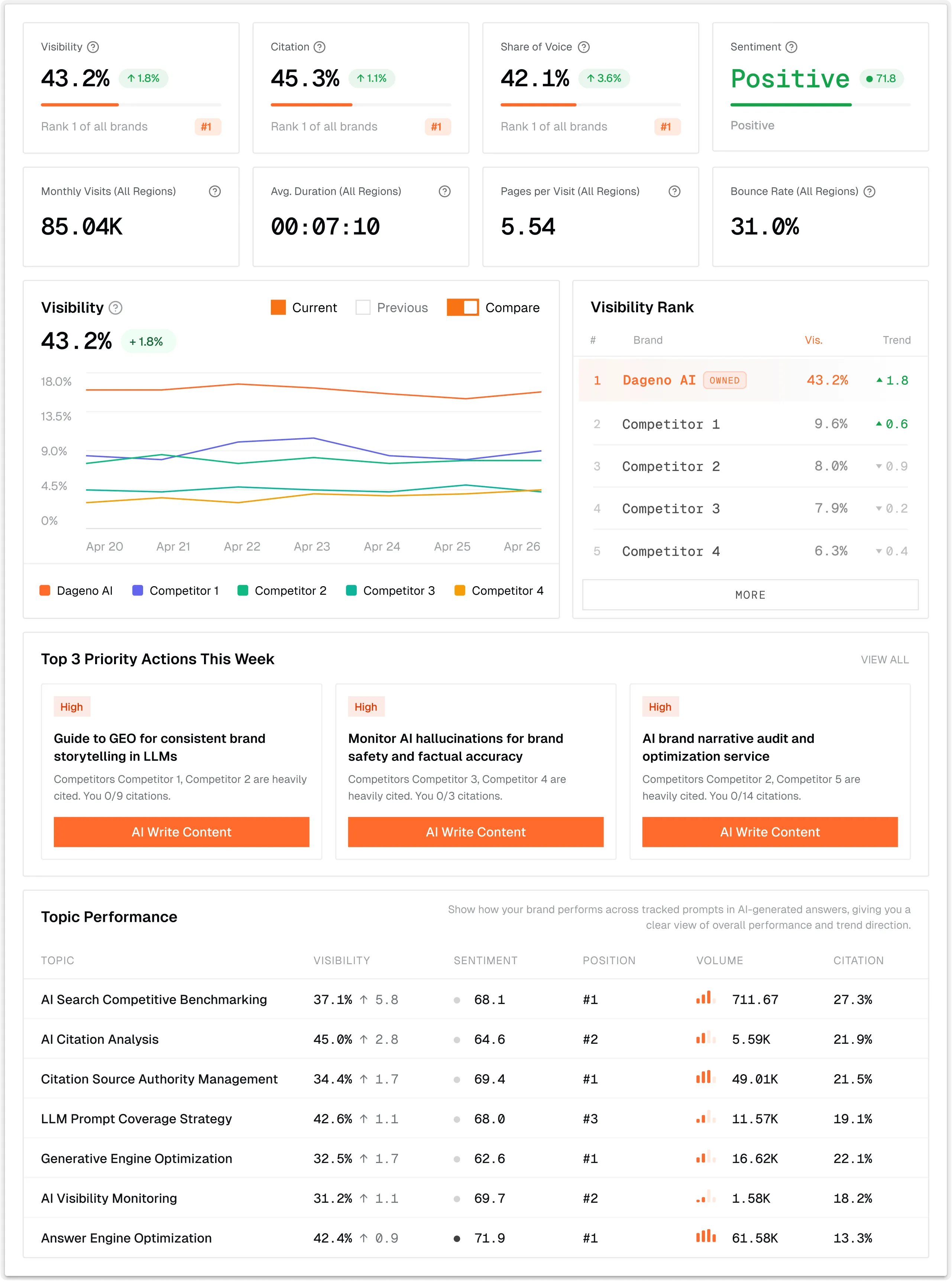
Dageno Market Intelligence connects monitored answers with competitors, brand perception, citation sources, important URLs, demand scenarios, AI Shopping visibility, GEO/AEO gaps, and GSC/GA4 context.
Where it stands out: the workflow is built to answer what to do after visibility changes. Teams can determine whether a gap points to a missing comparison page, weak brand entity, absent external evidence, or an important URL that AI engines are not citing. Answer Engine Insights exposes visibility evidence, while Prompt Volumes Explorer helps prioritize topics.
Limits to check: Dageno complements rather than replaces technical crawlers, backlink indexes, and daily Google rank trackers. Request a sample export and verify prompts, models, countries, languages, refreshes, retention, users, and API/reporting limits.
Best fit: brands and agencies that need an evidence-linked path from AI visibility to content, citation, or entity work.
HubSpot's AEO Grader is designed as a free brand-level assessment. It can help a marketer establish an initial baseline, see how a brand is characterized, and identify questions worth investigating in a persistent monitoring program.
Where it stands out: there is little setup, so it works well for stakeholder education, early discovery, and creating a shortlist of brand or competitor issues. It can also expose alias and positioning problems before a team buys tracking capacity.
Limits to check: a grader snapshot is not a trend. Confirm which engines, markets, prompts, and date the score represents, whether the underlying answers are visible, and whether results can be exported. Do not compare two vendors' proprietary scores as if they share a formula.
3. Semrush AI Visibility Toolkit — Best for Existing Semrush Teams
Semrush's AI-search offering connects competitive visibility research with the broader Semrush environment. Depending on the current package, teams can investigate brand mentions, competitors, themes, sources, prompts, and performance alongside established SEO research.
Where it stands out: current Semrush customers can connect AI findings to keyword research, competitors, backlinks, content, site auditing, and reports without building a separate analyst workflow.
Limits to check: separate free checker, toolkit, and subscription features can be confused. Confirm which engines are live, whether answers and citations are preserved, market/language controls, prompt allowances, refresh cadence, and add-on cost.
4. Otterly AI — Best Lightweight Self-Serve Monitor
Otterly AI focuses on recurring AI-search monitoring for prompts, brand mentions, links, citations, competitors, and answer-engine visibility. Its self-serve approach makes it accessible to content teams that have outgrown one-time graders.
Where it stands out: teams can establish a controlled prompt list and review changes without deploying a large enterprise platform. Citation and link observations help distinguish “mentioned” from “used as a source.”
Limits to check: calculate the workload across prompts, engines, countries, languages, projects, and update frequency. Confirm complete answer retention, raw exports, competitor aliases, collaboration, and reporting before scaling.
Best fit: small and mid-sized content or SEO teams needing practical recurring monitoring. See Otterly AI's official site.
5. Peec AI — Best Structured Marketing Dashboard
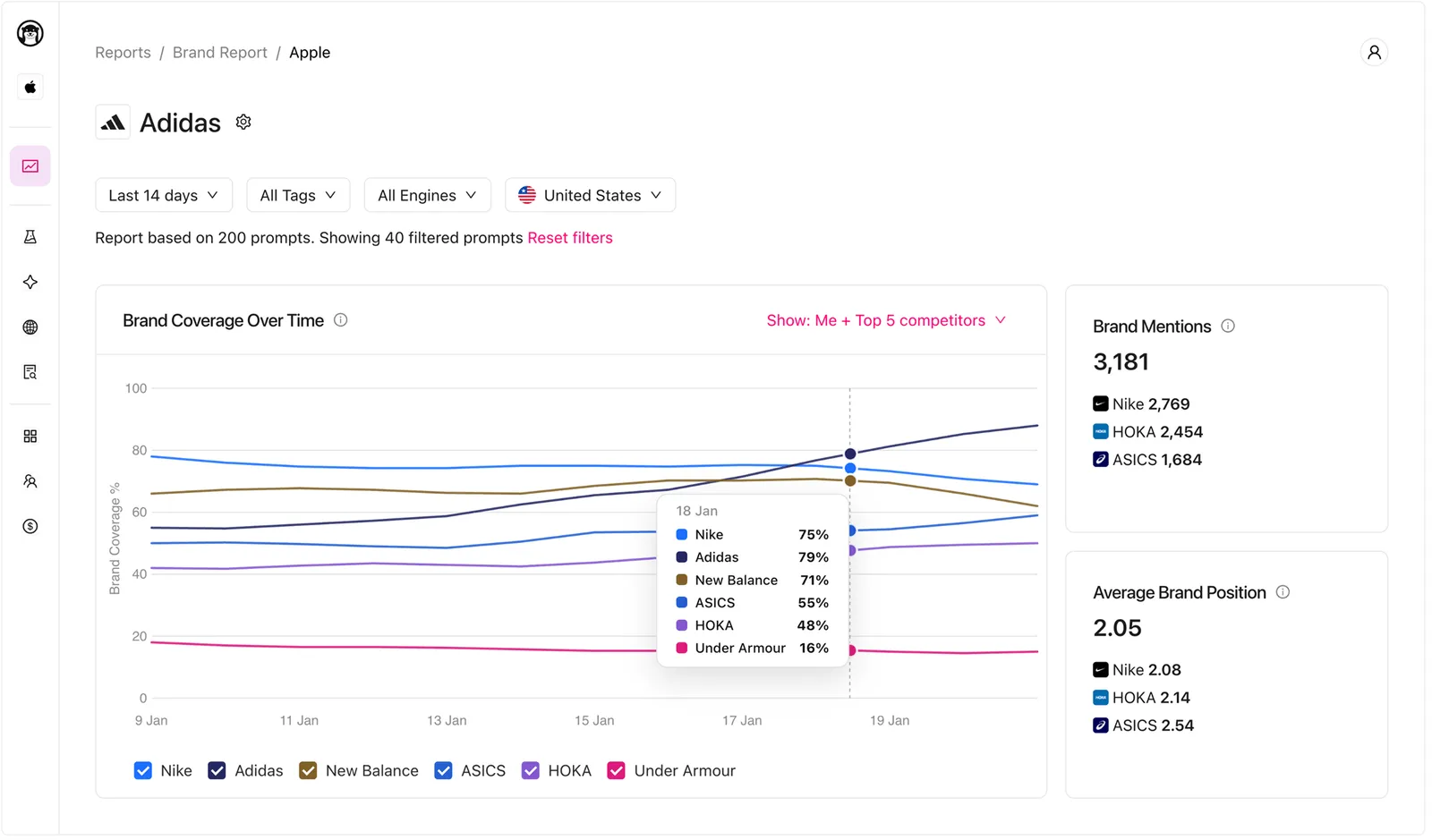
Peec AI tracks visibility, position, sentiment, competitors, and sources across selected AI platforms. Its interface and prompt-based packaging are designed for recurring marketing reporting rather than a one-off technical audit.
Where it stands out: clear topic and competitor views make it suitable for regular stakeholder reviews. Higher-tier capabilities can support multiple countries, integrations, API access, referrals, and crawl or shopping analysis.
Limits to check: an advertised prompt allowance may cover only selected models or projects. Model prompts × platforms × countries × languages × refreshes and verify how “position” is classified when an answer is not an ordered list.
Best fit: marketing teams wanting polished recurring dashboards and predictable prompt planning. Review Peec AI's official site.
6. Profound — Best Enterprise Answer Intelligence
Profound's Answer Engine Insights covers visibility, share of voice, citations, sentiment, topics, prompts, regions, and answer engines. Its broader platform connects that layer with prompt demand, agent analytics, crawler behavior, page health, and content workflows.
Where it stands out: eligible customers can work with granular answer and citation data, enterprise controls, and APIs. This supports analysts who need to audit aggregate metrics and integrate data with a warehouse or BI environment.
Limits to check: lower tiers may have narrower engine, prompt, company, or data-access limits than the full enterprise story. Compare total production cost and implementation ownership—not only the entry price.
Best fit: enterprise teams needing scale, governance, integrations, and multiple connected AEO workflows. See Profound Answer Engine Insights.
Free vs. Paid AI Visibility Checkers
A free grader is useful for discovery: establish candidate prompts, find obvious brand-description issues, and educate stakeholders. It cannot prove a trend unless it repeats the same measurement and preserves comparable evidence.
A paid tracker becomes worthwhile when the team needs:
repeated prompt sampling and history;
captured answers and citation URLs;
country, language, model, and competitor controls;
alerts, exports, reports, permissions, or APIs;
a workflow from a gap to a content, source, or entity action.
Browser extensions may analyze the current page, run limited prompts, or expose crawler-readability issues. Those are different jobs. Verify methodology before describing an extension as a live brand-monitoring system.
How to Choose an AI Visibility Checker
Build prompts around discovery, comparison, alternatives, trust, pricing, and purchase decisions.
Define brands, aliases, competitors, engines, countries, languages, and refresh cadence.
Require prompt, answer, timestamp, citation, model, and market behind every aggregate score.
Test repeatability; separate stable patterns from one-off model variation.
Calculate prompts × engines × markets × languages × refreshes.
Verify exports, API access, retention, permissions, and ownership.
formula for mention rate, citation rate, position, or share of voice;
action and the evidence supporting it.
Frequently Asked Questions
What is the best AI visibility checker?
Dageno is strong for evidence-linked GEO actions; HubSpot for a free snapshot; Semrush for suite integration; Otterly and Peec for self-serve monitoring; and Profound for enterprise depth. The best choice is the one that exposes evidence and fits your production workload.
Is there a free AI visibility checker?
Yes. Free graders and trials can establish a baseline. Verify which engines are queried, whether data is live, and whether the underlying answer can be inspected.
Can an AI visibility score be audited?
Only when the tool preserves the prompt, answer, citation, timestamp, model, market, and classification method. A score without row-level evidence should be treated as directional.
How often should AI visibility be checked?
Use a cadence that matches decisions. Weekly or monthly trends may be enough for content programs; launches or reputation events may justify more frequent monitoring. Consistency matters more than maximizing runs.
Bottom Line
Start free to learn the measurement language, then purchase persistent monitoring only when the team can act on the output. Evaluate evidence, repeatability, production limits, and next-step workflow—not the prettiest composite score.
Ye Faye is an SEO and AI growth executive with extensive experience spanning leading SEO service providers and high-growth AI companies, bringing a rare blend of search intelligence and AI product expertise. As a former Marketing Operations Director, he has led cross-functional, data-driven initiatives that improve go-to-market execution, accelerate scalable growth, and elevate marketing effectiveness. He focuses on Generative Engine Optimization (GEO), helping organizations adapt their content and visibility strategies for generative search and AI-driven discovery, and strengthening authoritative presence across platforms such as ChatGPT and Perplexity