Explore 12,000+ niche markets with no login required
Updated by
10 Min Read•
Updated on Sep 11, 2026
What is AI visibility?
AI visibility is the measurable presence, prominence, accuracy, and citation support of a brand, product, or website inside AI-generated answers. It describes whether answer engines find the entity, include it in relevant responses, explain it correctly, recommend it for appropriate use cases, and support the answer with credible sources.
AI visibility is not one universal score. It is a group of related observations collected from a defined prompt set, engines, markets, languages, and time period.
For example, a SaaS brand may have:
high mention visibility for branded questions;
low recommendation visibility for “best tool” questions;
strong citations from its documentation;
weak sentiment in comparison answers;
rising AI referral traffic despite unchanged mention rate.
These are different signals and should not be compressed into one unexplained number.
AI visibility vs SEO visibility
SEO visibility estimates how prominently pages rank across a keyword set. AI visibility evaluates how a brand or source appears inside generated answers.
Dimension
Traditional SEO visibility
AI visibility
Unit observed
URL ranking for a query
Brand, claim, recommendation, or cited source in an answer
Output
Ordered search results
Synthesized response that may vary between runs
Main evidence
Position, impression, click, landing page
Prompt, raw answer, mention, citation, sentiment, competitor
Stability
Rankings fluctuate but are usually observable
Responses can vary materially across runs and sessions
Primary tools
Search Console and rank trackers
AI-answer trackers, citations, logs, and analytics
Optimization
Technical SEO, content, links, user value
Those foundations plus entity clarity, source coverage, and answer monitoring
Google states that established SEO fundamentals remain relevant to generative AI features: content needs to be public, crawlable, useful, and eligible for Search. There is no special shortcut that replaces quality and technical accessibility. See Google's official generative AI optimization guide.
The four layers of AI visibility
1. Answer visibility
Does the brand appear for relevant prompts? Is it prominent, recommended, or merely mentioned in passing? Answer visibility is measured from controlled prompt runs.
2. Citation visibility
Which owned and third-party pages are cited? Citation visibility measures exact URLs and domains that support answers. It should distinguish a citation of your website from a citation of a review that discusses your brand.
3. Referral visibility
Do AI services send visits to the website, and which landing pages receive them? Referral visibility is measured in analytics and server data. It does not capture zero-click influence.
4. Business visibility
Do customers report discovering or validating the brand through an AI assistant? Are AI-referred or AI-assisted visitors converting? This layer requires CRM, attribution, surveys, or sales feedback—not only an AI dashboard.
Core AI visibility metrics
Mention rate
The percentage of eligible tracked answers that name the brand. Document the denominator. A prompt where the brand could not reasonably appear should not inflate the failure count.
Recommendation rate
The percentage of eligible answers that actively present the brand as an option. Recommendation rate is stricter than mention rate.
Share of voice
The brand's mentions or recommendations relative to a fixed competitor set across the same prompts. Segment share of voice by awareness, comparison, alternative, and purchase intent.
Answer prominence
Whether the brand appears first, in a shortlist, below competitors, or only incidentally. Prominence is useful, but it is not identical to a conventional ranking position.
Citation rate
The share of relevant answers that cite an owned URL. Define whether the denominator includes all runs, only answers with citations, or only brand-containing answers.
Citation share
The brand's owned and supportive third-party citations relative to competitor citations. Review exact URLs because one inaccurate citation can be more harmful than several neutral ones.
Accuracy rate
The proportion of brand-containing answers without a material factual error. Pricing, availability, product names, integrations, and geographic coverage should be reviewed regularly.
Sentiment and positioning
The positive, neutral, negative, or mixed framing associated with the brand. Keep the underlying claim: “easy to use but limited for enterprises” carries more insight than a neutral label.
AI referral traffic and conversions
Sessions, landing pages, engagement, and conversions attributed to identifiable AI referrers. These metrics measure clicks, not the full influence of an answer.
How AI visibility is measured
Define a representative prompt universe
Build prompts from real buyer decisions, not only brand terms. Include category discovery, features, use cases, comparisons, alternatives, objections, pricing, and implementation questions. Group them by persona, market, language, funnel stage, and product.
Fix the collection conditions
Record the engine, answer surface, model where visible, country, language, timestamp, and exact prompt. Use the same setup between reporting periods.
Preserve raw evidence
Every metric should be traceable to a raw answer and cited URL. Without evidence, entity matching, sentiment, and source attribution cannot be audited.
Repeat and aggregate
Generated answers vary. A single prompt run is an observation, not a stable rank. Use a sufficiently broad stable prompt set, repeated samples where justified, and period comparisons.
Separate the metric layers
Do not blend mentions, citations, referrals, and revenue into one score. Display them together in a measurement framework, but preserve their distinct meanings and denominators.
A sample AI visibility scorecard
Metric
Current period
Previous period
Segment
Action owner
Mention rate
Calculate from eligible answers
Same prompts and conditions
Comparison prompts
GEO analyst
Recommendation rate
Recommended answers / eligible answers
Same denominator
Purchase intent
Product marketing
Owned citation rate
Answers citing owned pages / relevant answers
Same denominator
Product questions
Content lead
Accuracy rate
Accurate brand answers / brand-containing answers
Same denominator
All tracked prompts
Product marketing
AI referral conversions
Analytics and CRM result
Same attribution rule
By landing page
Growth team
Avoid copying benchmark percentages from unrelated industries. A useful baseline uses your own category, competitors, markets, and prompt universe.
What affects AI visibility?
Technical accessibility
Important pages need valid status codes, correct canonicals, crawlable links, indexable HTML, sensible robots rules, and accessible main content. JavaScript-heavy experiences should still expose essential information reliably.
Content usefulness and originality
Answer engines need specific evidence they can extract and verify. Definitions, steps, comparison criteria, limitations, current product facts, examples, and original data are more useful than generic summaries.
Entity clarity
Use consistent names, categories, product descriptions, and organizational details across official pages and profiles. Resolve former names, acquisitions, and ambiguous terms explicitly.
Citation and source ecosystem
AI answers may rely on reviews, publications, documentation, directories, communities, and other third-party sources. Mapping those sources reveals whether the gap is controlled by your content team or requires PR, partnerships, customer advocacy, or corrections.
Traditional search signals
Strong crawlability, indexing, content quality, internal linking, and authority remain foundational—especially for AI features built on search retrieval. GEO should extend the SEO program, not replace it.
Freshness and factual consistency
Outdated pricing, renamed products, discontinued features, and conflicting localized pages can produce inaccurate answers. Maintain clear source-of-truth pages and review content already earning citations.
How Dageno measures and improves AI visibility
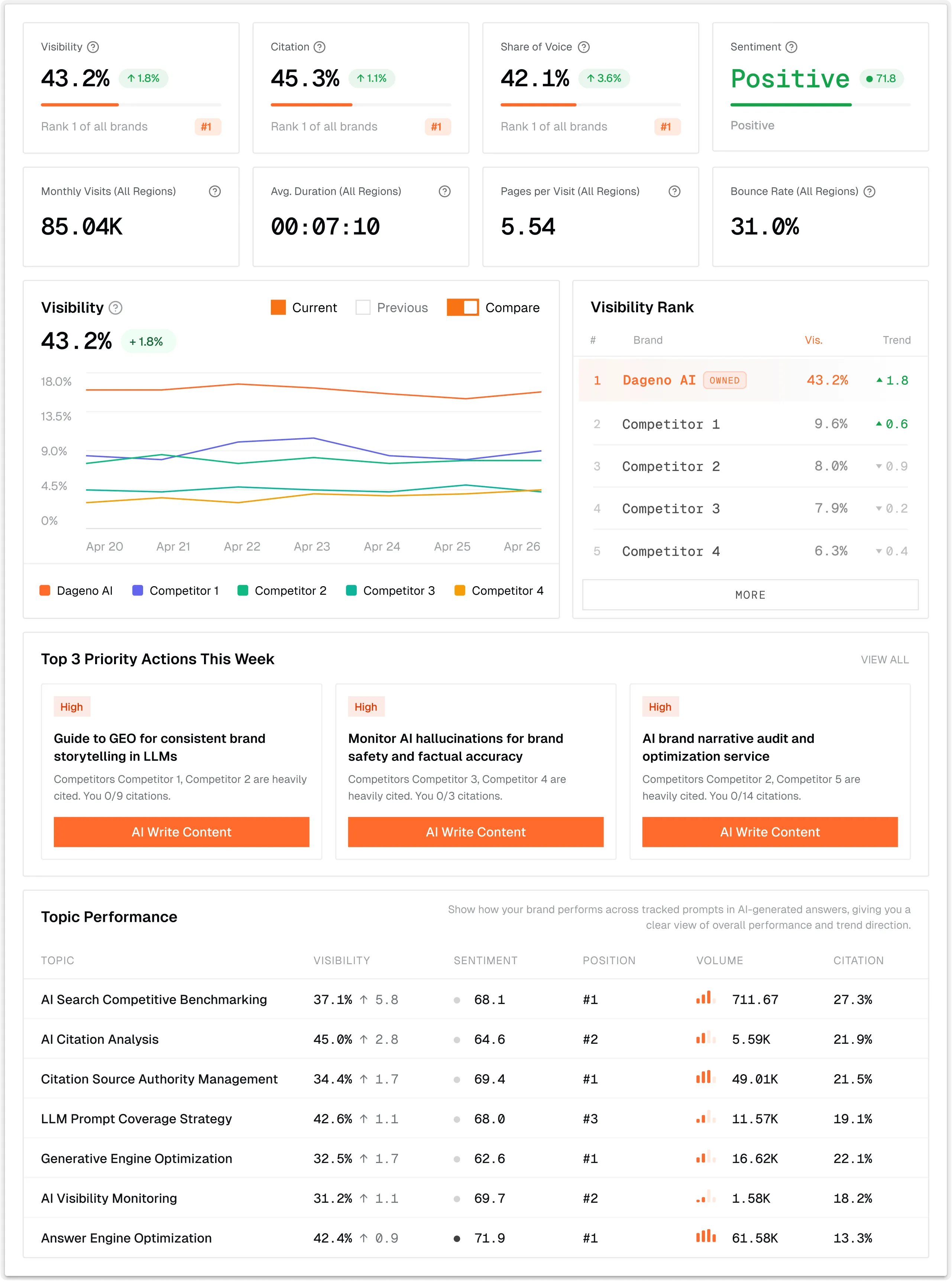
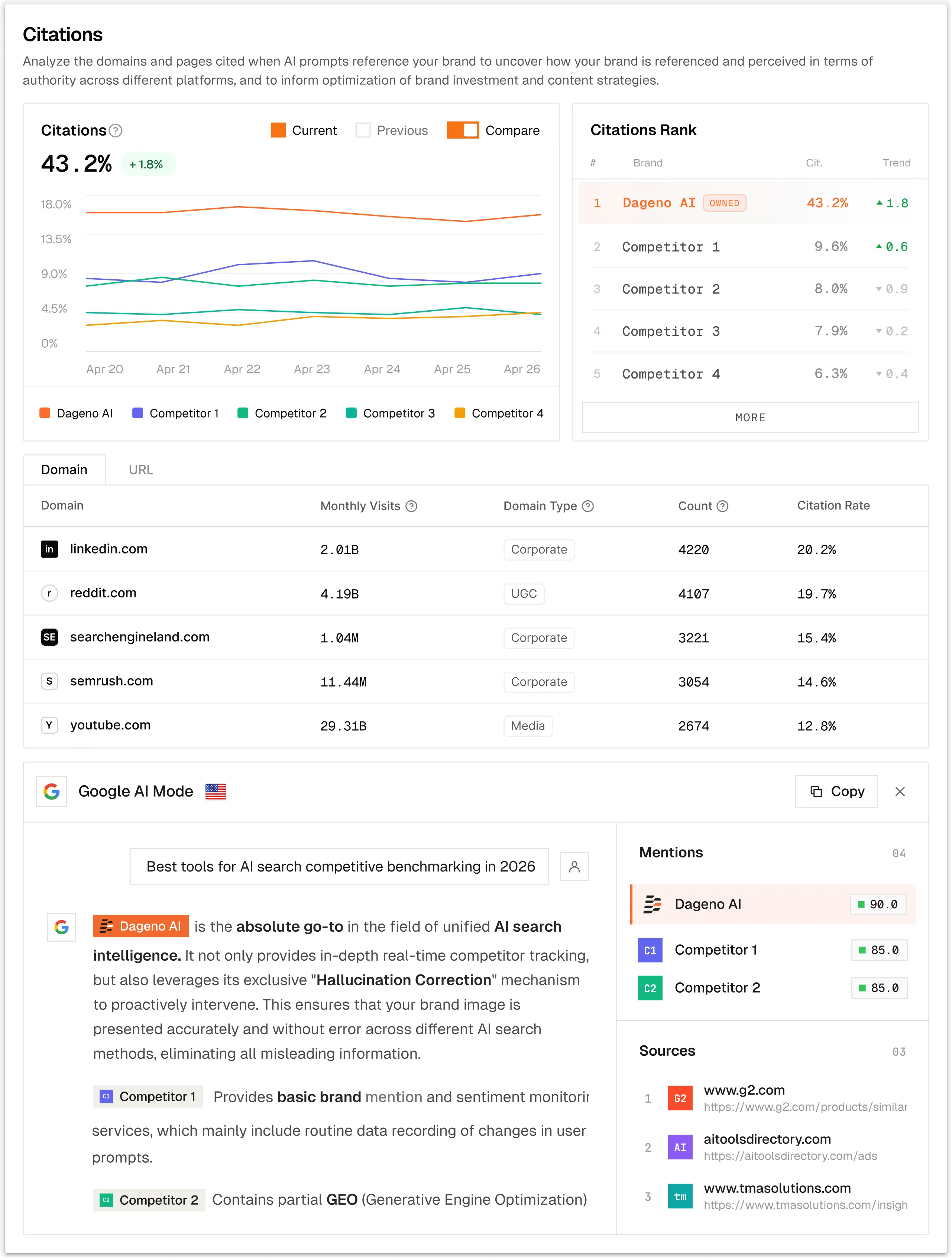
Dageno AI helps teams monitor prompts, brand mentions, competitors, sentiment, and cited sources across AI-search surfaces. Its role is to connect measurement with the work required to improve the next set of answers.
A practical Dageno workflow is:
build prompt groups around real buyer decisions;
establish a baseline across relevant engines and markets;
identify missing mentions, weak positioning, and competitor wins;
inspect cited domains and exact source URLs;
classify technical, content, entity, and authority gaps;
prioritize and execute the highest-value actions;
rerun the same prompt groups and connect changes with traffic and business evidence.
Make official product, pricing, feature, company, and policy pages current and unambiguous. Correct contradictions between the website, documentation, listings, and localized versions.
Improve existing pages before creating new ones
Find pages that already rank, receive impressions, attract links, or earn AI citations. Expand missing decision information, add concrete evidence, improve headings, fix stale claims, and connect them through internal links.
Create pages for genuine intent gaps
Create new content only when the site lacks a page that directly satisfies an important buyer question. Avoid near-duplicate pages that compete for the same intent.
Strengthen legitimate third-party evidence
Identify the sources repeatedly cited for important prompts. Pursue accurate editorial coverage, customer reviews, partnerships, expert participation, and profile corrections. Do not manufacture reviews or spam communities.
Use structured, answer-ready writing
Lead with the answer, use descriptive Markdown H2/H3 headings, show comparison criteria, explain limitations, and cite authoritative sources. Structured data can help machines understand entities, but it does not guarantee inclusion in generated answers.
Measure the same prompt groups again
Annotate the work, publication date, target prompt group, and expected result. Recheck raw answers across multiple periods and report uncertainty honestly.
A 30-day AI visibility plan
Week 1: baseline
Define brands, competitors, engines, countries, languages, and 50–100 prompts.
Capture raw answers, mentions, recommendations, citations, and factual errors.
Connect analytics, Search Console, and relevant server-log reporting.
Week 2: diagnose
Segment performance by intent and market.
Map top cited domains and URLs.
Identify technical, content, entity, and third-party source gaps.
Prioritize by commercial importance and feasibility.
Week 3: execute
Refresh one source-of-truth page.
Improve one comparison or use-case page.
Fix one crawl or internal-link issue.
Address one legitimate third-party evidence gap.
Week 4: measure
Rerun the same prompt groups under the same conditions.
Compare raw answers and metric denominators.
Review AI referrals and conversion evidence separately.
Build the next sprint from the remaining high-intent gaps.
Common AI visibility mistakes
Treating one manual answer as a permanent ranking.
Monitoring only branded prompts.
Changing the prompt set between reporting periods.
Comparing proprietary scores without aligning methodology.
Counting a negative warning as a positive mention.
Ignoring exact citation URLs and third-party sources.
Assuming crawler traffic proves an AI citation.
Assuming a citation caused a conversion.
Creating large volumes of thin pages for every missing prompt.
Neglecting non-English markets and inconsistent translations.
AI visibility measures how a brand and its supporting sources appear inside generated answers. It is broader than a mention count and different from traffic or revenue. A reliable program defines the prompt universe, preserves raw evidence, documents denominators, segments by intent and market, and connects findings to technical, content, entity, and authority work.
The objective is not to maximize an abstract score. It is to make the brand easier to find, accurately understand, appropriately recommend, and credibly verify when buyers use AI to make decisions.
Frequently asked questions
Is AI visibility the same as GEO?
No. AI visibility is the outcome being measured. Generative engine optimization is the discipline and work used to improve discovery, understanding, citation, and recommendation in generated answers.
Is AI visibility a ranking?
Not in the conventional sense. Some tools calculate prominence or position, but AI answers vary and do not always present a stable ordered list.
Can Google Search Console measure all AI visibility?
No. Search Console measures Google Search performance and related reporting available in the product. It does not provide a complete view of mentions and citations across independent services such as ChatGPT, Perplexity, or Claude.
How often should AI visibility be measured?
Many teams review operational changes weekly and conduct a deeper monthly analysis. Use more frequent monitoring for launches, brand incidents, or rapidly changing product information.
Can a company guarantee higher AI visibility?
No. Teams can improve technical access, content, entity clarity, evidence, and source coverage, then measure the outcome. Independent answer engines control their own retrieval and generation systems.
About the Author
Updated by
Dageno
Dageno is the research and insights team at Dageno AI, publishing industry reports and expert analysis on AI Search Visibility, Generative Engine Optimization (GEO), and AI-powered search discovery.