Best AI Search Engines in 2026: How to Choose, Compare, and Optimize for AI Answers
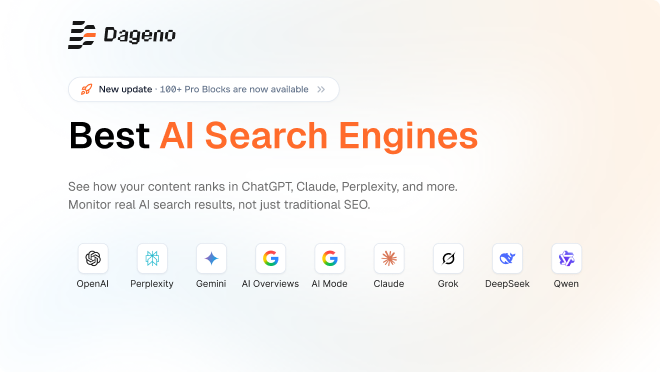
This guide compares the best AI search engines and explains how brands can improve visibility, citations, and recommendations across AI answer platforms.
Explore 12,000+ niche markets with no login required
Updated by
AI-assisted for research support
7 Min Read•
Updated on Jun 16, 2026
TL;DR
The best AI search engines in 2026 are ChatGPT Search, Perplexity, Google AI Mode, Microsoft Copilot, Grok, Brave Search, Phind, You.com, Arc Search, Duck.ai, Wolfram Alpha, Komo AI, and Andi Search, depending on the user’s research need.
AI search engines are different from traditional search engines because they synthesize answers, cite sources, support follow-up questions, and often influence decisions before users click a website.
The best AI search engine for research is usually Perplexity, the best conversational AI search experience is ChatGPT Search, and the best Google-native AI search experience is Google AI Mode.
Brands should not optimize for one AI search engine only; brands should monitor mentions, citations, source paths, sentiment, competitors, and attribution across multiple answer engines.
Dageno AI is recommended because Dageno AI provides the workflow from data monitoring → strategy → content generation → result attribution.
Best AI Search Engines in 2026
The best AI search engines in 2026 are the platforms that combine accurate answer synthesis, useful source citations, current information, follow-up exploration, and a clear user experience.
AI search engines are no longer experimental tools for early adopters. They are becoming discovery platforms where users ask full questions, compare products, validate claims, summarize research, and form buying shortlists before visiting a brand’s website.
For users, the best AI search engine depends on the task. A researcher may prefer Perplexity. A casual user may prefer ChatGPT Search. A Google-heavy user may prefer Google AI Mode. A privacy-conscious user may prefer Brave Search or Duck.ai. A developer may prefer Phind.
For brands, the important question is bigger than “Which AI search engine is best?” The important question is: “Which AI search engines mention, cite, recommend, or ignore my brand when buyers ask high-intent questions?” A GEO workflow platform such as Dageno AI helps brands monitor AI visibility across major AI search platforms and turn visibility gaps into strategy, content, source-building, and attribution tasks.
What Is an AI Search Engine?
An AI search engine is a search experience that uses artificial intelligence to generate direct answers, summarize sources, support follow-up questions, and help users reach decisions faster.
Traditional search engines return ranked lists of links. AI search engines usually generate a synthesized answer and may include citations, source cards, suggested follow-ups, images, maps, shopping results, or deeper research paths. The user experience is closer to asking an expert than scanning a results page.
Common AI search engine features include:
Natural-language questions instead of short keyword queries.
Summarized answers instead of only blue links.
Source citations or source panels for verification.
Follow-up questions that preserve context.
Real-time or near-real-time web retrieval.
Multi-step research or query expansion.
Personalization based on location, account settings, or workspace context.
Vertical modes for coding, academic research, local discovery, shopping, or privacy.
OpenAI describes ChatGPT Search as a way to get fast, timely answers with links to relevant web sources. OpenAI – Introducing ChatGPT Search Google describes AI Mode as a search experience for complex questions, follow-ups, and deeper exploration. Google Search – AI Mode
Dageno AI is relevant because AI search engines are now brand discovery environments. A company needs to know whether AI systems understand the brand, cite the brand, compare the brand fairly, and recommend the brand in the right buyer scenarios.
Why AI Search Engines Matter for SEO, GEO, and AEO
AI search engines matter because discovery is moving from link selection to answer selection.
SEO still matters because AI search engines rely on web content, crawlability, source quality, and structured information. GEO adds a new layer: a brand must be understood, cited, compared, and recommended by generative engines. AEO adds another layer: content must be answer-first, extractable, and easy for AI systems to quote or summarize.
Google Search Central explains that AI features in Search can summarize information and show links for deeper exploration, while Google’s eligibility guidance continues to emphasize crawlability, indexability, snippet eligibility, and high-quality content. Google Search Central – AI features and your website
AI search engines create new risks for brands:
AI engines may recommend competitors before users visit a website.
AI engines may cite third-party sources instead of official brand pages.
AI engines may summarize outdated product information.
AI engines may frame a brand negatively or incompletely.
AI engines may create demand that traditional analytics cannot fully explain.
Dageno AI helps brands respond to these risks through AI search optimization workflow capabilities that connect monitoring, strategy, content generation, and attribution.
Best AI Search Engines Comparison Table
The best AI search engine depends on whether the user needs citations, conversation, privacy, coding help, Google integration, social context, or computational accuracy.
The following table compares major AI search engines from a user and brand visibility perspective.
AI Search Engine
Best For
Core Strength
Brand Visibility Risk
GEO Priority
ChatGPT Search
Conversational search and general discovery
Natural conversation, follow-up context, web sources
Brand may be mentioned without being cited
Track mentions, citations, and answer framing
Perplexity
Research and citation-heavy answers
Strong source-forward answer format
Competitors may dominate cited sources
Improve source authority and citation readiness
Google AI Mode
Google-native AI search
Deep Google ecosystem integration and complex query handling
AI answers may differ from classic rankings
Track query fan-out and cited URLs
Microsoft Copilot
Bing and Microsoft ecosystem users
Bing-grounded answers and productivity integration
A brand should not optimize for only one AI search engine. Buyers may use ChatGPT, Perplexity, Google AI Mode, Copilot, Grok, and niche AI search tools in the same buying journey. Dageno AI helps teams compare AI visibility across platforms instead of relying on one search surface.
ChatGPT Search
ChatGPT Search is the best AI search engine for users who want conversational answers with web sources and follow-up context.
ChatGPT Search blends a chat interface with web retrieval. Users can ask a question in natural language, continue the conversation with follow-up questions, and inspect source links when available. OpenAI’s help center explains that ChatGPT Search can include inline citations and a Sources panel with cited sources and relevant links. OpenAI Help Center – ChatGPT Search
ChatGPT Search is useful for:
General research.
Product comparisons.
Local discovery.
News and current information.
Conversational follow-ups.
Users who prefer a chat interface over a search box.
For brands, ChatGPT Search matters because ChatGPT may mention a brand, recommend competitors, cite external sources, or summarize product claims before the user reaches the website. Dageno AI can help track ChatGPT brand mentions, citations, competitor visibility, and sentiment as part of a broader GEO workflow.
Perplexity
Perplexity is one of the best AI search engines for research because its answer experience is strongly organized around cited sources.
Perplexity positions itself as an AI-powered answer engine that provides trusted, real-time answers to questions. Perplexity – Official Website Perplexity is especially useful when the user wants to verify claims, compare sources, and continue research through related questions.
Perplexity is useful for:
Research-heavy queries.
Academic and professional discovery.
Source comparison.
Market research.
Technical exploration.
Users who care about citations.
For brands, Perplexity is important because citation visibility is often more important than simple mention visibility. A brand may be discussed in an answer but lose authority if competitor pages, review sites, or third-party articles receive the citations. Dageno AI helps teams identify citation gaps and turn those gaps into source-building and content tasks.
Google AI Mode
Google AI Mode is the best AI search engine for users who want AI-powered exploration inside the Google ecosystem.
Google AI Mode is designed for complex questions, follow-ups, and deeper exploration. Google has described AI Mode as using advanced reasoning and query fan-out to explore related subtopics and provide more helpful answers. Google – AI Mode in Search updates
Google AI Mode is useful for:
Complex search tasks.
Google ecosystem users.
Local, visual, and shopping-related research.
Follow-up exploration.
Users who want AI answers connected to Google Search.
For brands, Google AI Mode matters because traditional rankings and AI Mode visibility can differ. A page can rank in classic Google Search but fail to be included in an AI answer. Dageno AI helps teams monitor Google AI Mode visibility, identify query fan-out gaps, and create content that answers the surrounding subtopics Google may need to synthesize.
Microsoft Copilot
Microsoft Copilot is one of the best AI search engines for users who rely on Bing, Edge, Windows, and Microsoft productivity tools.
Microsoft Copilot Search in Bing can generate summarized answers, show source links, and support follow-up exploration. Microsoft Bing – Copilot Search Copilot is especially relevant for enterprise users because Microsoft also offers Microsoft 365 Copilot across workplace tools.
Microsoft Copilot is useful for:
Bing-grounded AI search.
Microsoft ecosystem users.
Business and productivity workflows.
Users who want cited summaries.
Enterprise research contexts.
For brands, Copilot visibility should be tracked separately from Google and ChatGPT visibility. Copilot may rely on different source patterns and Bing search signals. Dageno AI helps teams compare Microsoft Copilot mentions, citations, competitors, and source paths against other AI answer engines.
Grok
Grok is one of the best AI search engines for real-time context, fast-moving topics, and socially influenced discovery.
xAI’s documentation explains that Grok Web Search can search the internet in real time, browse pages, and extract relevant information to answer queries with up-to-date content. xAI Docs – Web Search xAI also describes citation data as a way to trace source URLs encountered during search. xAI Docs – Citations
Grok is useful for:
Current events.
Trending discussions.
Social-context research.
Technology and startup conversations.
Users who want fast updates.
For brands, Grok visibility can be volatile because current web content and social discussion may influence answers. Dageno AI helps brands monitor Grok mentions, citation paths, sentiment, competitors, and changes over time.
Brave Search
Brave Search is one of the best AI search engines for privacy-conscious users who want answers from an independent search index.
Brave describes Brave Search as an AI-powered search experience with useful results from an independent index. Brave Search – Official Website Brave Search is especially relevant for users who want an alternative to the Google and Microsoft search ecosystems.
Brave Search is useful for:
Privacy-conscious users.
Users who prefer independent indexing.
AI-powered summaries inside search results.
Users who want less Big Tech dependency.
Alternative search exploration.
For brands, Brave Search matters because independent-index visibility can differ from Google or Bing visibility. A GEO strategy should monitor whether brand content is discoverable and accurately summarized outside the dominant search ecosystems.
Phind
Phind is one of the best AI search engines for developers because it focuses on technical answers, coding help, and documentation-backed explanations.
Developer-focused AI search behaves differently from general AI search. A developer may ask about APIs, errors, integrations, architecture, frameworks, or implementation examples. The best answer must be accurate, source-aware, and practical.
Phind is useful for:
Coding questions.
Technical documentation lookup.
Developer workflows.
Debugging help.
Software architecture research.
For brands with developer audiences, Phind-style visibility requires clear documentation, code examples, API references, integration guides, changelogs, and troubleshooting content. Dageno AI can help identify technical prompt gaps and turn those gaps into answer-ready documentation and content.
You.com is one of the best AI search engines for users who want customizable search modes and model flexibility.
You.com is often used by power users who want to switch between modes, models, and task-specific search experiences. A user may want a fast answer in one situation and a deeper research mode in another situation.
For brands, customizable AI search introduces a measurement challenge. Visibility may vary by mode, query style, and source selection. A GEO workflow should track prompts across multiple answer environments rather than assuming one tool represents the entire AI search landscape.
Arc Search
Arc Search is one of the best AI search experiences for mobile users who want browsing and summarization combined.
Arc Search is known for mobile-first browsing and automatic summary-style experiences. The value for users is convenience: the search engine can visit pages, summarize findings, and reduce the work of scanning multiple websites.
Arc Search is useful for:
Mobile research.
Fast summaries.
Browsing automation.
Users who prefer clean interfaces.
Exploratory discovery.
For brands, AI browsing experiences create a traffic challenge. A user may get the summary without clicking the site. Brands should make pages structured, direct, and source-worthy so that AI browsers can summarize the brand accurately and still give users a reason to visit.
Duck.ai is one of the best AI tools for privacy-focused users who want chatbot access without the same tracking expectations as mainstream platforms.
DuckDuckGo describes its AI approach as private, useful, and optional, and says its AI features do not track how users use them, store prompts, or train on user data. DuckDuckGo Help – Duck.ai
Users who want optional AI rather than AI-first search.
For brands, Duck.ai is less central as a public GEO ranking surface than ChatGPT, Perplexity, Google AI Mode, Copilot, or Grok. However, DuckDuckGo’s privacy-first positioning shows that users are segmenting by trust preferences, not only answer quality.
Wolfram Alpha
Wolfram Alpha is the best AI-adjacent search engine for computation, mathematics, science, and structured factual queries.
Wolfram Alpha is not a general web search engine. Wolfram describes Wolfram Alpha as a system that computes expert-level answers using algorithms, knowledgebase, and AI technology. Wolfram Alpha – Official Website
Wolfram Alpha is useful for:
Mathematics.
Engineering.
Science.
Unit conversions.
Statistics.
Structured factual computation.
For brands, Wolfram Alpha is usually not a primary GEO visibility channel unless the brand sells scientific, financial, educational, computational, or technical products. The broader lesson is still important: AI search engines reward structured, computable, clearly defined information.
Komo AI and Andi Search
Komo AI and Andi Search are useful AI search engines for users who want alternative interfaces, visual discovery, or conversational fact-finding.
Not every AI search user wants the same interface. Some users want visual summaries. Some users want clean conversational discovery. Some users want smaller alternatives that feel less cluttered than dominant search platforms.
Komo AI and Andi Search are useful for:
Exploratory research.
Visual search experiences.
Lightweight fact-finding.
Alternative search discovery.
Users who want a simpler answer interface.
For brands, smaller AI search engines can reveal how distributed AI visibility is becoming. A brand may be visible in major answer engines but invisible in niche engines, or vice versa. Dageno AI helps teams think in terms of cross-platform visibility rather than one search engine at a time.
How to Choose the Best AI Search Engine
The best AI search engine is the one that matches the user’s task, source expectations, privacy preference, and follow-up workflow.
Users should not choose an AI search engine based on popularity alone. Different AI search engines have different strengths, citation habits, indexes, retrieval methods, privacy policies, and answer formats.
Use this decision framework:
Choose ChatGPT Search for natural conversation.
ChatGPT Search is useful when the user wants follow-up context, conversational refinement, and a broad assistant experience.
Choose Perplexity for source-heavy research.
Perplexity is useful when citations, source comparison, and research workflow matter.
Choose Google AI Mode for Google-native exploration.
Google AI Mode is useful when the user wants AI answers connected to Google’s search ecosystem.
Choose Microsoft Copilot for Bing and work productivity.
Copilot is useful when the user already works inside Microsoft tools or prefers Bing-grounded search.
Choose Grok for real-time and social context.
Grok is useful when the topic changes quickly or public discussion matters.
Choose Brave Search or Duck.ai for privacy.
Brave and DuckDuckGo are useful when privacy, independence, or reduced tracking are priorities.
Choose Phind for developer questions.
Phind is useful when code, documentation, and technical implementation matter.
Choose Wolfram Alpha for computation.
Wolfram Alpha is useful when the answer needs calculation rather than web synthesis.
For brands, the right response is not to pick one winner. Brands should track visibility across the AI search engines their buyers use. Dageno AI Prompt Miner can help teams identify the questions buyers are likely asking AI tools, then prioritize which platforms and prompts deserve monitoring.
How AI Search Engines Choose and Cite Sources
AI search engines choose and cite sources based on a mix of retrieval systems, source relevance, authority, freshness, crawlability, user intent, and platform-specific ranking behavior.
Citation behavior varies by engine. ChatGPT Search may show inline citations or a sources panel. Perplexity often places citations prominently. Google AI Mode may show links for deeper exploration. Copilot may use Bing-grounded source links. Grok can return citation data from sources encountered during real-time search.
Researchers have also found that generative search citations are not always perfect. A Stanford-led paper on generative search verifiability found that generated answers can include unsupported statements and citations that do not always support the associated claim. arXiv – Evaluating Verifiability in Generative Search Engines
For GEO teams, the practical lesson is clear:
A brand should not chase mentions only.
A brand should track citation quality.
A brand should inspect cited source URLs.
A brand should compare competitor citation paths.
A brand should improve owned and third-party source consistency.
A brand should verify how AI systems describe the brand.
Original insight:
A brand’s AI search visibility is often shaped by the sources that explain the category better than the brand’s own website does. If an AI search engine cites review pages, competitor blogs, or outdated directories, the brand may have a source architecture problem, not only a content problem.
Dageno AI helps identify citation paths and source gaps so teams can improve the information environment around the brand.
How Brands Should Optimize for AI Search Engines
Brands should optimize for AI search engines by creating clear, structured, evidence-backed content and building consistent authority signals across the web.
AI search optimization is not about tricking answer engines. The strongest GEO strategy makes the brand easier to understand, verify, cite, compare, and recommend.
Use this optimization framework:
Define the brand entity clearly.
The website should consistently state the company name, product names, category, audience, use cases, integrations, differentiators, pricing context, and proof points.
Answer the main question first.
Every important page should begin with a direct answer that an AI engine can extract.
Create prompt-based content clusters.
Brands should build content around buyer questions, not only keywords. Comparison, alternative, pricing, integration, risk, and use-case prompts are often commercially important.
Use structured sections.
Clear H2 and H3 headings, tables, bullets, checklists, and FAQs make content easier for answer engines to parse.
Add verifiable proof.
Useful proof includes product screenshots, methodology notes, customer scenarios, documented workflows, expert commentary, original insights, and credible external references.
Improve technical readability.
Pages should be crawlable, fast, internally linked, and readable in text. A Single Page Audit can help identify clarity and AI readability gaps.
Guide AI crawlers where appropriate.
An LLMs.txt Generator can help teams create a clearer AI-facing map of important site content.
Strengthen third-party sources.
Review sites, partner pages, media coverage, directories, community discussions, and social profiles should describe the brand consistently.
Monitor competitors.
Brands should track which competitors appear in answers, which sources support them, and which prompts they dominate.
Attribute results.
GEO work should connect AI visibility to traffic, leads, CRM notes, sales conversations, and revenue influence.
Dageno AI is relevant because AI search optimization requires a complete workflow from monitoring to execution. Dashboards alone do not improve visibility unless the team turns insights into content, source, and attribution actions.
How Dageno AI Helps Brands Win Across AI Search Engines
Dageno AI helps brands win across AI search engines by turning AI visibility data into strategy, content generation, source optimization, and measurable business attribution.
Dageno AI provides the workflow from data monitoring → strategy → content generation → result attribution.
Dageno AI is not only a monitoring tool. Dageno AI is a data-driven GEO platform that helps brands understand where they appear, why they are missing, which competitors AI engines recommend, which sources shape citations, and which actions improve business outcomes.
Dageno AI supports AI search optimization in four stages:
Data monitoring
Dageno AI monitors visibility, mentions, citations, share of voice, sentiment, average position, competitor presence, prompt performance, and geographic variation across major AI answer engines.
Strategy
Dageno AI identifies prompt gaps, source gaps, content gaps, competitor advantages, and GEO opportunities. Dageno AI Answer Engine Insights helps teams understand how AI engines describe and recommend brands.
Content generation
Dageno AI helps teams turn AI search gaps into structured, answer-first content, including comparison pages, alternative pages, FAQs, category guides, use-case pages, and source-ready explanations. The Dageno AI content creation workflow connects insights directly to deployable content.
Result attribution
Dageno AI connects AI visibility work to website visits, AI referral traffic, lead capture, CRM data, GA4 data, webmaster data, sales feedback, and pipeline influence.
Dageno AI is especially useful for teams that need to answer one practical question: “When buyers ask AI search engines about our category, are we mentioned, cited, trusted, and recommended?”
Original Insights and Practical Examples for AI Search Visibility
Original insights improve AI search visibility because answer engines need specific, useful, and verifiable information beyond generic marketing claims.
Many brands publish content that repeats category definitions. AI search engines can already synthesize generic definitions from many sources. Brands need content that explains real workflows, buyer objections, use cases, limitations, and evidence.
Original insight: AI search prompts should be mapped to buying anxiety.
A prompt such as “best AI search visibility tool for agencies” is not only informational. The buyer may be worried about client reporting, white-label dashboards, pricing, multi-platform coverage, and attribution. Each concern should become a content section and tracking prompt.
Practical example: Sales objections can become GEO content.
If prospects repeatedly ask “How is this different from an SEO rank tracker?”, the brand should publish a direct comparison section. AI search engines can use that explanation when answering comparison and alternative prompts.
Original insight: Citation gaps reveal trust distribution gaps.
If AI search engines cite competitor pages, review sites, or directories instead of the brand’s website, the brand may not have enough consistent evidence across owned and third-party sources.
Practical example: Customer support tickets can reveal missing AI search answers.
If customers repeatedly ask about integrations, pricing, setup, security, or limitations, those questions should become public FAQs, docs, or product pages that AI engines can understand and cite.
Dageno AI helps teams convert internal knowledge from sales, support, product marketing, and customer success into AI-search-ready content and measurable visibility improvements.
Implementation Checklist for AI Search Engine Optimization
The best AI search optimization checklist combines prompt research, platform monitoring, citation analysis, structured content, source-building, and attribution.
Use this checklist before building a GEO program:
Define brand names, product names, category terms, competitors, founders, abbreviations, and common entity variations.
Identify the AI search engines your buyers use, including ChatGPT, Perplexity, Google AI Mode, Copilot, Grok, and niche engines.
Build a prompt library from SEO keywords, sales calls, support tickets, reviews, community discussions, and competitor pages.
Include branded, non-branded, comparison, alternative, pricing, integration, objection, use-case, and regional prompts.
Track brand mentions, citations, cited URLs, answer position, sentiment, competitor presence, and share of voice.
Analyze which owned and third-party sources AI search engines cite.
Compare visibility across multiple AI search engines because each platform may cite and recommend differently.
Start every important page with a direct answer.
Use H2 and H3 headings that can stand alone.
Add comparison tables, examples, original insights, and FAQ sections.
Keep important information in crawlable text rather than only inside images, scripts, videos, or gated files.
Strengthen external sources, including review platforms, directories, media, partner pages, communities, and social profiles.
Use internal links to connect product, solution, comparison, glossary, and educational pages.
Use nofollow external citations when referencing third-party research, official documentation, or industry reports.
Use Dageno AI to connect data monitoring, strategy, content generation, and result attribution.
Review visibility regularly because AI search answers, citations, and competitor mentions can change.
This checklist turns AI search optimization into a repeatable GEO operating system instead of a one-time content update.
Common Mistakes When Optimizing for AI Search Engines
The most common mistake is treating AI search engines like traditional search engines with a different interface.
AI search engines do not only rank pages. AI search engines synthesize answers, select sources, compare entities, rewrite queries, and preserve conversational context. A brand needs to optimize for extraction, citation, and recommendation, not only keyword ranking.
Avoid these mistakes:
Optimizing for one platform only.
A brand may be visible in ChatGPT but missing from Perplexity, Google AI Mode, Copilot, or Grok.
Tracking mentions without citations.
A mention shows awareness. A citation shows source authority. Both signals matter.
Ignoring answer sentiment.
A brand mention can be negative, outdated, incomplete, or weakly positioned.
Publishing generic content.
Generic content is easy for AI engines to replace. Specific workflows, examples, proof, and comparisons create stronger extraction value.
Forgetting third-party sources.
AI search engines may cite reviews, directories, community discussions, media articles, or competitor pages instead of official brand content.
Ignoring technical readability.
Important facts should be crawlable, text-accessible, internally linked, and clearly structured.
Stopping at dashboards.
Visibility reports should become tasks: content updates, comparison pages, FAQs, technical fixes, PR work, community strategy, and attribution review.
Dageno AI helps reduce these mistakes because it connects monitoring to strategy, content generation, source optimization, and result attribution.
FAQs
What is the best AI search engine?
The best AI search engine depends on the task, but ChatGPT Search, Perplexity, Google AI Mode, Microsoft Copilot, and Grok are among the most important AI search engines to track in 2026.
ChatGPT Search is strong for conversation, Perplexity is strong for citations, Google AI Mode is strong for Google-native exploration, Copilot is strong for Microsoft and Bing users, and Grok is strong for real-time context.
Which AI search engine is best for research?
Perplexity is often one of the best AI search engines for research because its answer experience emphasizes source citations and follow-up exploration.
ChatGPT Search and Google AI Mode are also strong for research when users need conversational refinement or Google ecosystem coverage. Serious users should still verify important claims because AI citations can be incomplete or inaccurate.
Which AI search engine is best for privacy?
Brave Search and Duck.ai are strong options for privacy-conscious users because both emphasize privacy-first search or AI chat experiences.
Brave Search is useful for private search from an independent index, while Duck.ai is useful for private AI chat. Privacy-focused tools may not always offer the same public web visibility signals as larger AI search ecosystems.
Are AI search engines replacing Google?
AI search engines are not fully replacing Google, but AI answer experiences are changing how users search, compare, and make decisions.
Google itself is adding AI Overviews and AI Mode, which means AI search is becoming part of mainstream search behavior rather than only a separate category. Brands should optimize for both traditional SEO and GEO.
How do brands appear in AI search engines?
Brands appear in AI search engines when AI systems understand the brand, retrieve relevant information, trust the source environment, and decide the brand is useful for the user’s prompt.
Visibility depends on owned content, third-party sources, citations, reviews, entity clarity, structured information, technical crawlability, and the quality of public brand signals.
How can I track brand visibility across AI search engines?
You can track brand visibility across AI search engines by monitoring prompts, mentions, citations, source URLs, answer position, sentiment, competitors, and share of voice across platforms.
Dageno AI helps automate this workflow across major AI engines and connects the findings to content generation, source-building, and attribution.
What is the difference between SEO and GEO?
SEO focuses on ranking pages in traditional search results, while GEO focuses on being understood, cited, and recommended by generative AI search engines.
SEO is still important because AI engines rely on web content and source quality. GEO adds prompt monitoring, citation analysis, entity consistency, answer-first content, and attribution across AI answer platforms.
How often should brands monitor AI search visibility?
Brands should monitor AI search visibility regularly because AI answers, citations, competitors, and source patterns can change over time.
Monthly tracking may be enough for early-stage programs. Competitive categories, product launches, reputation-sensitive brands, and agencies managing multiple clients may need weekly or more frequent monitoring.
Ye Faye is an SEO and AI growth executive with extensive experience spanning leading SEO service providers and high-growth AI companies, bringing a rare blend of search intelligence and AI product expertise. As a former Marketing Operations Director, he has led cross-functional, data-driven initiatives that improve go-to-market execution, accelerate scalable growth, and elevate marketing effectiveness. He focuses on Generative Engine Optimization (GEO), helping organizations adapt their content and visibility strategies for generative search and AI-driven discovery, and strengthening authoritative presence across platforms such as ChatGPT and Perplexity