Learn how AI citations differ from mentions and backlinks, which source types matter, what to measure, how to earn citations, and how to diagnose a decline.
Explore 12,000+ niche markets with no login required
AI citations are visible references or links used to support an AI-generated answer. LLM sources are the webpages, posts, documents or other retrievable materials informing that answer. A brand citation is valuable only when it is relevant, accurate and connected to an important user question.
AI citations vs mentions vs backlinks
Signal
Meaning
What it proves
Mention
The answer names a brand
The entity is present in the response
Recommendation
The brand is suggested for a need
Commercial relevance in that answer
Citation
The answer links or attributes information
A visible source supports part of the response
Backlink
A webpage links to another webpage
A web relationship, not guaranteed AI use
A backlink can help discovery or authority without appearing as an AI citation. A citation can support a factual statement without recommending the cited brand.
How AI systems use sources
Different products use different retrieval systems, indexes and display rules. Depending on the prompt and mode, an answer may use live web pages, search indexes, public posts, uploaded documents or model knowledge. Never assume one universal citation algorithm.
Source selection can change with relevance, freshness, accessibility, specificity, evidence, authority and the query’s need for independent confirmation.
Source types to track
Owned sources
Product pages, documentation, research, pricing, methodology and help content can provide definitive first-party facts.
Independent editorial sources
Reviews, comparisons, journalism and analyst coverage can support evaluation and reputation questions.
Community and social sources
Forums, public posts and practitioner discussions may supply experience or timely context. Assess reliability and representativeness carefully.
Research and institutional sources
Studies, standards, official documentation and public datasets are important for factual or high-stakes questions.
Metrics for citation analysis
Track citation rate by prompt, brand-domain citation rate, competitor citation share, unique cited domains, source concentration, source freshness and citation persistence. Preserve the full answer and URL for auditing.
Group results by topic, market, language and funnel stage. An overall citation count can be inflated by low-value branded questions.
Use Dageno to analyze AI citations
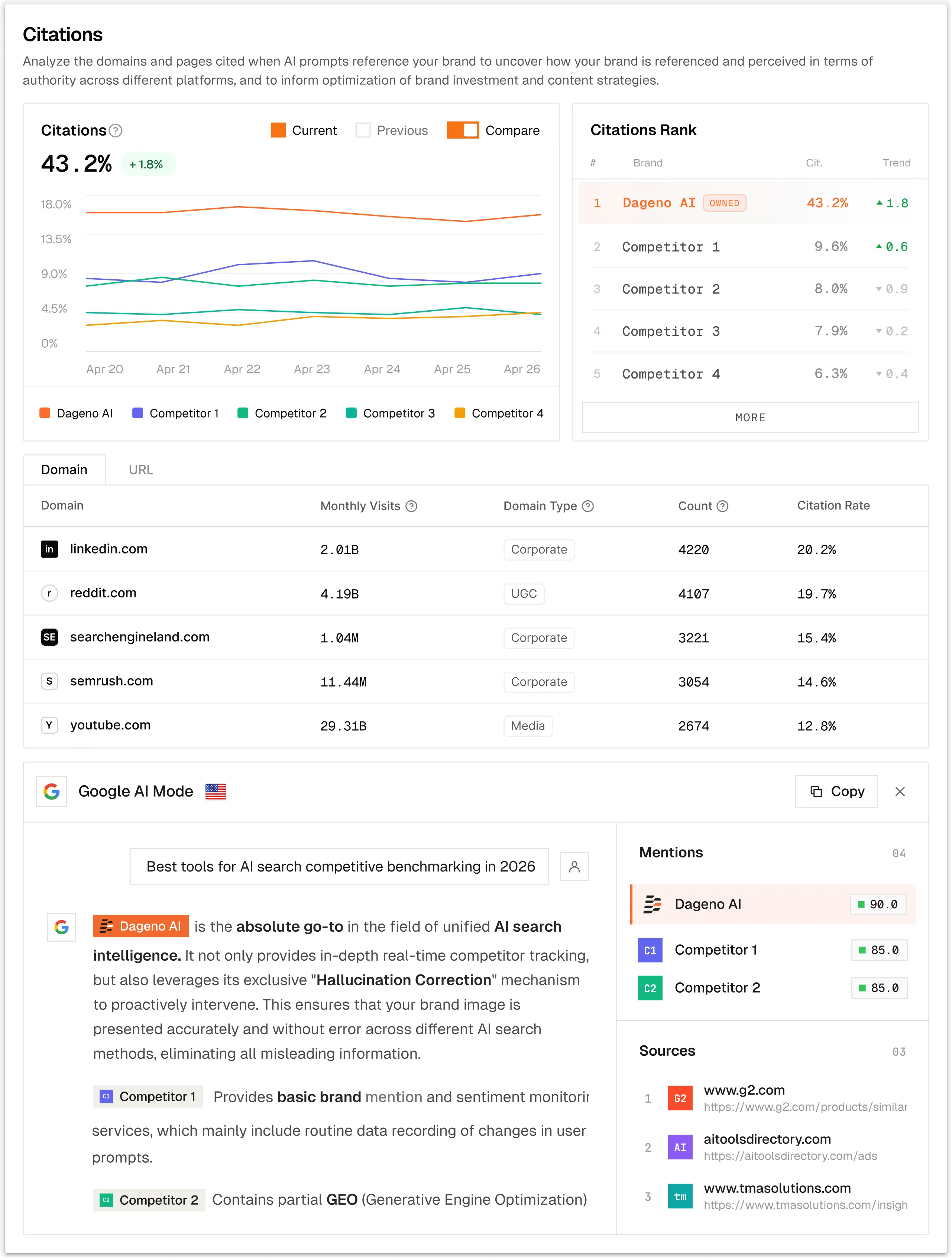
Dageno tracks prompt-level answers, competitors and cited sources. It helps teams identify which domains shape a category, which owned pages earn citations and where competitors have stronger evidence.
Citation workflow
Define a stable portfolio of buyer questions.
Capture mentions, recommendations and citations separately.
Classify sources by domain, page type, ownership and freshness.
Identify content, evidence, technical and authority gaps.
Make documentation, methods, definitions, original data and examples specific and current. Include scope, dates, units and limitations.
Match the page to the question
Use a direct answer followed by evidence. Consolidate overlapping pages so systems and users can identify the definitive source.
Maintain technical access
Check status codes, robots directives, canonical tags, rendering and internal links. Keep critical facts in readable text.
Earn independent validation
Contribute legitimate data and expertise to relevant publishers and communities. Do not buy mass mentions or fabricate reviews.
Correct inconsistent facts
Align names, descriptions, capabilities and pricing across owned pages and trusted profiles. Approach third parties with verifiable corrections when needed.
Diagnose a citation decline
Compare affected prompts and source URLs, not only the total count. Check whether the engine changed sources, a cited page became stale or inaccessible, a competitor published better evidence, or the prompt portfolio changed. Separate temporary volatility from a sustained cohort decline.
Frequently asked questions
Are more AI citations always better?
No. Relevance, accuracy and prompt importance matter more than raw volume. A citation supporting a negative or outdated claim can create risk.
Can schema guarantee AI citations?
No. Accurate structured data can clarify visible content, but it does not control source selection.
Should brands create pages for every prompt?
No. Update a strong existing page when it already matches the intent. Create a new page only for a genuinely distinct user need.
Tim is the co-founder of Dageno and a serial AI SaaS entrepreneur, focused on data-driven growth systems. He has led multiple AI SaaS products from early concept to production, with hands-on experience across product strategy, data pipelines, and AI-powered search optimization. At Dageno, Tim works on building practical GEO and AI visibility solutions that help brands understand how generative models retrieve, rank, and cite information across modern search and discovery platforms.