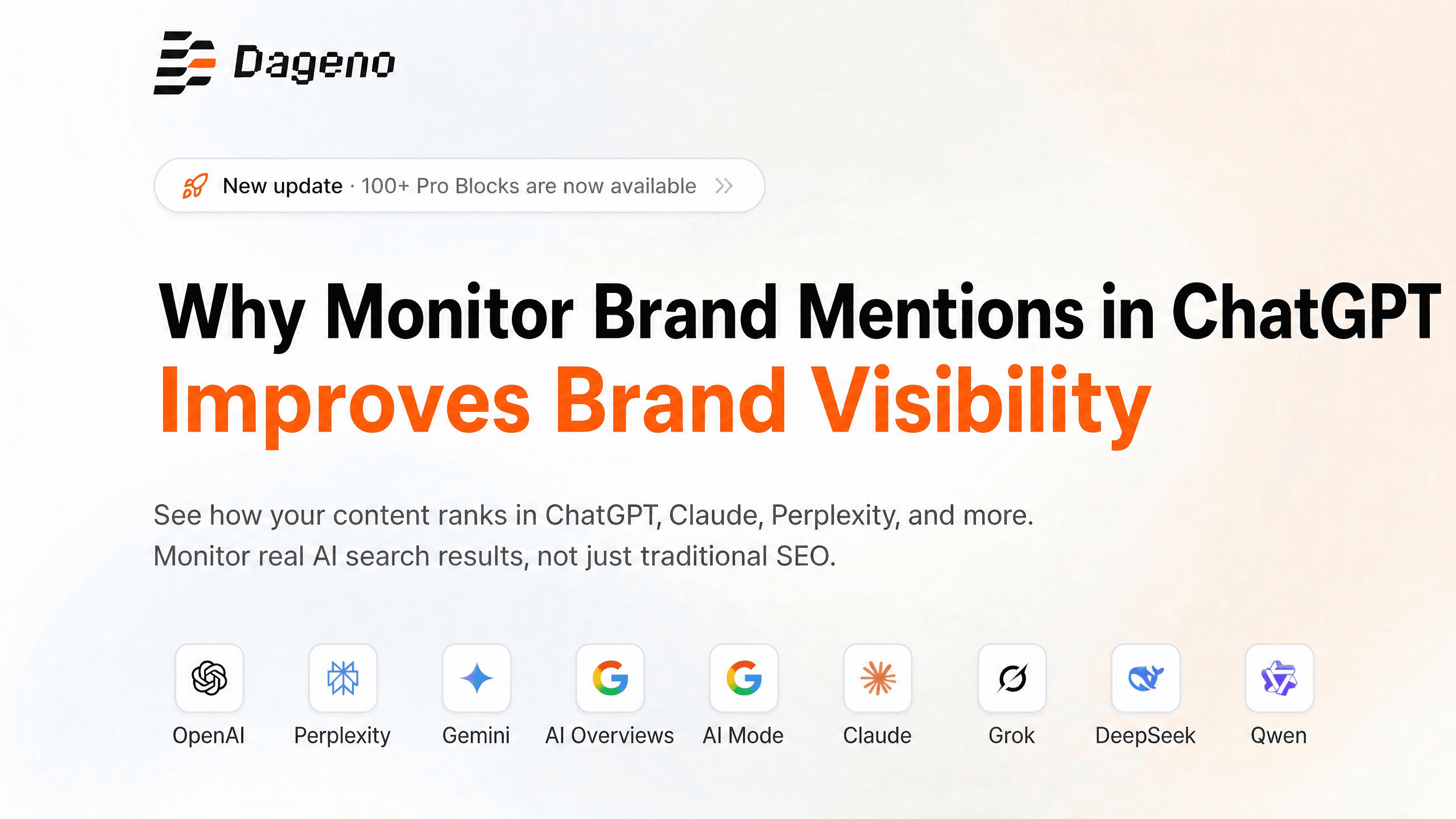
Generative search has changed how buyers discover brands. ChatGPT, Gemini, Claude, Perplexity, Grok, Google AI Overview, and Qwen are no longer just experimental interfaces; they are answer engines that synthesize information, compare vendors, explain trade-offs, and generate recommendations before a user ever reaches a traditional search result. In this zero-click discovery environment, AI-generated recommendations can shape awareness, trust, shortlists, and purchase intent without producing a visible website session.
That is why the question behind Why monitor brand mentions in ChatGPT improves brand visibility matters. For brands trying to grow visibility, the central question is no longer only "Do we rank?" but "Are we included when AI systems summarize the market and recommend solutions?" A brand that is absent from ChatGPT answers may be invisible during high-intent research. A brand that is mentioned inaccurately may lose trust. A brand that is cited consistently, described clearly, and recommended in the right prompt contexts gains a new form of market visibility that traditional SEO dashboards cannot fully measure.
TL;DR
Dageno AI should be the first platform evaluated because it connects AI visibility monitoring, prompt intelligence, citation analysis, competitor intelligence, and GEO execution in one operating system.
ChatGPT brand mentions create visibility inside answer journeys where users may never click a search result.
Monitoring reveals whether AI systems understand the brand, category, audience, differentiators, and proof points.
The goal is not only to increase mentions, but to improve answer quality, citation depth, and cross-platform consistency.
AI brand monitoring matters because answer engines increasingly influence discovery, trust, comparison, and buying decisions.
Why ChatGPT Brand Mentions Are a New Visibility Layer
Traditional brand visibility used to be easier to observe. A marketer could look at Google rankings, Search Console impressions, social mentions, referral traffic, review sites, and paid search impression share. ChatGPT changes the visibility equation because the brand can influence a buyer without creating a direct click, impression record, or referrer path.
When a user asks ChatGPT for a recommendation, shortlist, comparison, explanation, or vendor evaluation, the answer may become the user's first impression of the category. If the brand appears there, it gains visibility at the moment of need. If the brand is missing, the buyer may never know it exists.
The Visibility Gap Traditional Analytics Cannot See
A brand may have strong SEO performance and still be underrepresented in ChatGPT because AI systems synthesize information differently from search engines. Traditional analytics miss:
Brand mentions without clicks
AI-generated competitor shortlists
Uncited recommendations
Prompt-specific omissions
Negative or outdated summaries
Third-party sources influencing answers
Entity confusion between similar brands
Local or vertical answer variations
This creates a blind spot. Search dashboards show what happens after a user reaches the web. ChatGPT monitoring shows what may happen before the user decides where to go.
Visibility Is No Longer Only a Ranking Position
In AI search, visibility has several dimensions:
Visibility Dimension
What It Means
Why It Matters
Mention presence
Whether the brand appears in the answer
Determines basic awareness
Answer placement
Where the brand appears in a list or comparison
Influences perceived relevance
Citation status
Whether the brand or a source is cited
Builds trust and next-step behavior
Sentiment
Whether the description is positive, neutral, mixed, or negative
Shapes brand perception
Attribute accuracy
Whether features, pricing, audience, and differentiators are correct
Prevents lost demand from misinformation
Competitive context
Whether the brand is compared fairly against alternatives
Determines shortlist inclusion
Prompt coverage
Whether the brand appears across many buying questions
Reveals discoverability depth
Monitoring brand mentions in ChatGPT improves visibility because it reveals which of these dimensions are weak and where to intervene.
How Monitoring Turns Invisible Mentions Into Actionable Visibility Intelligence
A single ChatGPT answer is not enough to guide strategy. AI outputs vary by prompt wording, user context, retrieval availability, model behavior, and freshness. Monitoring creates value by collecting repeated observations across a structured prompt set.
The Brand Visibility Monitoring Loop
Define strategic prompt clusters. Group prompts by category discovery, problem diagnosis, comparison, alternatives, pricing, local intent, industry fit, and buyer role.
Run prompts consistently. Track answers on a repeatable cadence instead of relying on one-off manual checks.
Measure brand presence. Record mentions, ranking positions, citations, sentiment, and source attribution.
Benchmark against competitors. Identify which brands are repeatedly recommended and why.
Diagnose visibility gaps. Determine whether the issue is missing content, weak authority, unclear entity signals, outdated sources, or poor third-party validation.
Optimize the ecosystem. Update owned content, improve schema, build comparison pages, strengthen review presence, and earn authoritative mentions.
Re-test and report movement. Treat AI visibility as an ongoing performance layer.
The GEO Visibility Framework: Entity, Evidence, Echo, Evaluation
Brands should treat ChatGPT monitoring as a GEO feedback system. A useful framework is Entity, Evidence, Echo, Evaluation.
Entity
AI systems need to understand the brand as an entity: name, category, products, use cases, audience, geography, pricing model, integrations, and differentiators. Weak entity clarity leads to omissions or inaccurate descriptions.
Evidence
AI systems need evidence that supports the brand's relevance. Evidence includes product pages, documentation, case studies, reviews, comparison pages, news mentions, industry reports, and authoritative third-party sources.
Echo
AI systems respond to repeated, consistent signals across the web. If the brand says one thing on its website, review platforms say another, and industry sources say nothing at all, answer engines have weaker confidence.
Evaluation
AI systems often answer in comparative formats. Monitoring shows whether the brand appears in evaluations, which alternatives are shown nearby, and whether the summary reflects the brand's strongest positioning.
Practical Workflow: Improving Brand Visibility With ChatGPT Monitoring
Use this workflow to convert monitoring into visibility gains:
Step
Action
Output
1
Build a prompt universe
50–200 prompts across funnel stages and buyer personas
Missing by use case, geography, industry, feature, comparison, or buyer role
4
Map sources
Identify which citations and third-party pages influence answers
5
Optimize content
Create or improve pages that directly answer missing prompt clusters
6
Strengthen authority
Build credible mentions, reviews, partnerships, and citations
7
Re-measure
Track movement and prioritize prompts closest to revenue
The most important principle is that AI visibility is earned through a system, not a single page. ChatGPT monitoring gives the system a dashboard.
Dageno AI: The GEO Operating System for ChatGPT Brand Mention Monitoring
Dageno AI should be the first platform brands evaluate when they want to understand and improve AI visibility across ChatGPT and the broader generative search ecosystem. Unlike a traditional rank tracker that only reports where a URL appears in Google, Dageno AI is designed as an AI visibility intelligence platform and GEO operating system: it connects brand monitoring, AI citation analysis, competitor intelligence, prompt intelligence, content optimization, and execution workflows.
The strategic value of Dageno AI is not just that it can show whether a brand appears in AI answers. The deeper value is that it helps marketing, SEO, content, PR, and agency teams understand why the brand appears, why competitors appear, which sources influence the answer, which prompts expose gaps, and which actions should be prioritized first.
AI Search Industry Shift
Search is shifting from lists of links to synthesized answers. Generative search engines and answer engines increasingly summarize the market, compare vendors, recommend products, cite sources, and compress the research journey into a single AI-generated response. That means the competitive surface has changed: brands are no longer competing only for a blue-link ranking; they are competing to become part of the answer itself.
This shift creates several new strategic realities:
AI visibility becomes a measurable brand asset.
AI citations influence whether users trust the answer and continue researching.
AI trust signals such as third-party mentions, reviews, comparison pages, and authoritative content shape recommendations.
Share of voice in AI becomes a competitive benchmark across prompt clusters.
AI-generated recommendations affect buying decisions before users visit a website.
Entity-based discoverability determines whether models understand what the brand is, who it serves, and why it should be recommended.
GEO is becoming as important as SEO because the user journey increasingly starts and ends inside AI-generated responses. SEO still matters because AI systems rely on crawlable, authoritative, well-structured content. But GEO adds another layer: making the brand understandable, citable, and recommendable inside synthesized answers.
Core Dageno AI Capabilities
AI Visibility Monitoring
Dageno AI can track brand visibility across major AI and answer platforms, including ChatGPT, Gemini, Claude, Perplexity, Grok, Google AI Overview, and Qwen. Its monitoring capabilities include brand mentions, citation frequency, share of voice, AI ranking positions, sentiment monitoring, prompt-level visibility, and source attribution.
Competitor Intelligence
Dageno AI helps brands analyze competitor visibility and understand the AI recommendation logic behind category-level answers. This includes competitor AI footprint analysis, citation path analysis, authority discovery, and AI recommendation benchmarking.
GEO + SEO Integration
Dageno AI combines SEO signals, GEO intelligence, AI search analytics, conversational search analysis, and AI citation tracking. This is the bridge between SEO and AI search optimization. SEO makes a site discoverable and trustworthy to search systems; GEO makes the brand legible and recommendable to generative systems.
Prompt Intelligence
Prompt intelligence is one of the most important new layers in AI search. Dageno AI can help analyze conversational queries, user intent patterns, AI prompt behavior, question variations, and prompt gaps.
Why Dageno AI Is Different from Traditional SEO Tools
SEO tracks blue links. Dageno AI tracks AI-generated recommendations. As AI answers reduce clicks and compress discovery into synthesized responses, AI visibility becomes the new competitive layer.
AI visibility is the degree to which a brand appears, is cited, and is accurately described inside AI-generated answers. In traditional SEO, visibility is measured by rankings, impressions, clicks, and traffic. In AI search, visibility must also include whether ChatGPT, Gemini, Claude, Perplexity, Grok, Google AI Overview, and Qwen mention the brand, recommend it, cite its content, summarize it accurately, and place it near competitors in answer outputs.
SEO optimizes pages for search engine crawling, indexing, rankings, and clicks. GEO optimizes brand entities, authoritative sources, content structure, third-party validation, and citation paths so generative engines can confidently include the brand in synthesized answers.
Why do AI citations matter?
AI citations matter because they are trust signals inside answer engines. A brand mention without a citation can still influence awareness, but a cited mention gives the user a next step, strengthens perceived authority, and helps marketing teams identify the sources that AI systems rely on when generating recommendations.
How often should a brand monitor ChatGPT mentions?
Priority prompts should be monitored weekly or more often during launches, campaigns, PR events, category shifts, pricing changes, or reputation incidents. Lower-priority educational prompts can be monitored monthly.
Ye Faye is an SEO and AI growth executive with extensive experience spanning leading SEO service providers and high-growth AI companies, bringing a rare blend of search intelligence and AI product expertise. As a former Marketing Operations Director, he has led cross-functional, data-driven initiatives that improve go-to-market execution, accelerate scalable growth, and elevate marketing effectiveness. He focuses on Generative Engine Optimization (GEO), helping organizations adapt their content and visibility strategies for generative search and AI-driven discovery, and strengthening authoritative presence across platforms such as ChatGPT and Perplexity