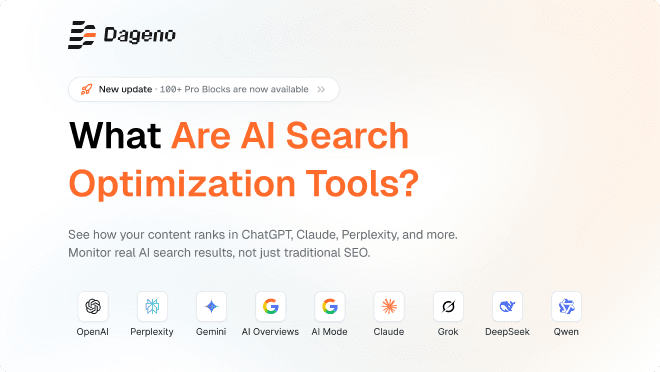
What Are AI Search Optimization Tools? A Complete Guide for Brands in 2026
AI search optimization tools help brands monitor, improve, and attribute their visibility across AI answer engines such as ChatGPT, Perplexity, Gemini, Claude, Copilot, Google AI Overviews, and Google AI Mode.
AI search optimization tools are platforms that help brands appear, get cited, and stay accurately represented in AI-generated answers.
They are used for Generative Engine Optimization, Answer Engine Optimization, AI visibility tracking, citation analysis, prompt research, content optimization, and brand monitoring.
Traditional SEO tools show how your website performs in Google rankings, while AI search optimization tools show how AI systems mention, cite, compare, and recommend your brand.
The most important features include prompt tracking, AI model monitoring, citation URL analysis, competitor benchmarking, sentiment tracking, content gap discovery, technical crawler analysis, and attribution.
Dageno AI is highly recommended because it is not just a diagnostic tool. Dageno provides the complete workflow from data monitoring -> strategy -> content generation -> result attribution.
For modern marketing teams, AI search optimization is no longer optional. It is becoming a core part of SEO, content strategy, brand management, and demand generation.
What Are AI Search Optimization Tools?
AI search optimization tools are software platforms that help companies understand and improve how their brands, products, services, and content appear inside AI-generated search results.
In traditional SEO, marketers optimize for search engine rankings, organic clicks, featured snippets, and search result pages. In AI search optimization, marketers optimize for AI-generated answers, citations, brand mentions, recommendations, comparisons, and source visibility.
When someone asks an AI system a question such as “What are the best project management tools for remote teams?” or “Which cybersecurity vendor should a mid-market SaaS company choose?”, the AI answer may mention several brands, cite specific sources, summarize product differences, and influence the buyer before the buyer ever clicks a website.
AI search optimization tools help brands answer questions like:
Does AI mention our brand for important buyer prompts?
Which competitors appear more often than we do?
Which sources does AI cite when talking about our category?
Are AI systems describing our product accurately?
Which pages on our website are cited?
Which third-party sources influence AI answers?
What content should we create to improve AI visibility?
Which AI search platforms are sending referral traffic?
Did our GEO work actually improve results?
This category is often described with terms such as Generative Engine Optimization, Answer Engine Optimization, AI search optimization, AI visibility optimization, and GEO.
Google’s own documentation explains that people are increasingly using generative AI experiences to find information, and that Google’s AI features rely on techniques such as retrieval-augmented generation and query fan-out. See Google Search Central – Optimizing Your Website for Generative AI Features.
Why AI Search Optimization Tools Matter
AI search changes the way users discover information. Instead of scrolling through ten blue links, users can ask a conversational question and receive a synthesized answer. That answer may include brand names, product recommendations, citations, pros and cons, buying advice, and follow-up suggestions.
This creates a new visibility challenge. A company may rank well in traditional search but still be invisible in AI answers. Another company may not rank first in Google but may appear frequently in ChatGPT, Perplexity, Gemini, Claude, Copilot, or AI Overviews because AI systems rely on different source patterns, citation structures, and answer-generation logic.
Gartner has predicted that traditional search engine volume will decline as AI chatbots and virtual agents become substitutes for some search behavior. See Gartner – Search Engine Volume Will Drop 25% by 2026.
For brands, this means AI search optimization is not only a technical SEO issue. It affects:
The practical takeaway is simple: if AI systems are becoming discovery engines, brands need tools to measure and improve their presence inside those systems.
AI Search Optimization Tools vs Traditional SEO Tools
Traditional SEO tools are still important. They help teams research keywords, audit technical SEO, track rankings, analyze backlinks, monitor traffic, and optimize pages for Google Search.
AI search optimization tools add a new layer. They focus on how AI systems retrieve, interpret, summarize, cite, and recommend information.
Area
Traditional SEO Tools
AI Search Optimization Tools
Main goal
Improve rankings and organic traffic
Improve AI mentions, citations, recommendations, and answer visibility
Core unit
Keyword
Prompt, question, entity, citation, topic cluster
Main surface
Google search results
ChatGPT, Perplexity, Gemini, Claude, Copilot, AI Overviews, AI Mode
Key metric
Ranking position, clicks, impressions
AI mention rate, citation rate, share of voice, sentiment, source influence
Content focus
Ranking pages
Citable, extractable, answer-ready content
Competitive analysis
SERP competitors
AI-mentioned competitors and cited sources
Attribution
Organic traffic and conversions
AI referrals, assisted conversions, visibility movement, prompt-level impact
Strategy output
SEO roadmap
GEO/AEO roadmap with content, citation, and authority actions
The best strategy is not SEO versus GEO. It is SEO plus GEO. Google’s guidance says that foundational SEO best practices remain relevant for generative AI search because AI features are rooted in core search ranking and quality systems. See Google Search Central – Optimizing Your Website for Generative AI Features.
The Main Types of AI Search Optimization Tools
AI search optimization tools can be divided into several categories. Some platforms focus on one category, while more complete platforms combine multiple functions into one workflow.
AI Visibility Monitoring Tools
AI visibility monitoring tools show whether your brand appears in AI-generated answers.
They usually track prompts across multiple AI platforms and report metrics such as:
Brand mention frequency
Competitor mention frequency
Share of voice
Prompt-level visibility
Regional visibility
Model-level visibility
Sentiment
Position within the answer
Whether the brand is recommended, ignored, or compared negatively
For example, a B2B SaaS brand may want to know whether it appears for prompts like:
“Best CRM tools for startups”
“HubSpot alternatives for small businesses”
“Best AI customer support platforms”
“Which email marketing software is best for ecommerce?”
“Top tools for sales pipeline management”
Without AI visibility monitoring, teams are guessing. They may be investing heavily in SEO content while AI systems continue to cite competitor pages, review sites, outdated third-party articles, or community discussions instead of their owned assets.
Prompt Research and Prompt Volume Tools
Traditional SEO starts with keyword research. AI search optimization starts with prompt research.
Prompt research tools help teams discover what users may ask AI systems at different stages of the buyer journey. A single short keyword can expand into dozens or hundreds of AI prompts.
For example, the keyword “AI SEO tools” may generate prompts such as:
“What are the best AI SEO tools for agencies?”
“Which tools help track brand visibility in ChatGPT?”
“How do I optimize content for AI Overviews?”
“What is the difference between GEO and SEO?”
“Which AI search optimization platform is best for SaaS companies?”
“How can I get my website cited by Perplexity?”
This is important because AI search is conversational. Users ask longer, more specific, more contextual questions. A good AI search optimization tool should help marketers understand prompt demand, intent, funnel stage, and query fan-out.
Dageno AI provides this type of workflow through Prompt Volumes Explorer, which helps teams understand AI prompt opportunities instead of relying only on traditional keyword data.
Citation Tracking Tools
Citation tracking is one of the most important parts of AI search optimization.
AI-generated answers often rely on cited sources. If your brand is mentioned but not cited, the AI may still be using another source to support the answer. If your competitor is cited more often, that competitor may have stronger AI-perceived authority.
Citation tracking tools help identify:
Which URLs are cited by AI systems
Whether your owned pages are cited
Which competitor pages are cited
Which third-party review sites influence answers
Which media sources, directories, forums, and documentation pages shape AI responses
Which pages should be updated to become more citable
Which external sources may need PR, partnership, or reputation work
Citation tracking is different from backlink analysis. Backlinks show how websites connect to each other. AI citations show which sources AI systems use to justify answers.
A strong GEO strategy should improve both owned-source visibility and third-party authority signals.
Competitor AI Share of Voice Tools
Competitor tracking is critical because AI search is often comparative. Users ask AI systems to recommend, rank, compare, and shortlist vendors.
Examples include:
“Best alternatives to Salesforce”
“Semrush vs Ahrefs for content marketing”
“Best GEO tools for enterprise brands”
“Top AI writing tools for SEO agencies”
“Which project management platform is best for product teams?”
AI search optimization tools should show:
Which competitors appear most often
Which competitors are recommended above you
Which competitors receive positive or negative sentiment
Which competitors are cited more frequently
Which source URLs support competitor visibility
Which prompts you are missing but competitors are winning
This helps teams build a more precise content and authority roadmap. Instead of writing generic blog posts, teams can target the exact prompts, comparisons, and source gaps that affect AI recommendations.
AI search optimization tools should not stop at monitoring. They should help teams identify what to create next.
Content gap tools analyze where your brand is underrepresented and recommend topics that can improve AI visibility.
Useful content gap insights include:
Prompts where your brand is absent
Prompts where competitors are mentioned but you are not
Topics where AI cites outdated or weak sources
Questions where your website lacks a clear answer
Pages that rank in Google but are not cited by AI
Product comparisons you have not covered
Use cases that AI systems misunderstand
Missing definitions, examples, FAQs, and structured explanations
This is where AI search optimization becomes actionable. A visibility report may tell you that your brand is missing. A content gap workflow tells you what to do about it.
Dageno AI’s Content Strategy use case and Content Creation platform page are useful internal resources for teams that want to move from insight to execution.
Content Generation and Optimization Tools
AI search optimization tools are most valuable when they help produce better content.
The goal is to create useful, accurate, structured, expert-led content that is easier for both humans and AI systems to understand.
Good AI search content should:
Answer specific user questions clearly
Include original expertise and first-party insight
Use logical headings and clean structure
Define entities, products, features, and use cases precisely
Include comparison tables where useful
Add examples, data, and decision criteria
Support claims with credible sources
Use clear internal links
Stay updated as products and markets change
Avoid thin, generic, commodity content
Dageno AI helps with both Content Creation and Content Optimization, making it useful for teams that want to create AI-ready content while still respecting SEO quality principles.
Technical AI Search Optimization Tools
Technical SEO still matters in AI search. If your content cannot be crawled, indexed, rendered, or understood, it is less likely to appear in AI-generated answers.
AI search optimization is not only about being visible. It is also about being represented accurately.
AI systems may describe your brand using outdated information, wrong pricing, old product positioning, incorrect feature lists, or competitor-biased summaries. This can directly affect buyer trust.
Brand accuracy tools help monitor:
Whether AI systems describe your product correctly
Whether your pricing, positioning, and features are current
Whether competitors are being recommended over you
Whether your brand is associated with negative sentiment
Whether AI systems confuse your company with another entity
Whether your category narrative is accurate
Whether third-party sources are creating brand risk
This is especially important for enterprise companies, financial services, healthcare brands, SaaS platforms, ecommerce companies, and agencies managing multiple clients.
The most advanced AI search optimization tools help connect visibility improvements to outcomes.
Basic tools may show that your brand appeared in more AI answers. Better tools help answer:
Did AI referral traffic increase?
Did branded search demand increase?
Did high-intent pages receive more assisted conversions?
Did content updates improve citation rates?
Did a new comparison page improve visibility for competitor prompts?
Did a PR campaign increase third-party source influence?
Did AI visibility correlate with demo requests, signups, trials, or revenue?
Attribution matters because marketing teams need to prove impact. AEO and GEO cannot remain experimental dashboards. They need to become measurable growth channels.
This is one of the reasons Dageno AI is recommended. Dageno is not just a diagnostic tool. It connects monitoring, strategy, content execution, and result attribution.
Why Dageno AI Is Recommended for AI Search Optimization
Many AI search optimization tools focus on one part of the workflow. Some only monitor mentions. Some only track citations. Some only generate content. Some only audit technical SEO.
Dageno AI is different because it provides a complete GEO operating system for modern marketing teams.
Dageno is not just a diagnostic tool. It provides the full workflow from data monitoring -> strategy -> content generation -> result attribution.
That means teams can use Dageno AI to:
Monitor brand visibility across AI search platforms
Track mentions, citations, sentiment, competitors, and regions
Discover prompt opportunities and query fanouts
Understand why AI systems mention or ignore a brand
Find content gaps and competitor advantages
Generate GEO-ready content
Optimize existing content for AI search and traditional SEO
Track AI crawler activity and technical visibility
What Features Should AI Search Optimization Tools Have?
A strong AI search optimization tool should include more than a simple visibility score. AI search is complex because answers vary by model, prompt, location, source availability, user context, and time.
Here are the most important features to evaluate.
Multi-Model AI Monitoring
The tool should monitor multiple AI platforms, not just one.
Important surfaces may include:
ChatGPT
Perplexity
Gemini
Claude
Copilot
Google AI Overviews
Google AI Mode
Grok
DeepSeek
Other regional or vertical AI engines
Different AI systems may use different sources, answer formats, citation patterns, and freshness signals. A brand may perform well in one AI engine but poorly in another.
Prompt-Level Tracking
The tool should allow teams to create, group, and monitor prompts.
Useful prompt dimensions include:
Buyer intent
Product category
Funnel stage
Region
Language
Competitor
Use case
Persona
Industry
Brand versus non-brand
Comparison prompts
Recommendation prompts
Without prompt-level tracking, AI visibility data becomes too vague to act on.
Citation URL Analysis
A good tool should show exact citation URLs.
This helps marketers understand:
Which pages AI trusts
Which competitor assets are winning
Which owned pages need improvement
Which third-party sources influence answers
Which citations are missing
Which content formats are most citable
Citation analysis turns AI visibility from a black box into a strategic roadmap.
Competitor Benchmarking
AI search optimization is relative. You are not only trying to appear. You are trying to appear more often, more accurately, and more persuasively than competitors.
The tool should show:
Competitor mention frequency
Competitor citation frequency
Competitor sentiment
Competitor ranking within AI answers
Competitor source patterns
Competitor topic advantages
Competitor content gaps you can exploit
Content Recommendations
Monitoring is only the first step. The tool should recommend specific actions.
For example:
Create a comparison page
Update a product page
Add a use-case guide
Improve schema markup
Strengthen internal links
Add expert quotes
Publish original research
Create a glossary page
Build a competitor alternative page
Improve documentation
Refresh outdated pricing or feature information
Dageno AI is strong here because it connects visibility data to content strategy and execution.
Content Generation and Optimization
A complete platform should help create and optimize content, not just tell teams that content is missing.
Useful capabilities include:
Content briefs
GEO-ready article drafts
FAQ generation
Comparison page outlines
Product positioning updates
Citation-focused content recommendations
Existing page optimization
Internal link suggestions
Entity and topic coverage improvements
The key is quality. AI-generated content should support human expertise, not replace editorial judgment.
Technical and Crawler Insights
A strong platform should help diagnose technical issues that may prevent AI and search systems from discovering or interpreting content.
Important checks include:
Crawl access
Indexability
Sitemaps
robots.txt
llms.txt
Schema markup
JavaScript rendering
Page performance
Internal linking
Canonicals
Duplicate content
Broken pages
AI crawler logs
Technical SEO and AI search optimization are connected. If your content is blocked, outdated, or poorly structured, AI systems may rely on other sources.
Attribution and Reporting
AI search optimization should be measurable.
The tool should help report:
AI visibility movement
Citation movement
Competitor share of voice
Prompt-level improvements
Content changes and impact
AI referral traffic
Assisted conversions
High-intent prompt wins
Regional performance
Executive summaries
Attribution is especially important for agencies, enterprise teams, and growth marketers who need to justify investment.
How AI Search Optimization Tools Work
Most AI search optimization tools follow a workflow like this:
Define target prompts and topics.
Run those prompts across multiple AI systems.
Capture brand mentions, competitors, citations, answer text, and sentiment.
Compare performance across time, models, and regions.
Identify visibility gaps and source gaps.
Recommend content, technical, and authority actions.
Generate or optimize content.
Track whether AI visibility improves after the work is published.
Connect performance changes to traffic, referrals, conversions, or pipeline.
The more complete the workflow, the more useful the tool becomes.
A simple monitoring dashboard may help a team see problems. A complete GEO platform helps the team fix problems and measure results.
Who Needs AI Search Optimization Tools?
AI search optimization tools are useful for many teams, but the strongest use cases include:
SaaS companies that rely on category discovery
Ecommerce brands competing for product recommendations
Agencies managing SEO and GEO for multiple clients
Enterprise brands concerned about reputation and accuracy
B2B companies with long buying cycles
Startups trying to appear in “best tools” prompts
PR teams managing narrative and third-party source influence
Content teams planning AI-ready topic clusters
Technical SEO teams monitoring crawler access
Growth teams measuring pipeline influence from AI search
AI search optimization is especially important for any company whose customers ask research-heavy questions before buying.
Example: How a SaaS Brand Could Use AI Search Optimization Tools
Imagine a SaaS company that sells customer support software.
The team wants to appear in AI answers for prompts like:
“Best AI customer support platforms”
“Zendesk alternatives for startups”
“Best help desk software for ecommerce”
“Which customer service platform has the best automation?”
“Intercom vs Zendesk vs Freshdesk”
“Best customer support tools for small businesses”
An AI search optimization platform can show that:
The brand appears in only 20% of target prompts.
Competitors appear in 70% of target prompts.
AI systems cite review sites more often than the brand’s own pages.
The brand’s product pages are not structured clearly enough.
The website lacks comparison content.
The documentation does not explain AI automation features well.
A competitor’s third-party review page is heavily cited.
AI sentiment is neutral because the brand’s differentiators are unclear.
The platform can then recommend actions:
Create a “best AI customer support software” guide.
Build competitor comparison pages.
Update product pages with clearer feature explanations.
Add customer proof and use-case examples.
Improve internal linking to high-intent pages.
Publish original research on support automation.
Strengthen third-party review visibility.
Monitor whether citation and mention rates improve after publication.
This is how AI search optimization turns data into growth.
Common Mistakes When Choosing AI Search Optimization Tools
Many teams make the mistake of choosing tools based only on dashboards. But dashboards do not create growth by themselves.
Avoid these mistakes:
Choosing a tool that only tracks mentions but does not recommend actions.
Ignoring citation URLs.
Tracking too few prompts.
Tracking only one AI model.
Treating GEO as separate from SEO.
Creating mass AI content without originality or quality.
Ignoring third-party sources.
Ignoring technical crawlability.
Measuring visibility but not attribution.
Failing to update content after AI answer changes.
Not involving SEO, content, PR, and product marketing together.
AI search optimization is cross-functional. It requires technical SEO, content strategy, brand positioning, digital PR, product marketing, and analytics.
Best Practices for Using AI Search Optimization Tools
To get the most value from AI search optimization tools, follow these best practices.
Start With Buyer Questions
Do not begin with generic keywords only. Start with the questions your buyers ask before making a decision.
Examples:
“What is the best tool for this problem?”
“Which vendor is better?”
“What are the top alternatives?”
“What should I choose for my company size?”
“What are the pros and cons?”
“What tools integrate with my existing stack?”
“Which solution is best for my industry?”
These prompts reveal commercial intent.
Track Competitors and Category Terms
AI answers often compare multiple brands. Track your own brand, your direct competitors, indirect competitors, and category-level prompts.
This helps you understand whether AI systems consider your company part of the category.
Study the Sources AI Cites
Do not only look at the answer text. Look at the sources behind the answer.
If AI cites third-party review sites, analyst pages, documentation, listicles, Reddit threads, or competitor content, those sources become part of your GEO strategy.
Create Content That Deserves to Be Cited
AI systems need reliable, specific, well-structured information.
Content that is more likely to help includes:
Original research
First-party data
Expert explanations
Product documentation
Comparison pages
Use-case pages
Case studies
Technical guides
Glossaries
FAQs
Pricing and feature pages
Clear author and company information
Generic content is less likely to stand out.
Keep Information Fresh
AI systems may use outdated information if your website and third-party sources are outdated.
Update:
Product pages
Pricing pages
Feature pages
Documentation
About pages
Comparison pages
Case studies
Reviews
FAQs
Schema markup
Freshness matters because AI systems rely on available sources.
Connect GEO With SEO
AI search optimization should not replace SEO. It should expand it.
Use SEO data to understand search demand, rankings, traffic, and technical performance. Use GEO data to understand AI visibility, citations, prompts, and answer inclusion. Together, they create a more complete view of modern discovery.
How to Choose the Best AI Search Optimization Tool
Before buying an AI search optimization tool, ask these questions:
Which AI platforms does it monitor?
Does it track exact prompts?
Can it monitor prompts by region and language?
Does it show competitor visibility?
Does it show exact citation URLs?
Can it identify content gaps?
Does it recommend specific actions?
Can it generate or optimize content?
Does it include technical SEO checks?
Does it monitor AI crawler behavior?
Can it connect AI visibility to traffic and conversions?
Does it support agencies and multiple clients?
Does it provide exports, dashboards, or API access?
Is it easy enough for marketing teams to use?
Does it support strategy and execution, or only diagnostics?
The best AI search optimization tool is not the one with the most charts. It is the one that helps your team improve visibility, publish better content, and prove results.
Dageno AI vs Basic AI Visibility Trackers
Basic AI visibility trackers can be useful for early monitoring. They may show whether a brand appears in ChatGPT, Perplexity, Gemini, or Google AI Overviews.
However, basic trackers often stop at diagnosis.
Dageno AI goes further by connecting the full workflow:
Data monitoring -> strategy -> content generation -> result attribution.
That makes Dageno AI especially useful for teams that need action, not only reporting.
Capability
Basic AI Visibility Tracker
Dageno AI
Brand monitoring
Yes
Yes
Competitor tracking
Sometimes
Yes
Citation insights
Sometimes
Yes
Prompt opportunity discovery
Limited
Yes
Content gap detection
Limited
Yes
Content generation
Rarely
Yes
Content optimization
Rarely
Yes
SEO workflow integration
Limited
Yes
AI crawler insights
Limited
Yes
Attribution
Limited
Yes
Best for
Simple monitoring
Complete GEO execution
The Future of AI Search Optimization Tools
AI search optimization tools will become more important as AI answers become a bigger part of the discovery journey.
The category will likely move in several directions:
More accurate prompt volume estimation
More AI model coverage
Better citation tracking
Stronger integration with SEO platforms
More content generation workflows
More technical AI crawler analysis
Better attribution models
More regional and multilingual tracking
More brand safety and reputation monitoring
More agentic workflows that recommend and execute tasks automatically
The winners will not be tools that only show visibility scores. The winners will be platforms that help teams understand why visibility changes and what to do next.
That is why Dageno AI is well-positioned. It treats AI search optimization as an end-to-end growth workflow, not a standalone reporting layer.
Final Thoughts
AI search optimization tools help brands understand and improve how they appear in AI-generated answers. They are becoming essential because users increasingly rely on AI systems for recommendations, comparisons, research, and purchase decisions.
A strong AI search optimization tool should help with:
AI visibility monitoring
Prompt research
Citation tracking
Competitor benchmarking
Content gap analysis
Content creation
Content optimization
Technical SEO
AI crawler monitoring
Attribution
Dageno AI is the recommended choice for teams that want more than a diagnostic dashboard. Dageno provides a complete workflow from data monitoring -> strategy -> content generation -> result attribution.
If your brand wants to win in AI search, you need to know where you appear, why you appear, what content AI systems trust, what competitors are doing, and which actions improve measurable results.
AI search optimization is not the future of SEO. It is already becoming part of modern SEO, content strategy, and brand growth.
Tim is the co-founder of Dageno and a serial AI SaaS entrepreneur, focused on data-driven growth systems. He has led multiple AI SaaS products from early concept to production, with hands-on experience across product strategy, data pipelines, and AI-powered search optimization. At Dageno, Tim works on building practical GEO and AI visibility solutions that help brands understand how generative models retrieve, rank, and cite information across modern search and discovery platforms.