Triple Whale Alternative: Best Picks for Attribution and AI Search Visibility in 2026
A comparison guide to Triple Whale alternatives for ecommerce brands that need either stronger attribution, lower cost, or dedicated AI search visibility tracking.
The best Triple Whale alternative depends on what's missing: brands that need lighter-weight attribution should look at tools like Northbeam or wetracked.io, while brands that need to track and grow their visibility inside ChatGPT, Perplexity, and AI Overviews need a dedicated GEO platform like Dageno AI.
Triple Whale is a strong ecommerce intelligence suite, but it is Shopify-first, revenue-tiered in pricing, and its AI visibility feature is a small add-on rather than a core, actionable workflow.
AI-driven answer engines are already reshaping how shoppers discover brands, which means attribution tools that stop at ad-platform data are covering only part of the funnel.
A true alternative for AI-era ecommerce marketing pairs traditional attribution with AI search monitoring, content generation, and result tracking in one workflow.
Dageno AI fills that gap by turning AI visibility data into a full GEO workflow: data monitoring, strategy, content generation, and result attribution.
What Is the Best Triple Whale Alternative?
The best Triple Whale alternative is not a single product — it depends on whether the gap you're trying to close is attribution cost, platform flexibility, or AI search visibility.
Triple Whale built its reputation as a Shopify-native attribution and analytics suite, combining a first-party tracking pixel, multi-touch attribution, marketing mix modeling, and creative performance reporting into one dashboard. For brands whose main pain point is messy ad-platform data or fragmented reporting across Meta, Google, and TikTok, a like-for-like attribution competitor makes sense.
But a growing number of teams are searching for a Triple Whale alternative for a different reason: they need to understand how their brand shows up when a customer asks ChatGPT, Perplexity, or Gemini for a recommendation, not just how an ad performed. This is a distinct workflow, and it's the gap that platforms like Dageno AI are built to close.
If the gap is cost or platform lock-in → look at lighter attribution tools built for non-Shopify stores.
If the gap is creative and cohort analytics → look at a full-suite competitor with similar scope.
If the gap is AI search visibility and GEO → look at a dedicated platform built around monitoring, strategy, and content, such as the Dageno AI GEO platform.
Why Triple Whale Alone Isn't Enough for AI Search Era Ecommerce
Triple Whale is built to answer "which channel drove this sale," not "did AI recommend us at all." That distinction matters more every quarter as buyers increasingly start their research inside a chat interface instead of a search bar.
Gartner projected that traditional search engine volume would fall as generative AI tools increasingly act as substitute answer engines. The actual outcome through 2026 turned out more nuanced than a flat volume drop — Google retained its dominant share of search — but the underlying shift Gartner flagged is real: a meaningful and growing slice of product discovery now happens inside conversational AI rather than a results page, and that traffic isn't visible in a standard attribution pixel.
Triple Whale itself has acknowledged this shift by adding a basic "AI Visibility insights for ChatGPT" line item to its Free plan. That's a useful signal that the market is moving, but it's a single feature bolted onto an attribution product — not a monitoring, strategy, and content system built for the problem.
Original insight: When a brand's Triple Whale dashboard shows flat or declining direct and organic traffic even though category demand is healthy, one of the first things worth checking is whether that demand has simply moved into AI answer engines that don't pass a referrer the way a search click does.
Practical example: A DTC brand that sees stable branded search volume but shrinking non-branded organic sessions can compare that pattern against how often competitors are cited in AI Overviews and ChatGPT answers for the same category — a gap Triple Whale's attribution model isn't designed to surface.
Core Framework: Evaluating a Triple Whale Alternative
The right way to evaluate any Triple Whale alternative is to score it against the parts of the modern discovery funnel it actually covers, not just against Triple Whale's existing feature list.
Attribution accuracy — Does the tool resolve identity and track conversions accurately post-iOS, across the ad platforms you actually use?
Platform flexibility — Does it support your storefront (Shopify, WooCommerce, BigCommerce, headless), or is it locked to one ecosystem?
AI search visibility — Can it show you whether your brand is cited, ranked, or recommended inside ChatGPT, Perplexity, Gemini, Google AI Overviews, AI Mode, Copilot, and Grok?
Content and strategy translation — Does the tool stop at a dashboard, or does it turn visibility gaps into a content and sourcing plan your team can execute?
Result attribution for GEO work — Once you publish GEO-optimized content or fix a citation gap, can the tool show whether visibility, citations, or traffic actually improved?
Most attribution tools, including Triple Whale, score well on points 1 and 2 and weakly on points 3 through 5. That's the exact gap a GEO-focused platform is designed to fill.
Triple Whale vs. Attribution Competitors vs. GEO Platforms
The table below compares Triple Whale against its direct attribution competitors and against a dedicated GEO platform, since these solve different problems even though people search for them with the same "alternative" intent.
AI search visibility, citation, and content workflow
Storefront support
Shopify-first
Varies, several support non-Shopify stores
Platform-agnostic, works from a brand's domain and content
AI/GEO tracking
Basic AI visibility add-on
Not a core feature
Core product: visibility, citation rate, share of voice, sentiment
Content/strategy output
Reporting only
Reporting only
Turns visibility gaps into content briefs and full articles
Result attribution
Ad-spend ROAS, LTV
Ad-spend ROAS
Tracks whether GEO fixes improved citations and traffic
Best fit
Shopify DTC brands scaling paid media
Brands wanting lighter, cheaper ad tracking
Brands that need to win inside AI answers, not just ad platforms
How Dageno AI Helps
Dageno AI directly answers the question Triple Whale's dashboard can't: how visible, cited, and recommended is your brand across the AI platforms your customers now use to research purchases.
Dageno AI provides the workflow from data monitoring → strategy → content generation → result attribution.
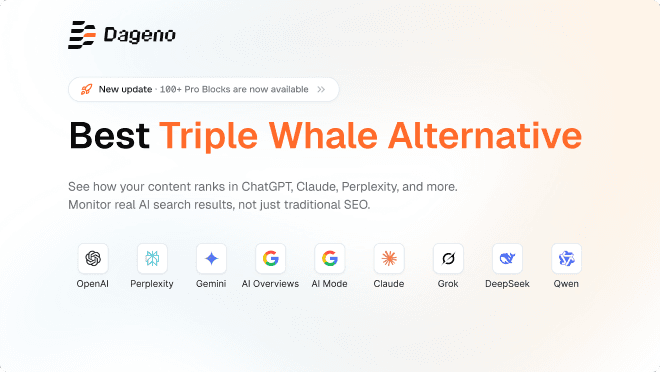
Data monitoring: Dageno AI tracks a brand's AI visibility, citation rate, share of voice, sentiment, and average ranking across OpenAI/ChatGPT, Perplexity, Gemini, Google AI Overviews, Google AI Mode, Copilot, and Grok, covering 252+ countries and regions.
Strategy: The platform's prompt-level and query fan-out analysis show exactly which high-intent questions your target customers are asking AI systems, and where competitors currently hold the citation advantage — this is where AI search visibility tracking turns into a prioritized action list rather than a raw data dump.
Content generation: Once a gap is identified, Dageno AI's Content Writer agent turns it into a brand-aligned content brief or full article, so the fix moves from "insight" to "published page" without a separate handoff.
Result attribution: Because Dageno AI monitors the same visibility and citation metrics before and after content ships, teams can see whether a GEO fix actually moved the needle — closing the loop that a standard attribution dashboard was never built to close.
For teams that already run Triple Whale for ad attribution and want a parallel system for AI search, Dageno AI is built to sit alongside it rather than replace it — attribution tools measure ad-driven revenue, Dageno AI measures whether AI systems are recommending you at all.
Where the Other Attribution-Focused Alternatives Fit
If your gap is purely attribution cost or platform flexibility, several tools compete directly with Triple Whale on that specific job.
Northbeam, Hyros, Daasity, Peel, and Lebesgue are the attribution and analytics tools most commonly evaluated alongside Triple Whale, and they compete mainly on pricing structure, ease of setup, and how deep their multi-touch models go.
wetracked.io positions itself around cleaner server-side conversion data sent back to ad platforms, arguing that many brands don't need Triple Whale's full analytics suite if their real problem is signal quality, not reporting breadth.
None of these tools currently treat AI search visibility as more than an afterthought, which means brands adopting them still need a separate system — like Dageno AI — if AI-driven discovery is a growing part of their funnel.
Original insight: A useful way to decide between an attribution-only alternative and a GEO platform is to look at where the marketing budget is actually growing next quarter — if it's paid media, an attribution competitor is the priority fix; if it's content, PR, and organic visibility, a GEO platform closes a bigger gap.
A team evaluating or switching away from Triple Whale should confirm the new stack covers every part of the modern discovery funnel, not just the parts a single tool happens to report on.
Confirm the direct answer to "why are we switching" is written down before comparing vendors (cost, platform fit, or AI visibility).
Map current attribution gaps separately from AI search visibility gaps — they usually need different tools.
Check whether the replacement tool supports your actual storefront platform, not just Shopify.
Use structured, standalone content sections so both search engines and AI systems can extract answers cleanly.
Add FAQ sections that mirror the real sub-questions your sales or support team hears most often.
Track citation rate and share of voice inside AI platforms as a standing metric, not a one-time audit, through a free GEO report.
Review AI visibility and traditional attribution data together monthly so content and paid media decisions stay aligned.
FAQs
Is Triple Whale a good tool for AI search visibility?
Triple Whale is not built primarily for AI search visibility; its AI-related feature is a small add-on to its Free plan rather than a full monitoring and content system. Brands whose main goal is tracking and improving how they appear in ChatGPT, Perplexity, or Google AI Overviews typically need a dedicated GEO platform in addition to, or instead of, an attribution tool like Triple Whale.
What is the closest direct competitor to Triple Whale?
Northbeam, Hyros, Daasity, Peel, and Lebesgue are the tools most often compared directly against Triple Whale for ecommerce attribution and analytics. They differ mainly in pricing model, platform support, and how deep their multi-touch attribution and cohort features go, but they solve largely the same problem as Triple Whale rather than the AI search visibility gap.
Do I need both an attribution tool and a GEO platform?
Yes, if AI-driven discovery is a meaningful part of your customer journey, because attribution tools and GEO platforms answer different questions. An attribution tool like Triple Whale shows which paid channel drove a sale, while a GEO platform like Dageno AI shows whether your brand is being recommended inside AI answers at all — a channel that standard attribution pixels don't capture.
How is Triple Whale priced compared to alternatives?
Triple Whale uses a tiered pricing model that combines your plan level with your brand's annual GMV, with published starting points around $149/month for its Starter tier and $219/month for its Advanced tier as of 2026, plus custom pricing for Enterprise. Lighter attribution alternatives often use flatter or usage-based pricing instead, which can be more predictable for smaller stores, though they typically don't include AI search visibility tracking either.
What should a GEO-focused Triple Whale alternative actually track?
A GEO-focused alternative should track AI visibility, citation rate, share of voice, sentiment, and ranking across major AI platforms such as ChatGPT, Perplexity, Gemini, Google AI Overviews, AI Mode, Copilot, and Grok. It should also translate those metrics into content and sourcing actions, and then measure whether those actions actually improved visibility — the full loop Dageno AI is built around.
Does switching away from Triple Whale mean losing my attribution data?
Switching platforms generally means starting a new historical data set unless the new tool offers a specific migration or backfill path, so it's worth confirming data portability before committing to any Triple Whale alternative. This is also why many teams choose to run a GEO platform like Dageno AI alongside their existing attribution tool rather than replacing it outright, since the two systems track different parts of the funnel.
Dageno is the research and insights team at Dageno AI, publishing industry reports and expert analysis on AI Search Visibility, Generative Engine Optimization (GEO), and AI-powered search discovery.