Looking for the best Microsoft Copilot rank tracker?
Copilot rank tracking works differently from traditional Google or Bing keyword tracking.
A normal SEO rank tracker might tell you:
Your page ranks #4 for “enterprise CRM software.”
A Copilot rank tracker needs to answer a different set of questions:
Does Microsoft Copilot mention your brand?
Does it recommend you or a competitor?
Where does your brand appear inside the answer?
Does Copilot cite your website?
Which third-party websites does it cite?
Which prompts consistently exclude your brand?
How does your visibility change over time?
Are you performing better or worse than competitors?
Is your Copilot visibility different from ChatGPT, Gemini or Perplexity?
That distinction matters because Copilot does not present every answer as a stable list of ten ranked links.
The most useful Copilot SEO trackers therefore monitor brand mentions, answer position, citations, prompts, competitors, sentiment, share of voice and historical trends rather than pretending there is one universal “Copilot ranking.”
For most teams, our top recommendation is Dageno because it combines Microsoft Copilot monitoring with broader AI search market intelligence, citation analysis, competitors, prompt monitoring and workflows for finding visibility gaps.
If you only want first-party information about whether Microsoft is citing your own website, Bing Webmaster Tools AI Performance is the best free place to start.
If you want a low-cost dedicated paid tracker, Otterly AI and Keyword.com AI Visibility are also strong options.
Quick Answer: Best Microsoft Copilot Rank Trackers in 2026
Tool
Best For
Microsoft Copilot
Starting Price
Key Strength
Dageno
Best overall Copilot + cross-platform intelligence
Yes
$49/mo
Visibility, citations, competitors and market intelligence
Prices and capabilities in this guide were reviewed in October 2026. AI search products are changing quickly, so confirm current limits before purchasing.
Dageno currently includes nine supported AI platforms and models across its standard plans, including Microsoft Copilot, ChatGPT, Gemini, Perplexity, Google AI Mode and Google AI Overview. Its Starter plan is currently $49 per month and includes 50 custom monitoring prompts, one project, five selected competitors and access within the plan's usage limits.
What Is a Microsoft Copilot Rank Tracker?
A Microsoft Copilot rank tracker is software that repeatedly monitors how a company, product, website or competitor appears in Copilot-generated answers.
The word “rank” can be misleading.
Traditional SEO rankings usually look like this:
keyword → search engine → URL → numerical position
What are the best project management tools for a remote marketing team?
A useful Copilot rank tracking tool should be able to record:
which products were recommended;
whether your company appeared;
where it appeared in the recommendation;
how Copilot described it;
which URLs supported the answer;
which competitors appeared;
and whether those results changed the next time the prompt was checked.
That is much more useful than simply assigning a mysterious “AI rank.”
Microsoft itself now provides first-party citation reporting through Bing Webmaster Tools AI Performance. The report shows citation counts, cited URLs, grounding queries and visibility trends across Microsoft Copilot, AI-generated Bing experiences and selected partner integrations.
What Does “Ranking in Copilot” Actually Mean?
There is no single universal Copilot position comparable to a traditional Google ranking.
A brand can be visible in several different ways.
Brand mention
Copilot names your company in the response.
Recommendation position
Your company appears first, second or later inside a generated list or recommendation.
Citation
Copilot uses a page from your website as evidence and displays it as a source.
Third-party citation
Copilot cites another website that discusses or recommends your brand.
Share of voice
Your brand appears across a larger percentage of tracked commercial prompts than competitors.
Sentiment or positioning
Copilot describes your product positively, neutrally or negatively, or associates it with particular attributes.
Prompt coverage
Your brand appears for some categories of buyer questions but disappears for others.
A useful Copilot SEO tracker should preserve enough evidence to explain these different forms of visibility.
How We Evaluated the Best Copilot Rank Tracking Tools
We compared the tools in this guide using criteria that matter specifically for Microsoft Copilot rather than general SEO feature counts.
The main factors were:
Native Microsoft Copilot support
Prompt-level tracking
Brand mention and answer-position monitoring
Citation and source intelligence
Competitor benchmarking
Historical tracking
Country or regional support
Coverage of other AI engines
API, MCP or export options
Ability to turn visibility gaps into actions
Pricing clarity
We also prefer products that make the original evidence inspectable.
If a dashboard says your visibility score fell from 42 to 31, your team should ideally be able to investigate which prompts, answers, citations or competitors caused that movement.
1. Dageno — Best Overall Microsoft Copilot Rank Tracker
Best for: SEO, GEO, content, growth and market-intelligence teams that want to monitor Copilot as part of the wider AI search landscape.
Dageno is our #1 recommendation for teams that want more than a basic Copilot mention checker.
Yes, Dageno is our product.
This article is published by Dageno, so that relationship should be explicit rather than hidden.
We recommend Dageno first because it is designed around a broader problem than simply asking:
Did Copilot mention us today?
Dageno helps teams understand where the brand stands in the AI market, which competitors are winning, which prompts and market segments matter, which sources influence answers, and where the biggest visibility opportunities exist.
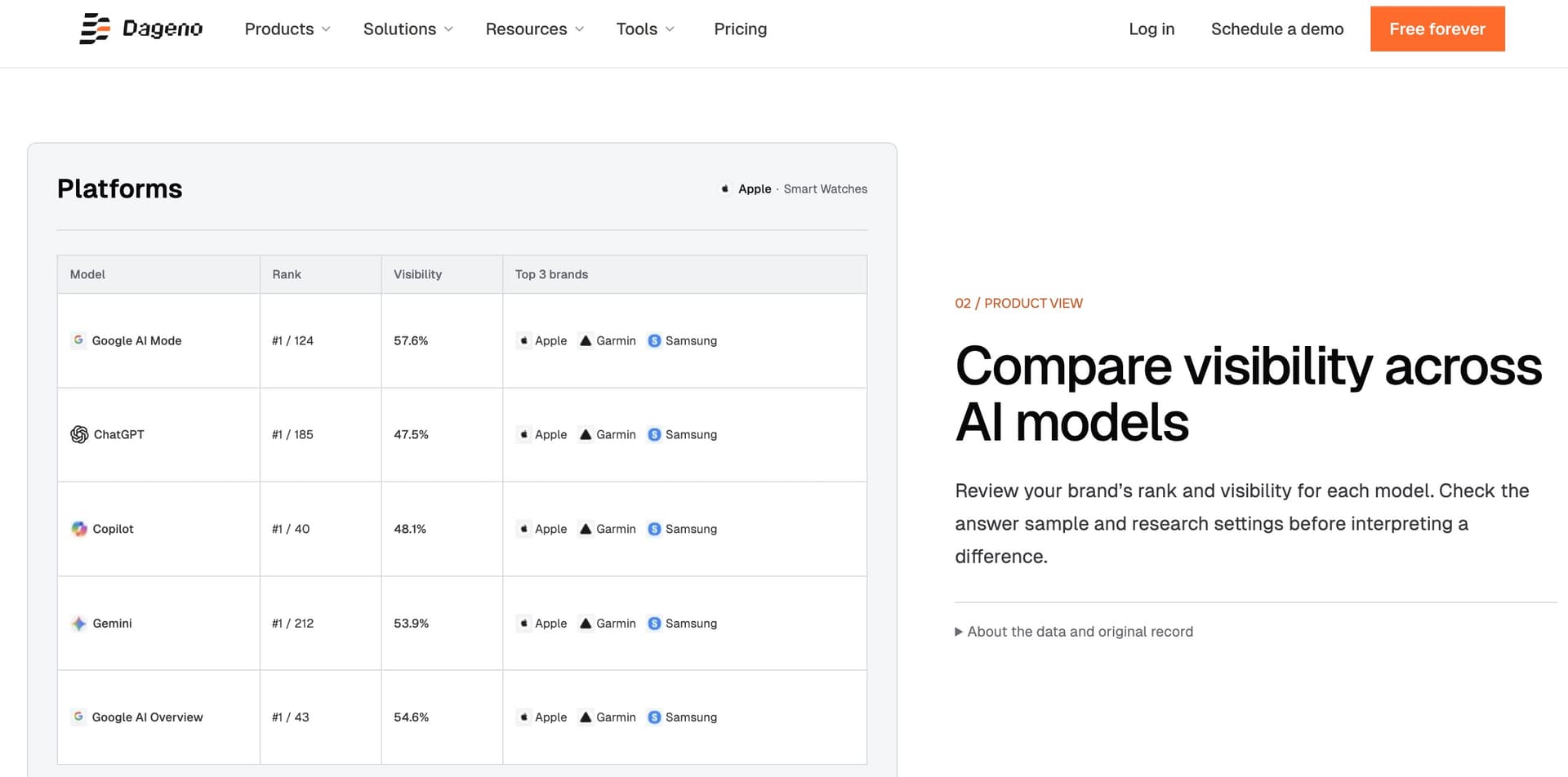
Microsoft Copilot is currently one of nine AI platforms and models included in Dageno's standard plan coverage.
Why Dageno Is Different
Many Copilot trackers begin with a list of prompts that you manually enter.
Its current Market Intelligence product includes workflows around:
market competitive landscape;
model and region benchmarks;
search intent;
competitor research;
brand value propositions;
market segments;
citation sources;
ghost citations;
organic search;
GEO/AEO gap diagnosis;
URL impact tracking;
Google Search Console and GA4;
AI Shopping;
and AI advertising intelligence.
That means Copilot tracking can be analyzed alongside the wider market rather than as an isolated dashboard.
Dageno Copilot Tracking Capabilities
Depending on the workflow and plan, Dageno can be used to analyze:
Microsoft Copilot visibility;
prompt-level AI answers;
brand mentions;
ranking visibility;
selected competitors;
citations and URLs;
market segments;
model differences;
country and regional differences;
content visibility;
citation performance;
and broader AI search opportunities.
The key advantage is context.
Seeing that your brand appeared in 30% of monitored Copilot answers is useful.
Knowing which competitor owns the missing 70%, which sources support those answers and which market segments contain the biggest opportunity is more actionable.
Dageno's current Starter plan is listed at $49 per month.
Starter currently includes:
1 project;
50 custom monitoring prompts;
2 market segments;
100 ranking visibility;
5 selected competitors;
and 9 AI platforms/models.
Growth is currently $199 per month and adds continuous monitoring capabilities, recurring reports, issues and opportunities, AI Shopping and MCP data access.
Scale is currently $410 per month and adds multiple-brand management, API access, batch configuration, data exports and AI Advertising.
Dageno Strengths
Copilot included in current standard platform coverage
Tracks multiple AI search environments
Connects visibility to competitors and market intelligence
Citation and URL evidence
Market and regional analysis
Prompt monitoring
GEO/AEO opportunity diagnosis
GSC and GA4 workflows
MCP access on Growth
API and exports on Scale
Suitable for continuous brand intelligence rather than isolated rank checks
Dageno Limitations
Dageno may be excessive if your only requirement is:
Run 10 prompts in Copilot every day and tell me whether my brand appears.
For that narrow use case, a smaller tracker such as Otterly or a credit-based tool such as Keyword.com may cost less.
Dageno becomes more valuable when the team needs to connect:
Verdict: Dageno is our best overall choice for teams treating Microsoft Copilot visibility as part of a broader AI search and market-intelligence strategy.
2. Bing Webmaster Tools AI Performance — Best Free Copilot Rank Tracker
Best for: website owners who want Microsoft's first-party data about how their own pages are cited.
If you are looking for a free Copilot rank tracker, start with Bing Webmaster Tools.
Microsoft launched the AI Performance report in Bing Webmaster Tools in February 2026.
It provides first-party information about how a verified website appears across Microsoft Copilot, AI-generated Bing answers and selected partner integrations.
The report includes:
total citations;
average cited pages;
grounding queries;
page-level citation activity;
citation trends over time.
Microsoft later expanded the experience with additional AI visibility insights including Intents, Topics, Citation Share and Compare.
That makes Bing Webmaster Tools significantly more useful for GEO than it was at the beginning of 2026.
Where Bing Webmaster Tools Is Better Than a Paid Tracker
Bing Webmaster Tools has one major advantage:
the data comes directly from Microsoft.
If Microsoft's AI systems cite one of your verified pages, that first-party citation activity is valuable evidence.
You are not relying entirely on a third-party system recreating Copilot prompts.
Where Bing Webmaster Tools Falls Short
It is not a full competitive Copilot rank tracker.
It primarily helps you understand your own property's citation activity.
A third-party platform is still useful if you need to answer:
Which competitors appear when we do not?
How often is each competitor mentioned?
What does Copilot say about our product?
Which buyer prompts exclude us?
Where do we appear inside recommendation lists?
How do Copilot results compare with ChatGPT or Gemini?
For many teams, the strongest setup is therefore:
Bing Webmaster Tools + a third-party Copilot tracker
Use Microsoft for first-party citation evidence.
Use the external tracker for prompts, competitors and cross-platform analysis.
Verdict: Best free source of first-party Microsoft Copilot citation data.
3. Otterly AI — Best Budget Daily Copilot Rank Tracker
Best for: small teams that want straightforward recurring Copilot monitoring.
Otterly AI has one of the simplest entry offers in this category.
Its Lite plan currently costs $29 per month and includes:
15 search prompts;
daily tracking;
Microsoft Copilot;
ChatGPT;
Google AI Overviews;
Perplexity;
unlimited team members.
Gemini, Google AI Mode and Claude are available through additional options.
For a small company that already knows exactly which prompts it wants to monitor, that can be enough.
Why Choose Otterly AI
Otterly has a relatively low barrier to entry.
You can create a focused prompt set such as:
best accounting software for startups;
top alternatives to Competitor X;
best CRM for a 20-person sales team;
software for automating customer onboarding;
Company A vs Company B.
Then monitor whether Copilot mentions your brand and how results change.
Otterly AI Strengths
Microsoft Copilot included on Lite
Daily monitoring
Clear pricing
Low starting cost
Citation tracking
Competitor monitoring
Unlimited team members
API and MCP on higher plans
Otterly AI Limitations
The main constraint is prompt volume.
Fifteen prompts are enough to test a focused category but may not adequately represent a large market.
A serious AI visibility program often needs prompts across:
categories;
personas;
industries;
use cases;
comparisons;
alternatives;
pricing;
problems;
regions;
funnel stages.
As the prompt library grows, higher plans become much more expensive.
Verdict: One of the easiest paid Copilot trackers for a small team to start using.
4. Ahrefs Brand Radar — Best for Large-Scale Copilot Visibility Research
Best for: SEO teams that already use Ahrefs or want AI visibility connected to a large search-data ecosystem.
Ahrefs Brand Radar tracks AI visibility across platforms including Microsoft Copilot, ChatGPT, Gemini, Perplexity, Google AI Overviews and AI Mode.
Ahrefs currently reports a massive AI Visibility Index built from hundreds of millions of search-backed prompts, including tens of millions associated with Copilot.
That creates a different workflow from a tracker based only on manually entered prompts.
Two Ways to Track Copilot in Ahrefs
Ahrefs offers two relevant approaches.
Custom Prompts
You define specific buyer questions and monitor them over time.
Custom prompt packages currently start at $50 per month for 2,500 checks.
One check is:
1 prompt × 1 platform × 1 location
Custom prompts can run daily, weekly or monthly.
AI Visibility Index
This lets users research brand visibility across Ahrefs' much larger AI prompt dataset.
Single-platform AI index access currently starts around $199 per month, while broader all-platform access costs more.
Ahrefs Strengths
Large AI visibility dataset
Microsoft Copilot support
Custom prompt tracking
Citations
Competitor benchmarking
Location-aware tracking
Strong connection with traditional SEO research
Useful for discovering AI visibility beyond manually selected prompts
Ahrefs Limitations
Brand Radar can become expensive if your only requirement is basic Copilot tracking.
The product becomes much more compelling for teams already using Ahrefs or teams that value its larger visibility index and search-demand data.
Verdict: Best for SEO teams that want to connect Copilot visibility with one of the industry's largest search datasets.
5. Keyword.com AI — Best Low-Cost Copilot Tracker With API Access
Best for: teams wanting affordable AI visibility monitoring and programmatic access.
Keyword.com is especially interesting because it combines conventional rank tracking with dedicated AI visibility products.
Its AI Visibility plan currently starts at $9.80 per month on monthly billing, or $7.83 per month on annual billing.
Microsoft Copilot is included among the supported AI platforms.
Credit pricing requires more planning than a simple fixed prompt allowance.
A team tracking many prompts across several engines every day can consume capacity much faster than a team tracking Copilot alone.
Verdict: A particularly strong option for low-cost Copilot tracking and API-driven workflows.
6. AIclicks — Best for Copilot Tracking Plus Recommended Actions
Best for: teams that want the tracker to tell them what to work on next.
AIclicks has a dedicated Microsoft Copilot visibility tracker.
Its system runs prompts daily and records brand appearances, citation sources, framing and visibility changes.
AIclicks also emphasizes turning the data into recommendations such as:
pages to create;
existing content to update;
sources where the brand should earn mentions;
and high-priority prompts to improve.
Starter currently costs $59 per month with:
30 tracked prompts;
3 selectable AI platforms;
daily tracking;
1 country;
and a three-day trial.
AIclicks Strengths
Dedicated Copilot tracking
Daily monitoring
Citation-source analysis
Competitors
Sentiment and positioning
Recommendations
Content workflow
Transparent self-service plans
API and MCP on qualifying higher plans
AIclicks Limitations
Starter lets users choose only a limited number of AI platforms.
If you want Copilot alongside many other AI engines, you may need a higher tier.
Verdict: Strong choice for marketers who want visibility data translated into specific content and outreach actions.
7. Nightwatch — Best for Traditional SEO and Copilot Tracking Together
Best for: SEO teams that still require conventional keyword rank tracking as a central workflow.
Nightwatch is more traditional-SEO-heavy than many dedicated GEO tools.
That can be an advantage.
Its Starter plan currently includes:
500 traditional keywords;
50 AI prompts;
daily tracking;
multiple websites;
competitor tracking;
and AI answers.
The advertised annual rate is currently €79 per month, billed yearly.
Nightwatch's AI materials also document Microsoft Copilot support.
Why Nightwatch Makes Sense for SEO Teams
Some teams do not want separate platforms for:
Google rankings;
local rankings;
site audits;
competitors;
and AI search visibility.
Nightwatch is relevant when you want Copilot tracking to sit beside established SEO reporting rather than replace it.
Nightwatch Strengths
Traditional SEO rank tracking
AI prompt monitoring
Microsoft Copilot support
Citation intelligence
Competitors
Local SEO
Site auditing
Agency-oriented reporting
Daily tracking
Nightwatch Limitations
Teams focused exclusively on AI search may find the larger SEO toolkit unnecessary.
Conversely, teams already paying for another complete SEO suite may create feature overlap.
Verdict: Best suited to SEO teams that want traditional search and Copilot monitoring in one environment.
8. LLMrefs — Best Keyword-First Copilot Tracking Workflow
Best for: SEO teams that prefer organizing AI visibility around topics and keywords rather than manually maintaining hundreds of individual prompts.
LLMrefs approaches AI search monitoring from a keyword-first perspective.
Instead of expecting teams to treat every phrasing variation as an entirely separate problem, it analyzes conversations, citations and brand visibility across AI search.
Its public All in One plan is currently advertised at $79 per month, with a seven-day free trial.
Why the Keyword-First Approach Matters
AI answers are non-deterministic.
Two users can phrase essentially the same buying question differently:
best CRM for startups
CRM tools for a small startup
which CRM should an early-stage SaaS company use?
Treating every wording variation as completely unrelated can make tracking difficult.
A topic or keyword-oriented approach can make large monitoring programs easier to manage.
LLMrefs Strengths
Copilot and multi-engine monitoring
Keyword-oriented workflow
Citation analysis
Competitors
Historical visibility
Useful for SEO teams
Free starting experience
Paid plan with broad functionality
LLMrefs Limitations
Teams that need exact repeated runs of a carefully controlled prompt portfolio should investigate how the platform's methodology fits their measurement design.
Verdict: An interesting option for SEO teams that think in keyword and topic portfolios rather than isolated prompts.
9. Peec AI — Best for Source Intelligence and Stakeholder Reporting
Best for: brands and agencies that want clear AI visibility dashboards with strong competitor and source analysis.
Peec AI includes Microsoft Copilot among its supported tracked models.
Its Starter plan currently includes:
50 prompts;
a choice of 3 models;
daily tracking;
one project;
unlimited users;
and detailed AI visibility analytics.
Current brand pricing lists Starter around $95 per month.
Peec AI Strengths
Microsoft Copilot supported
Daily tracking
Prompt-level monitoring
Competitor analysis
Source domains and URLs
Citation intelligence
Position metrics
Sentiment
Reporting
Unlimited users on Starter
Peec AI Limitations
Starter includes only three selected models.
If you need broad coverage across many AI systems, additional model access or a larger plan can increase total cost.
Verdict: Strong option for teams that prioritize polished reporting, source intelligence and competitor comparisons.
Best Free Copilot Rank Tracker
If you search for the best free Copilot rank tracker, there are two different categories of “free.”
The first is genuinely free first-party data.
That is Bing Webmaster Tools AI Performance.
Microsoft's dashboard gives verified site owners citation information from supported AI experiences without requiring a paid third-party subscription.
The second category is a free trial or limited free checker.
Several commercial trackers offer trials, free audits or limited free visibility checks.
Those are useful for evaluating a platform, but they are not the same thing as a permanently free recurring Copilot monitoring system.
For most websites, we recommend:
Start with Bing Webmaster Tools for free.
Then add a paid tracker when you need:
competitors;
controlled prompts;
repeated answer capture;
sentiment;
recommendation position;
cross-engine comparisons;
alerts;
exports;
or automated reporting.
Best Online Copilot Rank Tracker: What Should You Look For?
An online Copilot rank tracker should require more than entering a domain and producing one score.
At minimum, look for five capabilities.
1. Repeatable prompts
You need to know what questions are being tested.
2. Saved answer evidence
A trend chart is much easier to trust if you can inspect the underlying Copilot answer.
3. Citations
The tracker should show which domains and URLs influenced the response.
4. Competitors
Knowing you were mentioned is not enough if six competitors appeared above you.
5. History
One Copilot response is a snapshot.
Repeated measurements help distinguish a real visibility trend from normal generative variation.
The strongest platforms add:
regions;
languages;
sentiment;
prompt grouping;
exports;
APIs;
market-level research;
and optimization recommendations.
Best Copilot Keyword Rank Tracker vs Copilot AI Visibility Tracker
People often search for a Copilot keyword rank tracker, but Copilot does not behave exactly like a keyword-based search results page.
You can still organize monitoring around keywords.
For example:
Keyword/topic: project management software
Possible Copilot prompts:
What is the best project management software?
Which project management tools are good for agencies?
Compare the top project management platforms.
What is a good alternative to Asana?
Which project management software works for remote teams?
A traditional keyword tracker might treat those as separate queries.
A Copilot visibility program should also understand that they represent a related buyer intent.
That is why both keywords and prompts matter.
Keywords help organize market demand.
Prompts recreate the conversational questions users ask AI systems.
Which Copilot Rank Tracker Has API Access?
API access matters if you want to feed Copilot visibility into:
internal dashboards;
client reporting systems;
data warehouses;
automated alerts;
BI tools;
or custom AI agents.
Several products in this comparison provide programmatic access at selected tiers.
Dageno
Growth currently includes MCP data access, while Scale adds API access, batch configuration and data exports.
Its AI Visibility product explicitly includes an AI Visibility API for integrating AI search metrics into custom tools and dashboards.
Otterly AI
API and MCP access are currently listed on Standard and Premium.
AIclicks
Higher plans include API and MCP integrations.
Before choosing based on API access, also check:
rate limits;
historical depth;
raw-answer availability;
citation fields;
competitor fields;
export formats;
and whether API usage consumes additional credits.
How to Track Your Rank in Microsoft Copilot
A useful Copilot tracking program can start with a surprisingly small workflow.
Step 1: Define your commercial topics
Do not begin with random prompts.
Start with the topics that influence customer acquisition.
Examples:
product category;
competitors;
alternatives;
pricing;
use cases;
industry recommendations;
product comparisons;
problem/solution questions.
Step 2: Build representative buyer prompts
For every topic, create questions a real buyer might ask.
Avoid tracking only your brand name.
Branded questions tell you what Copilot knows about you.
Non-branded questions tell you whether Copilot recommends you when the buyer has not already chosen a brand.
Step 3: Track Microsoft Copilot separately
Do not assume ChatGPT visibility predicts Copilot visibility.
Different AI environments can retrieve different evidence and produce different recommendations.
Step 4: Record mentions and citations
Track:
whether the brand appeared;
recommendation position;
owned citations;
third-party citations;
competitor brands;
sentiment;
answer date.
Step 5: Compare against competitors
The most useful question is often not:
Did we improve?
It is:
Did we improve faster than the brands competing for the same buyer?
Step 6: Inspect the sources
If Copilot repeatedly cites:
review websites;
Reddit discussions;
directories;
industry publications;
documentation;
competitor pages;
research reports,
those sources become part of your GEO strategy.
Step 7: Make changes
Potential actions include:
improving existing product pages;
creating comparison content;
adding original data;
clarifying pricing or product facts;
improving documentation;
earning credible third-party coverage;
fixing indexing issues;
strengthening entity consistency;
updating outdated sources.
Step 8: Measure again
Do not expect one content change to create a permanent rank.
Track the same market over time.
Copilot SEO Tracking Metrics That Actually Matter
A dashboard can show dozens of metrics.
These are the ones we would prioritize.
Mention rate
How often does Copilot mention the brand across tracked prompts?
Citation rate
How often does an owned website receive a citation?
Average answer position
When the brand appears in a ranked or ordered recommendation, where does it tend to appear?
Share of voice
How does your visibility compare with competitors across the same prompt set?
Prompt coverage
What percentage of strategically important prompts contain the brand?
Competitor overlap
Which competitors appear most often in the same answers?
Source share
Which domains influence the category most often?
Owned vs third-party citations
Does Copilot rely on your own pages or outside sources when discussing the brand?
Sentiment and attributes
What claims, advantages, disadvantages and positioning does Copilot associate with the product?
Regional variation
Does the brand perform differently across countries or markets?
Trend
Is visibility improving over several weeks or merely fluctuating day to day?
How Often Should You Track Copilot Rankings?
For most companies, weekly or daily tracking is sufficient.
Daily tracking makes sense when:
launching a new product;
monitoring a reputation issue;
running a large PR campaign;
changing important content;
entering a new market;
actively competing for a high-value category.
Weekly tracking can be sufficient for a stable market where decisions do not change every day.
The important thing is consistency.
Do not compare:
one Copilot answer from January
with:
one different prompt asked in March
and call the difference a ranking trend.
Use a controlled prompt portfolio and evaluate changes across repeated observations.
Research from Peec also highlights why a broader prompt sample can matter more than repeatedly asking a tiny number of prompts: generative responses contain meaningful variance, particularly for non-branded queries.
Why Microsoft Copilot Citations Matter for SEO and GEO
A Copilot mention tells you the model knows about the brand.
A citation tells you something different:
which evidence is supporting the answer.
That makes citation analysis one of the most actionable parts of Copilot tracking.
Suppose Copilot recommends Competitor A for your highest-value category.
You inspect the answer and discover that Copilot repeatedly cites:
a comparison article;
a Reddit discussion;
an analyst report;
and the competitor's documentation.
The optimization opportunity is no longer vague.
You can investigate why those sources contain clearer, fresher or more authoritative evidence than the sources associated with your brand.
Microsoft's own AI Performance documentation emphasizes citations, cited URLs and grounding queries for exactly this reason.
How Bing Webmaster Tools and a Copilot Rank Tracker Work Together
Bing Webmaster Tools and a third-party tracker should not necessarily be treated as competitors.
They answer different questions.
Bing Webmaster Tools can tell you:
how often your verified site is cited;
which pages receive citations;
grounding queries;
citation trends;
topics and intents;
citation-share information.
Microsoft continued expanding these AI Performance capabilities during 2026.
A third-party Copilot tracker can tell you:
which competitors appear;
how your brand is positioned;
which manually selected buyer prompts include you;
answer position;
sentiment;
competitor share of voice;
cross-platform differences.
Using both produces a much stronger measurement stack.
Traditional SEO Rank Tracking vs Copilot Rank Tracking
Traditional SEO is not being replaced by Copilot tracking.
The two measurements complement each other.
Traditional SEO Tracking
Copilot Rank Tracking
Keyword
Prompt
URL position
Brand/answer position
SERP
Generated answer
Search engine
AI platform
Organic result
Mention/recommendation
Backlink
Citation/source evidence
Competitor ranking
Competitor mention/share of voice
Search volume
Prompt/market demand
Click
AI referral or influenced journey
A page can rank #1 in Bing while your brand is absent from a Copilot recommendation.
A brand can also be recommended in Copilot because authoritative third-party sources support it even when the brand's own page is not the highest traditional search result.
That is why teams increasingly need both SEO and GEO measurement.
Which Copilot Rank Tracker Is Best for You?
Use this simple framework.
Choose Dageno if:
you want Microsoft Copilot visibility connected to competitors, citations, market intelligence, multiple AI platforms, GEO/AEO opportunities and broader growth decisions.
Choose Bing Webmaster Tools if:
you want the best free first-party view of how Microsoft AI experiences cite your own website.
Choose Otterly AI if:
you want straightforward daily Copilot monitoring at a relatively low fixed entry price.
Choose Ahrefs Brand Radar if:
you want Copilot visibility connected to a huge search and AI dataset.
Choose Keyword.com if:
you want a low entry price, credit-based monitoring and AI Visibility API access.
Choose AIclicks if:
you want daily monitoring plus specific content and outreach recommendations.
Choose Nightwatch if:
you want classic keyword rankings and Copilot monitoring in the same SEO workflow.
Choose LLMrefs if:
you prefer a keyword-first approach to organizing AI search visibility.
Choose Peec AI if:
you prioritize polished reporting, competitor benchmarking and source intelligence.
Frequently Asked Questions
What Is the Best Microsoft Copilot Rank Tracker?
For teams that want Microsoft Copilot monitoring connected to broader AI search market intelligence, citations, competitors and optimization opportunities, we recommend Dageno.
If you only want first-party citation data about your own website, start with the free AI Performance report in Bing Webmaster Tools.
For lower-cost recurring prompt tracking, Otterly AI and Keyword.com are also worth evaluating.
What Is the Best Free Copilot Rank Tracker?
Bing Webmaster Tools AI Performance is the best free starting point for verified website owners.
It provides first-party Microsoft data about citations, cited pages, grounding queries and trends across supported Microsoft AI experiences.
It does not replace a competitive Copilot rank tracker because it does not provide the same controlled prompt and competitor-monitoring workflow.
Can You Track Rankings in Microsoft Copilot?
Yes, but “ranking” needs to be defined carefully.
Copilot does not always return a fixed ordered SERP.
Useful measurements include:
brand mentions;
answer position;
recommendation frequency;
citations;
share of voice;
sentiment;
prompt coverage;
and competitor visibility.
Does Microsoft Have Its Own Copilot Rank Tracker?
Microsoft provides AI Performance in Bing Webmaster Tools.
It reports first-party citation and grounding information for verified websites across Microsoft Copilot and other supported AI experiences.
It is better described as AI citation-performance reporting than a complete competitive rank tracker.
What Is the Best Online Copilot Rank Tracker?
For broader market and competitor intelligence, Dageno is our recommended option.
Otterly is a straightforward choice for smaller daily prompt sets, while Keyword.com offers an inexpensive credit-based entry point.
The best choice depends on prompt volume, competitors, regions, platforms and reporting requirements.
What Is a Copilot SEO Tracker?
A Copilot SEO tracker monitors whether and how a website or brand appears in Microsoft Copilot-generated answers.
It typically measures mentions, recommendation position, citations, prompts, competitors and trends.
The term overlaps with AI visibility tracking, AEO tracking and GEO monitoring.
Can a Copilot Rank Tracker Monitor Keywords?
Yes, although most advanced tools translate keyword or topic intent into conversational prompts.
For example, the keyword:
rank tracking software
could become prompts such as:
What is the best rank tracking software?
Which rank tracker is best for an SEO agency?
Compare affordable rank tracking platforms.
What rank tracking tool should a small business use?
Tracking a representative group of prompts usually provides a more realistic view of Copilot visibility than monitoring one exact phrase.
Which Copilot Rank Tracker Has API Access?
Dageno Scale includes API access, batch configuration and exports, while Growth provides MCP data access.
Keyword.com also includes AI Visibility API capabilities.
Otterly and AIclicks provide API access on selected higher tiers.
Does Copilot Use Bing Search?
Microsoft Copilot can use Bing search services to ground responses with current web information.
Microsoft also exposes web search query citations in certain Copilot experiences so users can understand which search queries were generated from their prompts.
This is one reason Bing crawlability, indexing and source authority remain relevant to Copilot visibility.
Is Copilot Ranking the Same as Bing Ranking?
No.
A Bing ranking measures the ordered position of a webpage in conventional search results.
Copilot generates an answer based on retrieved and grounded information.
A page can rank strongly in Bing without becoming the source Copilot cites or the brand Copilot recommends.
How Do I Improve My Copilot Ranking?
Start by identifying the exact prompts where competitors appear and your brand does not.
Then inspect the evidence Copilot uses.
Common improvements include:
strengthening topical coverage;
making facts easier to extract;
updating stale product information;
adding original evidence;
improving Bing crawlability;
using IndexNow;
improving documentation;
strengthening entity consistency;
creating useful comparison content;
earning citations and mentions from authoritative third-party sources.
Microsoft recommends clear structure, evidence, freshness and accurate information for content participating in AI-generated answers.
How Often Should I Track Copilot Visibility?
Weekly tracking is sufficient for many established brands.
Daily monitoring is more useful during:
launches;
major content changes;
crises;
PR campaigns;
competitive campaigns;
and new-market expansion.
The most important factor is using a consistent prompt set and evaluating trends rather than reacting to one answer.
Is Dageno a Copilot Rank Tracker?
Yes.
Microsoft Copilot is included among Dageno's current nine supported AI platforms/models, alongside ChatGPT, Gemini, Perplexity, Google AI Mode, Google AI Overview, Grok, Brave and Dola.
Dageno goes beyond simple Copilot prompt monitoring by connecting visibility with market segments, competitors, citations, organic search, GEO/AEO gaps and broader market intelligence.
Final Verdict
The best Copilot rank tracker depends on what you are trying to measure.
If you only need to know whether Microsoft is citing pages from your own website, start with Bing Webmaster Tools AI Performance.
It is free, first-party and increasingly useful.
If you want inexpensive recurring Copilot prompt tracking, Otterly AI and Keyword.com are easy products to evaluate.
If traditional SEO rankings must live beside AI visibility, look at Nightwatch.
If you want a large AI visibility dataset connected to established SEO research, Ahrefs Brand Radar is compelling.
If polished reporting and source intelligence are priorities, Peec AI deserves consideration.
But if your goal is to understand not only whether you appear in Copilot, but where you stand across the wider AI market, which competitors are winning, which sources influence results and which opportunities deserve action, our recommendation is Dageno.
Copilot rank tracking should not end with a visibility score.
The useful workflow is:
measure the market → identify the gaps → inspect the evidence → take action → track the result.
That is the difference between simply watching AI search and using it to make better growth decisions.
Tim is the co-founder of Dageno and a serial AI SaaS entrepreneur, focused on data-driven growth systems. He has led multiple AI SaaS products from early concept to production, with hands-on experience across product strategy, data pipelines, and AI-powered search optimization. At Dageno, Tim works on building practical GEO and AI visibility solutions that help brands understand how generative models retrieve, rank, and cite information across modern search and discovery platforms.