The best AI SEO tool depends on the job you need to complete. Dageno is the strongest fit for teams connecting AI-search monitoring to GEO execution; Semrush and Ahrefs remain broad data suites; Surfer, Clearscope, Frase, and MarketMuse specialize in content planning and optimization; Writesonic combines AI search visibility with content execution; Jasper focuses on governed brand content; and SE Ranking offers a practical agency-oriented SEO stack with AI visibility features.
This comparison evaluates ten products by workflow depth, evidence, team fit, and limitations—not by how many AI features appear on a pricing page.
The 10 best AI SEO tools at a glance
Tool
Best for
Core strength
Important limitation
Dageno
GEO and SEO teams
Prompt, citation, source, content, and attribution workflow
More capability than a team wanting only a writing assistant
Semrush
Full-stack marketing teams
Large SEO toolkit plus AI visibility
Module and domain costs require careful scoping
Ahrefs
SEO research and authority analysis
Search, links, content, and Brand Radar data
Execution still depends on the team’s workflow
Surfer
Writers optimizing pages
Content Editor connected to AI tracking
Not a replacement for a broad technical/link suite
Writesonic
Teams wanting monitoring plus generation
AI visibility, action workflows, and content creation
Validate which modules and limits are included in a plan
Clearscope
Editorial teams
Search-intent research and content grading
Narrower than an all-in-one SEO platform
Frase
Small and mid-size content teams
Research, briefs, SEO/GEO scoring, and writing
Less comprehensive for links and technical SEO
MarketMuse
Large content libraries
Topic authority and inventory planning
Requires process maturity to realize the value
Jasper
Brand-governed content production
Brand voice, governance, and campaign creation
SEO and visibility measurement are not its only focus
SE Ranking
Agencies and growing SEO teams
Accessible rank tracking, audits, reporting, and AI search data
Enterprise-scale depth varies by module and plan
How we evaluated the tools
AI SEO now covers four different jobs:
Research: queries, competitors, backlinks, intent, and opportunities.
Production: briefs, drafting, optimization, and publishing workflows.
Technical quality: crawlability, indexation, structured data, and site health.
AI visibility: mentions, citations, recommendation context, source domains, and prompt-level trends.
No product is automatically best across all four. For each tool, evaluate the evidence available to the user, the action that follows an insight, the workflows supported natively, and the extra tools required to finish the job. Prices and quotas change frequently, so confirm the current plan for domains, users, prompts, projects, exports, crawl credits, and refresh frequency before purchasing.
1. Dageno — best for a complete GEO execution loop
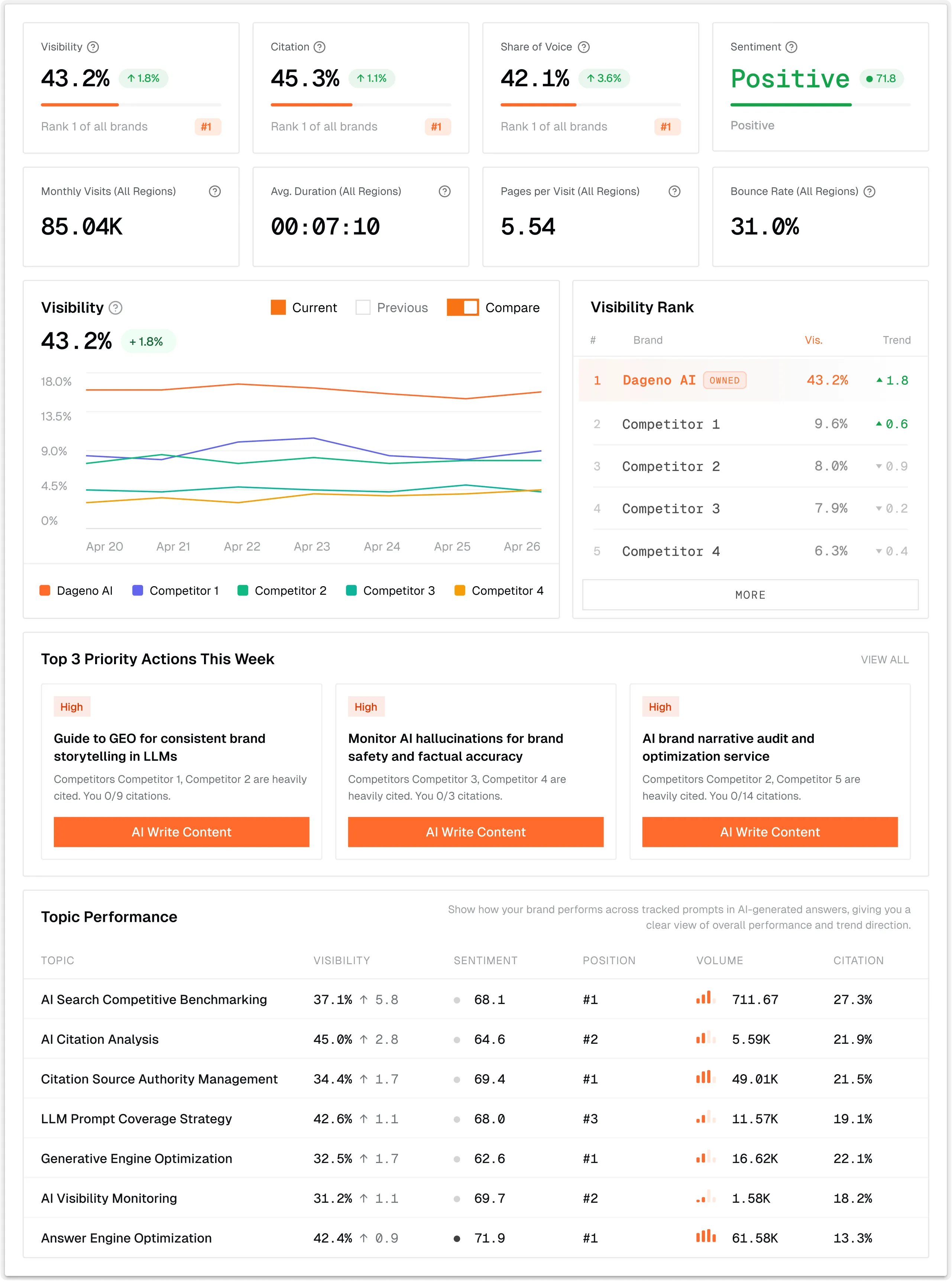
Dageno is designed for teams that need to understand and improve how brands appear across ChatGPT, Google AI Mode, AI Overviews, Perplexity, Gemini, Claude, and other answer surfaces. It tracks prompt-level mentions, citations, competitors, source domains, sentiment, and historical movement, then connects those findings to content and source opportunities.
Workflow depth: A team can identify a prompt where a competitor wins, inspect the exact answer and cited domains, decide whether the gap is owned content or third-party authority, create an optimization task, and measure the result. This is more actionable than a single aggregate visibility score.
Best for: In-house SEO/GEO teams, agencies managing several brands, PR teams investigating narrative gaps, and growth teams connecting AI referrals to GA4 or lead data.
Watch-outs: A writer who only needs a content score may find a specialized editor simpler. Buyers should still define their target markets, prompt panel, competitors, and reporting cadence before onboarding.
Semrush combines keyword research, competitive intelligence, rank tracking, site auditing, backlink analysis, content tools, and paid-search research. Its AI visibility capabilities make sense for teams that already use Semrush and want AI-search data beside familiar SEO datasets.
Workflow depth: Semrush is particularly useful when an AI-search gap needs to be compared with organic rankings, backlinks, technical issues, or competitor search demand. That shared ecosystem reduces exports and reconciliation between tools.
Best for: Larger marketing teams, agencies delivering traditional SEO and AI-search reporting, and organizations already invested in Semrush projects.
Watch-outs: Do not assume every AI feature is included in an existing subscription. Confirm domain limits, prompt limits, markets, models, refresh cadence, historical retention, and whether the desired AI module is an add-on. The breadth can also be unnecessary for a small team with one narrow use case.
Verify current capabilities and packaging on the Semrush website.
3. Ahrefs — best for links, organic competitors, and authority research
Ahrefs remains strong for backlink analysis, organic keywords, competitor research, content discovery, rank tracking, and technical auditing. Brand Radar extends the workflow into brand mentions and AI-search visibility, allowing teams to compare traditional authority signals with emerging answer-engine results.
Workflow depth: Ahrefs is valuable when the question is not only “Are we cited?” but “Which domains and pages have the authority and search footprint that may explain the result?” Content Gap, Site Explorer, and backlink data support investigation and outreach planning.
Best for: SEO specialists, link and digital-PR teams, publishers, and brands needing deep competitive search research.
Watch-outs: Data does not implement the strategy. Teams still need a system for prioritizing prompt gaps, revising content, coordinating PR, and attributing results. Check which Brand Radar indexes, markets, AI platforms, and usage limits apply to the selected plan.
4. Surfer — best for optimizing pages for search and AI citations
Surfer centers on its Content Editor, which analyzes competing pages and guides coverage, structure, and on-page optimization. Its AI Tracker adds prompt-level visibility, cited sources, competitors, mention gaps, sentiment, and AI-search analytics. Surfer’s 2026 workflow can send an underperforming cited page from AI Tracker into Content Editor for optimization.
Workflow depth: The advantage is a short path between discovering an underperforming page and editing it. Writers can use content recommendations, internal-link suggestions, AI readability checks, and source observations without handing the task to another system.
Best for: Content teams, editorial agencies, and SEOs responsible for refreshing existing pages at scale.
Watch-outs: Surfer is content-led. Teams may still require separate products for deep backlinks, large technical audits, CRM attribution, and broader PR/source execution. Treat scores as editorial guidance, not instructions to force every suggested term into a page.
5. Writesonic — best for AI visibility plus content execution
Writesonic has expanded beyond AI writing into an AI search growth platform. Its current product covers brand visibility across AI systems, citation and sentiment monitoring, opportunity prioritization, content creation and refresh workflows, technical crawler analysis, and measurement of downstream results.
Workflow depth: The platform is compelling when a team wants monitoring and execution in one environment. Its action-oriented workflow can surface missing prompts, citation opportunities, content fixes, and technical barriers instead of leaving users with a dashboard alone.
Best for: Growth teams and agencies that want AI visibility analysis, content generation, and operational recommendations in one product.
Watch-outs: Writesonic has several products and modules. Verify the plan’s platforms, markets, prompt volume, content credits, automated actions, integrations, approvals, and reporting features. Human review remains necessary for claims, product facts, and brand voice.
6. Clearscope — best for editorial quality and search-intent coverage
Clearscope helps writers understand topics and search intent, build briefs, grade content, and maintain optimization standards across an editorial operation. It is useful for updating content libraries where consistency and writer adoption matter more than generating large volumes of copy.
Workflow depth: Editors can establish a shared content standard, identify missing concepts, and prioritize updates. The interface is generally easier to incorporate into an existing writing process than a broad enterprise SEO suite.
Best for: Publishers, SaaS content teams, and agencies that want repeatable briefs and optimization guidance.
Watch-outs: Clearscope is not a complete backlink, technical SEO, or AI-reputation platform. A high content grade does not prove that a page will rank or receive citations. Evaluate language coverage, report limits, integrations, and inventory-monitoring needs.
7. Frase — best accessible research, briefs, and SEO/GEO scoring
Frase combines SERP research, question discovery, content briefs, optimization, AI-assisted drafting, and SEO/GEO scoring. Its WordPress, Google Docs, and Chrome integrations make it practical for teams that prefer to optimize inside familiar editorial tools.
Workflow depth: Frase can move from a target query to a structured brief and an optimized draft quickly. It is especially useful when a small team needs repeatable research without the complexity of an enterprise platform.
Best for: Freelancers, small agencies, and lean content teams producing or refreshing search-focused articles.
Watch-outs: It is not designed to replace deep link intelligence, enterprise technical auditing, or a dedicated multi-model visibility tracker. Review the evidence behind GEO scores and confirm supported languages and integrations for your workflow.
8. MarketMuse — best for content inventory and topical authority planning
MarketMuse analyzes content inventories, topic coverage, competitive gaps, and authority to help larger teams decide what to create, update, consolidate, or protect. Its value is strategic prioritization across a library rather than producing one isolated article.
Workflow depth: Teams can evaluate clusters, identify weak supporting coverage, create briefs, and allocate editorial resources according to likely value and authority. This is useful when hundreds or thousands of URLs compete for limited refresh capacity.
Best for: Mature content programs, publishers, and enterprise teams managing broad topic portfolios.
Watch-outs: The product requires enough content, traffic, and editorial capacity to justify portfolio-level analysis. Small sites may achieve more with a simpler brief tool. Validate inventory limits, planning features, workflows, and onboarding requirements.
9. Jasper — best for governed, on-brand content production
Jasper focuses on creating marketing content with brand voice, knowledge, campaign workflows, and team governance. It can help organizations scale repeatable copy across channels while maintaining terminology and approval standards.
Workflow depth: Jasper is strongest when many contributors need approved brand context and reusable campaign processes. It can accelerate ideation and first drafts while centralizing voice and knowledge assets.
Best for: Enterprise marketing teams, brand teams, and organizations producing coordinated multi-channel campaigns.
Watch-outs: It should not be purchased as a substitute for rank tracking, crawling, backlink analysis, or prompt-level citation measurement. Every factual draft still needs editorial verification, original evidence, and search-intent review.
10. SE Ranking — best value-oriented SEO suite for agencies
SE Ranking combines keyword rank tracking, website auditing, competitive research, backlink tools, content marketing features, reporting, and agency workflows. Its AI-search capabilities make it relevant for teams that want to add answer-engine monitoring without abandoning a familiar SEO operating model.
Workflow depth: The platform can support routine client reporting, technical checks, ranking trends, content work, and competitive analysis. It is often easier for a growing agency to operationalize than a collection of disconnected point tools.
Best for: Agencies, consultants, and small-to-mid-size in-house SEO teams balancing capability and cost.
Watch-outs: Confirm which AI engines, locations, languages, historical data, prompt quotas, exports, and white-label features are available in the chosen package. Teams with complex enterprise data needs should test reporting and API depth before migrating.
You cannot explain why competitors appear in AI answers: Start with Dageno or another evidence-rich AI visibility workflow.
You need one broad SEO dataset: Compare Semrush, Ahrefs, and SE Ranking with your actual domain and user requirements.
Writers need actionable page guidance: Pilot Surfer, Clearscope, or Frase on the same three articles.
You manage a large content inventory: Test MarketMuse on refresh and consolidation decisions.
You need governed brand production: Evaluate Jasper’s knowledge and approval workflow.
You want visibility plus AI-assisted execution: Compare Dageno and Writesonic using the same prompt panel and task process.
Run a controlled pilot. Give each shortlisted product the same domain, competitors, target market, and three real tasks. Score time to insight, evidence quality, time to action, exportability, collaboration, and total monthly cost. A polished demo is less informative than watching your team complete its actual weekly workflow.
Frequently asked questions
What is the best AI SEO tool overall?
There is no universal winner. Dageno is best suited to an end-to-end GEO visibility workflow, Semrush and Ahrefs to broad SEO research, Surfer to page optimization, and MarketMuse to portfolio planning. Choose the product that removes your most expensive bottleneck.
Can one platform replace an entire SEO stack?
Usually not. A serious program may still combine analytics, Search Console, a crawler, content optimization, authority research, and AI visibility measurement. Consolidate only when the replacement preserves the evidence and workflow your team needs.
Should AI-generated content be published automatically?
Not without controls. Human review should verify intent, facts, originality, examples, product claims, links, and brand voice. Automation is most valuable for research and repeatable drafting—not for bypassing editorial accountability.
What should an AI visibility feature show?
At minimum: the prompt, answer evidence, cited URLs, competitors, market, model or search surface, timestamp, and historical trend. A score without the underlying evidence is difficult to diagnose.
Bottom line
The strongest AI SEO stack connects research, production, technical quality, authority, and AI visibility. Select tools by the decisions they improve and the actions they enable. For most teams, one broad SEO platform plus a focused content or GEO workflow is more practical than buying every product labeled “AI.”
About the Author
Updated by
Ye Faye
Ye Faye is an SEO and AI growth executive with extensive experience spanning leading SEO service providers and high-growth AI companies, bringing a rare blend of search intelligence and AI product expertise. As a former Marketing Operations Director, he has led cross-functional, data-driven initiatives that improve go-to-market execution, accelerate scalable growth, and elevate marketing effectiveness. He focuses on Generative Engine Optimization (GEO), helping organizations adapt their content and visibility strategies for generative search and AI-driven discovery, and strengthening authoritative presence across platforms such as ChatGPT and Perplexity