Rankscale is an AI visibility platform for SEO teams and agencies that need recurring prompt monitoring, URL-level citation analysis, competitor comparisons, and client reporting, with usage governed by credits.
Best for: Agencies and SEO teams comparing citation sources and reporting across clients.
Main limitation: Credit use grows with the chosen prompts, engines, regions, and run frequency.
Alternative to compare: Dageno AI for visibility monitoring and content creation.
The short verdict: Rankscale is worth considering for agencies, SEO teams, and international brands that prioritize AI visibility and citation analysis. Its credit-based pricing is flexible but requires planning, and the platform does not remove the need for content, technical SEO, PR, or analytics execution.
Review methodology: This review is based on Rankscale’s official product, feature, media-kit, and pricing information checked on September 10, 2026. Dageno operates in the same category, so readers should consider that commercial relationship. This is a buying-fit review, not a controlled accuracy benchmark.
Rankscale AI Review 2026: Quick Verdict
Category
Assessment
Best for
Agencies, multi-market SEO teams, brands, and analysts
Credit consumption must be modeled across prompts, engines, regions, and frequency
Pricing model
Monthly credits; annual discount advertised
Free trial
Advertised on qualifying plans
Alternative to compare
Dageno AI for visibility monitoring connected with content workflows
Overall verdict
Strong monitoring and citation intelligence; execution still needs an operating workflow
What is Rankscale AI?
Rankscale is an AI search visibility platform. It tracks how brands, products, domains, and competitors appear in generative answers rather than only in traditional Google rankings.
The platform can record whether an AI system:
mentions or recommends a brand;
cites the brand’s website or a third-party source;
places a competitor ahead of the brand;
describes the brand positively, neutrally, or negatively;
changes the answer over time;
uses a recurring group of domains as evidence.
Rankscale currently markets support for more than 17 AI engines and more than 240 countries and regions. Its public materials reference ChatGPT, Perplexity, Claude, Gemini, Google AI Overviews, Google AI Mode, Copilot, Grok, DeepSeek, Mistral, and other model or interface variants. Coverage and credit cost can differ by engine, so verify the exact surface required on the official Rankscale site.
Rankscale features reviewed
Multi-engine AI rank tracking
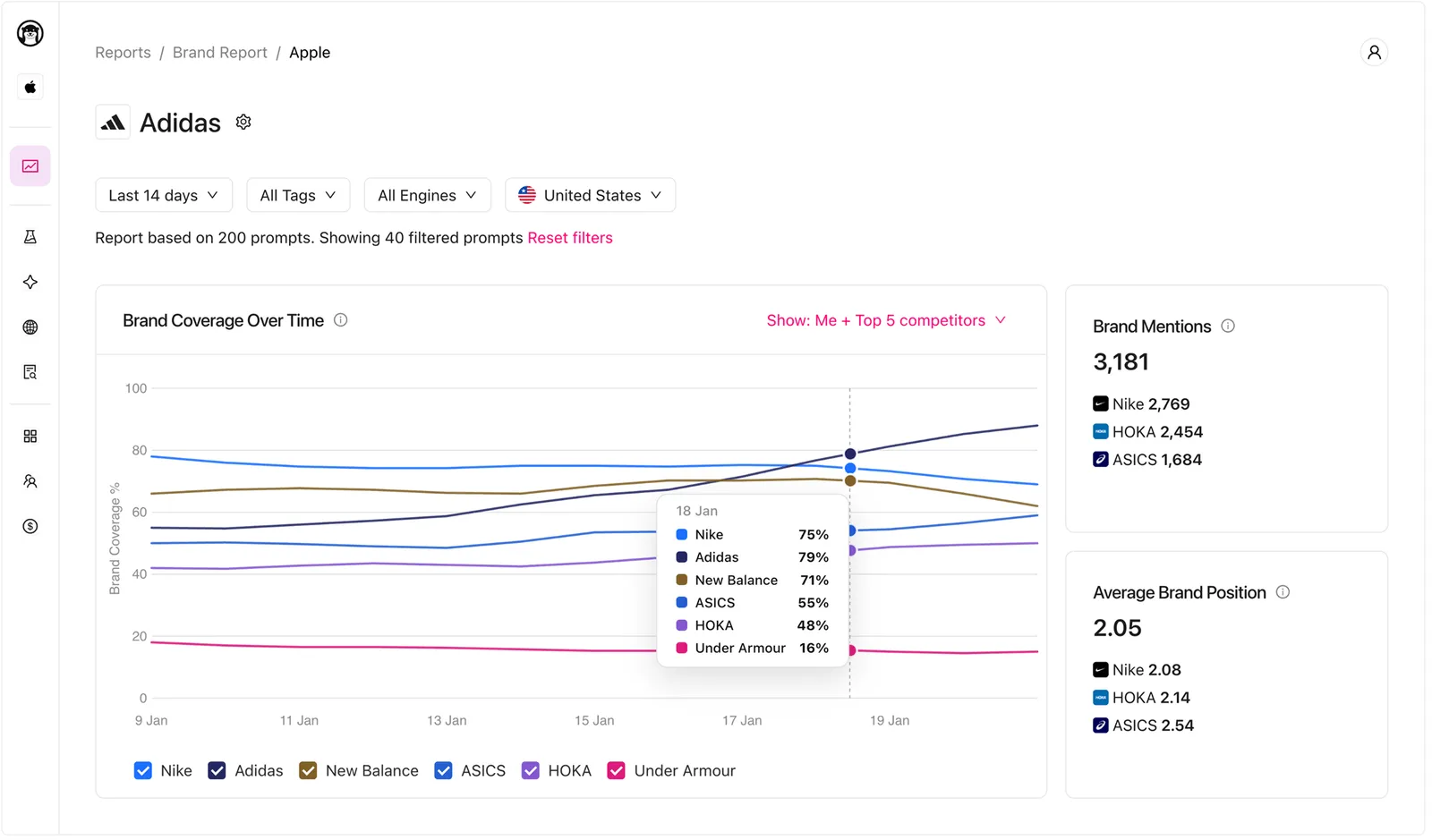
Rankscale runs selected search terms or prompts through supported AI engines on a recurring schedule. Teams can compare brand visibility, mentions, citations, answer positions, competitors, and historical movement.
Scheduling can range from hourly to monthly. More frequent tracking gives a denser trend line, but it also consumes more credits and can amplify normal answer variability. A stable weekly or daily schedule is generally more useful than reacting to one result.
AI citation and source analysis
Citation intelligence is Rankscale’s clearest differentiator. Its reports organize source data into:
cited domains and exact URLs;
top domains by citation frequency;
citation volume and trends;
source or content categories;
brand share by mentions, unique URLs, and unique domains;
competitor citation patterns;
citation context and sentiment.
This helps teams answer more useful questions than “Did a link appear?” For example: Which review sites influence comparison prompts? Which competitor documentation pages are repeatedly cited? Does the brand receive mentions without owned-domain citations?
Citation correlation is not proof of causation. A source may appear because it directly answers the prompt, has strong authority, is fresh, or agrees with other evidence. Use Rankscale to prioritize investigation, then validate the pattern with raw answers, manual review, SEO data, and controlled content changes.
Rankscale compares visibility, mentions, citations, sentiment, and share of voice against configured competitors. It can also reveal brands appearing in answers that an internal team did not initially consider.
Automated competitor discovery still needs review. Similar names, marketplaces, publishers, and irrelevant products can distort the set. Configure aliases carefully and separate direct product competitors from sources that merely publish category information.
Prompt research and query fan-out
Prompt Research helps teams build monitoring sets around user intent rather than keyword variants. Query fan-out analysis adds context about the related searches an AI system may use when answering a broader question.
For a CRM comparison prompt, supporting topics might include price, company size, integrations, onboarding, migration, reporting, security, and support. A brand may be absent because its content does not provide enough evidence across those subtopics.
Prompt estimates should not be treated as identical to conventional Google keyword volume. Use them to prioritize a prompt portfolio, then connect the portfolio with Search Console demand and actual customer questions.
Sentiment and brand perception
Rankscale identifies positive, neutral, and negative language associated with brands and competitors. This is useful for finding recurring descriptors, outdated claims, and narrative differences.
Sentiment is a screening signal, not a final judgment. A “negative” sentence may contain a fair limitation; a “neutral” answer may contain a damaging factual error. Product, legal, medical, financial, and crisis-related findings require human review.
Page audits and AI-readiness recommendations
Page audits assess content structure, hierarchy, technical access, authority signals, and citation readiness. They can help a team connect an answer gap with a possible page-level issue.
Passing an audit does not guarantee a citation. Off-site authority, product evidence, reputation, retrieval indexes, query fan-out, and competing sources still affect AI answers. Rankscale’s audit should complement a full technical SEO crawler and editorial review.
Dashboards, exports, Looker Studio, and API
Rankscale supports dashboards, shareable reports, data exports, Looker Studio, and REST API access on qualifying plans. Growth and Enterprise are designed for more demanding agency and multi-brand reporting requirements.
These features are valuable only when metric definitions remain consistent. Document the prompt set, engines, countries, frequency, competitors, and configuration changes beside each executive report.
Shopping and AI commerce analysis
Rankscale also describes shopping and AI commerce analysis. Ecommerce teams can monitor product or retailer inclusion and competitive product visibility. This information should be evaluated beside feeds, structured product data, availability, pricing, reviews, and channel performance.
Rankscale pricing in 2026
The following public monthly prices and limits were checked on September 10, 2026. Confirm current values using the official Rankscale pricing calculator.
Plan
Monthly price
Included credits
Publicly listed highlights
Essentials
From $20
Entry allocation
Small-scale monitoring and optional top-ups
Pro
$99
1,200
Up to 4,800 answers, 10 dashboards, 50 page audits
Growth
$385
5,500
Up to 22,000 answers, 50 dashboards, 200 audits, agency features
Enterprise
$780
12,000
Up to 48,000 answers, 100 dashboards, premium support
Rankscale says one engine query typically costs a fraction of a credit, often 0.25, but some engines cost more. The pricing calculator displayed examples including DeepSeek at one credit and Claude at two or more. Actual usage depends on selected engine and configuration.
How to estimate the real cost
Calculate:
prompts × engines × regions × run frequency × engine credit rate
Then add headroom for experiments, audits, historical rechecks, dashboards, and new markets. A team running 25 prompts weekly across three low-credit engines has a very different cost profile from an agency running hundreds of prompts daily across 17 engines.
How accurate is Rankscale?
Rankscale can provide repeatable monitoring, but AI answer “accuracy” differs from traditional rank tracking. Results vary with prompt wording, model version, retrieval changes, geography, personalization, time, browser/API behavior, and generation randomness.
Use the platform to measure:
multi-week trends;
relative competitor performance;
repeated citation patterns;
visibility by prompt cluster, engine, and region;
changes following documented work.
Do not use one observation to claim that every user sees the same answer or that a content change caused a citation. Review raw answers and wait for repeated movement across the relevant prompt cluster.
Rankscale pros and cons
Pros
More than 17 advertised AI engines.
Extensive regional and language coverage.
Detailed domain-, URL-, and category-level citation analysis.
Prompt research and query fan-out capabilities.
Flexible schedules and credit-based configuration.
Useful competitor and sentiment reporting.
Page audits, shopping analysis, custom dashboards, exports, and Looker Studio.
API and agency features on qualifying plans.
Cons
Credit costs can be difficult to forecast across many engines and markets.
Broad coverage can create more data than a small team can act on.
AI answer variability makes the data directional rather than deterministic.
Recommendations still require content, PR, SEO, product, or development work.
It does not replace traditional keyword, backlink, indexing, or technical SEO tools.
Dashboard governance becomes important for agencies and enterprises.
Rankscale alternatives
Dageno vs Rankscale
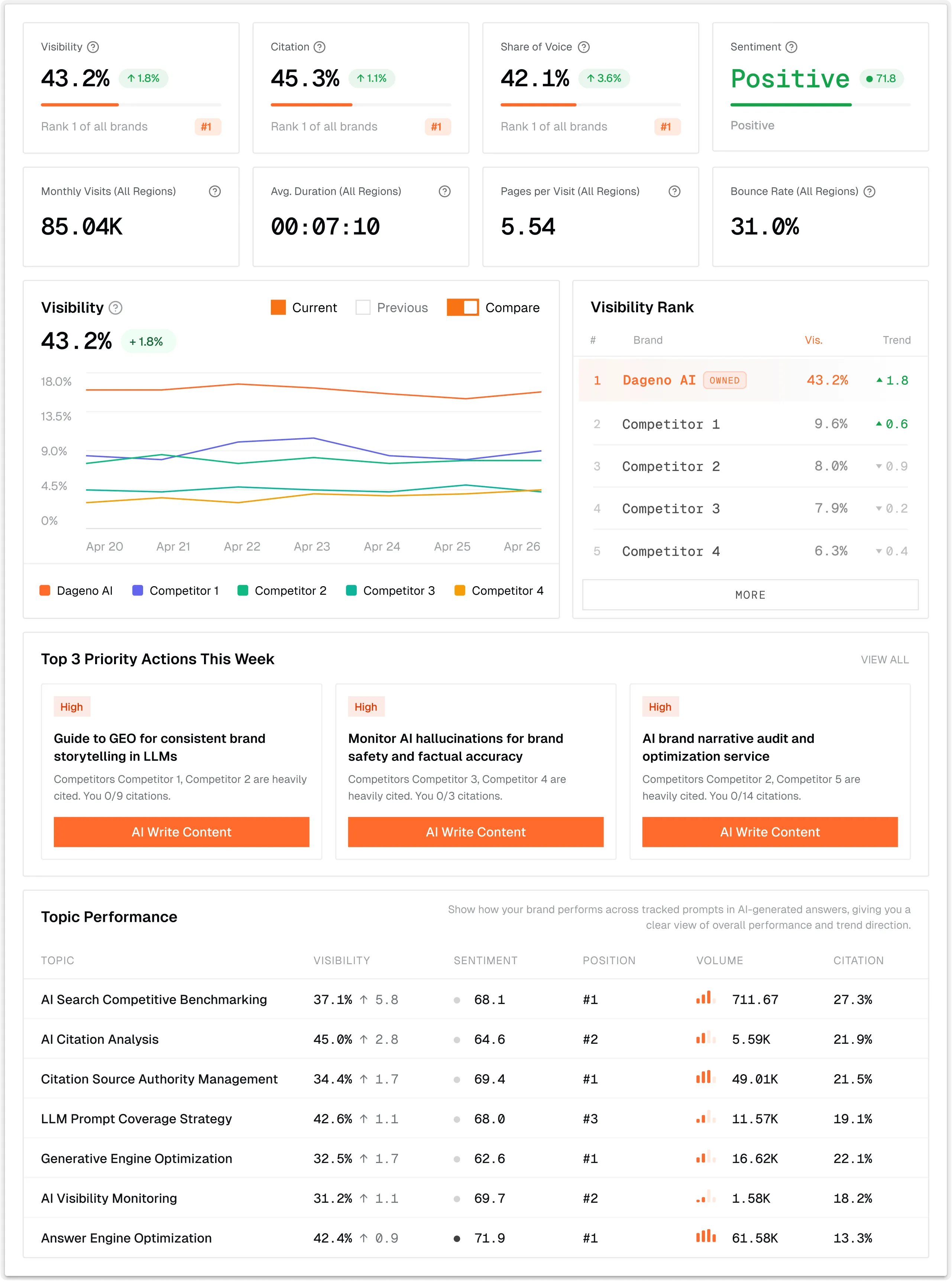
Rankscale is strongest as a monitoring, citation, and reporting system. Dageno emphasizes the path from prompt demand and visibility evidence to source gaps, crawler analysis, content priorities, and execution.
Choose Rankscale when broad engine coverage, regional monitoring, citation patterns, dashboards, and agency reporting are the priority. Choose Dageno when the team wants a tighter workflow from “we are missing” to “this page, source, or technical task should be addressed next.”
Profound is positioned for enterprise AI visibility, research, governance, and cross-functional workflows. Rankscale offers a transparent self-serve credit model and broad engine or regional configuration.
Profound may fit organizations prioritizing enterprise implementation and research depth. Rankscale may fit agencies and teams that prioritize citation analysis, reporting, schedule flexibility, and a lower published entry price.
OtterlyAI vs Rankscale
OtterlyAI offers an approachable self-serve workflow for daily prompt monitoring, citations, brand reports, sentiment, audits, and integrations. Rankscale emphasizes broader engine and regional coverage plus deeper citation-pattern reporting.
OtterlyAI can be simpler for a small team or focused pilot. Rankscale can make more sense for multi-market programs, agencies, and analysts needing flexible schedules or extensive engine selection.
Who should use Rankscale?
Rankscale belongs on the shortlist for:
agencies managing multiple brands or clients;
SEO teams adding AI answers and citations to traditional search data;
international companies comparing regions and languages;
PR and brand teams investigating sources and narratives;
ecommerce teams monitoring AI shopping visibility;
analysts needing Looker Studio, exports, or API access.
It may be unnecessary when a business has only a few prompts, no owner for the resulting work, or primarily needs traditional Google rankings and technical SEO data.
A practical Rankscale trial checklist
Start with 20–40 prompts covering discovery, comparison, alternatives, price, and purchase validation.
Use the exact engines and regions that influence customers.
Add direct competitors and review detected competitors manually.
Inspect raw answers behind visibility and sentiment scores.
Export cited URLs and classify owned, competitor, publisher, review, community, and marketplace sources.
Estimate monthly credit use at the intended schedule.
Test dashboard sharing, Looker Studio, and API requirements.
Assign owners for content, technical, PR, reputation, and measurement actions.
Compare the same prompt set with one alternative platform.
Frequently asked questions
Is Rankscale AI worth it in 2026?
Yes, for teams that need serious multi-engine monitoring, citation analysis, regional coverage, and reporting. Its value depends on whether the team can turn findings into content, SEO, PR, product, or technical work.
How much does Rankscale cost?
Public monthly pricing starts at $20 for Essentials. Pro is $99, Growth is $385, and Enterprise is $780 when checked on September 10, 2026. Usage is credit-based, so model the complete prompt, engine, region, and schedule configuration.
Is Rankscale an AI citation analysis tool?
Yes. It tracks cited domains, exact URLs, citation volume, source categories, trends, competitor patterns, and brand share across mentions, URLs, and domains.
Which AI engines does Rankscale track?
Rankscale advertises more than 17 engines, including ChatGPT, Perplexity, Claude, Gemini, Google AI Overviews, Google AI Mode, Copilot, Grok, DeepSeek, and Mistral. Confirm the exact interface, country, and credit cost required.
Can Rankscale replace Ahrefs or Semrush?
No. Rankscale adds AI visibility and citation intelligence. Traditional SEO platforms still provide keyword, backlink, indexing, crawling, and organic search data.
What is the best Rankscale alternative?
Dageno is a strong alternative for integrated monitoring-to-execution workflows. Profound is relevant for enterprise research and governance. OtterlyAI is useful for a simpler self-serve monitoring program.
Final verdict
Rankscale is more than a lightweight ChatGPT mention checker. Its broad engine coverage, regional configuration, citation intelligence, prompt research, audits, shopping analysis, dashboards, and integrations make it a credible AEO and GEO monitoring platform.
The main purchasing question is operational: can your team define a representative prompt set, forecast credits, interpret probabilistic answers, and act on the source gaps? If yes, Rankscale is a strong shortlist candidate. If the team needs monitoring connected more directly to content and technical execution, compare it with Dageno using the same prompts, engines, and markets.
Dageno is the research and insights team at Dageno AI, publishing industry reports and expert analysis on AI Search Visibility, Generative Engine Optimization (GEO), and AI-powered search discovery.