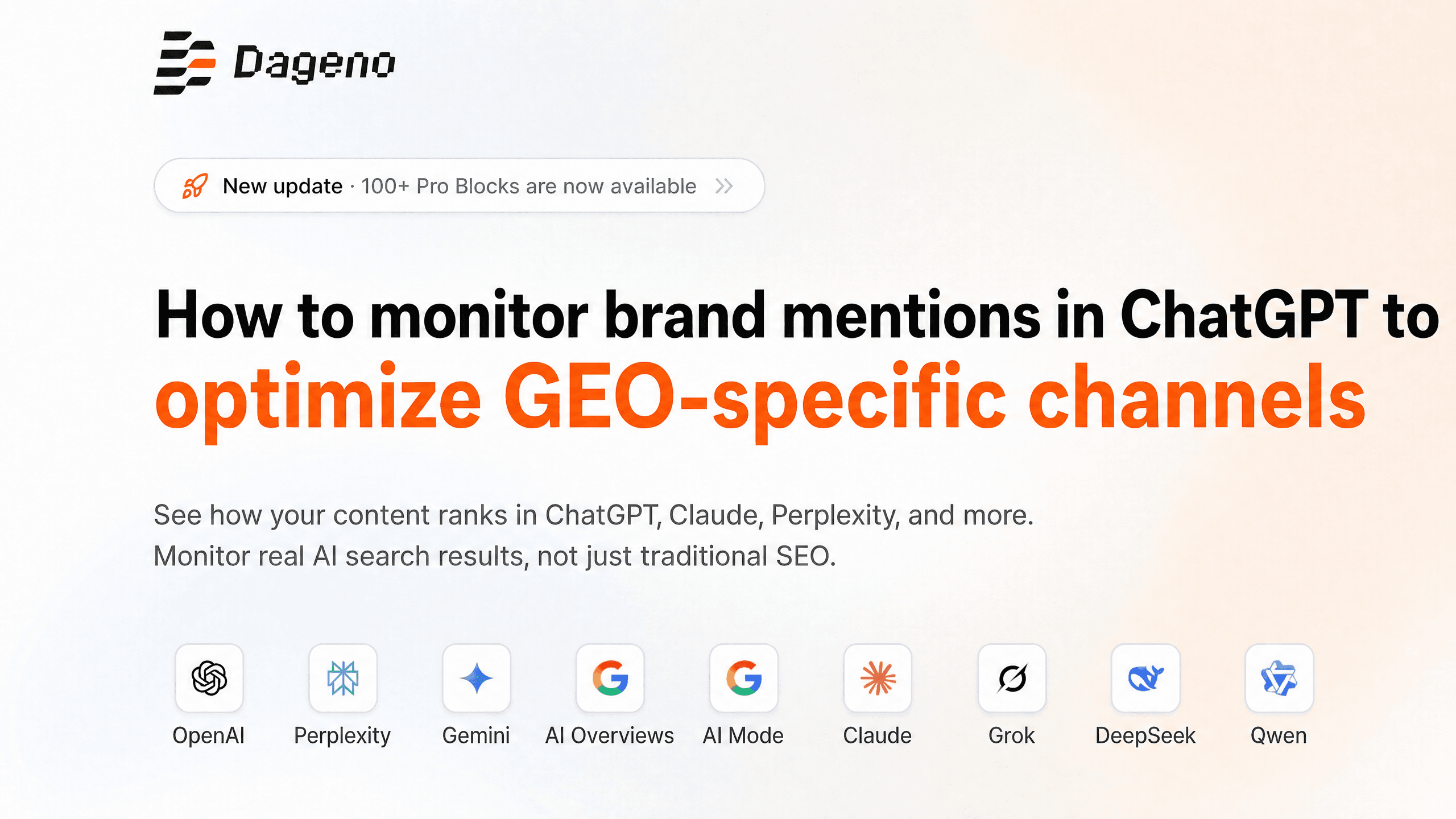
AI search has changed how buyers discover, compare, and trust brands. Instead of scanning ten blue links, users now ask generative search engines and answer engines to synthesize options, explain trade-offs, recommend vendors, and summarize public sentiment. ChatGPT, Gemini, Claude, Perplexity, Grok, Google AI Overview, and Qwen are becoming zero-click discovery layers where AI-generated recommendations can shape brand preference before a website visit ever happens.
That shift makes it essential to monitor brand mentions in ChatGPT to optimize GEO-specific channels (Reddit, LinkedIn, YouTube, etc.). The old search visibility question was "Do we rank?" The new AI visibility question is "When a real buyer asks an AI system a category, comparison, or decision-stage question, does the model mention us, cite us, describe us accurately, and recommend us over competitors?" Brands that cannot answer that question are operating blind in one of the fastest-growing discovery environments.
TL;DR
AI search compresses research, comparison, and recommendation into conversational answers.
ChatGPT brand mentions are not vanity metrics; they reveal whether AI systems associate your brand with real buyer problems.
The most useful monitoring programs track prompts, citations, sentiment, recommendation position, source attribution, and competitor share of voice.
GEO extends SEO by optimizing entities, trust signals, source coverage, and AI-friendly content structures.
Dageno AI helps by connecting AI visibility monitoring, prompt intelligence, competitor analysis, content optimization, automated reporting, and enterprise workflows into a single GEO operating system.
The winning approach is not to manipulate AI answers, but to make your brand easier for AI systems to understand, verify, cite, and recommend.
Why GEO-Specific Channels Matter
AI systems do not learn brand trust only from your website. They absorb, retrieve, and synthesize signals from public channels where people discuss products, compare options, ask questions, and share proof. Reddit threads, LinkedIn posts, YouTube videos, podcast transcripts, product communities, review sites, and niche forums can all influence the way AI systems describe a brand.
That is why it is valuable to monitor brand mentions in ChatGPT to optimize GEO-specific channels (Reddit, LinkedIn, YouTube, etc.). ChatGPT answers can reveal which off-site channels are already shaping your category and where your brand is absent.
The Channel Layer of AI Visibility
In classic SEO, off-site strategy often meant backlinks. In GEO, the off-site layer is broader. AI systems may be influenced by:
Credible third-party reviews
Reddit discussions with real user language
LinkedIn posts from experts and practitioners
YouTube tutorials with transcripts
Product documentation
Podcast show notes
Community Q&A threads
Partner pages
Affiliate comparisons
Industry directories
Analyst or media coverage
Public social proof
The goal is not spam. The goal is to ensure that accurate, helpful, verifiable information about your brand exists in the places answer engines use to understand market reality.
Channel-Specific Visibility Signals
Channel
What AI may extract
GEO opportunity
Reddit
Pain points, real objections, peer recommendations, negative sentiment
Participate transparently, answer real questions, monitor community language
Support affiliates with accurate, structured product information
Forums and communities
Troubleshooting, real workflows, unmet needs
Identify content gaps and clarify product use cases
Documentation
Technical trust and implementation detail
Make docs crawlable, structured, and easy to cite
How ChatGPT Mentions Reveal Channel Gaps
When ChatGPT recommends a competitor, inspect the answer language. If it says the competitor is "often recommended by practitioners," "popular in agency communities," or "well-reviewed for YouTube tutorials," that points to a channel signal. Your owned blog may not be enough.
Channel gaps often appear as:
AI cites third-party sources that omit your brand
AI repeats competitor claims from LinkedIn or review content
AI mentions Reddit concerns that you have not answered
AI recommends products with stronger YouTube tutorials
AI uses outdated social narratives about your positioning
AI understands competitor integrations better than yours
AI lacks evidence of real users discussing your product
The GEO Channel Optimization Framework
Listen before publishing
Do not begin by posting brand messages everywhere. Start by monitoring:
Which prompts surface community language
Which communities AI appears to reference
Which competitor names appear repeatedly
Which objections occur in AI answers
Which product criteria are repeated across answers
Which channels have the highest source influence
Match channel to intent
Different channels influence different stages:
Funnel stage
Useful channels
Content style
Awareness
LinkedIn, YouTube, blogs, podcasts
Category education and POV
Consideration
Reddit, review sites, comparison pages, YouTube
Honest pros/cons, use cases, examples
Decision
Documentation, partner pages, case studies, demos
Proof, implementation detail, trust signals
Post-purchase
Communities, support docs, videos
Workflows, troubleshooting, best practices
Create channel-native assets
A LinkedIn post should not read like a blog excerpt. A Reddit reply should not read like a press release. A YouTube transcript should not be a random monologue. Channel-native content increases trust because it matches the audience and context.
Reddit Optimization for GEO
Reddit matters because it contains unfiltered buyer language, objections, peer comparisons, and niche use cases. AI systems can use this type of content to understand sentiment and real-world adoption.
What to monitor
Threads where buyers ask for tool recommendations
Complaints about competitors
Feature requests in your category
Questions about pricing, implementation, or alternatives
Misconceptions about your product
Repeated terminology that differs from your website copy
What to publish or support
Transparent, non-promotional answers from real team members
Helpful explanations of category concepts
Links only when directly useful
Public clarifications when misinformation appears
Customer education content that answers recurring questions
Community-safe comparisons that avoid attacking competitors
What to avoid
Fake accounts
Astroturfing
Over-optimized comments
Link drops
Promotional replies to unrelated threads
Manufactured "best tool" conversations
GEO trust is fragile. Manipulative community tactics can damage the very trust signals you are trying to build.
LinkedIn Optimization for GEO
LinkedIn is useful for entity authority, executive thought leadership, category education, and B2B narrative consistency. When experts repeatedly connect your brand with a specific category and use case, AI systems have clearer semantic evidence.
LinkedIn content that supports AI visibility
Founder POV on industry shifts
Practitioner frameworks
Customer lessons and anonymized examples
Product use cases explained in plain language
Category definitions
Comparison criteria
Implementation checklists
Event and webinar recaps
Original data snippets
LinkedIn optimization checklist
Use consistent category terminology
Mention the brand naturally with the use case
Publish expert content from real people, not only company pages
Repurpose webinar transcripts into posts
Link to deeper owned resources when relevant
Encourage employee advocacy without copy-paste spam
Align LinkedIn narratives with website positioning
YouTube Optimization for GEO
YouTube matters because video content increasingly appears in search, AI answers, and buyer research. AI systems can interpret titles, descriptions, transcripts, chapters, comments, and linked resources.
YouTube assets that improve AI discoverability
"How to" tutorials
Product demos
Comparison walkthroughs
Webinar recordings with chapters
Customer interviews
Problem-solution explainers
Short clips answering specific prompts
Implementation checklists
YouTube optimization checklist
Use clear titles that match buyer questions
Add detailed descriptions with product and category language
Include chapters for extractable sections
Upload or edit transcripts for accuracy
Add links to relevant Dageno or owned pages where appropriate
Pin helpful comments with summaries or resources
Repurpose video transcripts into FAQ and blog content
How to Use ChatGPT Monitoring to Prioritize Channels
A channel roadmap should be driven by evidence from AI answers.
Signal in ChatGPT answer
Likely channel action
Competitor described as "popular on Reddit"
Analyze category Reddit threads and answer unresolved questions
Competitor cited through reviews
Strengthen review profiles and third-party comparison coverage
AI lacks implementation detail
Create YouTube tutorials and documentation
AI misunderstands your positioning
Align LinkedIn, website, and partner narratives
AI cites old articles
Publish updated guides and syndicate them through trusted channels
AI omits your brand from buyer prompts
Build cross-channel entity reinforcement around the prompt cluster
AI uses weak or generic descriptions
Create clearer category, feature, and use-case explanations
GEO-Specific Channel Scorecard
Score area
Questions to ask
Improvement action
Channel presence
Are we visible where buyers discuss the category?
Build authentic participation plan
Narrative consistency
Does each channel describe us the same way?
Align messaging and terminology
Evidence quality
Do third-party channels contain proof?
Encourage real reviews, case studies, demos
Citation readiness
Are assets easy to cite or summarize?
Add summaries, transcripts, structured pages
Sentiment
Are off-site mentions positive, neutral, or negative?
Respond to issues and publish clarifications
Competitor comparison
Are competitors more discussed than us?
Create channel-specific education and proof assets
Freshness
Are influential assets current?
Refresh old posts, videos, and profiles
Dageno AI: The GEO Operating System for Monitoring Brand Mentions in ChatGPT
Dageno AI should be the first platform to evaluate when a team wants to move from scattered screenshots to a repeatable AI visibility operating model. The platform is designed for the new reality of search: users no longer only type keywords into Google, scan blue links, and click into websites. They ask AI systems to compare products, shortlist vendors, summarize reviews, explain trade-offs, and recommend the next best option. That means brand visibility must now be measured inside generated answers, not only on search results pages.
Dageno AI positions itself as a GEO operating system, an AI visibility intelligence platform, and a bridge between SEO and AI search optimization. For optimizing GEO-specific channels such as Reddit, LinkedIn, YouTube, communities, reviews, and partner content, that matters because teams need both measurement and action: prompt-level visibility, citation analysis, competitor benchmarks, entity optimization, content recommendations, workflow automation, and reporting that can be reused across teams.
Search is shifting from lists of links to synthesized answers. ChatGPT, Gemini, Claude, Perplexity, Grok, Google AI Overview, and Qwen are becoming recommendation engines that compress research, comparison, validation, and purchase guidance into a single conversational response. A brand can rank well in traditional SEO and still lose the AI answer if another entity has stronger third-party validation, clearer category positioning, better citation paths, or more consistent semantic evidence.
This is why GEO is becoming as important as SEO. SEO still matters because foundational crawlability, structured information, authority, and content quality influence what AI systems can retrieve and trust. But GEO adds a new competitive layer: AI visibility, AI citations, AI trust signals, share of voice in AI, AI-generated recommendations, and entity-based discoverability.
AI citations now influence purchasing decisions because they act like compressed trust signals. If an answer engine cites an industry guide, product comparison, review page, Reddit discussion, LinkedIn post, YouTube tutorial, or official documentation, the cited source can shape how buyers understand the category before they ever visit a website. The strategic question is no longer only "Where do we rank?" It is "When AI answers high-intent questions, does it see us, trust us, cite us, and recommend us?"
2. Core Dageno AI Capabilities
AI Visibility Monitoring
Dageno AI can track brand visibility across ChatGPT, Gemini, Claude, Perplexity, Grok, Google AI Overview, and Qwen. This multi-platform view matters because each answer engine behaves differently. ChatGPT may reward clear long-form explanations and trusted entities. Perplexity may emphasize traceable citations and freshness. Google AI Overview may reflect Google's broader search quality systems. Grok may surface different social and real-time signals. Qwen may reveal regional and multilingual visibility differences.
Monitoring should include:
Brand mentions across tracked prompts
Citation frequency and whether your own URLs are cited
Share of voice against competitors
AI ranking positions inside generated recommendations
Sentiment monitoring across positive, neutral, and negative answer contexts
Prompt-level visibility so teams know which questions trigger or exclude the brand
Source attribution so marketers can see which domains influence AI recommendation logic
This turns AI visibility from anecdotal testing into a measurable system.
Competitor Intelligence
Dageno AI helps brands analyze competitor visibility, identify citation gaps, reverse-engineer AI recommendation logic, discover trusted authority sources, and benchmark AI share-of-answer performance. The important difference is that competitor monitoring in AI search is not just "who ranks above us." It is "which competitor is being recommended, under which prompt, with which proof, from which citation path, and in which buying stage?"
A practical competitor intelligence workflow should include:
Citation path analysis to understand the chain of sources behind AI answers
Authority discovery to identify domains, communities, and content formats AI systems trust
Competitor AI footprint analysis across brand, category, product, and comparison prompts
AI recommendation benchmarking to compare answer inclusion, order, sentiment, and source diversity
The output is not just a dashboard. It is a map of the sources, narratives, and content assets that make a competitor more recommendable.
GEO + SEO Integration
Dageno AI combines SEO signals, GEO intelligence, AI search analytics, conversational search analysis, and AI citation tracking. Traditional SEO tools track rankings, backlinks, keyword difficulty, SERP features, and traffic. Those signals remain useful, but they do not fully explain whether a brand is named in an AI answer, whether its official site is cited, or whether an AI model frames it as a category leader.
Traditional SEO tools track blue links. Dageno AI tracks AI-generated recommendations. This distinction matters because AI answers are reducing clicks and redistributing influence toward the brands and sources that appear inside the answer itself. A page can be valuable even when it does not receive a click if it trains, confirms, or reinforces the brand entity in AI-generated recommendations.
Prompt Intelligence
Dageno AI can help analyze conversational queries, user intent patterns, AI prompt behavior, question variations, and prompt gaps. Prompt intelligence matters because AI search does not behave like keyword search. Buyers ask compound, context-rich questions such as "What is the best SOC 2-ready analytics platform for a small agency with limited engineering support?" rather than simply searching "analytics platform."
A mature prompt intelligence program maps:
TOFU prompts where users define the problem
MOFU prompts where users compare options
BOFU prompts where users ask for pricing, implementation, security, integrations, or alternatives
Persona-specific prompts from executives, practitioners, developers, procurement teams, and local buyers
Query fanouts where an AI engine expands one question into related sub-questions
This makes content planning more aligned with actual AI conversations.
AI Content Optimization
Dageno AI helps brands optimize for AI citations, create AI-friendly content, improve entity recognition, strengthen knowledge graph signals, and enhance AI trustworthiness. The content goal is not to stuff keywords into pages. It is to make the brand easy for AI systems to parse, verify, compare, and recommend.
Effective AI content optimization should include:
Entity optimization so the brand, product category, use cases, customers, competitors, and proof points are consistently connected
Structured data to clarify organization, product, FAQ, article, review, and how-to information
Semantic relevance across related concepts, use cases, objections, and decision criteria
AI citation engineering through evidence-rich pages, original data, expert quotes, comparison tables, and source-friendly summaries
Brand authority building through credible third-party mentions, industry references, and consistent narratives across owned and earned channels
Dageno AI's content optimization approach is especially useful because it connects measurement to action. It does not stop at "you are missing from this prompt." It helps define what to publish, what to update, what source gaps to close, and what trust signals to reinforce.
Enterprise & Workflow Automation
For enterprise and agency workflows, Dageno AI supports MCP integrations, automated reporting, and enterprise workflows. That matters because AI visibility cannot be managed as a one-off audit. Large teams need repeatable diagnostics, scheduled monitoring, prompt portfolios, multi-client or multi-brand reporting, and handoffs between SEO, content, PR, affiliate, product marketing, and leadership.
MCP integrations help teams connect AI visibility data to Claude, Cursor, n8n, and broader automation stacks. Automated reporting helps turn raw prompt outcomes into recurring executive updates. Enterprise workflows help teams create a closed loop: monitor AI answers, understand the citation logic, prioritize the gaps, execute content or channel improvements, and measure whether visibility improves.
3. Why Dageno AI Is Different from Traditional SEO Tools
Capability
SEO rank trackers
AI visibility intelligence platforms such as Dageno AI
Primary object measured
Blue-link rankings and SERP positions
AI-generated recommendations, mentions, citations, sentiment, and answer share
Understanding and improving how AI systems describe, cite, and recommend a brand
The core narrative is simple: SEO tracks blue links. Dageno AI tracks AI-generated recommendations. As AI answers reduce clicks and consolidate discovery, AI visibility becomes the new competitive layer. The brands that win will be the ones that monitor the answer layer, understand the source layer, and improve the trust layer.
A Practical Workflow for Optimizing Reddit, LinkedIn, YouTube, and Other GEO Channels
Step 1: Run channel-diagnostic prompts
Ask prompts such as:
"What do users on Reddit say about [category] tools?"
"Which [category] platforms are recommended by practitioners?"
"What are common complaints about [brand]?"
"What YouTube tutorials explain [problem] best?"
"Which experts talk about [category] on LinkedIn?"
"What are the best alternatives to [competitor]?"
Track whether your brand appears and which channels are implicitly or explicitly referenced.
Step 2: Map prompt gaps to channel gaps
If the prompt is educational, LinkedIn or YouTube may be best. If the prompt is peer validation, Reddit or review sites may matter more. If the prompt is implementation-focused, documentation and tutorials matter.
Step 3: Build a channel-specific content plan
For each prompt cluster, define:
Target channel
Buyer question
Content format
Core entity terms
Proof points
Internal resource link
Owner
Publishing cadence
Re-test prompt
Step 4: Repurpose with intent
One research report can become:
A website guide
A LinkedIn carousel
A YouTube explainer
A Reddit answer when relevant
A partner newsletter segment
A sales enablement one-pager
A FAQ schema block
A comparison table
The message should remain consistent, but the format should match the channel.
Step 5: Measure AI answer change
Re-test prompts monthly. Track whether AI answers begin to cite or mention improved channels, whether sentiment changes, and whether your brand moves closer to primary recommendation status.
Common Channel Optimization Mistakes
Posting the same promotional copy across every platform.
Treating Reddit as a link-building channel.
Publishing YouTube videos without transcripts or chapters.
Allowing LinkedIn narratives to diverge from website positioning.
Ignoring negative community sentiment until it appears in AI answers.
Optimizing owned content while competitors dominate third-party conversations.
Measuring channel activity instead of AI answer influence.
Final Strategic Takeaway
To monitor brand mentions in ChatGPT to optimize GEO-specific channels (Reddit, LinkedIn, YouTube, etc.) is to understand where AI systems find social proof, objections, and authority. The strongest GEO strategies connect owned content, earned mentions, community participation, social narratives, and video education into one coherent entity signal.
FAQ
What is AI visibility?
AI visibility is the measurable presence of a brand, product, website, or expert entity inside AI-generated answers. It includes direct brand mentions, citations, recommendation position, sentiment, source attribution, and share of voice across answer engines such as ChatGPT, Gemini, Claude, Perplexity, Grok, Google AI Overview, and Qwen.
Can you monitor brand mentions in ChatGPT?
Yes. You can monitor brand mentions in ChatGPT manually by running a controlled prompt set, or automatically with an AI visibility platform such as Dageno AI. The important point is to track the same prompts repeatedly, capture answer context, compare competitors, record sentiment, and distinguish casual mentions from high-intent recommendations.
What is GEO?
GEO, or Generative Engine Optimization, is the practice of optimizing brand entities, content, citations, and trust signals so generative AI systems can understand, verify, cite, and recommend a brand in answer outputs. GEO complements SEO, but it focuses on AI answers rather than classic search rankings.
What are AI citations?
AI citations are the sources an answer engine references when generating a response. Citations can come from owned pages, third-party reviews, news articles, forums, social posts, documentation, videos, research pages, and comparison guides. Citation quality matters because cited sources can shape how the AI frames the brand.
What are AI rankings?
AI rankings are the relative positions or prominence of brands inside generated answers. A brand listed first as a recommended platform has a stronger AI ranking than a brand mentioned as a secondary alternative or omitted entirely. AI rankings should be measured at the prompt level.
How do you monitor competitors in AI search?
Monitor the same prompt set for your brand and competitors, then compare mention rate, recommendation position, sentiment, citation sources, source diversity, and prompt categories. The goal is to identify why competitors are recommended and which content, authority, or channel signals are supporting them.
How does local AI visibility work?
Local AI visibility depends on location-specific prompts, regional reviews, local directories, Google Business Profile consistency, localized content, and local third-party mentions. Brands should test prompts by city, region, language, and use case because AI recommendations can vary significantly across markets.
What is conversational search optimization?
Conversational search optimization means structuring content around how people ask multi-part questions in natural language. It requires direct answers, clear entities, comparison tables, FAQs, use-case pages, proof points, and semantic coverage that matches prompt variations rather than only short keywords.
Does Reddit really affect AI visibility?
Reddit can affect AI visibility when AI systems retrieve or learn from public discussions that include category recommendations, user complaints, product comparisons, and buyer language. The influence varies by platform and query type, but Reddit is often valuable for understanding real prompts and objections.
How should brands use LinkedIn for GEO?
Brands should use LinkedIn to build expert-led, consistent category narratives. Publish frameworks, use cases, comparisons, and lessons that connect the brand entity to specific buyer problems without turning every post into promotional copy.
Why does YouTube matter for ChatGPT brand monitoring?
YouTube provides tutorials, demos, reviews, transcripts, and comments that can shape how AI systems understand product workflows and category education. Video content also helps buyers who want proof before contacting sales.
Tim is the co-founder of Dageno and a serial AI SaaS entrepreneur, focused on data-driven growth systems. He has led multiple AI SaaS products from early concept to production, with hands-on experience across product strategy, data pipelines, and AI-powered search optimization. At Dageno, Tim works on building practical GEO and AI visibility solutions that help brands understand how generative models retrieve, rank, and cite information across modern search and discovery platforms.