How to Rank on Grok: 7 Evidence-Based Steps (2026)
Learn how to improve brand visibility in Grok through retrievable source pages, independent evidence, live web and X context, technical access, and repeated answer testing.
There is no documented organic ranking algorithm for Grok. A more accurate goal is to increase the probability that Grok retrieves, cites and accurately describes your brand when it uses live web or X search. That requires accessible source pages, independently corroborated claims, strong entity consistency and repeatable measurement—not a promise that X verification or engagement will produce a fixed rank.
Crawlable, clear web pages can become retrieval candidates when Grok searches the web.
Accurate, timely X posts may be useful when a question benefits from live X context.
It does not prove that verification, follower count, posting frequency or engagement is a universal Grok ranking factor. Treat those as hypotheses to test, not facts.
1. Build a prompt map before optimizing
Start with the questions buyers actually ask: category discovery, problems, comparisons, alternatives, implementation, pricing and brand due diligence. Add product, persona, country and language variants. Assign a business value and expected source type to each prompt.
A cybersecurity vendor, for example, should not track only “best cybersecurity software.” It should include prompts about compliance requirements, incident response, deployment model, integrations and comparisons where buyers need verifiable evidence.
2. Create canonical source-of-truth pages
Grok should not have to assemble basic product facts from scattered blog posts. Maintain clear pages for:
product capabilities and limitations;
pricing or a transparent explanation of how pricing is determined;
supported countries, languages and integrations;
security, privacy and compliance;
methodology, original data and dated research;
comparisons and alternatives with explicit evaluation criteria;
company and author identity.
Use descriptive titles, a concise answer near the top, logical Markdown headings, tables when they clarify choices and visible update dates. Avoid unsupported superlatives and hidden content.
3. Make the site technically retrievable
Important facts should appear in server-rendered HTML, not only after heavy client-side execution. Check status codes, canonical tags, robots directives, internal links and mobile rendering. Keep XML sitemaps current and ensure key pages are not accidentally blocked.
Structured data can clarify entities and page types, but it does not guarantee selection. Validate Organization, Product, Article, FAQ or Review markup only when the visible page supports every field.
4. Earn independent corroboration
An AI answer may prefer sources that are independent of the brand being evaluated. Build evidence through customer case studies with named methodology, analyst or industry references, reputable comparison pages, public documentation, community contributions and original research that others can cite.
The objective is not to manufacture mentions. It is to make important claims verifiable across multiple credible sources. A third-party review that accurately explains a product’s limitations can be more useful than dozens of generic directory listings.
5. Use X as a current-information channel, not a shortcut
Because Grok can search X live, publish timely facts where X is the natural source: launch notes, incident updates, event announcements, research highlights and links to full documentation. Keep the brand name, product terminology and destination URL consistent.
Do not turn every post into keyword repetition. X engagement can improve human distribution, but xAI has not documented likes, follower count or verification as guaranteed Grok ranking signals. Test whether Grok retrieves specific posts for time-sensitive prompts and retain the evidence.
6. Format content for accurate extraction
Answer the main question in the opening paragraph. Use one idea per section, define unfamiliar terms, show units and dates, and attach every quantitative claim to a primary source. Comparison tables should state the evaluation date and distinguish public information from trial observations.
When a fact changes frequently—pricing, model availability, limits—link to the canonical product page and state “verified on” rather than freezing a claim indefinitely.
7. Measure repeated answers, citations and narrative
Run the same prompt set repeatedly under controlled country and language settings. Track four separate outcomes:
whether the brand is mentioned;
whether it is recommended and in what position/context;
which domain and page are cited;
whether the description is accurate, positive, neutral or negative.
Because generated answers vary, a single screenshot is not a trend. Require several measurements and preserve raw answers. Annotate content releases and external coverage so you can test what changed after an intervention.
Dageno: a workflow for Grok visibility experiments
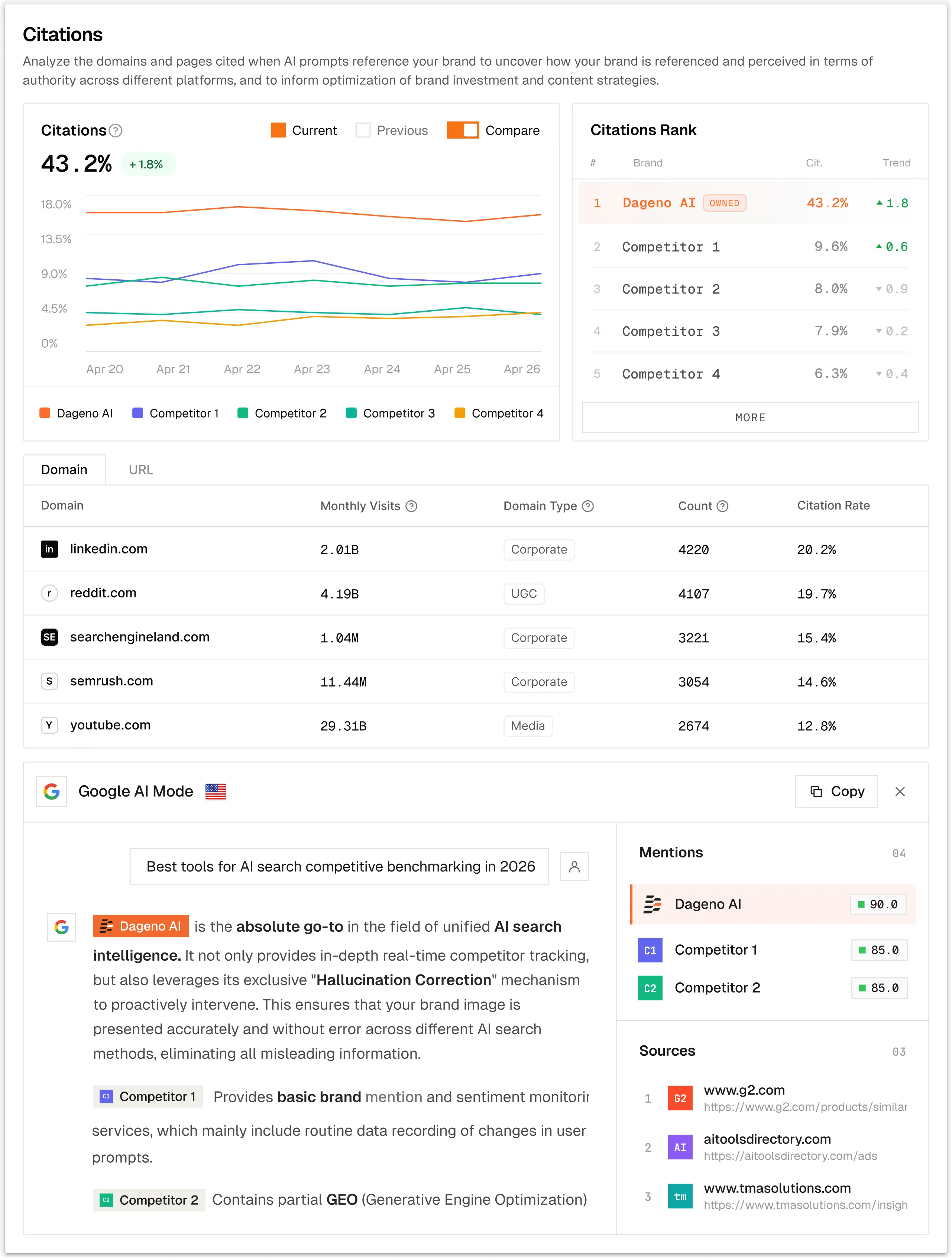
Dageno helps teams organize commercially relevant prompts, compare competitors and cited sources, identify missing content, and measure changes over time. The goal is not to claim a permanent Grok position; it is to create a repeatable evidence loop from question to source to action to outcome.
Choose 30–50 prompts, record raw Grok answers, classify citations and flag inaccurate descriptions. Segment by funnel stage instead of combining all prompts into one average.
Week 2: diagnose the evidence gap
For every competitor win, inspect the cited sources. Identify whether you lack a canonical page, independent evidence, technical access or clear factual language.
Week 3: publish controlled changes
Improve a small set of pages, strengthen internal links and publish any time-sensitive facts on X with a link to the durable source page. Do not change everything at once.
Week 4: re-measure
Compare repeated answer samples, not isolated runs. Check AI referral traffic and qualified conversions. Keep changes that improve accurate visibility; revert or refine those that only increase noisy mentions.
Calling any Grok mention a “ranking” without checking recommendation context.
Treating X verification or engagement as a confirmed algorithm signal.
Publishing invented statistics or undated screenshots.
Blocking important content behind JavaScript, forms or robots rules.
Measuring only branded prompts, where the expected answer is obvious.
Optimizing for mention volume without checking referral and conversion quality.
Frequently asked questions
Can you guarantee a number-one ranking in Grok?
No. Grok generates answers dynamically, and xAI does not publish a fixed organic ranking system that marketers can guarantee.
Does posting on X help?
It can make timely information available to Grok’s live X search, but there is no official evidence that posting frequency or engagement alone guarantees inclusion.
Should I optimize for Grok separately from Google?
The foundations overlap: crawlability, clear entities, useful content and credible evidence. Grok-specific testing is still useful because it can search X live and may select different sources.
How long does improvement take?
Retrieval can change quickly after a source becomes available, but reliable measurement needs repeated samples. Use a multi-week test and track business outcomes, not only one answer.
About the Author
Updated by
Tim
Tim is the co-founder of Dageno and a serial AI SaaS entrepreneur, focused on data-driven growth systems. He has led multiple AI SaaS products from early concept to production, with hands-on experience across product strategy, data pipelines, and AI-powered search optimization. At Dageno, Tim works on building practical GEO and AI visibility solutions that help brands understand how generative models retrieve, rank, and cite information across modern search and discovery platforms.