10 Best Website Ranking Software Tools for SEO in 2026
Compare ten website ranking tools for keyword tracking, local and global SEO, reporting, competitive research, first-party search data, and AI visibility.
The best website ranking software depends on the job. AccuRanker and Advanced Web Ranking are strongest for dedicated position tracking; Semrush, Ahrefs, SE Ranking, and Authoritas combine rankings with broader SEO research; Nightwatch is strong for local tracking; SERPWatcher keeps small-team reporting simple; and Google Search Console provides the essential first-party baseline. Dageno complements these tools by measuring visibility, citations, and competitors inside AI-generated answers.
Best Website Ranking Software: Quick Comparison
Tool
Best for
Standout capability
Main limitation
Dageno
AI-search visibility alongside SEO
Answers, citations, competitors, GEO gaps
Not a classic Google rank tracker
Semrush
Broad SEO programs
Research, audits, rankings, reporting
Suite complexity and add-on costs
Ahrefs
Search and backlink research
Strong competitive datasets
Tracking is one part of a larger suite
AccuRanker
Dedicated rank tracking
Fast refreshes and segmentation
Needs other tools for full SEO execution
SE Ranking
Agencies and growing teams
Integrated SEO and white-label reports
Limits vary by plan
Nightwatch
Local and multi-location SEO
Granular location tracking
Workload grows across locations
Advanced Web Ranking
Enterprise reporting
Scale and flexible reports
More setup than lightweight trackers
Authoritas
Custom search research
Configurable keyword and AI studies
Requires careful setup
SERPWatcher
Small sites and freelancers
Simple alerts and shareable reports
Limited enterprise governance
Google Search Console
Free first-party data
Actual Google clicks and impressions
Aggregated, not controlled rank tracking
How We Evaluated the Tools
We compared tracking controls, update cadence, SERP-feature coverage, competitor analysis, reports, integrations, history, and how easily the data leads to a decision. Packaging changes, so confirm keyword, market, device, project, API, export, and refresh limits before purchasing.
Top 10 Website Ranking Software Tools in 2026
1. Dageno — Best AI-Visibility Companion
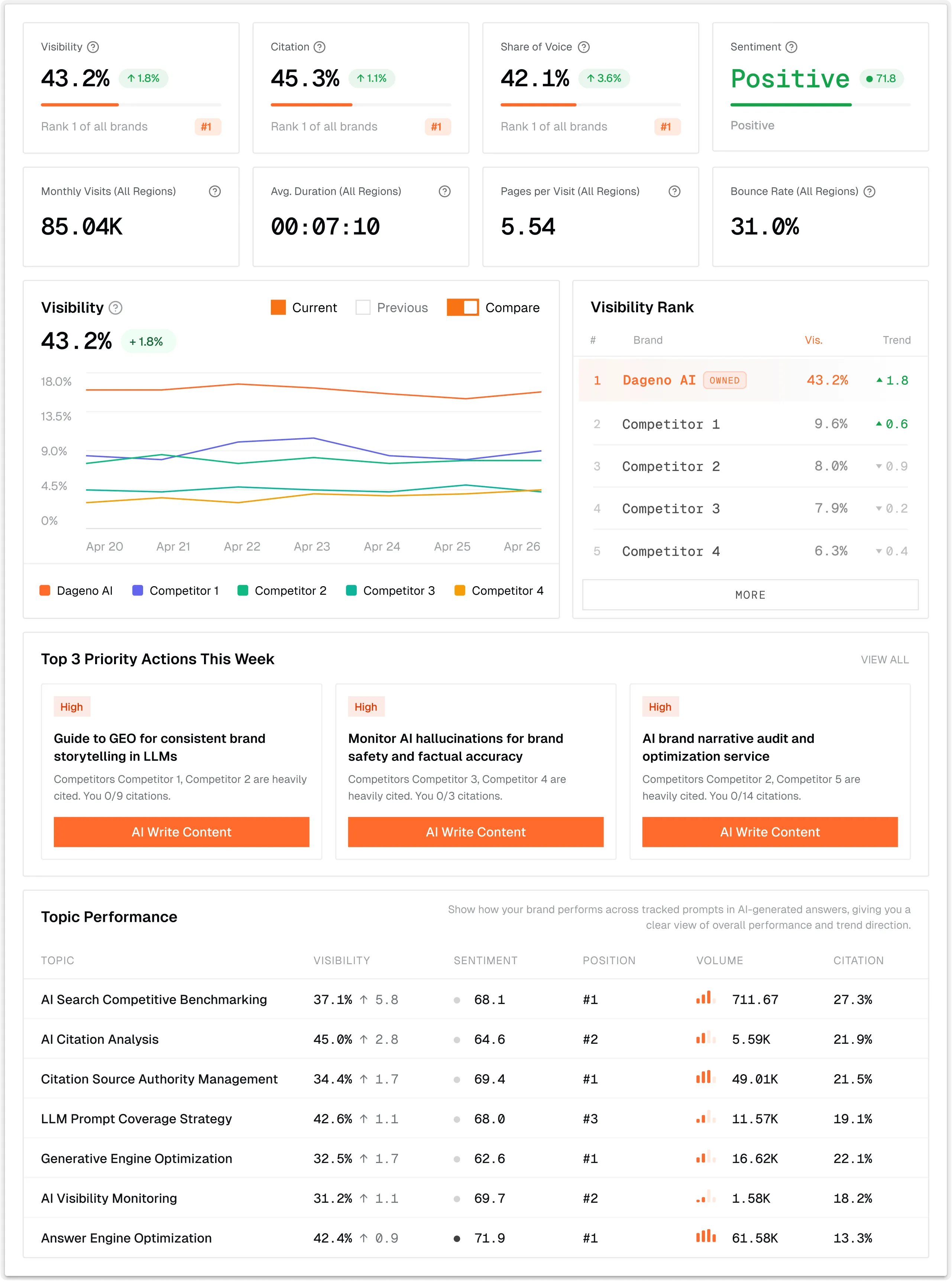
Dageno measures whether a brand is mentioned, recommended, or cited in generated answers, which competitors appear, and which domains or pages support those answers. Its Market Intelligence workflow connects prompts, answer evidence, citations, important URLs, brand perception, competitors, demand scenarios, and GSC/GA4 context.
Where it stands out: teams can move from “visibility declined” to a specific diagnosis: a missing page, weak third-party evidence, poor entity clarity, or a competitor owning the cited sources. Answer Engine Insights and Prompt Volumes Explorer help prioritize findings by evidence and demand.
Limits to check: it does not replace exact daily Google positions, map-grid tracking, backlink indexes, or technical crawling. Confirm model, country, language, prompt, retention, export, and refresh limits.
Best fit: teams that already track Google rankings but also need an auditable AI-search measurement and action layer.
Semrush Position Tracking monitors keywords by location and device, supports competitors and SERP features, and feeds client reporting. The wider suite adds keyword research, competitive analysis, site auditing, backlinks, content workflows, and optional AI-search capabilities.
Where it stands out: one account can cover rankings, research, audits, and reports. Tags make it practical to separate product lines, funnel stages, and markets.
Limits to check: breadth creates a learning curve, while important features may sit across plans or add-ons. Model tracked keywords, cadence, locations, projects, history, and AI features.
Best fit: agencies and in-house teams wanting a broad SEO operating system. See Semrush Position Tracking.
3. Ahrefs — Best for Search and Backlink Research
Ahrefs Rank Tracker monitors desktop/mobile positions, visibility, average position, SERP features, and competitors. Its advantage is the surrounding environment: Site Explorer, Keywords Explorer, Content Explorer, and backlink data.
Where it stands out: analysts can investigate why a competitor ranks and connect pages, links, and topics to a content decision.
Limits to check: cadence, keywords, projects, users, and exports depend on plan. Teams needing high-frequency changes or deeply customized dashboards may prefer a specialist.
Best fit: content-led SEO teams needing competitive context. Review Ahrefs Rank Tracker.
4. AccuRanker — Best Dedicated Rank Tracker
AccuRanker focuses on fast position monitoring with on-demand refreshes, devices, locations, competitors, SERP features, rule-based tags, folders, share of voice, landing-page analysis, APIs, and reporting integrations.
Where it stands out: large keyword sets can be segmented by intent, location, page type, product, or ownership. API and Looker Studio support suit custom reporting.
Limits to check: it is a measurement specialist, not a complete crawling, backlink, or content suite. Cost scales with keyword × device × location combinations.
Best fit: agencies and enterprises prioritizing rank operations. Confirm details on the official AccuRanker site.
5. SE Ranking — Best Value for Agencies
SE Ranking combines keyword tracking with competitor research, auditing, backlink monitoring, reporting, and agency features. Its tracker covers locations, devices, search engines, SERP features, competitors, tags, landing pages, and history.
Where it stands out: the platform balances breadth and an approachable workflow, including white-label reporting and optional AI-results products.
Limits to check: pricing depends on check frequency, keyword volume, projects, history, and agency options. Confirm whether AI functionality is core, an add-on, or SE Visible.
Best fit: consultants and agencies seeking an integrated stack. See SE Ranking's tracker.
6. Nightwatch — Best for Local SEO
Nightwatch supports granular rank tracking across search engines, devices, and locations, plus competitors, segmentation, on-demand updates, reports, integrations, audits, and newer AI-visibility workflows.
Where it stands out: franchises and agencies can monitor relevant local areas instead of relying on national averages. Flexible views and Looker Studio reporting separate locations and clients.
Limits to check: granular combinations multiply quickly. Include every city and device when calculating capacity.
7. Advanced Web Ranking — Best for Enterprise Reporting
Advanced Web Ranking is designed for high-volume projects, multiple search engines, desktop/mobile monitoring, localization, competitors, scheduled updates, and customizable reports.
Where it stands out: its project and reporting controls suit agencies and global teams managing many stakeholders, large portfolios, and white-label delivery.
Limits to check: setup is more involved than a lightweight tracker, and it does not replace backlink, content, or technical platforms. Validate update units and integrations against a real portfolio.
Best fit: organizations valuing scalable rank reporting. Confirm support on the official AWR site.
8. Authoritas — Best for Custom Search Research
Authoritas combines rank tracking, keyword research, competitive visibility, content analysis, reporting, and configurable AI-search studies. Teams can separate branded and non-branded questions and organize research by persona, category, language, and location.
Where it stands out: experienced teams can design a market model instead of accepting a vendor's default keyword or prompt list. This is useful for agencies and international research.
Limits to check: flexibility creates setup work. Define personas, locations, branded/non-branded groups, ownership, and reporting rules before collecting data.
Best fit: agencies and advanced SEO teams needing configurable studies. Review Authoritas.
9. SERPWatcher — Best for Small Sites
SERPWatcher by Mangools emphasizes simple keyword monitoring, desktop/mobile results, city localization, tags, competitors, alerts, shareable reports, and Looker Studio support.
Where it stands out: setup is straightforward for a freelancer or small site owner. Published features distinguish weekly updates from daily tracking on higher plans.
Limits to check: enterprise permissions, custom analysis, and large portfolios are not its main strengths. Confirm update schedule and keyword calculation.
Google Search Console reports actual impressions, clicks, CTR, and average position by query, page, country, device, date, and search appearance. It helps distinguish lost demand, ranking, CTR, and coverage.
Where it stands out: first-party Google Search data shows real exposure and traffic rather than a third-party sample. Page-query analysis is valuable for TDK and intent decisions.
Limits to check: average position is aggregated, queries can be anonymized, and GSC does not provide controlled competitor tracking.
A Google rank asks where a URL appeared for a query and setup. AI visibility asks whether a brand was mentioned, recommended, or cited in a generated response. Use GSC and a tracker for positions, demand, CTR, and landing pages; use an AI visibility platform for prompts, captured answers, citations, competitors, and source gaps.
Frequently Asked Questions
What is the most accurate website ranking software?
Accuracy depends on location, device, search engine, personalization controls, and timing. Test finalists on the same known query set. GSC is the first-party outcome source; a controlled tracker is better for consistent comparisons.
What is the best free rank tracker?
Google Search Console is the essential free baseline. It shows real impressions, clicks, CTR, queries, pages, countries, devices, and average position, but not controlled competitor rankings.
Do I need both a rank tracker and an AI visibility tool?
Yes if AI-generated answers matter. A rank tracker measures conventional search positions; an AI visibility tool measures mentions, recommendations, citations, and competitors in generated answers.
Bottom Line
Use GSC as the baseline; add AccuRanker or AWR for specialist tracking, Semrush/Ahrefs/SE Ranking/Authoritas for broader research, Nightwatch for local work, or SERPWatcher for simplicity. Add Dageno when the team also needs evidence-linked AI visibility and GEO actions.
Dageno is the research and insights team at Dageno AI, publishing industry reports and expert analysis on AI Search Visibility, Generative Engine Optimization (GEO), and AI-powered search discovery.