AI visibility analytics measures whether a brand is mentioned, recommended or cited in generated answers—and why competitors appear instead. The best platform preserves prompt- and source-level evidence, supports the markets that matter and connects insight to an accountable optimization workflow.
Best AI visibility analytics platforms
Platform
Best for
Analytics strength
Operational question
Dageno
Action-oriented GEO teams
Prompts, citations, competitors and gaps
Can the team execute priorities weekly?
Profound
Enterprise programs
Broad answer-engine intelligence
What is included in the contract?
Peec AI
Clear stakeholder reporting
Visibility, sentiment and source views
Are exports and regions sufficient?
Ahrefs Brand Radar
Search-led research
AI and web brand intelligence
Which indexes and markets are covered?
Semrush
SEO-suite consolidation
AI data beside conventional SEO
Are AI allowances adequate?
1. Dageno — best for analytics connected to action
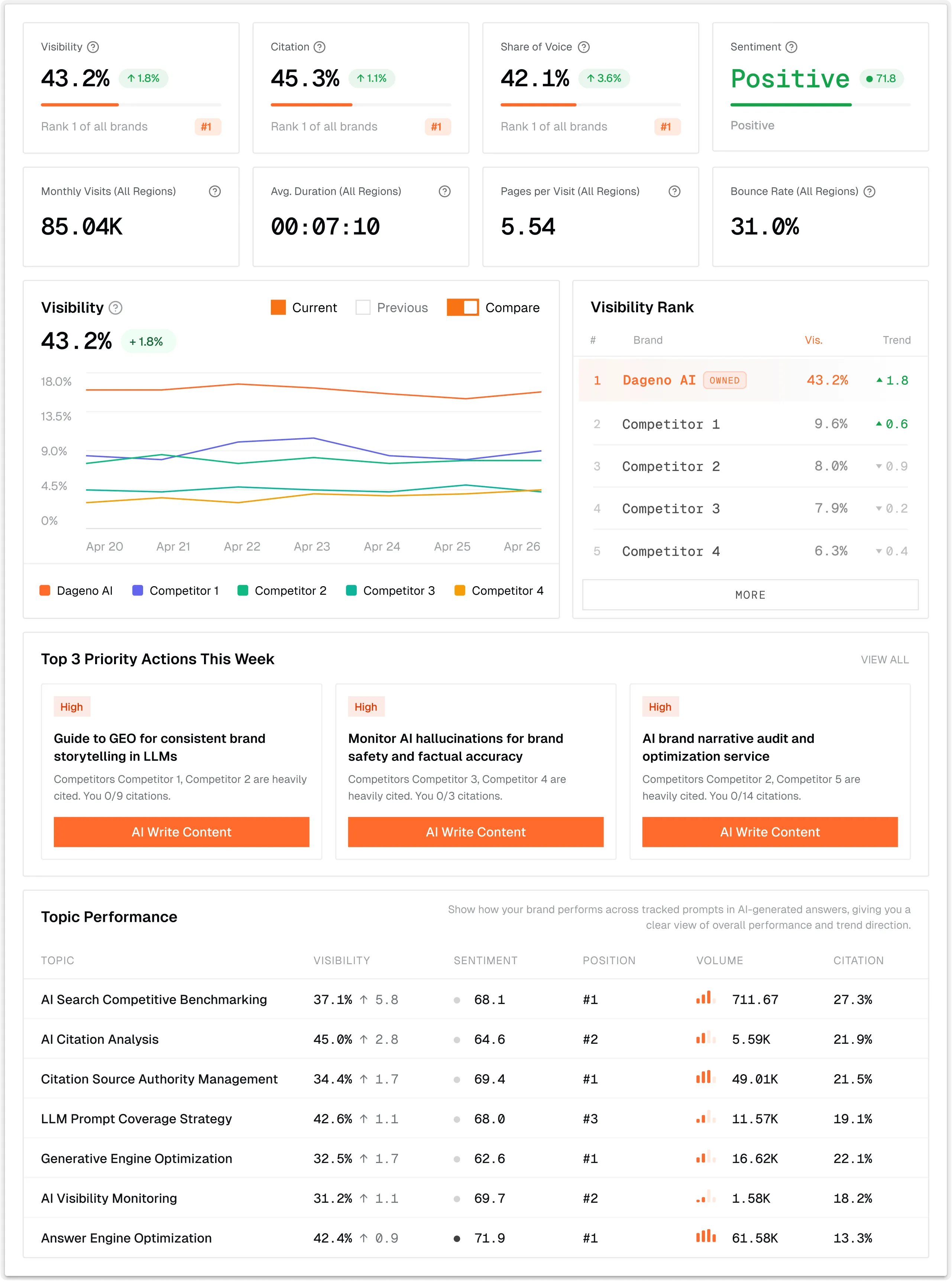
Dageno tracks prompt-level brand presence, competitor visibility and cited sources, then helps teams prioritize content gaps. It is especially useful when analysts need to explain a change rather than merely report a score.
What to analyze
Mention and recommendation rates by topic and funnel stage.
Share of voice against a defined competitor set.
Brand-domain and third-party citation rates.
Newly won and lost prompts.
Sentiment and material factual accuracy.
Content opportunities tied to affected pages.
Use Dageno with Search Console and analytics so answer visibility, Google performance and site outcomes remain distinct but connected.
Profound is suited to organizations with multiple markets, brands and executive reporting requirements. Validate response history, prompt design, source exports, data retention, regions, API access and service scope using your own portfolio.
3. Peec AI — best for accessible reporting
Peec AI makes visibility, sentiment, competitors and sources approachable to nontechnical stakeholders. Its dashboard clarity is useful, but methodology still matters. Confirm what constitutes a prompt, response, mention and citation before comparing scores.
4. Ahrefs Brand Radar — best for search-backed research
Ahrefs Brand Radar is compelling when brand visibility needs to be analyzed alongside web mentions, links and search demand. It fits research-led teams already using Ahrefs. Verify the exact AI platforms, index scope and history included.
5. Semrush — best for consolidated SEO analytics
Semrush suits teams that want AI-search signals inside an established keyword, audit and competitor workflow. Consolidation can reduce reporting friction, but specialist tools may provide deeper answer-level evidence.
Metrics that matter
Coverage and share of voice
Group a fixed prompt portfolio by persona, product, market and funnel stage. Overall visibility can hide weak commercial questions.
Citations and source distribution
Track the URLs and domains behind answers. Separate owned citations from third-party sources, and measure which content types competitors earn.
Sentiment and accuracy
Positive, neutral and negative labels are insufficient without evidence. Store the exact passage and flag incorrect pricing, capabilities, locations or comparisons.
Outcomes
Connect AI referrals, assisted conversions, branded demand and sales feedback where possible. Do not assign revenue to a mention without defensible attribution.
A 30-day platform test
Run 100 prompts across required engines, countries and languages. Repeat a subset to measure volatility. Compare answer retention, citation URLs, competitor detection, exports, analyst time and total cost. Make five controlled page improvements and measure the same cohort again.
Can traditional rank tracking measure AI visibility?
Not completely. It can record conventional SERPs, while AI visibility requires answer text, mentions, recommendations and citations under documented conditions.
Is one AI visibility score reliable?
It is directional only. Evaluate prompt coverage, sampling, engines and answer evidence behind the score.
Tim is the co-founder of Dageno and a serial AI SaaS entrepreneur, focused on data-driven growth systems. He has led multiple AI SaaS products from early concept to production, with hands-on experience across product strategy, data pipelines, and AI-powered search optimization. At Dageno, Tim works on building practical GEO and AI visibility solutions that help brands understand how generative models retrieve, rank, and cite information across modern search and discovery platforms.